Quick answer
Stoicism is not a treatment for clinical depression, but several of its core practices — separating what you control from what you don't, examining the judgment behind a feeling, and structuring each day around small, repeatable actions — overlap with cognitive behavioral therapy and can meaningfully support standard care. It is a complement to professional treatment, not a substitute for it.
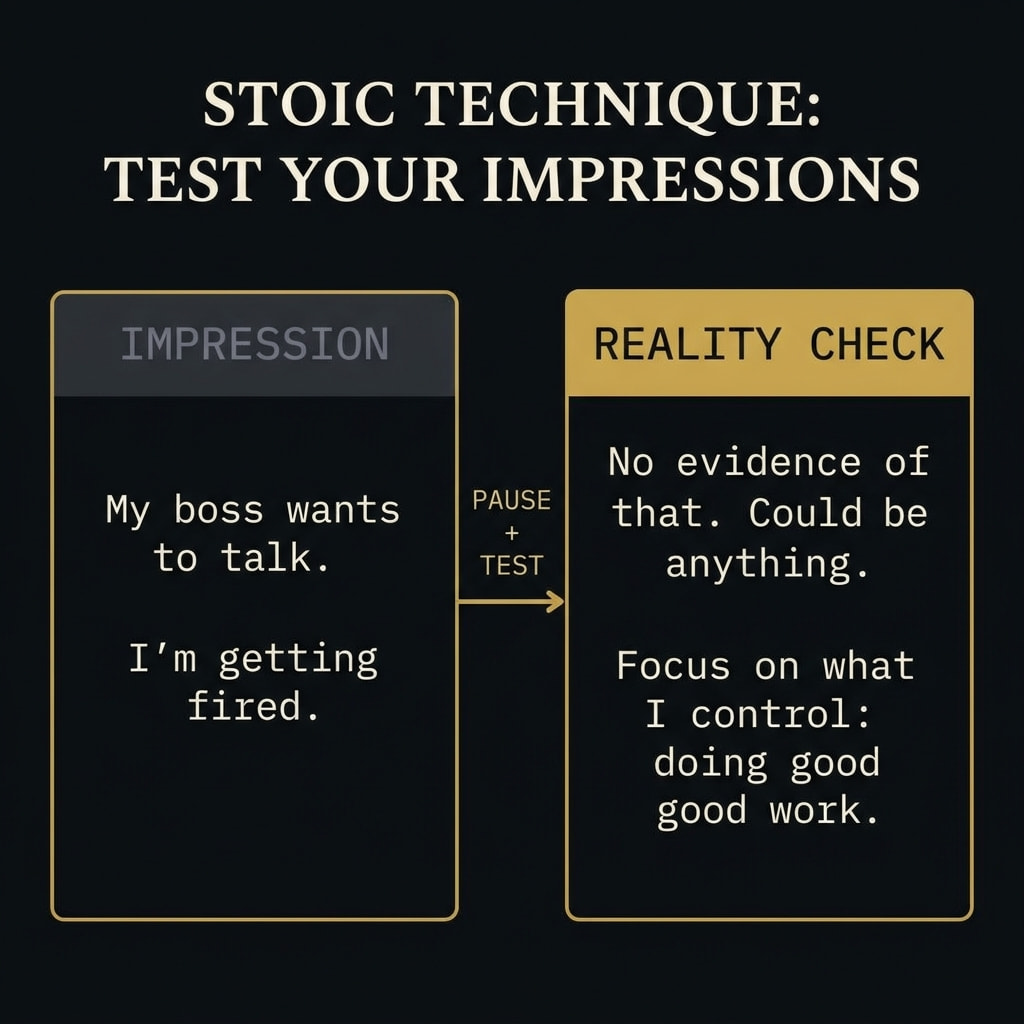
Stoicism did not set out to treat depression — the ancient Stoics had no such diagnosis, and it would be dishonest to pretend they did. What they left behind is a two-thousand-year-old method for examining automatic thoughts, sorting what is yours to control from what isn't, and building a daily structure sturdy enough to hold weight on the heaviest days. Modern cognitive therapy borrowed directly from it. Here is what that overlap actually looks like, and where it stops.
What Stoicism Can Actually Offer
Depression, as clinicians define it, is a persistent, often biologically rooted condition — not a mood you philosophize your way out of by Tuesday. Stoicism can't touch the biology. What it can do is give you a repeatable way to notice and question the automatic thoughts that ride alongside depression: I'm a burden. Nothing will change. This is my fault. Those thoughts feel like facts. Stoic practice treats them as claims to be examined, which is a smaller, more honest job than "cure depression," and a genuinely useful one.
That framing matters because it sets the right expectation from the start. This is a philosophy of daily practice, not a single insight that fixes anything. If you want the fuller method behind it, start with how to practice Stoicism every day before layering on anything specific to low mood.
Where This Idea Comes From
The claim at the center of Stoic ethics is 2,000 years old and stated plainly by Epictetus, a former slave turned philosophy teacher, in the opening line of his handbook:
“Men are disturbed not by the things which happen, but by the opinions about the things.” — Epictetus, Enchiridion 5
This is not a modern reinterpretation applied retroactively to an old text. When the psychiatrist Aaron Beck developed cognitive therapy in the 1960s and 70s, he opened his foundational text on treating depression with a line drawn from that same Enchiridion, crediting the Stoics directly as the philosophical root of the idea that emotional disturbance comes from interpretation, not from events themselves. Albert Ellis, who founded Rational Emotive Behavior Therapy around the same period, said the same thing even more bluntly — that Epictetus was, in effect, the first cognitive therapist. The techniques used in Stoic approaches to anxiety and grief share this exact ancestry.
The overlap isn't a marketing coincidence. It's a straight lineage, which is why the practices below resemble homework from a therapist's office more than they resemble ancient ritual.
The Core Mechanism: The Dichotomy of Control
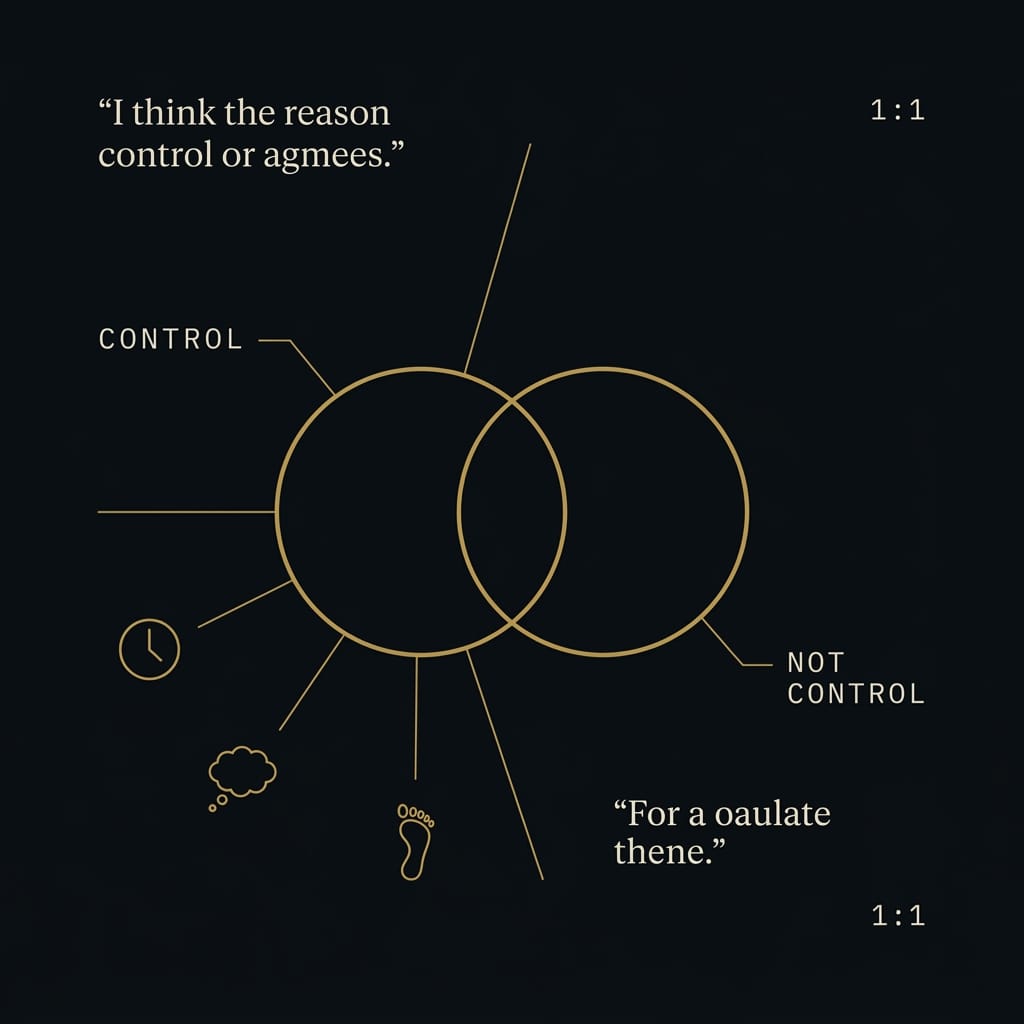
Depression often distorts control in two opposite directions at once: it makes you feel responsible for things you never controlled (a relationship ending, someone else's mood, the outcome of an interview), while making you feel powerless over things you actually can influence (getting up, sending one email, going for a walk). The dichotomy of control is the Stoic tool built precisely for that confusion — a daily sort of "mine to work on" versus "not mine to carry."
Marcus Aurelius, writing private notes to himself rather than a book for readers, put the same idea in terms of retreat rather than control:
“Nowhere can a man find a quieter or more untroubled retreat than in his own soul.” — Marcus Aurelius, Meditations 4.3
He wasn't claiming the outside world stops being hard. He was pointing at the one variable that stays within reach even when everything else doesn't: the judgment you attach to what's happening. That's a smaller claim than "think positive," and a more workable one on a bad day. Full method in the Meditations summary.
Four Stoic Practices to Try Today
None of these require belief in anything. They are small, mechanical, and designed to be done on the days you least feel like doing them — which is the entire point.
1. A two-minute morning frame
Before the day's noise starts, name one thing that's in your control today and one thing that isn't — out loud or on paper. It does the sorting work before the day does it for you. See the Stoic morning routine for the full version.
2. Evening reflection, not rumination
Depression often produces rumination that looks like reflection but just loops. Seneca's structured version — three fixed questions, asked and answered in writing, then closed — gives the mind a stopping point. Details in the Stoic evening reflection method.
3. Negative visualization, used carefully
Negative visualization was designed to build gratitude by briefly imagining loss. For most people it works well. If you're already living inside low mood, it can occasionally tip into rumination instead of relief — try it for a few minutes, and stop if it makes things heavier rather than lighter.
A caution, not a warning against it: Stoic exercises are tools, not tests. If a specific practice consistently deepens a low mood rather than easing it, drop that one and keep the others. There is no failure in that — only information about what helps you specifically.
4. One small, completed thing
Depression's most common companion is paralysis — a to-do list that never gets touched, which then becomes its own evidence for self-criticism. The Stoic answer isn't motivation; it's discipline applied to something tiny and finishable. This overlaps directly with Stoicism for procrastination: pick the smallest possible version of the task and do only that.
What This Gets Wrong (When People Misread It)
Misconception 01
Stoicism Means Suppressing Emotion
Misconception 02
Stoicism Says Just Choose to Feel Better
Where Stoicism Isn't Enough
Seneca himself wrote from experience with prolonged illness, in a letter often read today as an early meditation on endurance:
“Sometimes even to live is an act of courage.” — Seneca, Letters 78
Even Seneca, writing that line, didn't stop there and call it treatment. He also sought out remedies, rest, and the company of people who could help. That's the honest limit of this whole approach: philosophy can reframe a thought, but it cannot correct a chemical imbalance, replace medication, or substitute for a licensed clinician when depression is persistent, severe, or paired with thoughts of self-harm. If that describes what you're experiencing, the next right step is a conversation with a mental health professional or your doctor — not a longer reading list. Seneca's Letters are worth reading, but they were never meant to stand in for a treatment plan.
Used well, in the right order: professional care first when depression is persistent or severe, Stoic practice as a daily structure alongside it. Not the reverse.
Making It a Daily Habit, Not a One-Time Read
None of the four practices above work as a one-off. Their value comes from repetition on ordinary days, so that the structure is already in place before a hard day arrives. If you want a fixed on-ramp rather than building your own from scratch, the 30-day Stoic challenge lays out a day-by-day plan that sequences these same tools without requiring you to design anything yourself.
Build a daily Stoic practice with StoicNow
Join the WaitlistFree Quiz
Which Stoic Are You?
A 3-minute personality quiz — Marcus, Seneca, Epictetus, or Cato.
FAQ
Can Stoicism help with depression?
Stoicism is not a clinical treatment, but several of its practices — separating what you control from what you don't, examining automatic negative judgments, and building daily structure — overlap closely with cognitive behavioral therapy. Used alongside proper diagnosis and treatment, it can meaningfully support how someone manages persistent low mood, though it should never replace medical care.
Is Stoicism a substitute for therapy or medication?
No. Stoicism is a philosophical practice, not a clinical intervention, and the ancient Stoics never claimed otherwise. If you are experiencing persistent depression, a licensed mental health professional should be your first step; Stoic exercises work best as a daily complement to that care, not a replacement for it.
What Stoic exercises are most useful for depression?
The dichotomy of control, morning and evening reflection, and small daily acts of discipline tend to help most, because they give an unstructured, heavy day a repeatable shape. Negative visualization can also help build gratitude, but it should be used cautiously and stopped if it deepens rumination rather than easing it.
Did cognitive behavioral therapy really come from Stoicism?
Its founders said so directly. Aaron Beck opened his foundational text on cognitive therapy with a line from Epictetus's Enchiridion, and Albert Ellis, who developed Rational Emotive Behavior Therapy, credited Epictetus as its philosophical root. Both therapies build on the same core Stoic claim: it is our judgments about events, not the events themselves, that disturb us.
Does Stoicism say you shouldn't feel sad?
No — that is a common misreading. The Stoics distinguished between a first, involuntary emotional reaction and the judgment layered on top of it. Feeling sad is not a failure of Stoic practice; the practice is examining the thoughts that follow the feeling, not suppressing the feeling itself.
Where should I start if I want to use Stoicism to help with depression?
Start small: a two-minute morning routine that names what is in your control that day, and a short evening reflection at night. Add the dichotomy of control as a daily filter for recurring worries. Build from there, and treat it as one tool among several, not a cure on its own.

Marcus Adler
Founder & Lead Writer, StoicNow
Marcus Adler is the founder of StoicNow. For over a decade he has applied Stoic philosophy to daily life — testing the practices of Marcus Aurelius, Seneca, and Epictetus against modern problems and translating them into simple, repeatable routines. More about the author →
Further reading