
Quick answer
The Stoics treated procrastination as the most expensive mistake a person makes — not because of the missed task, but because of the false belief underneath it. We delay as if our time were infinite.
The single most powerful man in the Roman Empire began his private notebook with an argument about how to get out of bed.
Read that again. Marcus Aurelius — emperor, philosopher, commander of legions — spent the opening passage of Meditations Book 5 talking to himself about morning resistance. Not because he was unusually weak, but because he was unusually honest. He had noticed something most productivity advice misses: the problem isn’t willpower. The problem is what you believe about time.
If you genuinely believed your time was finite — if “tomorrow” weren’t a credit line you assumed would be honored — the resistance would collapse on its own. You wouldn’t need to push. You’d just see the situation and move. The Stoic argument is that procrastination, at its root, is not a discipline problem. It’s a metaphysical mistake.
Here’s what they wrote about it, and five techniques you can use this week.
The Stoic Diagnosis: You Are Acting as if Immortal
Seneca opens On the Shortness of Life with a sharper version of the same insight Marcus would write 100 years later:
“You act like mortals in all that you fear, and like immortals in all that you desire.” — Seneca, On the Shortness of Life 3
Underline that sentence. It catches the procrastinator in the act — fearing death (and so playing safe, avoiding risk, delaying conversations), while simultaneously planning, accumulating, and deferring as if life were endless. The two halves don’t fit. One of them is wrong, and Seneca’s argument is that it’s the second.
In Letter 1, he sharpens the point further: no person hands their money out to passersby, but to how many do we hand out our lives. The single most precious resource — the one you cannot earn more of — is the one you give away most carelessly. The procrastinator is, in this frame, the financial equivalent of someone scattering banknotes in the street.
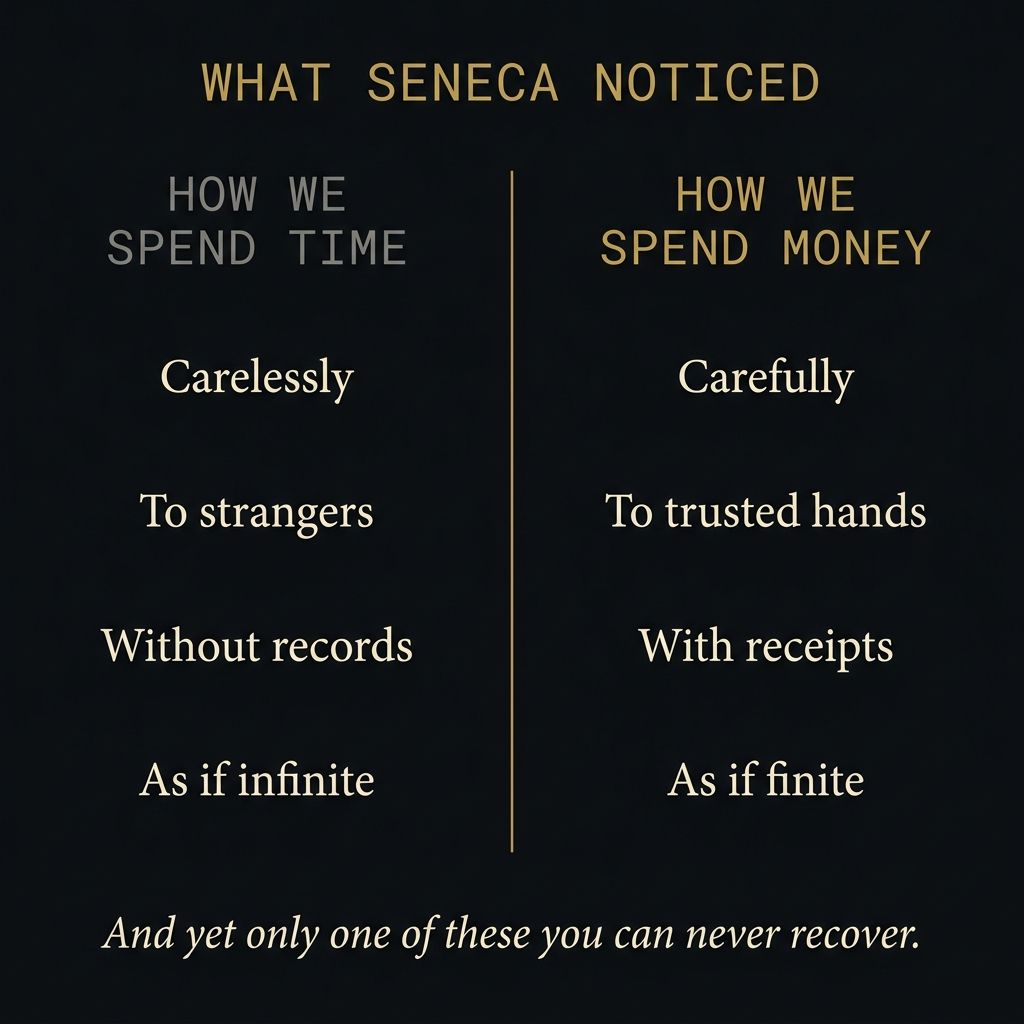
Note carefully what the Stoics did not say. They did not say procrastination is laziness, or moral weakness, or a failure of grit. Their diagnosis is more interesting and more useful: it’s a perceptual error. Your brain, by default, models time as unlimited. The Stoic intervention is to keep correcting the model — not to fight the resistance with more force, but to remove the belief the resistance is standing on.
Marcus Aurelius’s Most Famous Passage
In Meditations 5.1, Marcus catches himself in mid-resistance and writes the argument out by hand. It is the most quoted anti-procrastination passage in Western literature, and you should read the whole thing at least once a year.
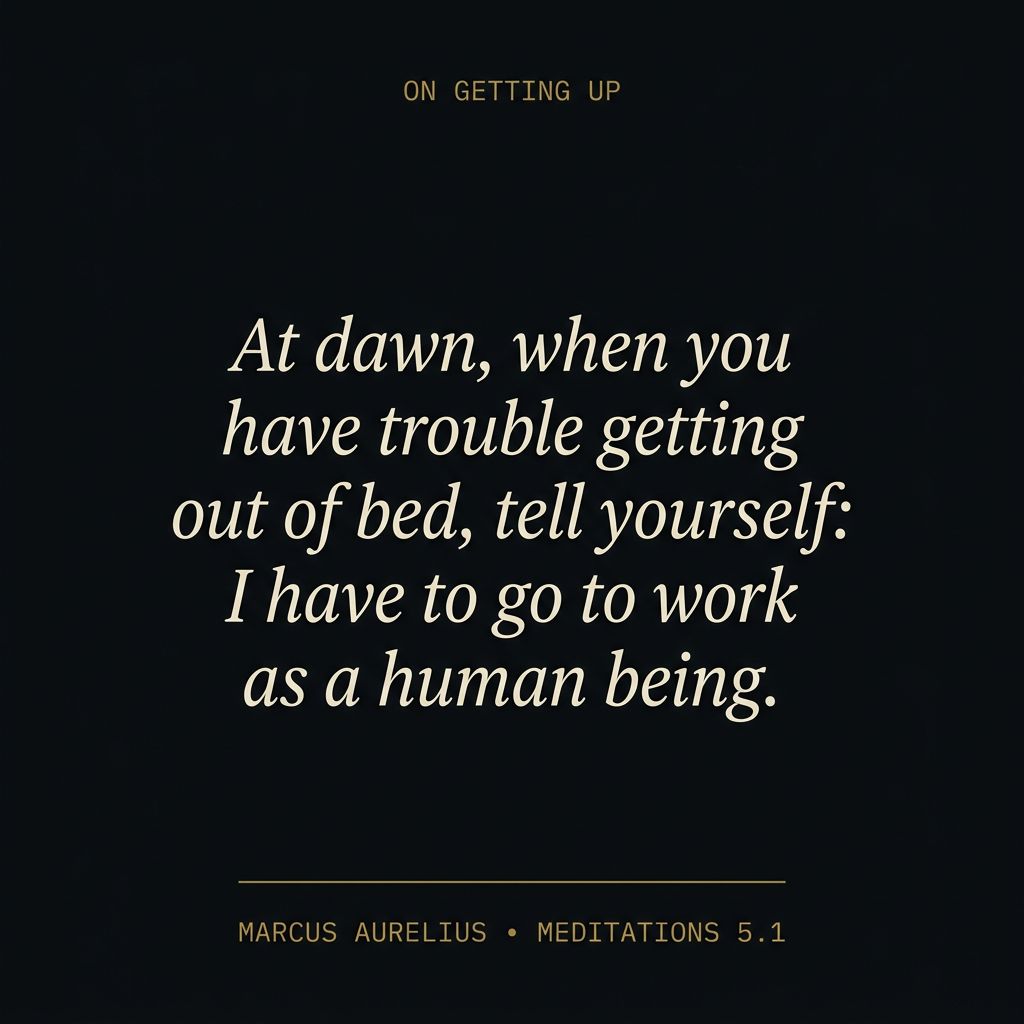
“At dawn, when you have trouble getting out of bed, tell yourself: I have to go to work as a human being. What do I have to complain of, if I’m going to do what I was born for — the things I was brought into the world to do? Or is this what I was created for? To huddle under the blankets and stay warm?” — Marcus Aurelius, Meditations 5.1
Three things are doing work in that passage, and they map onto a complete Stoic anti-procrastination program.
First, he asks what he was made for. Not what he feels like, not what would be comfortable — what is his nature, his job, his role. Procrastination thrives in the gap between “what I want to do right now” and “what I am.” The reframe closes the gap.
Second, he names the alternative honestly. “Huddle under the blankets and stay warm.” No dressing up. No “I’m just resting,” no “I’ll start fresh tomorrow.” He calls the avoidance what it is. You almost can’t stay in bed once you’ve said that out loud to yourself.
Third, he acts. The passage doesn’t end in self-analysis. It ends in him getting up. The whole point of writing it was to provoke action by the last sentence. Stoic philosophy, almost uniquely, is judged by what happens next.
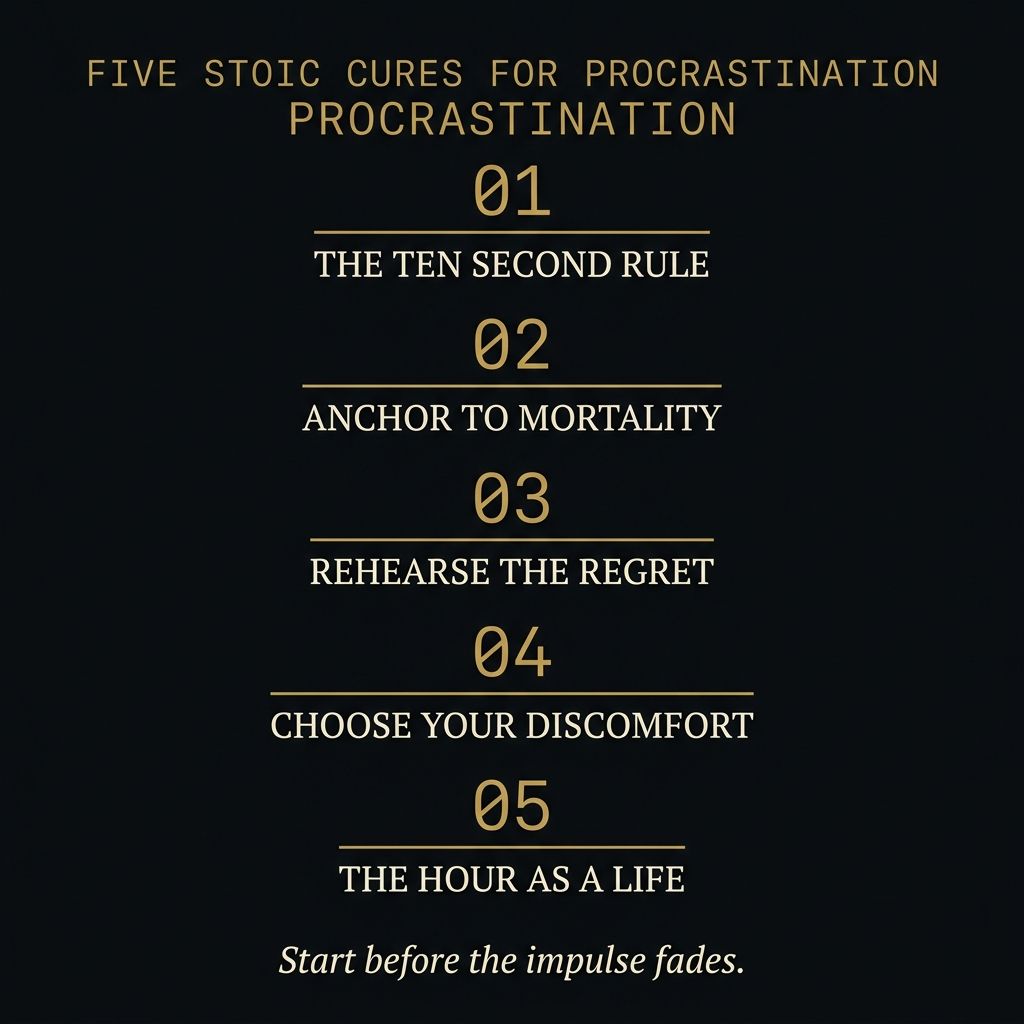
Five Stoic Techniques for Stopping Procrastination
These are not productivity hacks. They are interventions on the belief that procrastination grows out of — the assumption that time is renewable. Pick one and use it for a week before adding another.
Technique 01
The Ten-Second Rule
When you notice the thought I should do X, give yourself ten seconds. Not ten seconds to decide — ten seconds to begin. Open the document. Pick up the phone. Put on the shoes. Stoic philosophy treats the gap between intention and action as the danger zone. Compress it.
This is not the same as modern “5-second rule” advice, which is a willpower technique. The Stoic version is structural: you act while the perception is fresh because the perception is the real currency. Wait, and the perception decays.
Technique 02
Anchor to Mortality
Before any task you’ve been avoiding, run the filter: if I knew this was my last week, would I still be putting this off? Most of what you procrastinate on either evaporates (it wasn’t important) or gets done immediately (it was). Neither outcome is bad. Both kill the limbo.
For the deeper version of this practice, see our guides on memento mori and the memento mori calendar.
Technique 03
Rehearse the Regret
This is the procrastination-specific application of negative visualization. Sit for sixty seconds. Picture the version of you in five years who never started the project, never had the conversation, never made the change. Not as catastrophe — as accurate forecast. Then ask: is that the trade I’m making right now? The answer is almost always no, and the resistance often dissolves with it.
Technique 04
Choose Your Discomfort
The Stoic move is to refuse the false binary of “hard task vs. relaxing.” That’s never the actual choice. The real choice is between two pains: the focused discomfort of doing the thing now, and the diffuse discomfort of carrying it unfinished for weeks. The second one is heavier; it just hides better.
When you find yourself in resistance, name both costs. Say them out loud. Almost always the math is obvious. You weren’t avoiding pain — you were avoiding the visible pain in favor of the invisible one.
Technique 05
The Hour as a Life
If you scale this down, Seneca’s line works on hours too. The next hour is itself a small life. It will be either lived or wasted, complete in itself. You don’t need permission from the larger plan, and you don’t need confidence about the rest of the day. You need to live the hour in front of you.
This pairs naturally with the Stoic evening reflection — the nightly audit that turns abstract intent into a closed loop.
When This Doesn’t Apply: Rest vs. Procrastination
A small but important distinction. The Stoics were not anti-rest. Marcus took breaks; Seneca explicitly defended leisure (in De Otio) as legitimate when it served philosophy and contemplation. Procrastination is not the same as recovery, and treating real fatigue as moral failure is its own mistake.
The honest test: after the activity ends, do you feel restored or do you feel worse? Real rest restores. Procrastination depletes — even when it looks like rest from the outside. If the “break” consistently leaves you flatter, more anxious, or more avoidant, it wasn’t a break.
The Stoic frame for this: real rest is a chosen activity that serves the larger life. Procrastination is an unchosen drift that erodes it. Same hour spent in a chair, sometimes opposite outcomes. Notice which one you’re actually doing.
What Modern Research Confirms
Two findings from contemporary research line up almost word-for-word with Seneca and Marcus.
Temporal discounting. Humans massively undervalue future rewards relative to present ones — a present-bias effect described by economists like George Ainslie and David Laibson. It’s the same problem Seneca was describing: you can’t see future-you clearly enough to act for them. The Stoic anti-procrastination techniques are all, in different forms, attempts to make future-you vivid enough to count.
Implementation intentions. Peter Gollwitzer’s research shows that pre-specifying when and where you’ll act dramatically increases follow-through. The Stoic version of this is the morning routine: deciding what the day requires before resistance has a chance to lodge. See our 3-step Stoic morning routine for the operational form.
The Greeks had a word for the gap between knowing what to do and actually doing it: akrasia. They considered it the central puzzle of moral life. Twenty-four centuries later, behavioral economics has a fancier name for the same problem and is still working on it. The Stoics didn’t solve it — nobody has — but they did write the clearest field manual we have.
“Begin at once to live, and count each separate day as a separate life.” — Seneca, Letters 101
Read one Marcus passage each morning in StoicNow
Join the WaitlistFAQ
What did the Stoics say about procrastination?
The Stoics treated procrastination as the most expensive mistake a person makes — not because of the missed task, but because of the false belief underneath it. We delay as if our time were infinite. Seneca wrote: “You act like mortals in all that you fear, and like immortals in all that you desire.” The Stoic cure is structural: notice the mismatch between behavior and finitude, and close the gap.
What is the most famous Stoic quote about procrastination?
Marcus Aurelius, Meditations 5.1, opens with one of the most quoted passages in Western philosophy: “At dawn, when you have trouble getting out of bed, tell yourself: I have to go to work as a human being.” He is talking himself out of bed, on his own behalf, in private. The most powerful man in the world also had to argue with his own resistance every morning.
Is procrastination the same as laziness?
No. The Stoics did not equate them. Laziness is an aversion to effort. Procrastination is usually the opposite — you care, which is exactly why you delay; you fear failing at something that matters. The Stoic move is to redirect that care from worry about outcomes (which you don’t fully control) to action on inputs (which you do).
How can Stoicism help me stop procrastinating?
Five concrete techniques: (1) the ten-second rule — act while the impulse is still fresh; (2) anchor to mortality — “you could leave life right now”; (3) rehearse the regret of not doing it; (4) choose your discomfort — discipline is picking which pain you carry; (5) treat each hour as a separate life, judged on its own. Pick one and use it for a week.
Where can I read the Stoics on time and procrastination?
Three sources. Marcus Aurelius’s Meditations 5.1 is the single best passage on getting started. Seneca’s On the Shortness of Life is the most thorough book ever written on how we waste time. His Letters to Lucilius (especially 1, 47, and 101) return to the theme repeatedly. Start with Meditations 5.1 — it’s a single page and will reset your morning.
Is Stoic anti-procrastination just willpower advice?
No. Willpower advice assumes you should push harder against the resistance. Stoicism does something stranger: it changes the belief the resistance is built on. If you actually believed your time was finite, push wouldn’t be needed. The discipline is upstream of effort — in seeing the situation accurately, you stop arguing with what you should obviously do.

Marcus Adler
Founder & Lead Writer, StoicNow
Marcus Adler is the founder of StoicNow. For over a decade he has applied Stoic philosophy to daily life — testing the practices of Marcus Aurelius, Seneca, and Epictetus against modern problems and translating them into simple, repeatable routines. More about the author →