Quick answer
Memento mori is Latin for 'remember, you will die' or 'remember you must die.' It is a philosophical concept encouraging reflection on mortality as a tool for living with intention, gratitude, and clarity.
Memento mori is a Latin phrase that translates to “remember, you will die.” It’s not a threat. It’s an invitation — to stop wasting time on things that don’t matter and to pay attention to the things that do.
The idea has been around for at least two millennia. Roman generals heard it whispered in their ears during victory parades. Stoic philosophers wrote about it in private journals. Medieval painters filled canvases with skulls and hourglasses to keep the thought alive. Steve Jobs called it “the most important tool I’ve ever encountered.”
This article covers what memento mori actually means, where it came from, how it evolved through art and philosophy, and how you can use it today — not as a morbid fixation, but as a practical tool for living better.
The Literal Meaning
Memento is the imperative form of meminisse (to remember). Mori is the infinitive of morior (to die). Together: “Remember that you will die” or “Remember you must die.”
The phrase is a command directed at you — not a statement about someone else. It’s personal. You, specifically, will die. Not in the abstract. Not in the philosophical sense. Your body will stop working and you will cease to exist. The question is: what will you do between now and then?
That question is the entire point.
Origin: The Roman Triumph
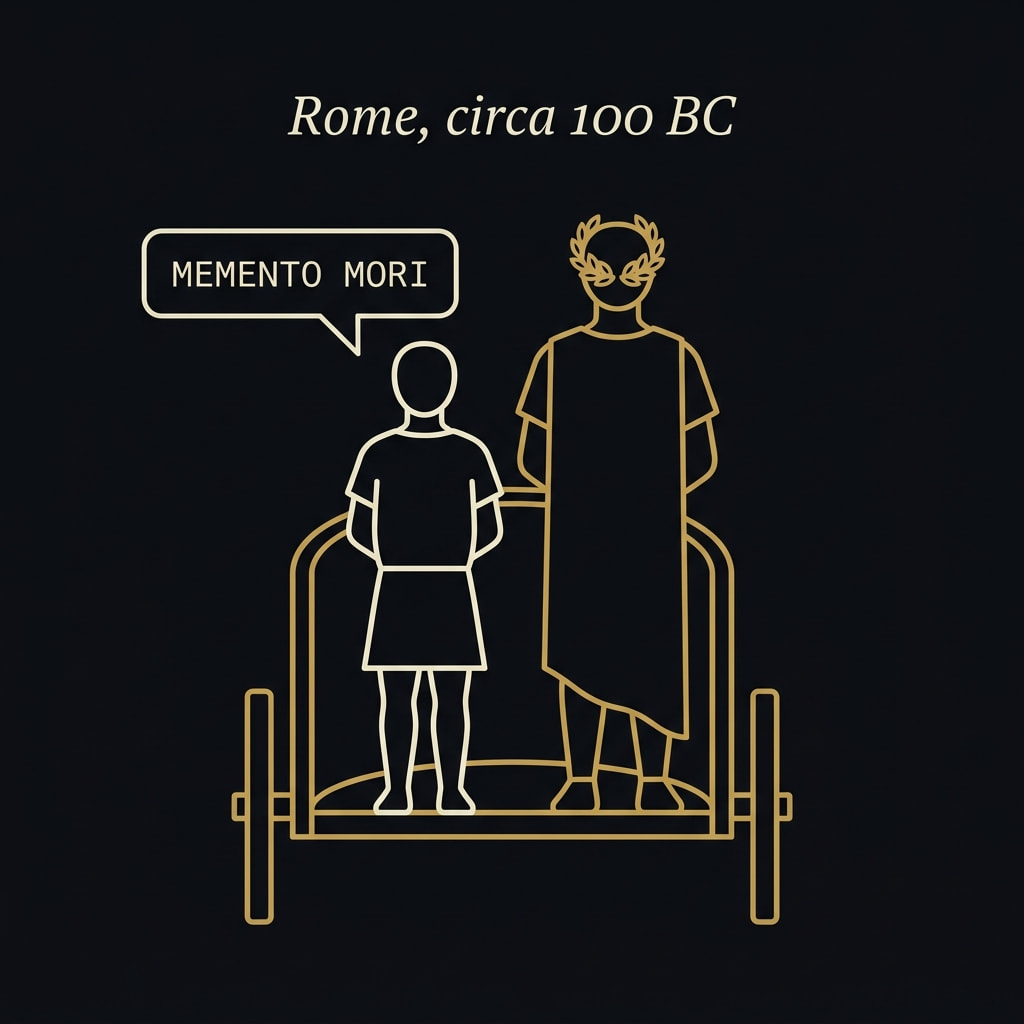
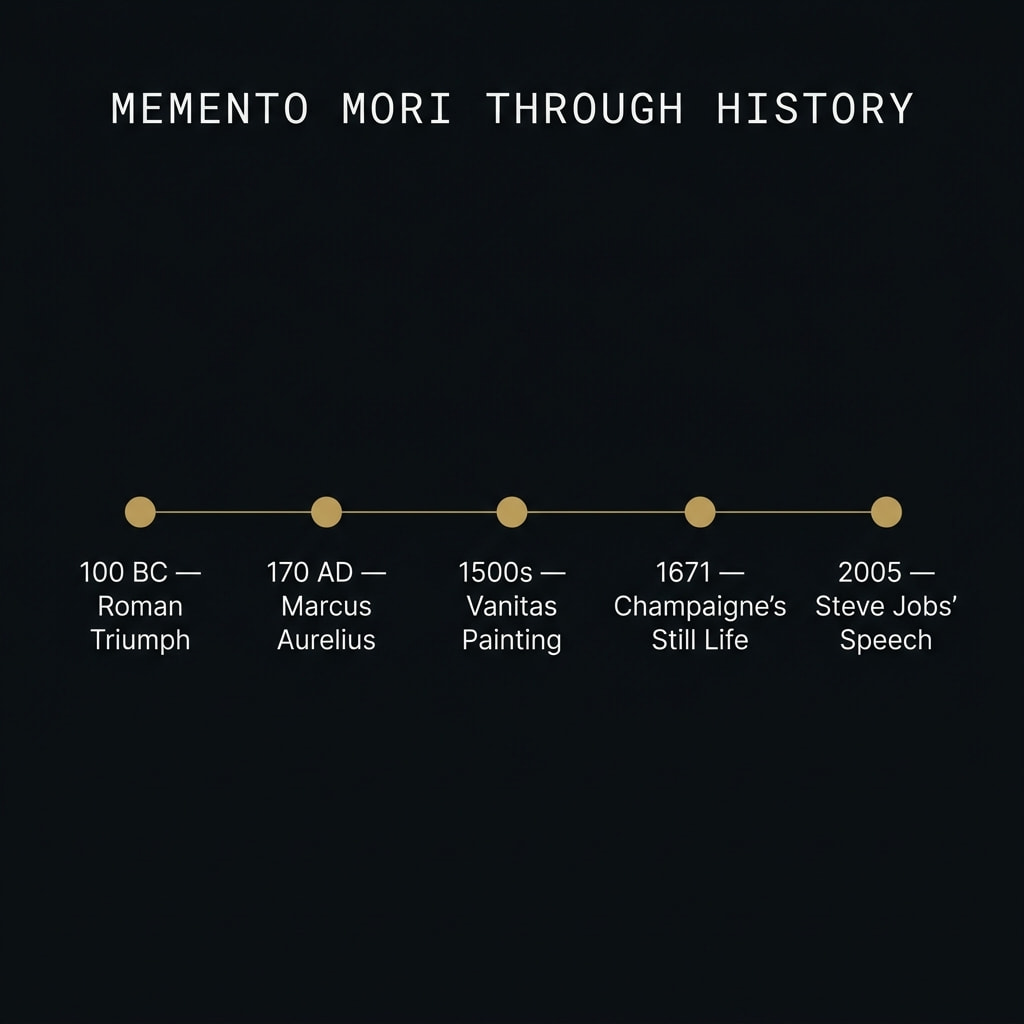
The earliest recorded use of memento mori comes from ancient Roman military traditions. When a general won a major victory, the city celebrated with a triumphus — an elaborate public parade. The general rode through the streets in a chariot, showered with praise, treated almost like a god.
But standing behind him in the same chariot was a slave. The slave had one job for the entire procession: whisper into the general’s ear. The words were: “Respice post te. Hominem te esse memento. Memento mori.” — “Look behind you. Remember you are mortal. Remember you will die.”
The purpose was practical, not cruel. Rome had seen what happened when generals started believing their own mythology. They became tyrants. The slave’s whisper was a check on ego — a reminder that victory is temporary, glory fades, and the man wearing the laurel wreath is made of the same flesh as the people cheering for him.
The Stoic Practice
The three major Stoic philosophers — Marcus Aurelius, Seneca, and Epictetus — all wrote extensively about reflecting on death. For them, memento mori wasn’t a ritual or a slogan. It was a daily mental exercise with a specific purpose: to cut through distraction and focus on what’s real.
Marcus Aurelius wrote in his Meditations: “You could leave life right now. Let that determine what you do and say and think.” He was Roman emperor at the time — one of the most powerful people on earth — and he was reminding himself that he could die today. Not someday. Today.
Seneca devoted an entire essay to the subject. De Brevitate Vitae (On the Shortness of Life) argues that life isn’t actually short — we just waste most of it. His diagnosis: people spend their time on busyness, social obligations, and things they don’t care about, then complain at the end that time went too fast. The cure is awareness of mortality — not to create panic, but to force honest prioritization.
Epictetus taught his students to practice memento mori with their loved ones. When you hug your child, he said, remind yourself: this person is mortal. Not to create grief, but to create presence. If you know this moment might be the last, you pay attention to it fully.
The Stoic version of memento mori wasn’t morbid or pessimistic. It was the opposite — a tool for gratitude, focus, and urgency. The Stoics believed that the person who ignores death is the one who wastes life, while the person who remembers death is the one who truly lives.
Memento Mori in Art: Skulls, Hourglasses, and Vanitas Paintings
The idea didn’t stay in philosophy textbooks. Artists across centuries turned memento mori into a visual tradition that’s still recognizable today.
Medieval Europe (12th–15th century) was ravaged by plague, famine, and war. The Danse Macabre (“Dance of Death”) became a common artistic motif — skeletons dancing with kings, merchants, and peasants, showing that death comes for everyone regardless of status. Churches displayed these images to encourage parishioners to prepare for the afterlife.
Renaissance and Baroque Europe (15th–17th century) saw the rise of vanitas painting, particularly in the Dutch Golden Age. These still-life paintings featured skulls, extinguished candles, wilting flowers, hourglasses, and soap bubbles — all symbols of life’s fragility. Philippe de Champaigne’s famous Still Life with a Skull (1671) reduced the concept to three objects: a tulip (life), a skull (death), and an hourglass (time). Nothing else needed.
The word vanitas comes from Ecclesiastes 1:2 — “Vanity of vanities, all is vanity” — meaning the emptiness of worldly pursuits. These paintings weren’t decoration. They were arguments: stop chasing wealth and status, because you’ll be dead soon and none of it comes with you.
Portraits with hidden skulls were another tradition. Hans Holbein’s The Ambassadors (1533) shows two wealthy men surrounded by instruments of knowledge and power. But stretched across the bottom of the painting is an anamorphic skull — visible only when viewed from a specific angle. The message: behind all this accomplishment, death is always present.
Memento Mori in the Modern World
The concept never disappeared — it just changed forms.
Steve Jobs, in his famous 2005 Stanford commencement speech, described looking in the mirror every morning and asking himself: “If today were the last day of my life, would I want to do what I am about to do today?” When the answer was “no” for too many days in a row, he knew something needed to change. He called this practice “the most important tool I’ve ever encountered to help me make the big choices in life.”
Ryan Holiday, author of The Obstacle Is the Way and The Daily Stoic, popularized memento mori in the modern self-improvement world. His Daily Stoic brand sells a memento mori medallion — a coin designed to be carried in a pocket as a physical mortality reminder. The idea is simple: reach into your pocket, feel the coin, and remember that your time is limited.
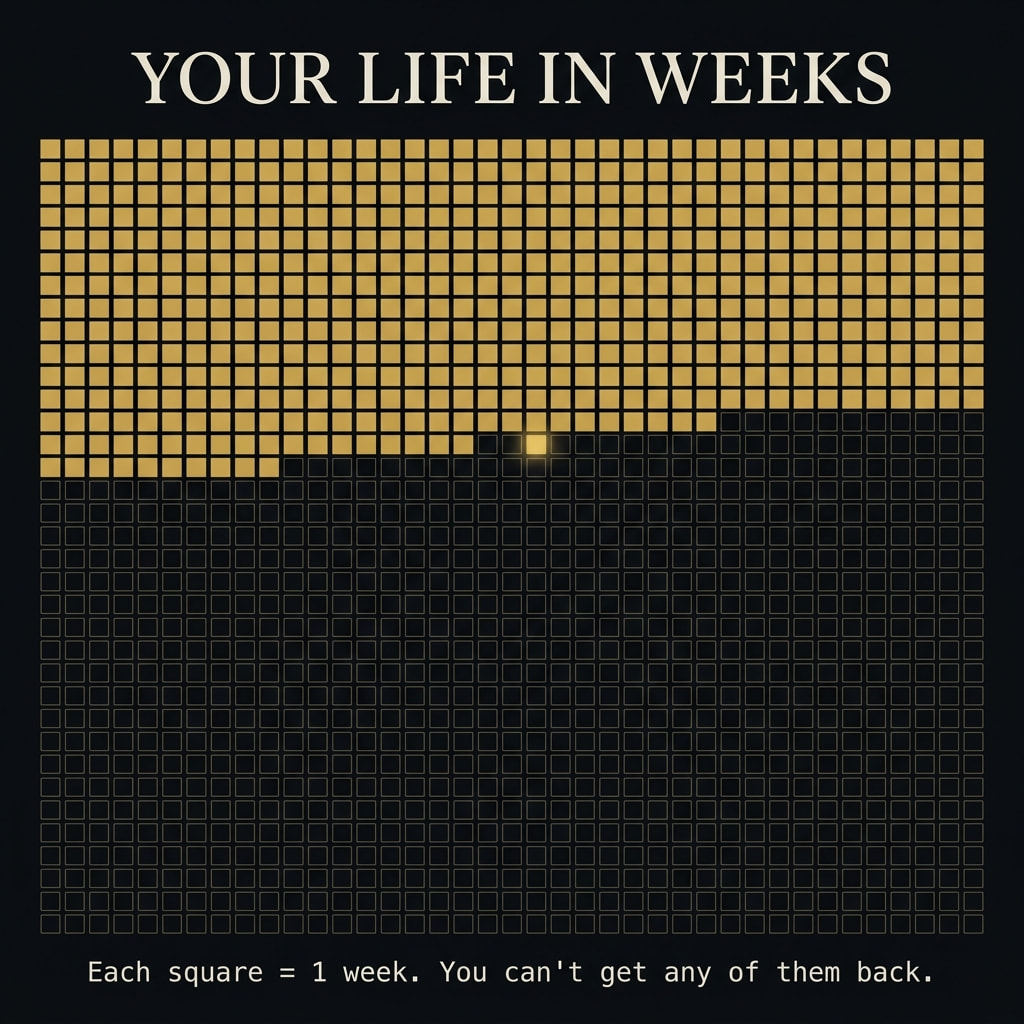
Tim Urban’s “Your Life in Weeks” (2014) turned memento mori into a viral visual. His blog post on Wait But Why showed an entire lifespan as a grid of squares — each representing one week. The image went viral because it made the abstract concrete: you could see how much life had passed and how little remained.
Oliver Burkeman’s Four Thousand Weeks (2021) built an entire book around the memento mori premise. The title comes from the approximate number of weeks in an 80-year life. His argument: productivity culture is a denial of death. The real question isn’t “how do I get more done?” but “what deserves my finite time?”
These modern examples share the same core as the Roman slave’s whisper: the awareness of death creates clarity about life.
How to Practice Memento Mori Today
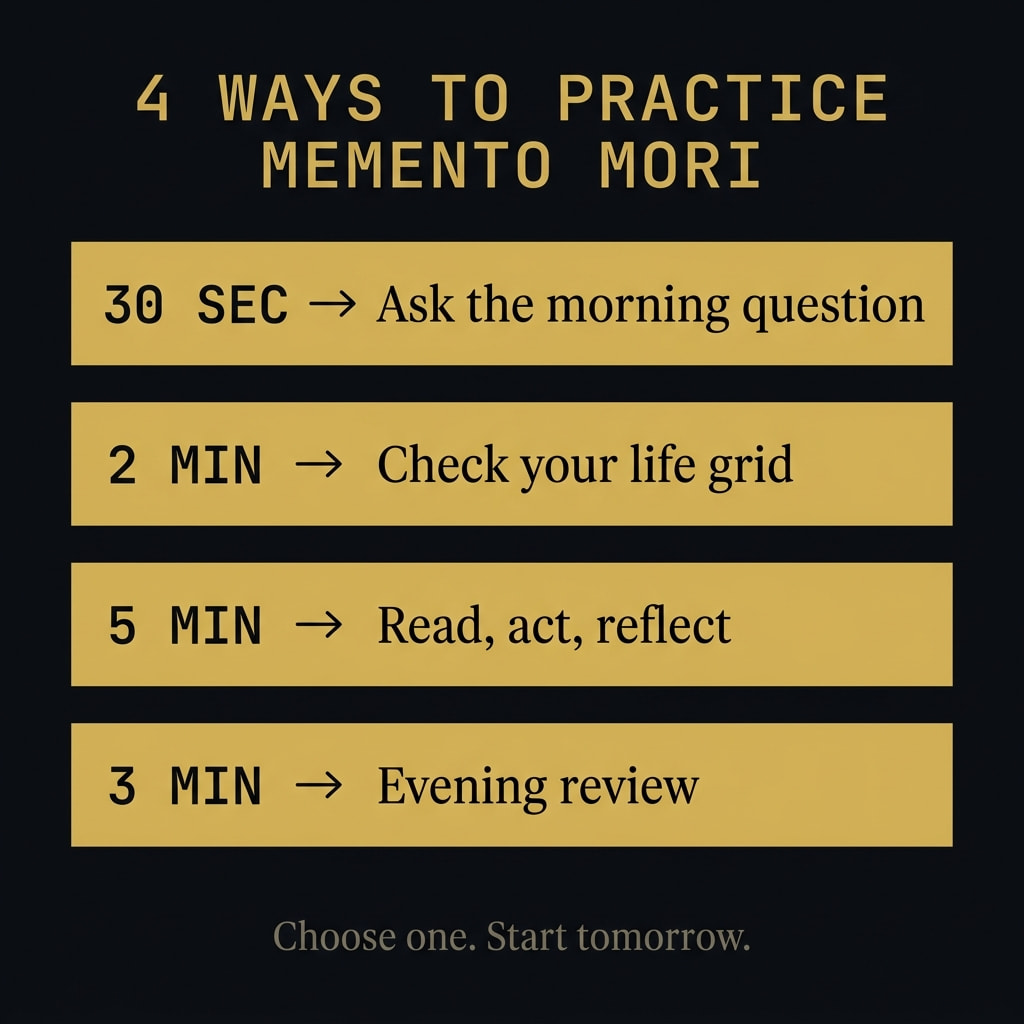
You don’t need a coin, a painting, or a philosophy degree. Here are four practical approaches, ranked from simplest to most immersive:
1. The morning question (30 seconds). Before you check your phone, ask: “If today were my last, would I spend it this way?” If the answer is no, adjust. If it’s yes, proceed with more conviction.
2. The weekly grid (2 minutes). Look at a Memento Mori calendar — a grid showing your life in weeks. One more square filled every seven days. The visual forces the reality that a wall of text can’t.
3. The daily quote + challenge (5 minutes). Pair a mortality reflection with a specific action. Read a Stoic quote about time, then choose one thing to do today that your future self would be proud of. This is the structure behind a Stoic morning routine — read, act, reflect.
4. Evening reflection (3 minutes). At the end of the day, ask: “Did I use today well? What would I change?” Seneca did this every night. It turns memento mori from a one-time thought into a daily feedback loop.
The point of all these practices isn’t to think about death constantly. It’s to think about death enough — enough to stop procrastinating on the things that matter, enough to forgive the things that don’t, and enough to actually be present in the life you have.
What Memento Mori Is Not
It’s not nihilism. Nihilism says nothing matters because you’ll die. Memento mori says everything matters because you’ll die. The awareness of death doesn’t remove meaning — it concentrates it.
It’s not depression. Research on mortality salience (the psychological term for awareness of death) shows that reflective reminders of mortality increase people’s sense of purpose and meaning. Fear-based reminders do the opposite. A memento mori practice is reflective by design.
It’s not a death wish. The Stoics valued life highly — that’s exactly why they meditated on losing it. You don’t appreciate something you take for granted. The reminder “this will end” is what makes “this is happening right now” feel real.
It’s not just for old people. A 25-year-old has already used about 31% of their weeks (assuming 80 years). The grid doesn’t care about your age. It cares about proportion. And the earlier you see it, the more time you have to actually use the insight.
The Takeaway
Memento mori is a 2,000-year-old idea with a simple message: you have limited time, and you should act like it.
Roman generals heard it whispered in moments of triumph. Stoic philosophers wrote about it in moments of crisis. Dutch painters encoded it in every wilting flower and empty hourglass. Steve Jobs used it as a decision-making tool. And you can use it too — with nothing more than a morning question or a glance at a grid.
The StoicNow app was built around this idea. It puts a Memento Mori grid on your phone, sends you a daily Stoic quote, and gives you a challenge to complete before the day ends. It’s the Roman slave in your pocket — minus the chariot and the parade.
The Roman slave in your pocket
Try StoicNow — Free on iOS
Free Tool
Your Life in Weeks
See exactly how many weeks you have left — a Memento Mori calculator.
FAQ
What does memento mori mean in English?
Memento mori is Latin for “remember, you will die” or “remember you must die.” It is a philosophical concept encouraging reflection on mortality as a tool for living with intention, gratitude, and clarity. The phrase originated in ancient Roman military traditions and was adopted by Stoic philosophers.
Is memento mori a religious concept?
Memento mori has been used in both religious and secular contexts. In Christianity, it appears in medieval art and church imagery as a reminder to prepare for the afterlife. In Stoic philosophy, it’s secular — focused on living well in this life by acknowledging its limits. Buddhism has a parallel practice called maranasati (death awareness). The concept crosses cultural and religious boundaries.
What is the difference between memento mori and vanitas?
Both involve reflecting on mortality, but they differ in emphasis. Memento mori focuses on the fact of death — “you will die, so live well.” Vanitas focuses on the emptiness of worldly pursuits — “wealth and status are meaningless because you’ll die.” Vanitas paintings typically include luxury objects alongside symbols of death, while memento mori art uses simpler mortality symbols like skulls and hourglasses.
How do you practice memento mori daily?
The simplest practice is asking yourself each morning: “If today were my last, would I spend it this way?” You can also use a Memento Mori calendar (a visual grid of your life in weeks), read daily Stoic quotes about mortality, or do a brief evening reflection on how you used the day. Apps like StoicNow automate this with a lock screen widget, daily quotes, and challenges.
Is memento mori the same as being pessimistic?
No. The Stoics practiced memento mori specifically to increase their appreciation of life, not to diminish it. Psychological research confirms that reflective mortality awareness increases purpose and meaning. The practice is designed to make you more present, not more fearful.

Marcus Adler
Founder & Lead Writer, StoicNow
Marcus Adler is the founder of StoicNow. For over a decade he has applied Stoic philosophy to daily life — testing the practices of Marcus Aurelius, Seneca, and Epictetus against modern problems and translating them into simple, repeatable routines. More about the author →
Further reading
- Memento mori (Wikipedia) Wikipedia