Quick answer
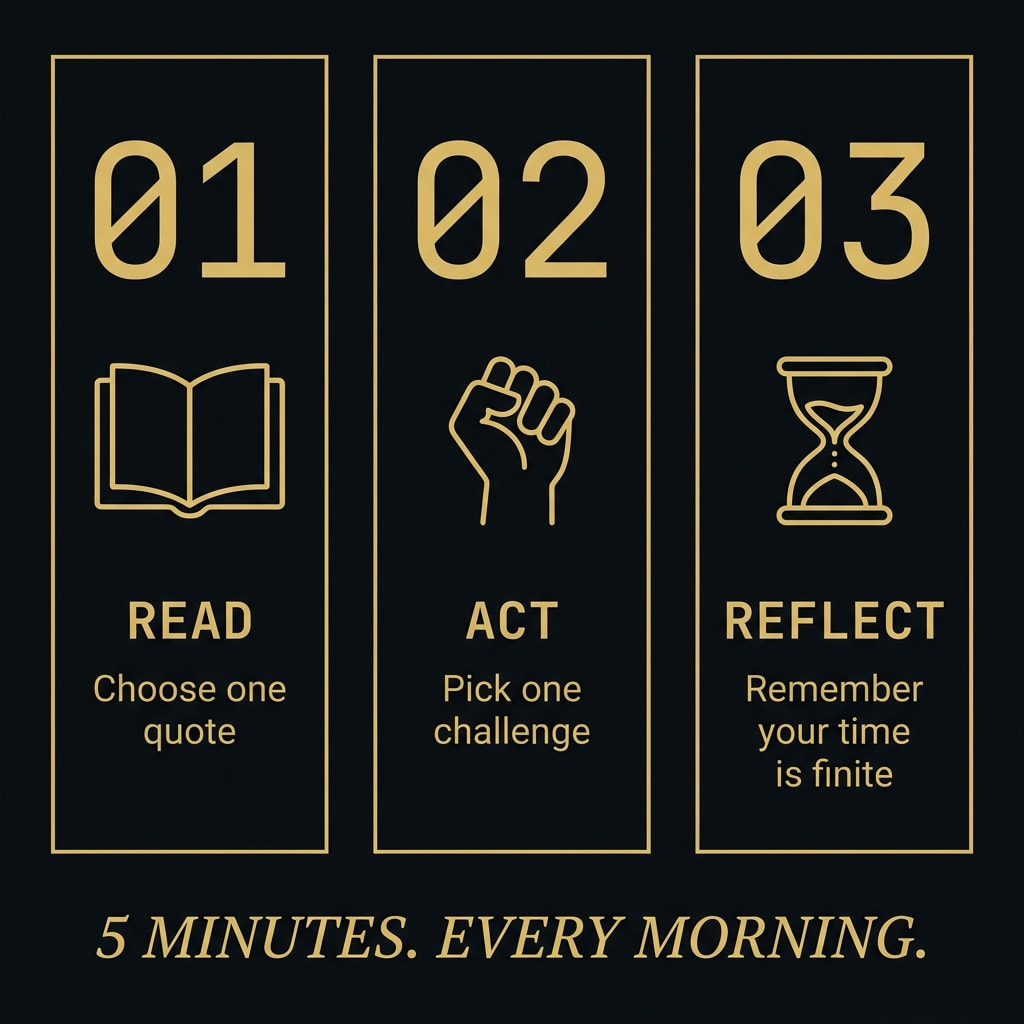
The core practice takes about 5 minutes: 90 seconds to read a Stoic quote, 90 seconds to choose a daily challenge, and 90 seconds of mortality reflection.
Marcus Aurelius ruled the Roman Empire during a plague, two wars, and constant political betrayal. He still started every morning the same way: sitting down, writing in his journal, and mentally preparing for the day ahead.
He didn’t have a 90-minute routine. He didn’t need a cold plunge, a smoothie, or a meditation app. His morning practice was simple, repeatable, and direct — and it’s been working for people for nearly 2,000 years.
A Stoic morning routine isn’t about optimization or productivity hacking. It’s about starting your day with clarity on two things: what you can control today, and what kind of person you want to be while doing it. The whole thing takes five minutes. Here’s how.
Why the Stoics Focused on Mornings
The Stoics treated the morning as the most dangerous part of the day — not because bad things happen early, but because the mind is most vulnerable before it’s been directed.
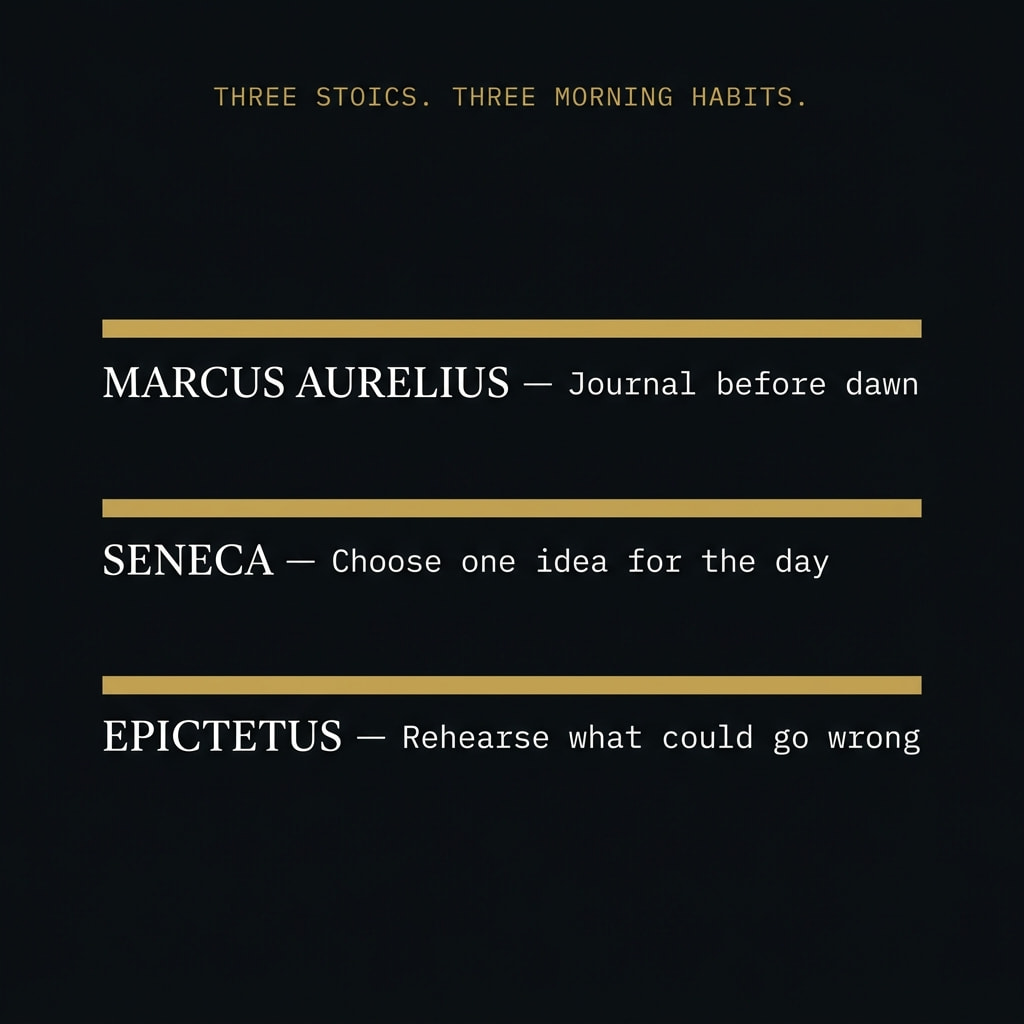
Marcus Aurelius opened Book 5 of his Meditations with a passage about not wanting to get out of bed. His own response to himself was blunt: you were born to do work as a human being, not to huddle under blankets. He wasn’t writing a motivational poster. He was arguing with himself in real time, on paper, first thing in the morning.
Seneca took a slightly different approach. He recommended choosing one philosophical idea each morning and carrying it through the day like a tool. Not reading an entire book — just selecting one thought and letting it shape your responses to whatever happens.
Epictetus told his students to rehearse the day’s difficulties before they arrived. Who might frustrate you today? What could go wrong? If you’ve already imagined it, it can’t blindside you. He called this praemeditatio malorum — premeditation of adversity.
All three Stoics converged on the same insight: what you do in the first few minutes of your day determines how you react to everything that follows. Not because of magic, but because direction beats drift. A mind that’s been pointed at something holds up better than one that’s just reacting.
The 3-Step Stoic Morning Routine
Every overcomplicated morning routine eventually gets abandoned. The Stoics knew this — that’s why their practices were short, portable, and required nothing but your own mind.
This routine has three steps. Each takes about 90 seconds. Total: under five minutes. You can do it in bed, at your desk, or standing in your kitchen before the coffee is ready.
Step 1: Read (90 seconds)
Open one Stoic quote and read it slowly. Not skim — read. Let it sit for a moment.
This is Seneca’s method: take one idea and carry it with you. Don’t try to learn Stoicism in the morning. Just give your mind a direction.
Good sources for daily quotes: the Meditations of Marcus Aurelius (any random passage), Seneca’s Letters to Lucilius, or Epictetus’ Discourses. All are public domain and free online.
Examples that work well as morning anchors:
“You have power over your mind — not outside events. Realize this, and you will find strength.”
— Marcus Aurelius, Meditations 6.8
“We suffer more often in imagination than in reality.”
— Seneca, Letters 13.4
“It’s not what happens to you, but how you react to it that matters.”
— Epictetus, Discourses 1.5
Pick one. Read it twice. Move on.
Step 2: Act (90 seconds)
Choose one concrete challenge or task for the day. Not a to-do list. One thing.
The Stoics called this prohairesis — the deliberate exercise of choice. Each day is a chance to practice one virtue: discipline, patience, courage, fairness. Your challenge should connect to one of these.
This could be:
- Going 4 hours without checking your phone
- Having a difficult conversation you’ve been avoiding
- Doing something physically uncomfortable (a cold shower, a workout, skipping a comfort)
- Giving someone your full attention for an entire meal
The format matters less than the commitment. You’re not setting a vague intention. You’re picking a specific action and deciding in advance that you’ll do it.
Step 3: Reflect (90 seconds)
Pause for a moment and think about your mortality. Not in a dramatic, existential way — just a brief recognition that today isn’t guaranteed, and this morning is one of a finite number you’ll ever have.
This is the memento mori practice. Marcus Aurelius put it simply: “You could leave life right now. Let that determine what you do and say and think.”
You can do this by glancing at a Memento Mori calendar — a visual grid of your life in weeks. Or just by asking yourself: “If this were my last Tuesday, would I spend it the way I’m about to?”
The point isn’t to be morbid. It’s to filter out the trivial. When you’re aware that time is limited, you stop spending it on grudges, doom-scrolling, and things you don’t actually care about.
That’s it. Read, act, reflect. Five minutes. Done.
What Marcus Aurelius Actually Did Each Morning
We have a rare window into a Stoic’s real morning practice because Marcus Aurelius’ journal survived. The Meditations was never meant to be published — it was his private notebook, written to himself, often from a military camp on the Roman frontier.
His morning routine, reconstructed from the text, looked something like this:
Wake early. He acknowledges the temptation to stay in bed and talks himself out of it. His argument: bees, ants, and spiders get to work at dawn — you’re a human being, not less than an insect.
Prepare for difficult people. At the start of Book 2, he writes a preemptive list: today you’ll deal with meddling, ungrateful, arrogant, dishonest, jealous people. But they’re this way because they don’t know better. And they’re your fellow humans — so you can’t hate them any more than you can hate your own hand.
Remind himself of what matters. Throughout the journal, he returns to mortality, impermanence, and duty. “How small your share of all the infinity of time,” he writes. This wasn’t depression — it was calibration.
Write. The act of journaling itself was the routine. Writing forces clarity. You can’t be vague on paper the way you can in your head.
The entire process likely took him 10–15 minutes. And he did it while managing an empire, a pandemic (the Antonine Plague killed an estimated 5 million people), and two major military campaigns. If he had time for it, so do you.
The Evening Bookend
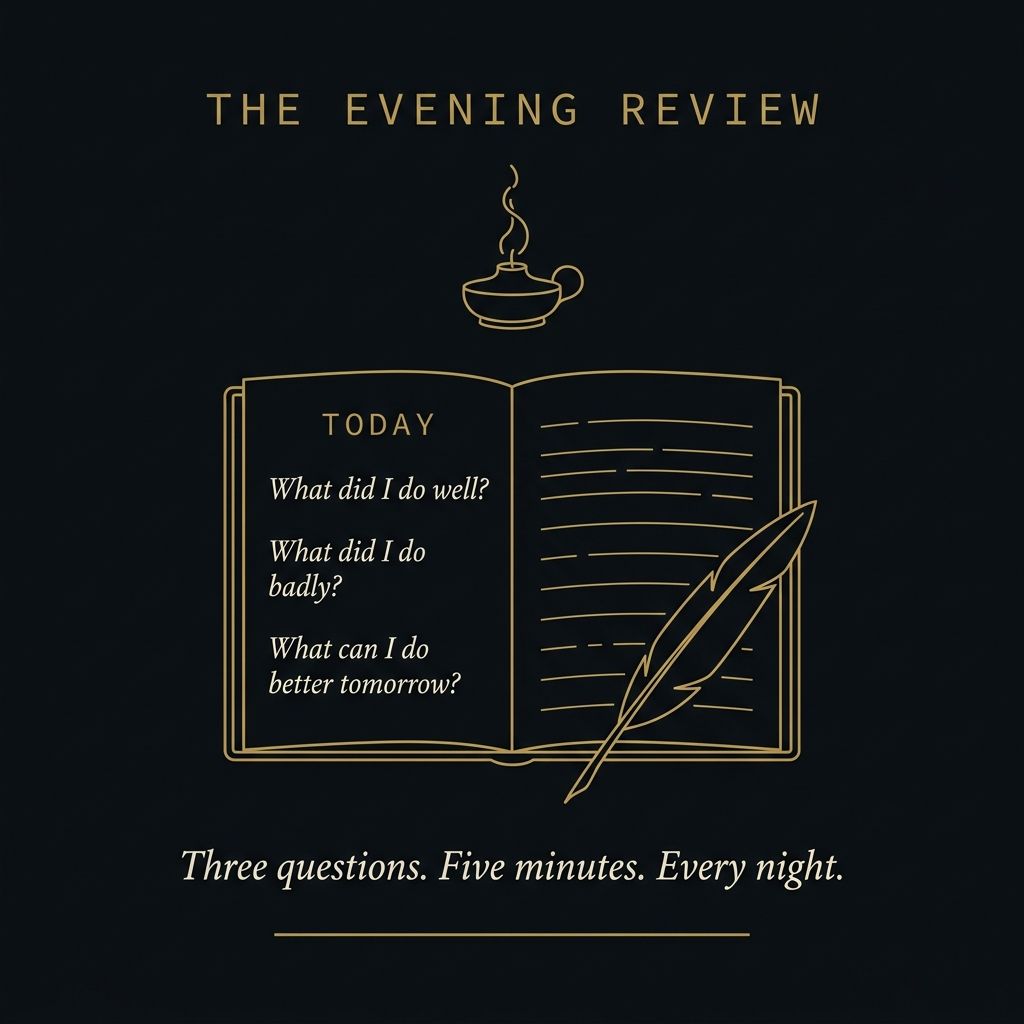
The morning routine works best when paired with a brief evening review. Seneca practiced this religiously — after his wife fell asleep, he’d review his entire day: what went well, where he fell short, what he’d do differently.
His approach wasn’t self-punishment. He explicitly said: “I conceal nothing from myself, I pass nothing by. I have nothing to fear from my errors when I can say: See that you do not do this anymore. For the moment, I excuse you.”
A simple evening check takes two minutes:
- What went well? Name one thing.
- Where did I react instead of respond? Name one moment.
- What will I do differently tomorrow?
The morning gives you direction. The evening gives you feedback. Together, they create a loop that compounds over weeks and months.

Common Mistakes
Making it too long. A 30-minute routine you abandon after a week is worse than 5 minutes you do for a year. Start small. The Stoics valued consistency over intensity.
Turning it into productivity theater. This isn’t about getting more done. It’s about getting the right things done — and being the kind of person you want to be while doing them. If your morning routine makes you feel busy but not grounded, it’s not Stoic. It’s just another task.
Skipping the mortality piece. The reflection step is the one people drop first because it’s uncomfortable. But it’s the part that actually changes your behavior. Without it, the routine is just reading and planning — which you could do with any self-help system. The Stoic difference is the awareness that your time is finite.
Doing it passively. Reading a quote while scrolling Instagram isn’t a Stoic morning. The practice requires a few minutes of genuine attention — not much, but not zero. Put the phone face-down for five minutes. That’s all.
How to Get Started Tomorrow
Here’s the simplest possible version. Do this tomorrow morning before you check your phone:
- Read one quote from Marcus Aurelius, Seneca, or Epictetus (pick any — it doesn’t matter which).
- Decide on one small challenge for the day. Something you can complete by tonight.
- Ask yourself: “Am I using today well?”
That’s the entire practice. Do it for seven days and see what changes.
If you want the quotes delivered to your phone automatically, StoicNow sends a Stoic quote every morning as a push notification — plus a daily challenge and a Memento Mori grid that tracks your weeks. It’s built around exactly this three-step structure: Read, Act, Reflect.
Start your practice
Download StoicNow — Free on iOS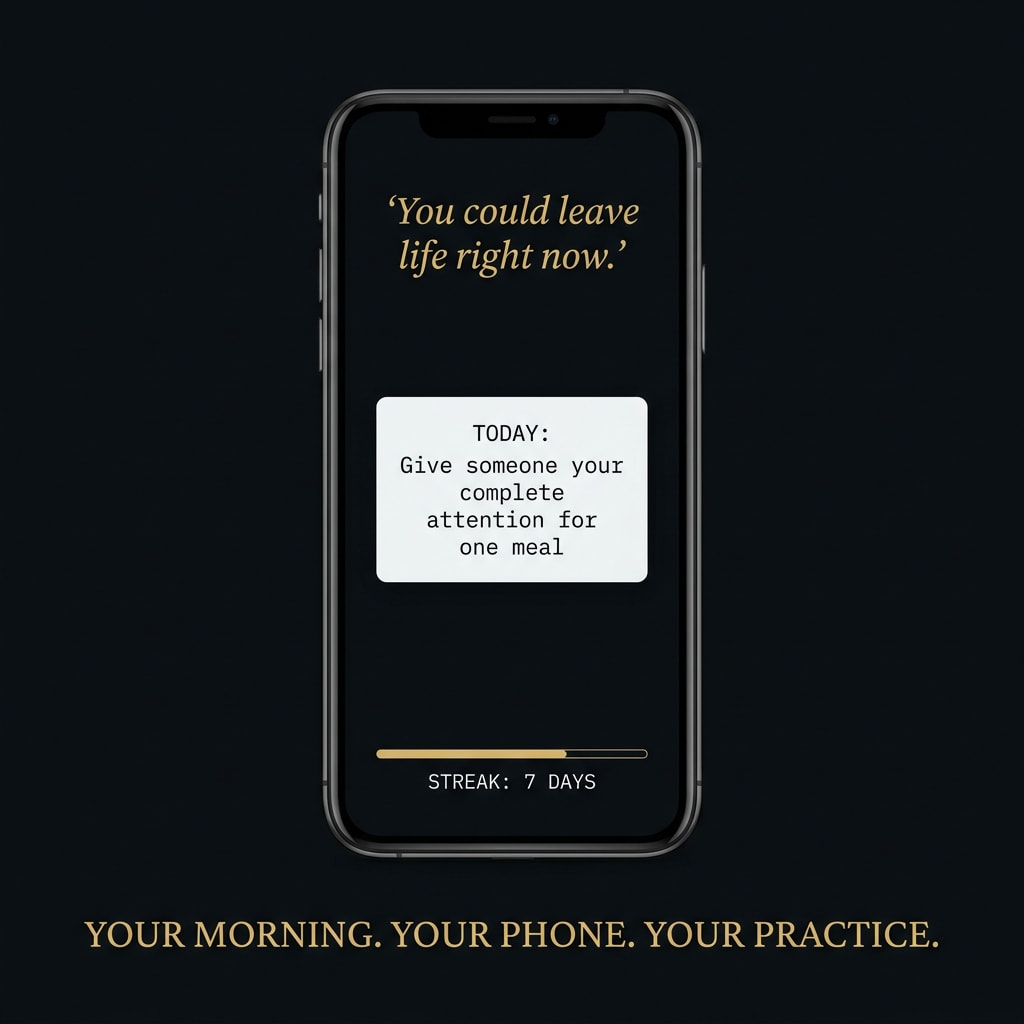
FAQ
How long does a Stoic morning routine take?
The core practice takes about 5 minutes: 90 seconds to read a Stoic quote, 90 seconds to choose a daily challenge, and 90 seconds of mortality reflection. You can expand it with journaling or meditation, but the minimal version is designed to be done even on your busiest days.
What time should I start a Stoic morning routine?
The Stoics valued waking early, but the specific time doesn’t matter. What matters is doing the routine before your day gets reactive — before emails, social media, or other people’s demands take over. For most people, this means within 15 minutes of waking up.
Do I need to read Stoic books to do this?
No. You need one quote per day. You can get these from free online sources, apps like StoicNow, or by opening Meditations to a random page. Over time, you’ll naturally learn more about Stoicism through daily exposure — which is exactly how the Stoics themselves recommended studying philosophy.
What’s the difference between a Stoic morning routine and regular meditation?
Meditation focuses on awareness — observing thoughts without judgment. A Stoic morning routine focuses on preparation — deciding how you want to act and what kind of person you want to be today. Both are valuable. They complement each other, but they’re not the same thing.
Can I combine this with my existing morning routine?
Yes. These three steps fit before, after, or between whatever you already do. They don’t require a special environment, equipment, or extra time beyond five minutes. Many people add them right after waking, before getting out of bed.

Marcus Adler
Founder & Lead Writer, StoicNow
Marcus Adler is the founder of StoicNow. For over a decade he has applied Stoic philosophy to daily life — testing the practices of Marcus Aurelius, Seneca, and Epictetus against modern problems and translating them into simple, repeatable routines. More about the author →