Quick answer
A Memento Mori calendar is a visual grid showing your entire lifespan in weeks (typically 4,160 squares for 80 years). Filled squares represent weeks you've lived; empty squares represent what remains. It's based on the ancient Stoic practice of reflecting on mortality to live more intentionally.
You have roughly 4,000 weeks to live.
That number comes from a simple calculation: 80 years × 52 weeks = 4,160 weeks. If you’re 30, you’ve already spent about 1,560 of them. The remaining 2,600 fit on a single sheet of paper — one tiny square per week.
This is a Memento Mori calendar. It turns your lifespan into a grid you can actually see, count, and feel. No abstraction. No comfortable vagueness about “someday.” Just rows of squares, most of them already filled in.
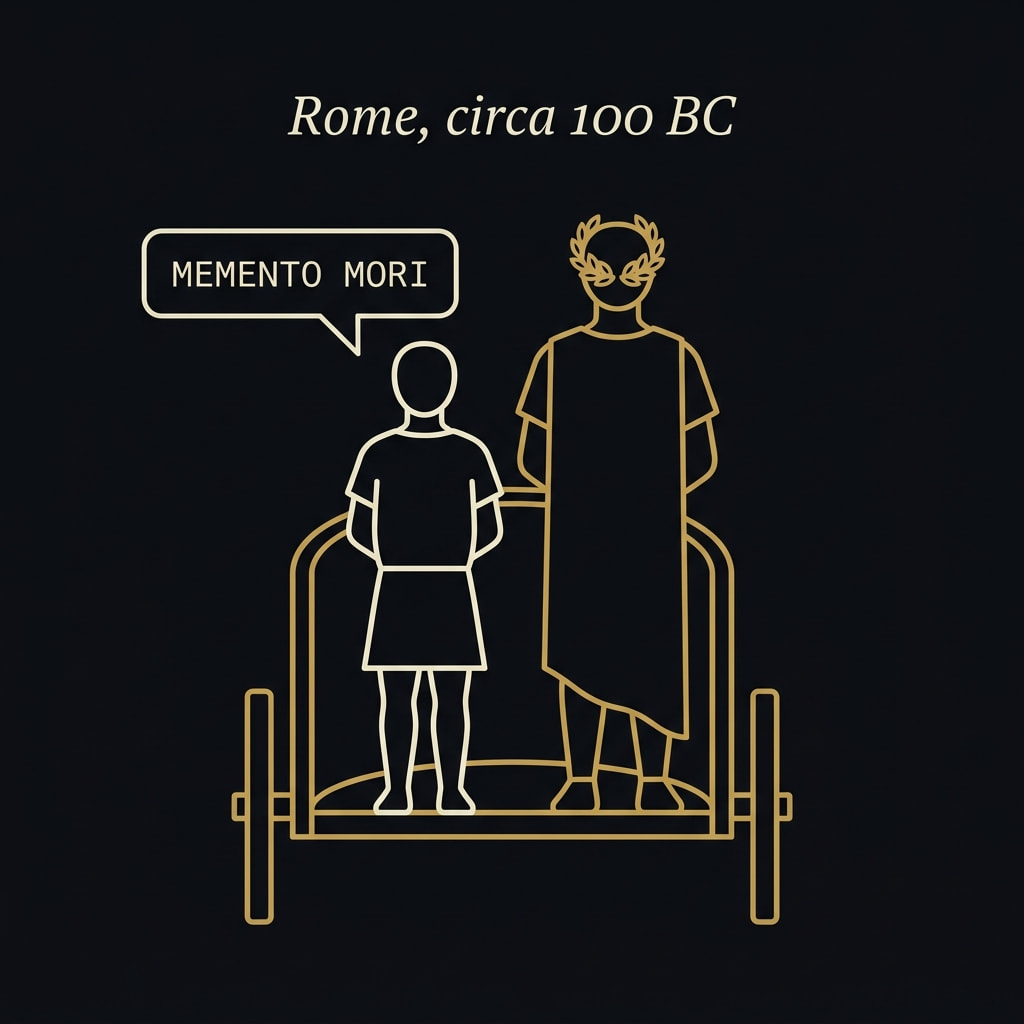
The ancient Stoics called this practice memento mori — Latin for “remember, you will die.” But they didn’t mean it as something dark. They used mortality as a lens to sharpen every decision, every morning, every conversation. A Memento Mori calendar is that same idea, made visual.
In this article, you’ll learn how the calendar works, what the Stoics actually said about reflecting on death, and how to use this tool to change the way you spend your time — starting today.
Try it free
Open Memento Mori CalculatorWhat Is a Memento Mori Calendar?
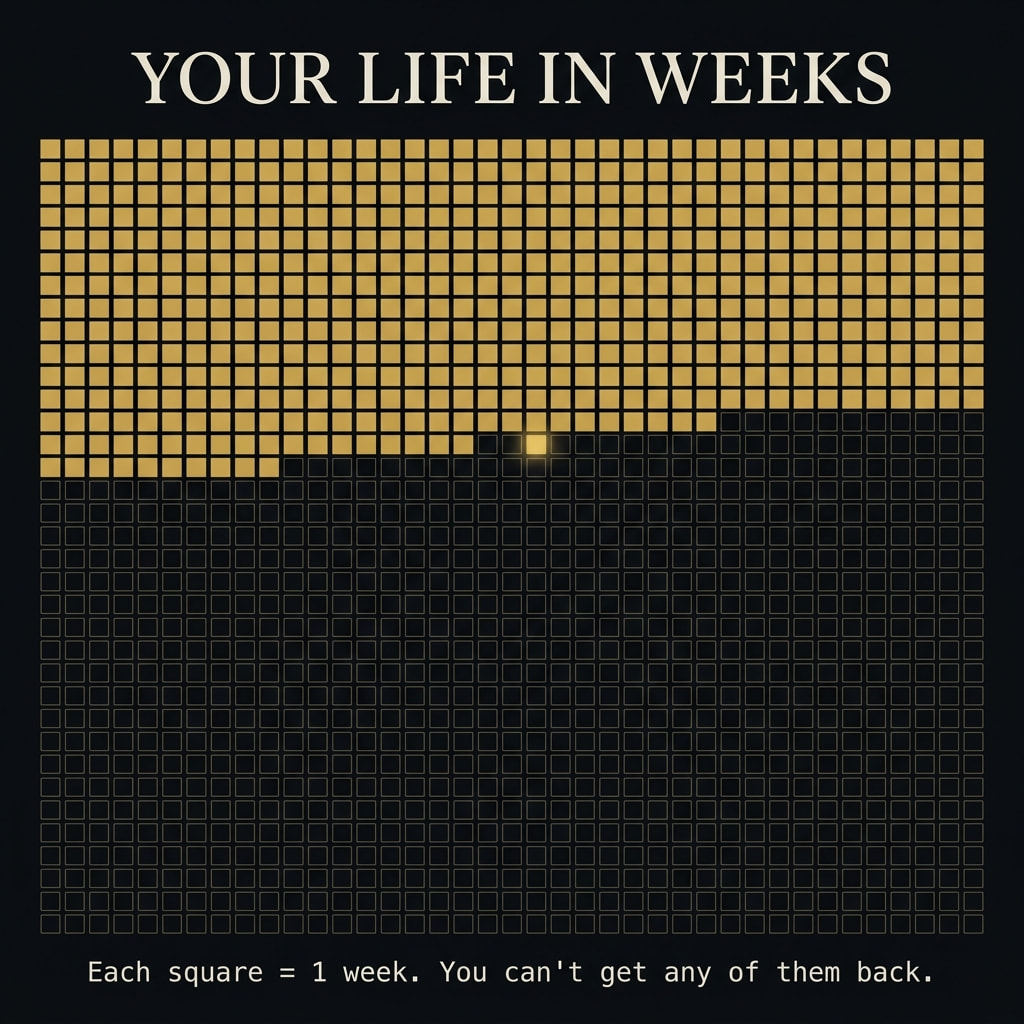
A Memento Mori calendar is a visual grid that represents your entire life in weeks. Each square equals one week. Filled squares are weeks you’ve already lived. Empty squares are what’s left.
Most versions use an 80-year lifespan (4,160 weeks), displayed as 52 columns (weeks per year) by 80 rows (years). You enter your birth date, and the grid fills in automatically — showing at a glance how much time has passed and how much likely remains.
The concept got popular online after Tim Urban’s 2014 blog post “Your Life in Weeks” on Wait But Why, where he visualized a 90-year life as a poster of dots. But the idea itself is much older. The Stoics were doing this mentally two thousand years ago.
What makes the calendar powerful isn’t the math — it’s the feeling. Seeing 1,500 filled squares and 2,600 empty ones hits differently than telling yourself “I’m 30.”
The Stoic Philosophy Behind It
The Stoics didn’t have grid paper, but they had the same idea.
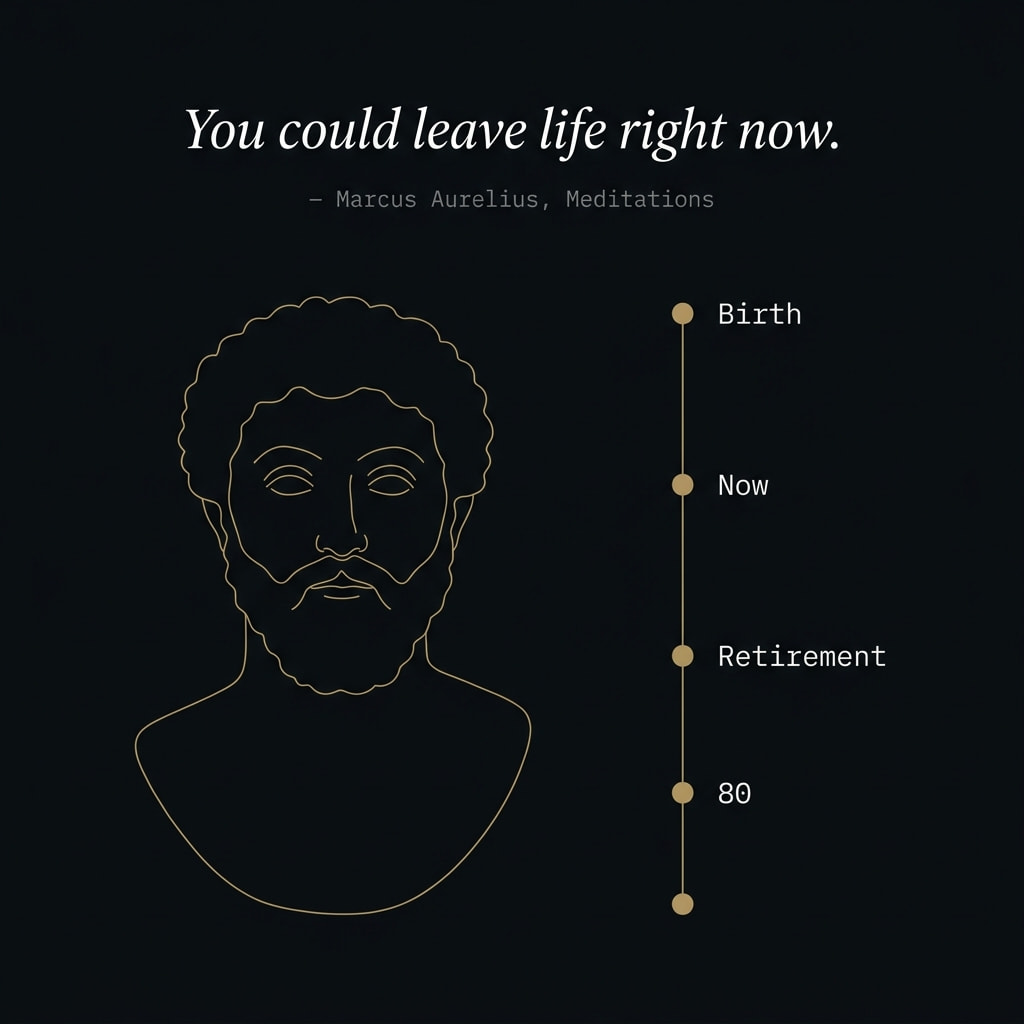
Marcus Aurelius, Roman emperor and practicing Stoic, wrote in his private journal: “You could leave life right now. Let that determine what you do and say and think.” He wasn’t being dramatic. He was giving himself a daily tool — a mental reset that filtered out the trivial.
Seneca, writing to his friend Lucilius, put it even more directly. He argued that most people don’t have short lives — they have wasted lives. The problem isn’t that time runs out. The problem is that we spend it as if it were unlimited: on status games, grudges, mindless scrolling, and things that don’t actually matter to us.
Epictetus taught his students to remind themselves that every time they hugged a loved one, it could be the last time. Not to create anxiety, but to create presence. If you know this dinner with your parents might be one of only 200 remaining, you put your phone away.
This is what a Memento Mori calendar does. It takes the Stoic insight — “your time is limited, act accordingly” — and turns it into something you can stare at for thirty seconds every morning.
How to Read Your Memento Mori Calendar
Here’s what the numbers actually look like for different ages:
| Your Age | Weeks Lived | Weeks Left | % Used |
|---|---|---|---|
| 20 | 1,040 | 3,120 | 25% |
| 25 | 1,300 | 2,860 | 31% |
| 30 | 1,560 | 2,600 | 38% |
| 35 | 1,820 | 2,340 | 44% |
| 40 | 2,080 | 2,080 | 50% |
| 50 | 2,600 | 1,560 | 63% |
| 60 | 3,120 | 1,040 | 75% |
The 40-year mark is the exact midpoint. If you’re past it, more than half your weeks are behind you. If you’re 25, you still have 69% of your weeks ahead — but 1,300 are already gone.
These numbers assume average life expectancy. Your mileage varies with genetics, health, and luck. The point isn’t precision. The point is proportion — and the visceral realization that life has a shape, a boundary, an edge.
Some people break the grid down further. The writer Oliver Burkeman, in his book Four Thousand Weeks, argued that confronting this limit is the only honest starting point for deciding how to spend your time. Not productivity hacks. Not more optimization. Just seeing clearly how little time there is — and choosing what actually deserves it.
How to Use a Memento Mori Calendar Daily
Staring at a grid once is interesting. Using it daily is where the change happens.
Morning check-in (30 seconds). Open the grid first thing. Look at where “today” falls. One more square filled. No judgment — just awareness. The Stoics called this praemeditatio — contemplation before the day begins. It works because it resets your default from “I have plenty of time” to “I have this day.”
Weekly reflection. Every Sunday, mark off another week. Ask yourself one question: “Did I use this week on things I actually care about?” Not “was I productive” — but “was it mine?” There’s a difference between a busy week and a meaningful one.
Decision filter. When you’re stuck between options — a job, a commitment, a grudge — zoom out to the grid. Does this thing deserve 50 of your remaining squares? 100? Sometimes the answer is yes. Often it isn’t.
Milestone tracking. Some people label rows with life stages: childhood, education, early career, kids, retirement. This adds context. You can see that “retirement” isn’t some distant chapter — it’s row 65. And everything after row 80 is a bonus.
The point isn’t to live in anxiety about dying. It’s the opposite. When you know time is limited, you stop spending it on things you don’t value. You call back your friend. You start the project. You say the thing you’ve been avoiding.

Digital Memento Mori Tools
Physical posters work, but most people won’t fill in a paper grid every week. Digital tools solve this.
StoicNow (our app) puts a Memento Mori grid on your phone — and optionally on your iPhone lock screen as a widget. You enter your birth date once, and the grid updates automatically every week. The current week pulses. Stats show your weeks lived, weeks remaining, and percentage. You can share your grid as an image.
The advantage of having it on your phone: you see it constantly. Not once a year when you find the poster behind your desk, but every time you unlock your screen. The Stoics would have loved this — they wanted mortality reminders integrated into daily life, not tucked away in a journal.
Other digital options exist: Tim Urban’s “Life Calendar” poster, various browser-based calculators, and Notion templates. But none of them sit on your lock screen where they can actually interrupt your autopilot.
Your life in weeks
Try the Free Memento Mori GridThe Science of Thinking About Death
This isn’t just philosophy. Psychologists call it “mortality salience” — making death present in your mind — and research shows it changes behavior.
A 2011 study published in Personality and Social Psychology Review found that mortality reminders increased people’s desire to contribute to something meaningful — to build a legacy rather than accumulate comfort. Terror Management Theory (TMT), developed by Sheldon Solomon, Jeff Greenberg, and Tom Pyszczynski, shows that when people are reminded of death in a reflective (not fearful) way, they tend to clarify their values and align their actions with what matters most.
Psychologist Laura King’s research at the University of Missouri found that writing about death for just 20 minutes increased participants’ sense of meaning in life. Not decreased — increased. The key is whether the reminder is reflective or fear-based. Reflective mortality awareness leads to growth. Fear-based reminders lead to avoidance.
A Memento Mori calendar is a reflective tool. It doesn’t say “be afraid.” It says “be aware.” That’s exactly the distinction the Stoics were making two millennia ago.
Common Objections
“Isn’t this depressing?”
Only if you misunderstand the point. The Stoics didn’t reflect on death to feel bad. They did it to feel awake. If looking at your remaining weeks makes you uncomfortable, that discomfort is information. It means something in your life isn’t aligned with what you actually want.
“But 80 years is just an average — I might live to 95.”
You might. You might also live to 60. The specific number doesn’t matter. What matters is that the number is finite and unknown. The grid makes that real.
“I don’t want to think about death every day.”
Fair enough. But consider: you already make decisions every day as if you’ll live forever. That’s also a choice about death — it’s just an unconscious one. The calendar makes the choice conscious.
Start Today
You don’t need an app to begin. Open a spreadsheet, draw a grid with 52 columns and 80 rows, and fill in the squares from your birth week to today. Look at what’s left.
Or use our free calculator at StoicNow.app — it builds your personal grid in seconds. If you want the grid on your phone permanently, the StoicNow app puts it on your lock screen as a widget, updated weekly.
The Stoics spent their lives practicing this kind of awareness. Marcus Aurelius wrote about it almost every day in his journal. Seneca devoted an entire essay to it — On the Shortness of Life. Epictetus taught it to every student who walked into his classroom.
They did it because it works. Not as a morbid exercise, but as the clearest possible lens for seeing what your life is — and what you want to do with the time you have left.
Your next week starts Monday. One more square. Make it count.
See your life in weeks
Open Free CalculatorFree Tool
Your Life in Weeks
See exactly how many weeks you have left — a Memento Mori calculator.
FAQ
What is a Memento Mori calendar?
A Memento Mori calendar is a visual grid showing your entire lifespan in weeks (typically 4,160 squares for 80 years). Filled squares represent weeks you’ve lived; empty squares represent what remains. It’s based on the ancient Stoic practice of reflecting on mortality to live more intentionally.
How many weeks are in a human life?
At an average life expectancy of 80 years, a human life contains approximately 4,160 weeks. At 90 years, it’s about 4,680 weeks. The exact number varies by country, gender, and individual health factors, but 4,000 weeks is the common round number used in Memento Mori calendars.
Where did the Memento Mori calendar idea come from?
The philosophy dates back to ancient Rome and Stoic thinkers like Marcus Aurelius, Seneca, and Epictetus. The visual grid format was popularized by Tim Urban’s 2014 “Your Life in Weeks” post on Wait But Why, and by Oliver Burkeman’s 2021 book Four Thousand Weeks.
Is thinking about death every day unhealthy?
Research suggests the opposite — when done reflectively rather than fearfully. Studies on mortality salience show that non-anxious reminders of death increase people’s sense of purpose and meaning. The Stoics practiced this daily and considered it essential to a well-lived life.
What is the best Memento Mori app?
StoicNow is a free iOS app that includes a Memento Mori grid, daily Stoic quotes, challenges, and an AI Stoic mentor. It also offers a lock screen widget that displays your life grid, so you see it every time you pick up your phone. Other options include physical posters and browser-based calculators.

Marcus Adler
Founder & Lead Writer, StoicNow
Marcus Adler is the founder of StoicNow. For over a decade he has applied Stoic philosophy to daily life — testing the practices of Marcus Aurelius, Seneca, and Epictetus against modern problems and translating them into simple, repeatable routines. More about the author →