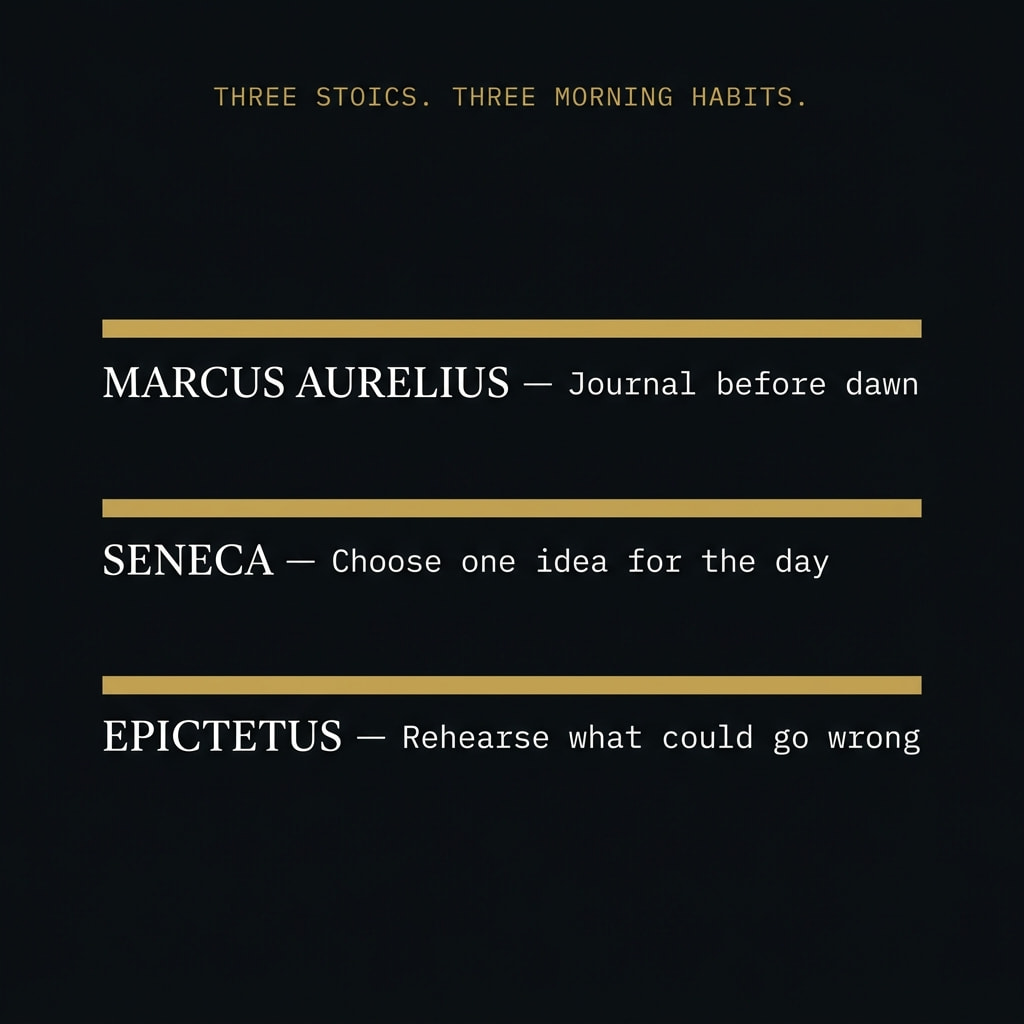
Quick answer
The most widely quoted Stoic line is Marcus Aurelius' 'You have power over your mind — not outside events. Realize this, and you will find strength' — a popular modern rendering of a recurring theme in his Meditations (especially Books 8 and 12), not a single verbatim passage.
Most “Stoic quotes” articles give you a wall of 90 quotes with no context. You scroll through, nod at a few, forget them by lunch.
This one is different. These 30 quotes are organized by the specific situation you might be facing right now — anxiety, loss, failure, anger, or the feeling that time is slipping away. Each quote includes who said it, where it comes from, and a brief note on why it matters.
The Stoics weren’t writing fortune cookies. They were writing to themselves or to friends in crisis — during plagues, exile, wars, and political betrayal. Their words hit hard because they were forged in real difficulty, not theoretical comfort.
Find your section. Read slowly. Take one quote with you today.

When You’re Anxious About the Future
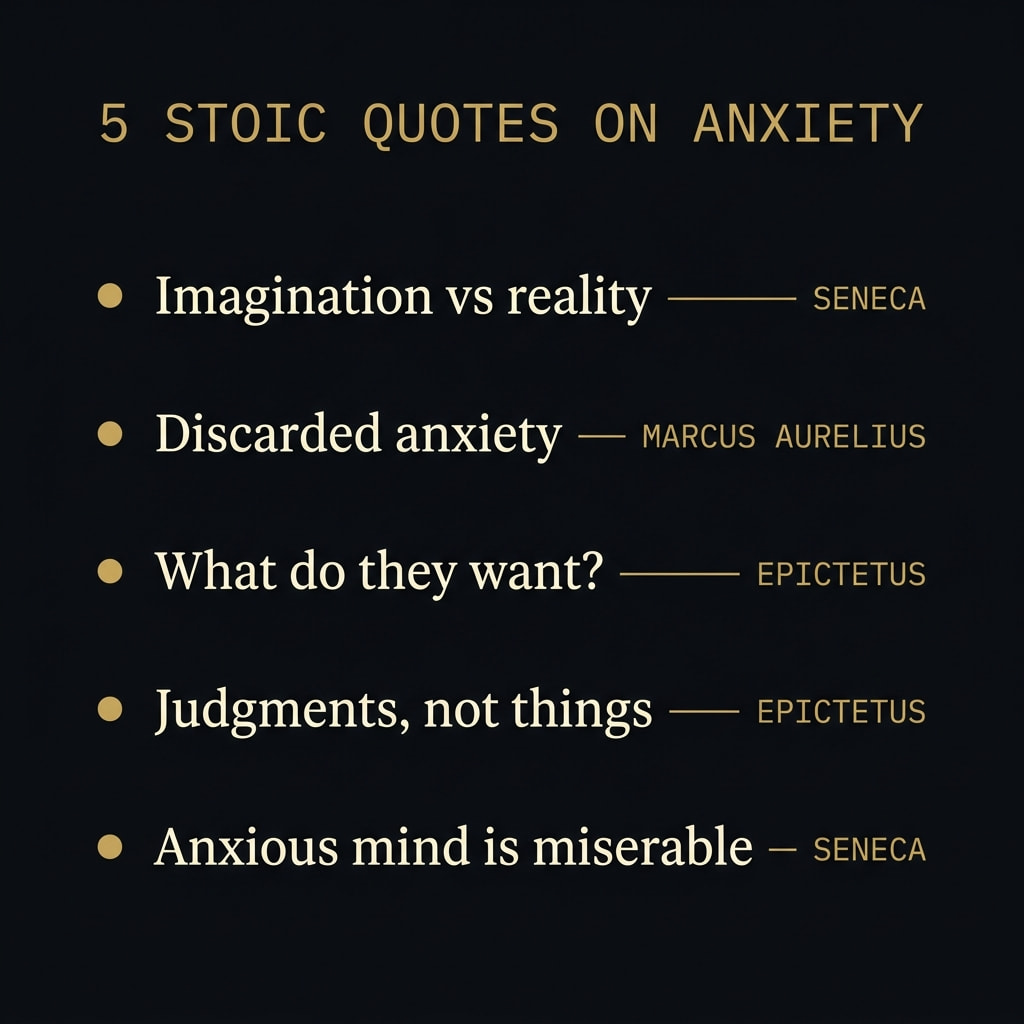
Anxiety was one of the Stoics’ central concerns. Seneca wrote an entire letter about it (Letter 13 to Lucilius), arguing that most of what we fear never actually happens — and even if it does, the anticipation is usually worse than the event itself.
#1
“We suffer more often in imagination than in reality.”
— Seneca, Letters to Lucilius 13.4
The most quoted Stoic line on anxiety, and for good reason. Seneca’s point: your mind is generating worst-case scenarios that haven’t occurred. The suffering is real, but the cause isn’t — yet. And statistically, it probably won’t be.
#2
“Today I escaped anxiety. Or no, I discarded it, because it was within me, in my own perceptions — not outside.”
— Marcus Aurelius, Meditations 9.13
Even the Roman emperor dealt with anxiety. His breakthrough was realizing it wasn’t caused by external events — it was generated by his interpretation of them. That distinction is the foundation of cognitive behavioral therapy, developed 1,800 years later.
#3
“When I see an anxious person, I ask myself, what do they want? For if a person wasn’t wanting something outside of their own control, why would they be stricken by anxiety?”
— Epictetus, Discourses 2.13
Epictetus cuts to the root: anxiety comes from wanting to control things you can’t. The job offer, the medical result, other people’s opinions — you can influence them, but you can’t guarantee them. The moment you accept that, the anxiety loosens.
#4
“It is not things that disturb us, but our judgments about things.”
— Epictetus, Enchiridion 5
The core Stoic principle in one sentence. The event is neutral. Your reaction is yours. This doesn’t mean you shouldn’t feel — it means you have more power over your experience than you think.
#5
“The mind that is anxious about future events is miserable.”
— Seneca, Letters to Lucilius 98.6
Seneca’s diagnosis is blunt: if you’re living in the future, you’re not living. You’re rehearsing pain. The antidote isn’t “don’t think ahead” — it’s “do what you can today, and release the rest.”
When You’ve Lost Something or Someone
The Stoics dealt with loss constantly. Seneca was exiled twice and eventually ordered to kill himself by Nero. Epictetus was born a slave. Marcus Aurelius buried multiple children. They didn’t write about loss from a comfortable distance.
#6
“What we lose with death is nothing more than what we lose with every passing day.”
— Seneca, Letters to Lucilius 24.20
Seneca reframes death as something that’s already happening. Every day, time passes and doesn’t return. The shock of loss is real, but impermanence isn’t an exception — it’s the rule.
#7
“Don’t demand that things happen as you wish. Let them happen as they do, and you will go on well.”
— Epictetus, Enchiridion 8
This sounds cold, but Epictetus isn’t saying “don’t care.” He’s saying: stop insisting the universe match your expectations. Grief comes from the gap between what you wanted and what is. Close the gap — not by caring less, but by accepting more.
#8
“Loss is nothing else but change, and change is nature’s delight.”
— Marcus Aurelius, Meditations 4.3
Marcus wrote this while ruling through plague and war. His point: the same process that grows a flower kills it. Fighting that process is fighting reality itself.
#9
“Say to yourself in the early morning: I shall meet today ungrateful, violent, treacherous, envious, uncharitable men.”
— Marcus Aurelius, Meditations 2.1
Not about loss specifically, but about disappointment in people — which is its own form of loss. Marcus prepared himself every morning for the gap between how people should be and how they actually are.
#10
“He who has a why to live for can bear almost any how.”
— Adapted from Epictetus via Nietzsche
Nietzsche attributed this insight to Stoic thinking. Purpose doesn’t eliminate pain, but it makes pain navigable. If you know why you’re enduring, the how becomes tolerable.
When You’ve Failed
The Stoics didn’t see failure the way we do. They drew a hard line between effort (which is yours) and outcome (which isn’t). You can do everything right and still lose. That’s not failure — that’s the nature of things.
#11
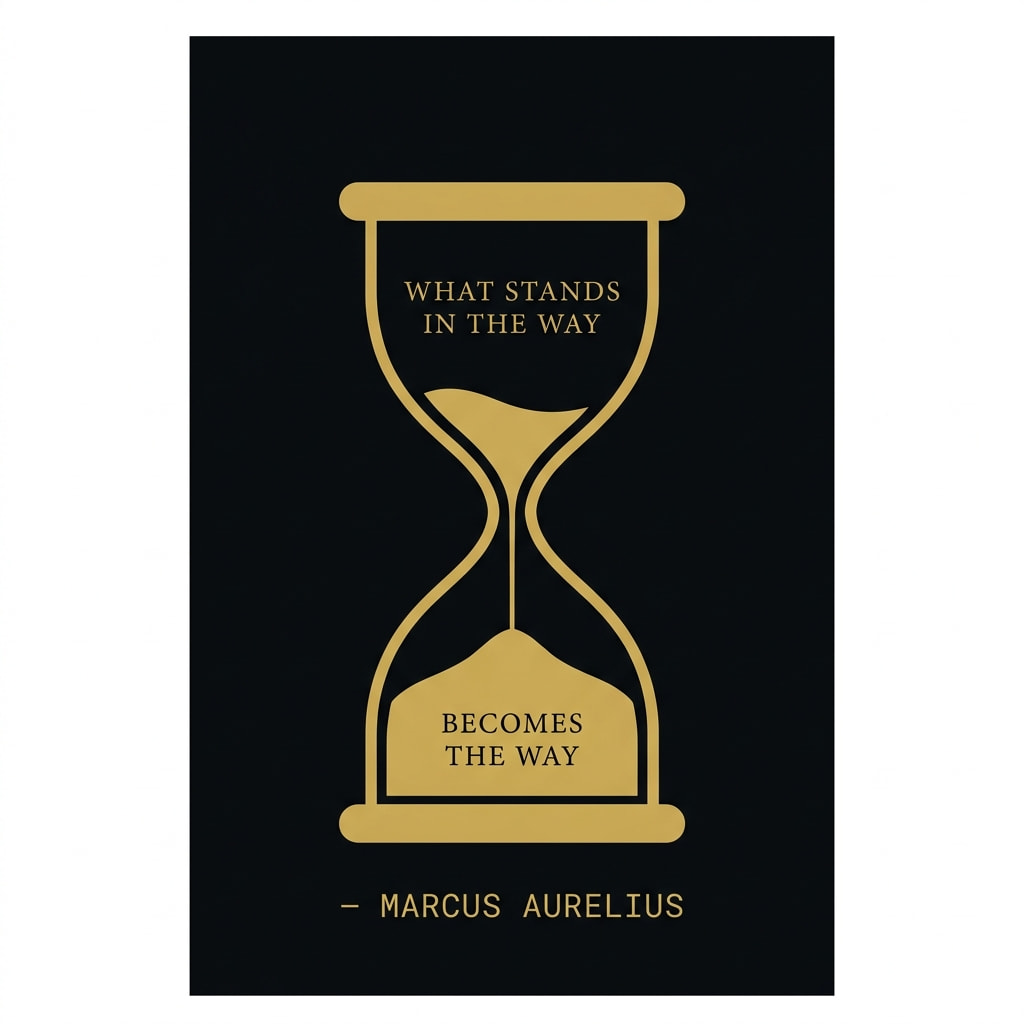
“The impediment to action advances action. What stands in the way becomes the way.”
— Marcus Aurelius, Meditations 5.20
This quote became the basis of Ryan Holiday’s bestseller The Obstacle Is the Way. The Stoic idea: an obstacle isn’t separate from your path — it is your path. The blocked road is the road.
#12
“A blazing fire makes flame and brightness out of everything that is thrown into it.”
— Marcus Aurelius, Meditations 10.31
Whatever happens to you — setback, rejection, embarrassment — can be fuel. The fire doesn’t care what you throw in. It burns it all. Your job is to be the fire, not the wood.
#13
“It is not that we have a short time to live, but that we waste much of it.”
— Seneca, On the Shortness of Life 1
After a failure, the temptation is to ruminate: what went wrong, what could have been, how you should have known better. Seneca would say: that rumination is itself a waste of the time you’re mourning. Move.
#14
“No man is more unhappy than he who never faces adversity. For he is not permitted to prove himself.”
— Seneca, On Providence 4.3
Seneca’s argument is that failure is a prerequisite for knowing your own strength. A person who has never been tested doesn’t know what they’re made of — and that ignorance is its own kind of poverty.
#15
“The true man is revealed in difficult times. So when trouble comes, think of yourself as a wrestler whom God, like a trainer, has paired with a tough young buck.”
— Epictetus, Discourses 1.24
Epictetus spent years as a slave. His view of difficulty was simple: it’s training. You don’t get strong by wrestling an infant. You get strong by facing something that can actually beat you.
When You’re Angry
Seneca wrote an entire book on anger — De Ira (On Anger). He considered it the most destructive emotion, worse than fear or grief, because it actively makes you do things you’ll regret.
#16
“How much more grievous are the consequences of anger than the causes of it.”
— Marcus Aurelius, Meditations 11.18
The thing that made you angry lasted a moment. The angry email, the broken relationship, the impulsive decision — those last much longer. Marcus asks: is the reaction proportional to the cause?
#17
“Anger, if not restrained, is frequently more hurtful to us than the injury that provokes it.”
— Seneca, On Anger 3.27
Seneca saw anger as a fire that burns the container more than the target. The person you’re angry at might not even know. Meanwhile, you’re losing sleep.
#18
“If someone can prove me wrong and show me my mistake in any thought or action, I shall gladly change. I seek the truth.”
— Marcus Aurelius, Meditations 6.21
This is the antidote to defensive anger. If someone criticizes you and they’re right — thank them. If they’re wrong — it doesn’t matter. Either way, anger doesn’t help.
#19
“No one does evil willingly.”
— Paraphrased from Socrates, echoed by Epictetus, Discourses 1.28
People do harmful things because they don’t know better, not because they’re fundamentally evil. This Socratic principle, adopted by the Stoics, disarms anger at its source. It’s hard to hate someone you pity.
#20
“The best answer to anger is silence.”
— Marcus Aurelius, Meditations (attributed)
Not because silence wins arguments, but because it gives you time. Time to let the initial surge pass. Time to choose your response instead of being chosen by your reaction.
When Time Feels Like It’s Running Out
The Stoics wrote about time more than almost any other topic. Seneca’s essay On the Shortness of Life is essentially a 20-page argument that you’re wasting your life on things that don’t matter — and you don’t have as much left as you think.
#21
“You could leave life right now. Let that determine what you do and say and think.”
— Marcus Aurelius, Meditations 2.11
The single most powerful sentence in Stoic literature. Not a threat — a clarifier. If today were your last, would you spend it this way?
#22
“Let us prepare our minds as if we’d come to the very end of life. Let us postpone nothing.”
— Seneca, Letters to Lucilius 101.10
Seneca’s advice isn’t “live fast.” It’s “live deliberately.” Don’t postpone the conversation, the project, the kindness. Not because you’ll die tomorrow — but because you might.
#23
“It is not death that a man should fear, but he should fear never beginning to live.”
— Marcus Aurelius, Meditations 12.1
The real tragedy isn’t dying. It’s reaching the end and realizing you never started doing the things that actually mattered to you.
#24
“How small your share of all the infinity of time.”
— Marcus Aurelius, Meditations 12.32
Perspective. The entire span of your life is a blink in cosmic time. This isn’t depressing if you use it correctly — it means the petty annoyances truly don’t matter. What matters is what you do with the blink.
#25
“Begin at once to live, and count each separate day as a separate life.”
— Seneca, Letters to Lucilius 101.10
This pairs with a Memento Mori calendar — a grid of your life in weeks. When you can see how few days remain, the impulse to waste them drops.
When You Need to Keep Going
Some days you don’t need philosophy. You need a push. These quotes are for the days when you’re running on empty and need one reason to continue.
#26
“First say to yourself what you would be; and then do what you have to do.”
— Epictetus, Discourses 3.23
Don’t wait to feel motivated. Decide who you are, then act like that person. Identity drives action — not the other way around.
#27
“Dig within. Within is the wellspring of good; and it is always ready to bubble up, if you just dig.”
— Marcus Aurelius, Meditations 7.59
On bad days, you forget what you’re capable of. Marcus’ reminder: the strength isn’t gone. It’s buried under fatigue and distraction. Dig.
#28
“We are more often frightened than hurt; and we suffer more in imagination than reality.”
— Seneca, Letters to Lucilius 13.4
A repeat of #1, but it belongs here too. When you’re dreading the next step, remember: the dread is almost always worse than the step.
#29
“If it is not right, do not do it. If it is not true, do not say it.”
— Marcus Aurelius, Meditations 12.17
When everything is complicated, simplify. This two-part filter eliminates 90% of the noise: is it right? Is it true? If both, do it. If not, don’t.
#30
“Waste no more time arguing about what a good man should be. Be one.”
— Marcus Aurelius, Meditations 10.16
The most Stoic sentence possible. Stop reading about what to do. Go do it.
How to Actually Use These Quotes
Reading 30 quotes in one sitting is interesting. Carrying one with you through a bad day is transformative. Here’s how:
Pick one. Whichever hit you the hardest — that’s the one you need today. Don’t overthink it.
Write it down. On a sticky note, in your phone’s notes app, or in a journal. The act of writing forces it deeper than reading.
Return to it. When the difficult moment arrives today — the anxious thought, the angry impulse, the procrastination — pull out the quote and read it once. Not as a magic spell, but as a reset.
Rotate weekly. Next Monday, pick a different quote. Over time, you’ll build a personal library of lines that work for you specifically.
If you’d rather automate this, StoicNow delivers a different Stoic quote to your phone every morning — with context explaining who said it and why it matters. It also puts quotes on your iPhone lock screen widget, so you see one every time you pick up your phone.
Daily Stoic wisdom on your phone
Try StoicNow — Free on iOSFAQ
What is the most famous Stoic quote?
The most widely quoted Stoic line is Marcus Aurelius’ “You have power over your mind — not outside events. Realize this, and you will find strength” — a popular modern rendering of a recurring theme in his Meditations (especially Books 8 and 12), not a single verbatim passage. Seneca’s “We suffer more often in imagination than in reality” (Letters 13.4) is a close second, especially in discussions about anxiety.
Did the Stoics believe in suppressing emotions?
No. The Stoics distinguished between initial reactions (which are involuntary) and sustained emotional states (which involve judgment). They didn’t aim to feel nothing — they aimed to respond wisely rather than react impulsively. Seneca himself wrote passionately; Marcus Aurelius clearly struggled with frustration and sadness. The goal was mastery, not suppression.
Which Stoic philosopher is best for dealing with anxiety?
Seneca is the most practical writer on anxiety. His Letters to Lucilius (especially Letters 13, 24, and 98) directly address worry, fear, and overthinking. Epictetus is best for understanding why anxiety arises (the desire to control what you can’t). Marcus Aurelius is best for daily reminders and perspective shifts.
Are Stoic quotes only for men?
No. While the three most famous Stoics were men (writing in a patriarchal society), Stoic philosophy explicitly taught that virtue is universal. Musonius Rufus, a Stoic teacher, argued in the 1st century that women should study philosophy on equal terms with men. The principles of focus, resilience, and clarity apply regardless of gender.
How can I read Stoic quotes daily?
Free options include opening Meditations to a random page each morning (the full text is public domain), following Stoic accounts on social media, or subscribing to email newsletters like Daily Stoic. For a more structured experience, the StoicNow app delivers a daily quote with context, depth explanations, and a daily challenge tied to Stoic philosophy.

Marcus Adler
Founder & Lead Writer, StoicNow
Marcus Adler is the founder of StoicNow. For over a decade he has applied Stoic philosophy to daily life — testing the practices of Marcus Aurelius, Seneca, and Epictetus against modern problems and translating them into simple, repeatable routines. More about the author →