Quick answer
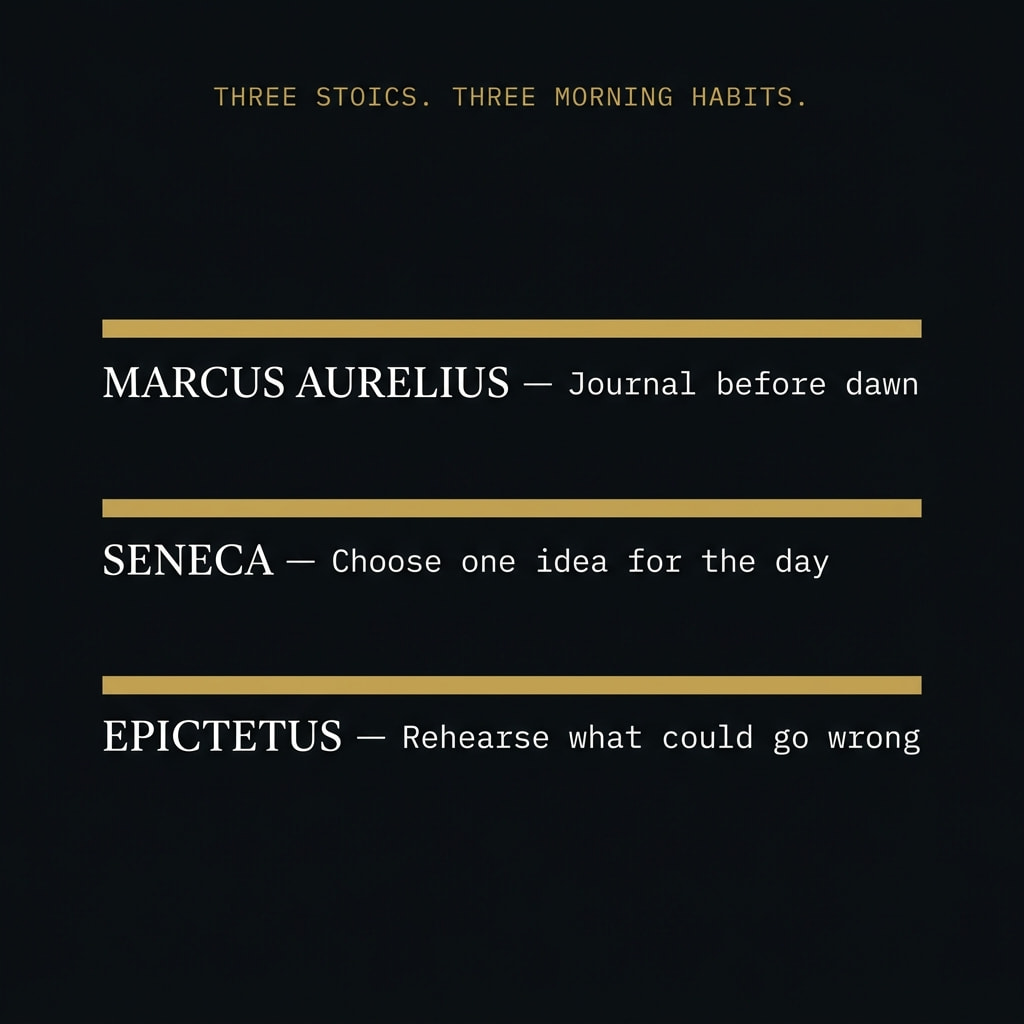
Start with two exercises: morning preparation (2 minutes of imagining the day's challenges) and evening reflection (3 minutes of reviewing what happened). These require no philosophical knowledge and less than five minutes total.
Stoicism isn’t a set of beliefs you agree with. It’s a set of practices you do.
That distinction matters because most people discover Stoicism through quotes — they read Marcus Aurelius or Seneca, feel inspired for twenty minutes, and then go back to doom-scrolling. The inspiration fades because it was never anchored to action.
The ancient Stoics had a word for this: askesis — training. They treated philosophy the way athletes treat physical conditioning: daily repetition of specific exercises designed to build mental strength. Not theory. Practice.
This article covers seven Stoic exercises you can start today. Each one is simple enough to do in a few minutes, backed by the original Stoic sources, and designed for people who’ve never read a philosophy book.
Exercise 1: The Dichotomy of Control
Exercise 01
The Dichotomy of Control
Separate what’s yours from what isn’t. Act only on the first.
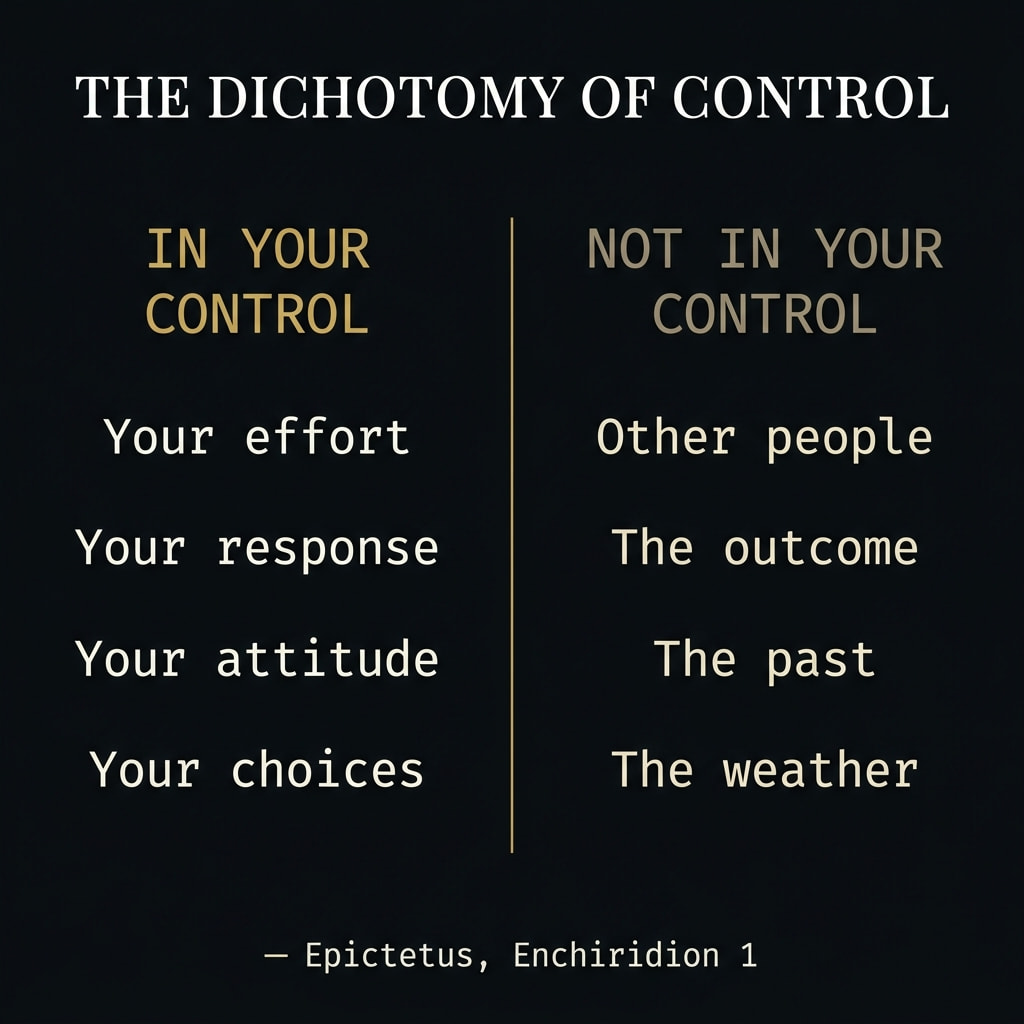
Where it comes from: Epictetus opened his Enchiridion (Stoic Handbook) with this: “Some things are within our power, while others are not.” He considered this the single most important idea in Stoic philosophy.
How to practice it
When something bothers you today — traffic, a rude email, a project that’s not going well — pause and ask two questions:
- What part of this is within my control? (Your response, your effort, your attitude.)
- What part is outside my control? (Other people’s behavior, the outcome, the timing.)
Then redirect all your energy toward the first category and release the second.
This sounds obvious on paper. In practice, it’s surprisingly hard — because most of our anxiety comes from trying to control things in category two. The meeting result. The other person’s reaction. Whether the flight is delayed.
Epictetus’ point: if something is outside your control, worrying about it is irrational. Not because you shouldn’t care, but because your worry can’t change it. Only your action can — and only within the boundary of what’s actually yours to decide.
30 sec per situation
Exercise 2: Morning Preparation
Exercise 02
Morning Preparation (Praemeditatio)
Rehearse the day’s difficulties before they arrive.
Where it comes from: Marcus Aurelius began Book 2 of his Meditations with a morning exercise: imagine the difficult people you’ll encounter today — the ungrateful, the arrogant, the dishonest. Not to dread them, but to prepare. Epictetus called this praemeditatio malorum — premeditation of adversity.
How to practice it
Before you check your phone, ask yourself:
- What’s the hardest thing I’ll face today?
- Who might frustrate me?
- What could go wrong?
Then, for each item, decide in advance how you want to respond. Not how you’ll probably respond — how the best version of you would handle it.
This works because strong emotions hit hardest when they’re unexpected. If you’ve already imagined your boss giving you critical feedback, the feedback itself loses its sting. You’ve rehearsed your response. You’re not surprised.
We built an entire article around this concept: The 5-Minute Stoic Morning Routine breaks it into three steps — read, act, reflect — that you can do in the time it takes to brew coffee.
2–3 min, every morning
Exercise 3: The Daily Challenge
Exercise 03
The Daily Challenge
One small uncomfortable task. Completed on purpose.
Where it comes from: Seneca regularly practiced voluntary discomfort. He’d sleep on a hard surface, wear rough clothing, or eat plain food — not as punishment, but as training. His logic: if you’ve practiced being uncomfortable on your own terms, you’ll handle involuntary discomfort better when it arrives.
Epictetus took it further. He taught that virtues like discipline and courage aren’t abstract — they’re skills that require practice, just like playing an instrument.
How to practice it
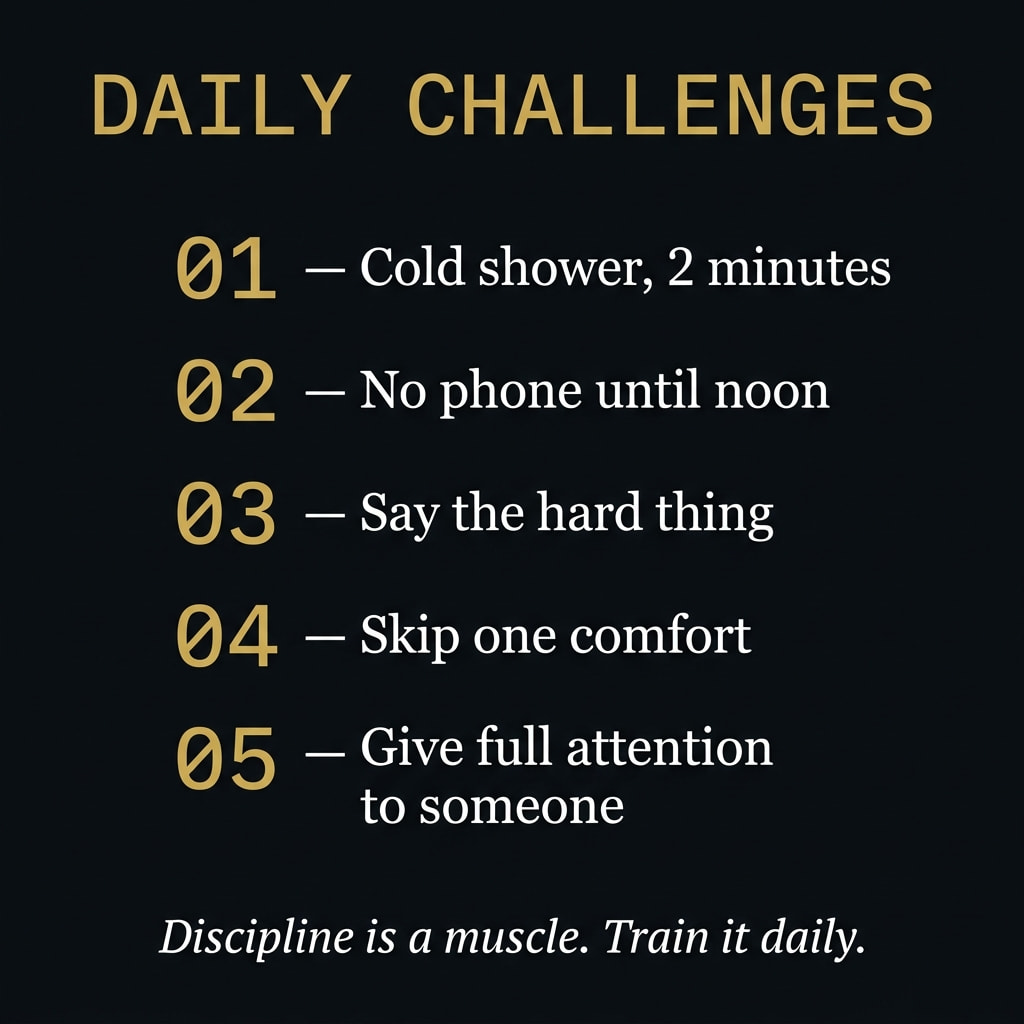
Choose one thing each day that’s slightly outside your comfort zone:
- Take a cold shower (the modern version of Seneca’s rough cloak)
- Go four hours without checking your phone
- Have the conversation you’ve been putting off
- Skip a meal and notice what real hunger feels like
- Give honest feedback to someone, kindly but directly
The task doesn’t have to be dramatic. It has to be deliberate. The Stoic point is that comfort is a drug — the more you indulge it, the more you need, and the weaker you become when it’s taken away.
Decision: 30 sec. Execution: woven into your day
Exercise 4: The View from Above
Exercise 04
The View from Above
Zoom out from your desk to the cosmos. Gain perspective.
Where it comes from: Marcus Aurelius did this repeatedly in Meditations. He’d remind himself of the scale of the universe and the brevity of his life relative to all of history. “How small your share of all the infinity of time,” he wrote.
How to practice it
When you’re stressed or stuck in a problem that feels enormous, close your eyes for 60 seconds and mentally zoom out:
- See yourself sitting where you are now
- Pull back to see the building, then the city
- Pull back to the country, then the planet
- Pull back to the solar system, the galaxy
From that vantage point, ask: does this problem still feel the same size?
This isn’t about minimizing real struggles. It’s about proportion. Most of what stresses us daily — the email, the argument, the career anxiety — is genuinely small against the backdrop of existence. The things that aren’t small (health, relationships, purpose) become clearer when everything else shrinks.
60 seconds, anywhere
Exercise 5: Memento Mori
Exercise 05
Memento Mori — Reflect on Your Mortality
A brief reminder that you will die. Used for prioritization, not despair.
Where it comes from: Memento mori is one of the oldest and most central Stoic practices. Marcus Aurelius: “You could leave life right now. Let that determine what you do and say and think.” Seneca devoted an entire essay (On the Shortness of Life) to the argument that we waste most of the time we’re given.
How to practice it
Option A: Ask yourself once a day — “If today were my last, would I spend it this way?”
Option B: Look at a Memento Mori calendar — a grid of your life in weeks, with the lived weeks filled in and the remaining ones empty.
Option C: Read one quote about time and mortality from our collection of Stoic quotes for hard times. Let it sit for 30 seconds before moving on.
The Stoics weren’t trying to scare themselves. They were trying to wake themselves up. The person who forgets they’ll die is the person who wastes decades on things they don’t care about. The person who remembers has a filter: is this worthy of my limited time?
30 sec – 2 min
Exercise 6: Evening Reflection
Exercise 06
Evening Reflection (Examen)
Review your day. What went well, what didn’t, what to change.
Where it comes from: Seneca did this every night. From On Anger (3.36): “When the light has been taken away and my wife has fallen silent, I examine my entire day, going through what I have done and said. I conceal nothing from myself, I pass nothing by.”
How to practice it
Before bed, answer three questions:
- What went well today? (Name one thing you’re satisfied with.)
- Where did I fall short? (Not to punish yourself — but to notice. Seneca’s rule: “See that you do not do this anymore. For the moment, I excuse you.”)
- What will I do differently tomorrow? (One specific change.)
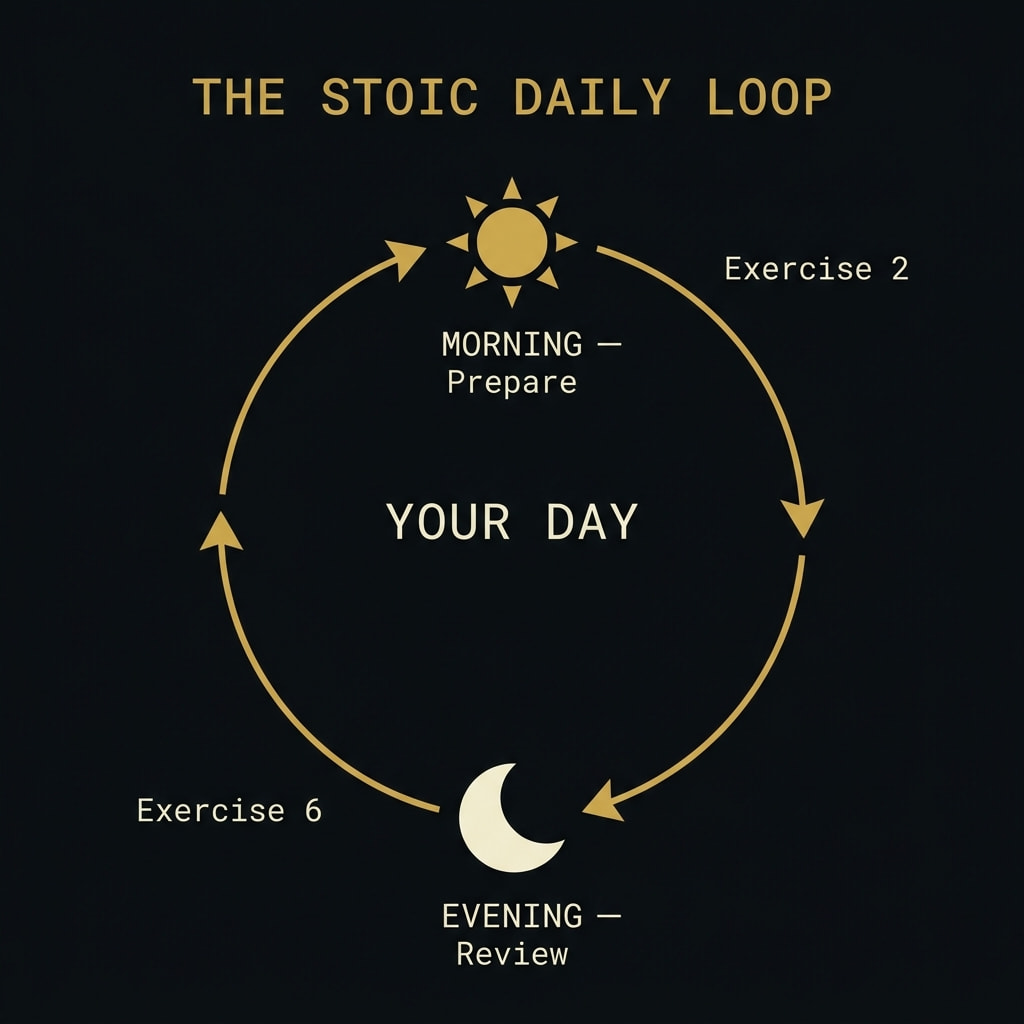
The evening reflection completes the loop that the morning preparation starts. Morning = direction. Evening = feedback. Over time, this cycle produces real change — not because any single day matters enormously, but because the compound effect of daily self-correction is massive.
3 min, before sleep
Exercise 7: Journaling
Exercise 07
Journaling
Write to yourself. The pen forces honesty the mind avoids.
Where it comes from: Marcus Aurelius’ Meditations is literally a journal. He never intended anyone to read it. He wrote to himself — working through anger, frustration, grief, and confusion on the page. The act of writing was the practice.
How to practice it
You don’t need a special journal or a structured template. The simplest version:
Open a note on your phone. Write one paragraph about something that happened today and how you handled it — or wish you had. Ask yourself what a Stoic would have done differently.
That’s it. One paragraph. The practice isn’t about volume. It’s about reflection — the same thing Seneca did every evening and Marcus did every morning. The pen (or keyboard) forces honesty. You can lie to yourself in your head. It’s harder on paper.
If you want more structure, use the three prompts from Exercise 6 (what went well, where I fell short, what I’ll change). Over weeks and months, your journal becomes a record of your own growth.
5–10 min
Building Your Practice: Start with Two
Seven exercises is a menu, not a requirement. Don’t try to do all seven tomorrow — that’s the fastest way to do none of them by Friday.
Pick two. The recommended starting pair:
- Morning preparation (Exercise 2) — takes 2 minutes, sets direction for the day
- Evening reflection (Exercise 6) — takes 3 minutes, closes the loop
Do these two for one week. If they stick, add a third. If they don’t, swap one out and try again. The Stoics themselves didn’t do everything every day — even Marcus Aurelius had off days, which is exactly why he kept writing about the same struggles.
The only thing that matters is consistency. Five minutes a day for a year beats an hour once a month. The compound effect is real: people who maintain a daily Stoic practice report noticeably calmer reactions within 1–2 weeks, and lasting behavior changes within 4–8 weeks.
If you want the structure automated, StoicNow was built around these exercises. It delivers a daily quote (Exercise 2’s reading component), a daily challenge (Exercise 3), a Memento Mori grid (Exercise 5), an evening reflection prompt (Exercise 6), and a streak counter to keep you consistent. If you’d rather compare options first, see our roundup of the best Stoic apps.
All 7 exercises in one app
Try StoicNow — Free on iOS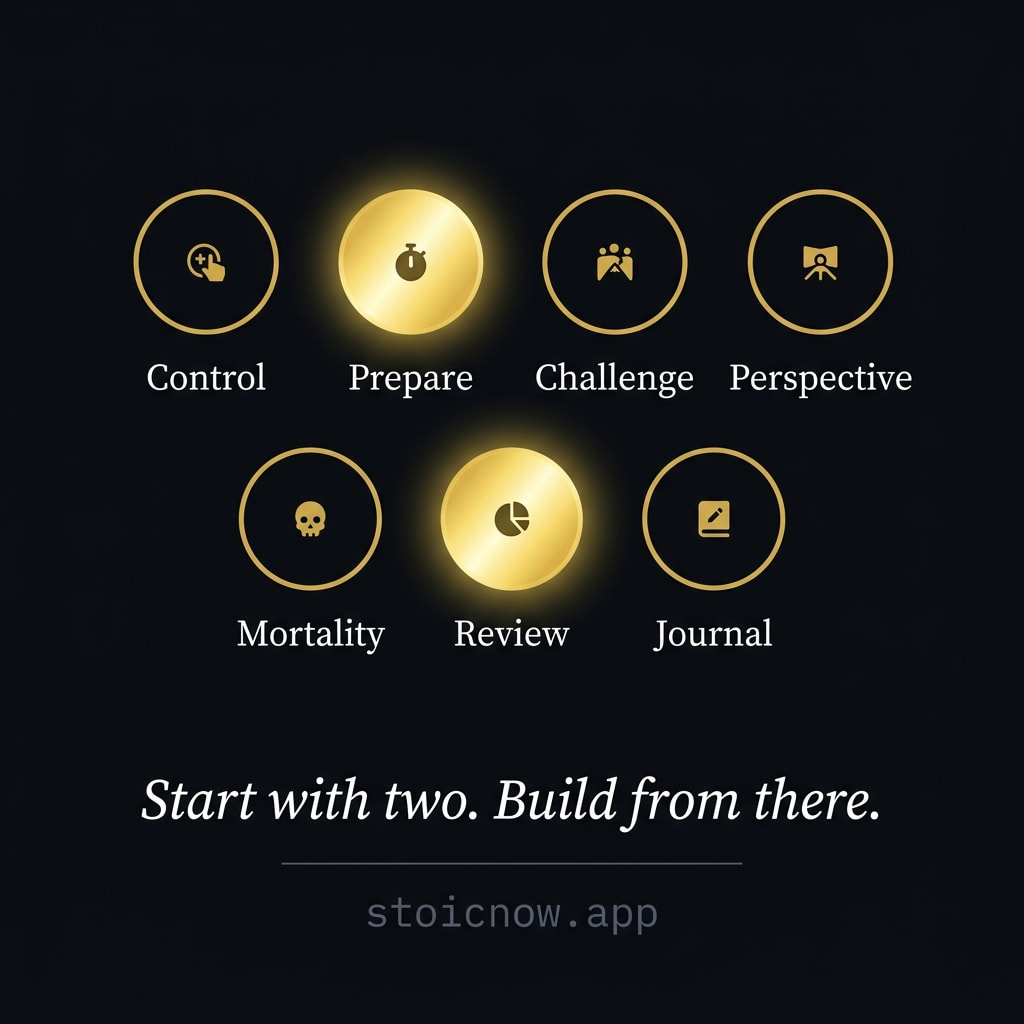
FAQ
How do I start practicing Stoicism with no experience?
Start with two exercises: morning preparation (2 minutes of imagining the day’s challenges) and evening reflection (3 minutes of reviewing what happened). These require no philosophical knowledge, no special tools, and less than five minutes total. After one week, add a third exercise from this list.
Is Stoicism about suppressing emotions?
No. The Stoics distinguished between first movements (involuntary emotional reactions, which are natural) and passions (sustained states driven by false judgments). They didn’t aim to eliminate feelings — they aimed to choose their responses rather than be controlled by impulse. Seneca himself was passionate and emotional in his writing. The goal is wisdom, not numbness.
How long before I notice changes from Stoic practice?
Most people report calmer reactions to stress within 1–2 weeks of consistent daily practice. Deeper behavioral changes — less reactivity, better decision-making, more emotional stability — typically emerge at the 4–8 week mark. The ancient Stoics practiced for their entire lives and still found new challenges, so patience is part of the practice.
Do I need to read Marcus Aurelius or Seneca to practice Stoicism?
It helps, but it’s not required. You can start practicing all seven exercises in this article without reading a single philosophical text. If you want to go deeper, start with Marcus Aurelius’ Meditations (the Gregory Hays translation is the most readable modern version) or Seneca’s Letters to Lucilius.
What’s the relationship between Stoicism and CBT?
CBT was directly influenced by Stoic philosophy. Aaron Beck and Albert Ellis, who developed cognitive therapy in the 1960s, both cited Epictetus’ principle that “it is not things that disturb us, but our judgments about things.” The core technique — identifying and challenging irrational beliefs — comes straight from Stoic practice.
Can I practice Stoicism and still be religious?
Yes. Stoicism is a philosophy, not a religion. It focuses on virtue, reason, and practical ethics — values shared by most religious traditions. Modern Stoic practice doesn’t require any specific metaphysical beliefs. Many practitioners integrate Stoic exercises with their existing faith.

Marcus Adler
Founder & Lead Writer, StoicNow
Marcus Adler is the founder of StoicNow. For over a decade he has applied Stoic philosophy to daily life — testing the practices of Marcus Aurelius, Seneca, and Epictetus against modern problems and translating them into simple, repeatable routines. More about the author →