Quick answer
Amor fati is a Latin phrase meaning 'love of fate.' It describes the practice of accepting and embracing everything that happens — including hardship — rather than resisting it. The concept originates from Stoic philosophy and was popularized by Nietzsche.
You get fired. Your flight is cancelled. Someone you trusted lies to you. The test result comes back bad.
Your instinct says: resist. Fight it. Wish it hadn’t happened.
The Stoics said something different: love it.
Not “pretend it’s fine.” Not “be grateful for suffering.” But stop arguing with reality — because that argument is where most of your pain actually lives. The event happened. Your resistance to it is optional. And that resistance costs more energy than the event itself.
This is amor fati — Latin for “love of fate.” It’s one of the most powerful ideas in Stoic philosophy, and one of the most misunderstood. People hear “love your fate” and think it means be passive, be a doormat, accept abuse. It means none of those things.
Amor fati means: once something has happened, stop wishing it hadn’t. Use it. Let it make you stronger, clearer, or more compassionate. Turn the obstacle into material.
What Amor Fati Means
Amor fati translates directly from Latin: amor (love) + fati (of fate). Love of fate. Love of what happens.
The concept has two layers:
Layer 01
Acceptance
Whatever happened, happened. You can’t undo it. Fighting the fact that it occurred is wasted energy. This is the Stoic baseline — the dichotomy of control. You control your response. You don’t control the event.
Layer 02
Embrace
This is where amor fati goes further than simple acceptance. It asks you not just to tolerate what happened, but to actively use it. To see the setback as raw material. Marcus Aurelius put it this way: “A blazing fire makes flame and brightness out of everything that is thrown into it.”
The fire doesn’t care what you throw in — wet wood, garbage, obstacles. It burns it all. Your job is to be the fire, not the thing being thrown.

The Stoics Invented It. Nietzsche Named It.
The ancient Stoics practiced this concept daily, but they never used the exact phrase “amor fati.” That credit goes to Friedrich Nietzsche, who wrote in 1882:
“My formula for greatness in a human being is amor fati: that one wants nothing to be different, not forward, not backwards, not in all eternity.”
Nietzsche took the Stoic idea and sharpened it. For the Stoics, accepting fate was easier because they believed the universe had a rational order — everything happened for a reason within a grand cosmic plan. Nietzsche rejected that comfort. He said: love your fate even if the universe has no purpose at all. Love it because it’s yours. Love it because the alternative — bitterness, regret, resistance — is worse.
Both traditions arrive at the same practice: stop spending energy on wishing things were different. Start spending it on what you can do next.
The three major Stoics all practiced amor fati, even without calling it that:
Marcus Aurelius constantly reminded himself to accept events without complaint. He governed through plague, war, and betrayal. His journal (Meditations) is full of passages where he argues himself out of resentment and back toward acceptance.
Epictetus, born a slave with a permanent disability, taught: “Do not seek for things to happen the way you want them to. Rather, wish that what happens happen the way it happens: then you will be happy.” This isn’t resignation — it’s the elimination of the gap between expectation and reality, which is where suffering lives.
Seneca, exiled twice and eventually ordered to kill himself by Emperor Nero, wrote that the wise person doesn’t just endure fate — they work with it. “The willing are led by fate; the unwilling are dragged.”
Amor Fati vs. Memento Mori: How They Work Together
These two concepts are the twin engines of Stoic practice. They’re different, but complementary:
| Amor Fati | Memento Mori | |
|---|---|---|
| Means | “Love your fate” | “Remember you will die” |
| Focus | What happens to you | That everything ends |
| Practice | Accept and use every event | Reflect on mortality daily |
| Effect | Removes resistance | Removes procrastination |
| Question | “How can I use this?” | “Am I using my time well?” |
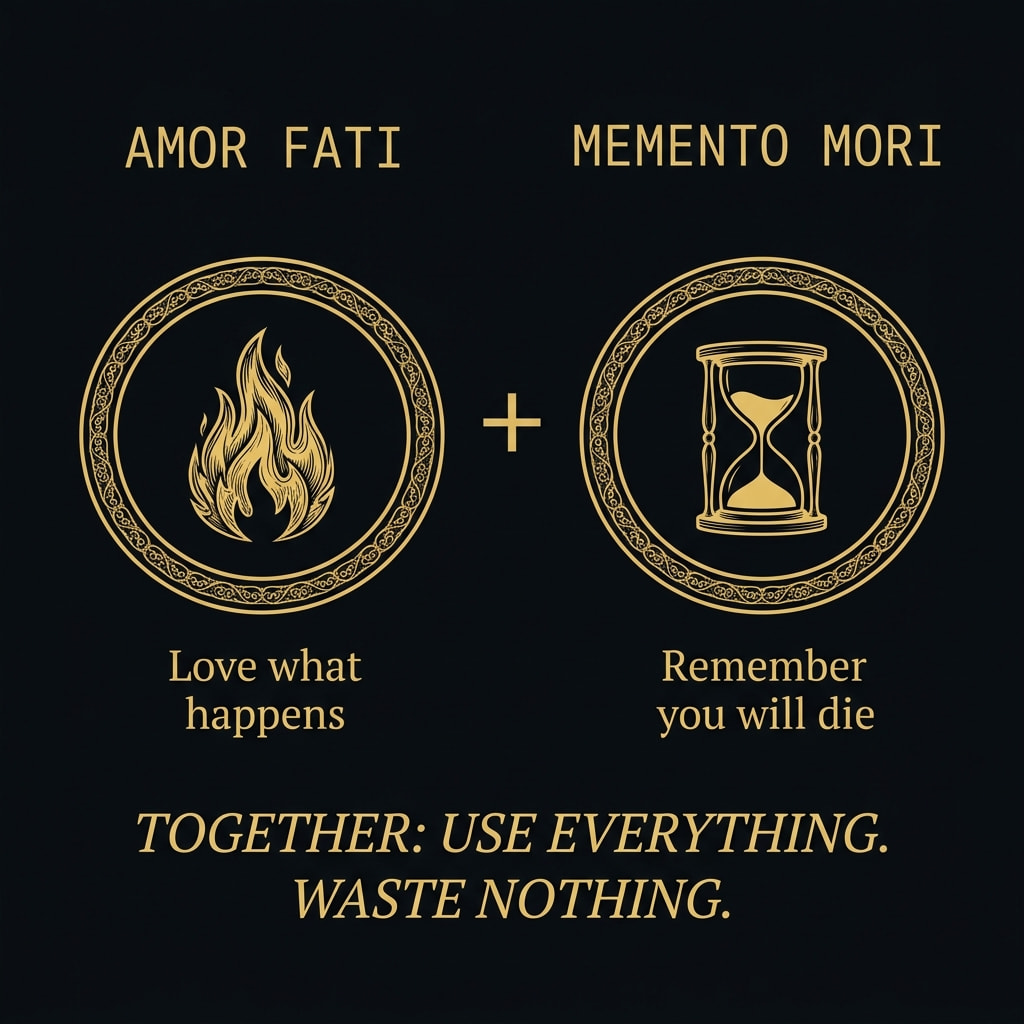
Memento mori says: your time is limited, so don’t waste it. Amor fati says: whatever fills that time — good or bad — use it all.
Together, they create a complete philosophy of action. Memento mori gives you urgency. Amor fati gives you resilience. One without the other is incomplete: urgency without resilience leads to panic. Resilience without urgency leads to complacency.
A Memento Mori calendar shows you how many weeks you have left. Amor fati determines what you do with those weeks when they don’t go as planned — which is most of them.
What Amor Fati Is Not
It’s not passivity. Amor fati doesn’t mean lie down and accept abuse, injustice, or situations you can change. The Stoics were not doormats — Marcus Aurelius fought wars, Seneca navigated politics, Epictetus ran a school. Amor fati applies to what has already happened or what you truly cannot change. For everything else, you act.
It’s not toxic positivity. You don’t have to smile when something terrible happens. You don’t have to pretend you’re grateful for a loss. Amor fati is not about how you feel in the moment — it’s about what you do after the feeling passes. You’re allowed to grieve, be angry, or feel shocked. The question is: after that, do you stay stuck or do you move?
It’s not fatalism. Fatalism says: nothing I do matters, so why try? Amor fati says the opposite: everything I do matters, especially how I respond to what I can’t control. The Stoics believed in vigorous action within your sphere of control. They just didn’t waste energy on the rest.
It’s not religious. You don’t need to believe in God, fate, or cosmic order to practice amor fati. You just need to accept that some things are outside your control and that resisting them is counterproductive. That’s a practical observation, not a metaphysical claim.
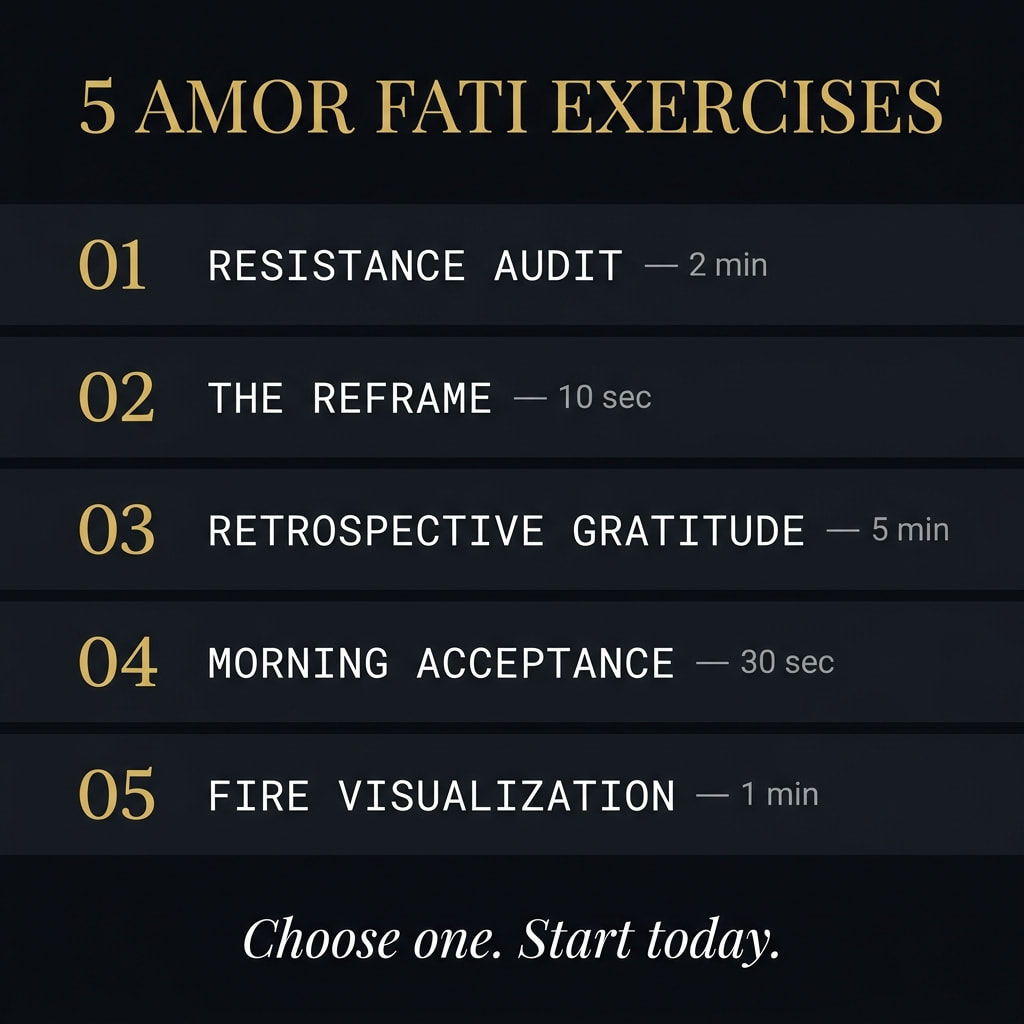
5 Ways to Practice Amor Fati Daily
At the end of each day, ask: “What happened today that I resisted? What did I wish was different?” Name one thing. Then ask: “What would it look like to stop fighting the fact that this happened — and start using it instead?”
This is the simplest entry point. You’re not changing anything yet. You’re just noticing where your energy goes when things don’t match your expectations.
When something goes wrong, pause before reacting. Ask one question: “What can I do with this?” Not “why did this happen to me?” — that’s a victim question. “What can I do with this?” is a builder question. It shifts your brain from resistance mode to action mode.
Marcus Aurelius: “The impediment to action advances action. What stands in the way becomes the way.”
Think of a past hardship — something you hated when it happened. Ask: did anything good come from it? A lesson, a redirect, a strength you didn’t have before? Almost always, the answer is yes. This trains your brain to trust the process in real time, not just in retrospect.
As part of your Stoic morning routine, add one line: “Today, things will happen that I didn’t plan. I will use them.” That’s it. You’re pre-committing to amor fati before the day tests you.
When you’re struggling with a setback, imagine Marcus Aurelius’ blazing fire. See the setback being thrown into the flame. Watch it burn and become fuel — more heat, more light, more power. The fire doesn’t reject what’s thrown in. It transforms it.
This isn’t magic. It’s a mental model that interrupts the default pattern (resist → ruminate → suffer) and replaces it with a productive one (accept → use → grow).
Real Examples
Viktor Frankl survived Auschwitz and wrote Man’s Search for Meaning. His central insight: “You cannot control what happens to you in life, but you can always control what you will feel and do about what happens to you.” He didn’t use the phrase “amor fati,” but he lived it — using the worst possible circumstances as material for understanding human psychology.
Steve Jobs was fired from Apple — the company he built. He later said: “I didn’t see it then, but it turned out that getting fired was the best thing that could have ever happened to me. The heaviness of being successful was replaced by the lightness of being a beginner again.” He went on to found Pixar and return to Apple to build it into the most valuable company in the world.
Epictetus himself — born a slave, crippled (his master broke his leg), eventually freed, exiled from Rome, and started a philosophy school in Greece. He took every setback and turned it into teaching material. His students included some of the most powerful men in the Roman Empire. His disability, his slavery, his exile — all became fuel.
These aren’t people who passively accepted their fate. They actively used it. That’s the difference between fatalism and amor fati.
The Connection to Everything Else
Amor fati doesn’t exist in isolation. It connects to every other Stoic practice:
- Dichotomy of control → tells you what to accept (what’s outside your control)
- Amor fati → tells you how to accept it (with love, not resentment)
- Memento mori → tells you why to act now (because time is finite)
- Daily challenges → give you practice at embracing discomfort
- Evening reflection → helps you notice where you resisted today
If you’re building a daily Stoic practice, amor fati is the glue that holds everything together. Without it, the other exercises become mechanical. With it, they have emotional depth.
StoicNow integrates amor fati into its daily practice: the morning quote often touches on acceptance and fate, the daily challenge pushes you outside your comfort zone (a small form of embracing what you’d normally resist), and the AI Stoic Mentor can help you reframe specific situations through a Stoic lens.
Your Stoic mentor in your pocket
Try StoicNow — Free on iOS
FAQ
What does amor fati mean?
Amor fati is a Latin phrase meaning “love of fate.” It describes the practice of accepting and embracing everything that happens — including hardship, setbacks, and loss — rather than resisting or resenting it. The concept originates from Stoic philosophy and was popularized by Friedrich Nietzsche in the 19th century.
Is amor fati the same as “everything happens for a reason”?
Not exactly. “Everything happens for a reason” implies a cosmic purpose behind events. The Stoics believed in a rational cosmic order, so they’d partially agree. But amor fati works even without that belief — you don’t need to think events have a purpose to decide you’ll use them. The practice is about your response, not the universe’s intentions.
How is amor fati different from giving up?
Amor fati applies to things you cannot change — events that have already happened or outcomes outside your control. For things you can change, the Stoics advocated vigorous action. Marcus Aurelius fought wars. Seneca navigated politics. Amor fati is not “don’t try.” It’s “don’t waste energy fighting what’s already real.”
What is the difference between amor fati and memento mori?
Amor fati (“love your fate”) is about accepting what happens. Memento mori (“remember you will die”) is about remembering your time is limited. They complement each other: memento mori creates urgency to act; amor fati creates resilience when things don’t go as planned. Together, they form a complete approach to Stoic daily life.
Can I practice amor fati if I’m going through something really bad?
Yes, but timing matters. In the immediate aftermath of loss or crisis, focus on feeling what you feel — grief, anger, shock are natural. Amor fati enters once the initial wave passes. It’s not “be happy about tragedy.” It’s “once the tragedy is real, what will I do with it?” Even Viktor Frankl, who developed this insight in a concentration camp, acknowledged that suffering must first be experienced before it can be transformed.

Marcus Adler
Founder & Lead Writer, StoicNow
Marcus Adler is the founder of StoicNow. For over a decade he has applied Stoic philosophy to daily life — testing the practices of Marcus Aurelius, Seneca, and Epictetus against modern problems and translating them into simple, repeatable routines. More about the author →
Further reading
- Amor fati (Wikipedia) Wikipedia