Quick answer
No. The Stoics made a clear distinction between 'first movements' (involuntary emotional reactions, including tears and pain at loss) and 'passions' (sustained states driven by false judgments). First movements are natural, unavoidable, and not condemned. The Stoic aim is not to eliminate grief, but to prevent it from becoming a permanent, destructive state that stops you from living.
Marcus Aurelius had thirteen children. He buried most of them. He continued to govern an empire, write his Meditations, and be, by nearly all accounts, a decent and principled human being — while carrying a weight of personal loss that most of us can barely imagine.
Seneca lost a child. He watched friends exiled and killed. He spent eight years in exile himself. And at the end, when Nero ordered him to die, he reportedly turned to his weeping friends and asked why they were surprised — had he not been rehearsing for this his whole life?
These men knew grief from the inside. When they wrote about it, they were not dispensing theory from a safe distance. They were describing what they had actually done with the weight — and what they had seen other people do, for better and for worse.
This article is not going to tell you to stop feeling. No serious reading of Stoicism says that. What the Stoics actually offer is something different: a set of approaches for carrying grief without being destroyed by it — and for honoring the person you lost by continuing to live well, not by stopping.
What the Stoics Did Not Say
Before anything else: the Stoics did not say “don’t grieve.” That is the single most common misreading of Stoic philosophy, and it is wrong.
The Stoics distinguished between two things that often get confused. First movements — the involuntary surge of pain, the tears, the catch in the chest when something reminds you of the person who is gone — are natural, unavoidable, and not criticized by any Stoic text. Seneca wept. Marcus clearly struggled. Epictetus, in Discourses 3.24, explicitly says that sorrow at the death of a loved one is a human response, not a failure of philosophy.
What they warned against is something different: the transformation of acute grief into a permanent identity, the refusal to rejoin life, the conviction that because someone you loved has died, nothing good can be permitted again. That state — which they called a passion in the technical Stoic sense — is driven not by the loss itself, but by a set of beliefs about the loss. And beliefs can be examined.
“Let your tears flow, but let them also stop. Let sighs come from your inmost heart, but let them also have an end.” — Seneca, Consolation to Marcia
That is the Stoic position on grief, stated plainly: feel it fully, then return to living. Not because the person didn’t matter, but because they did — and the living owe the dead something better than self-destruction.
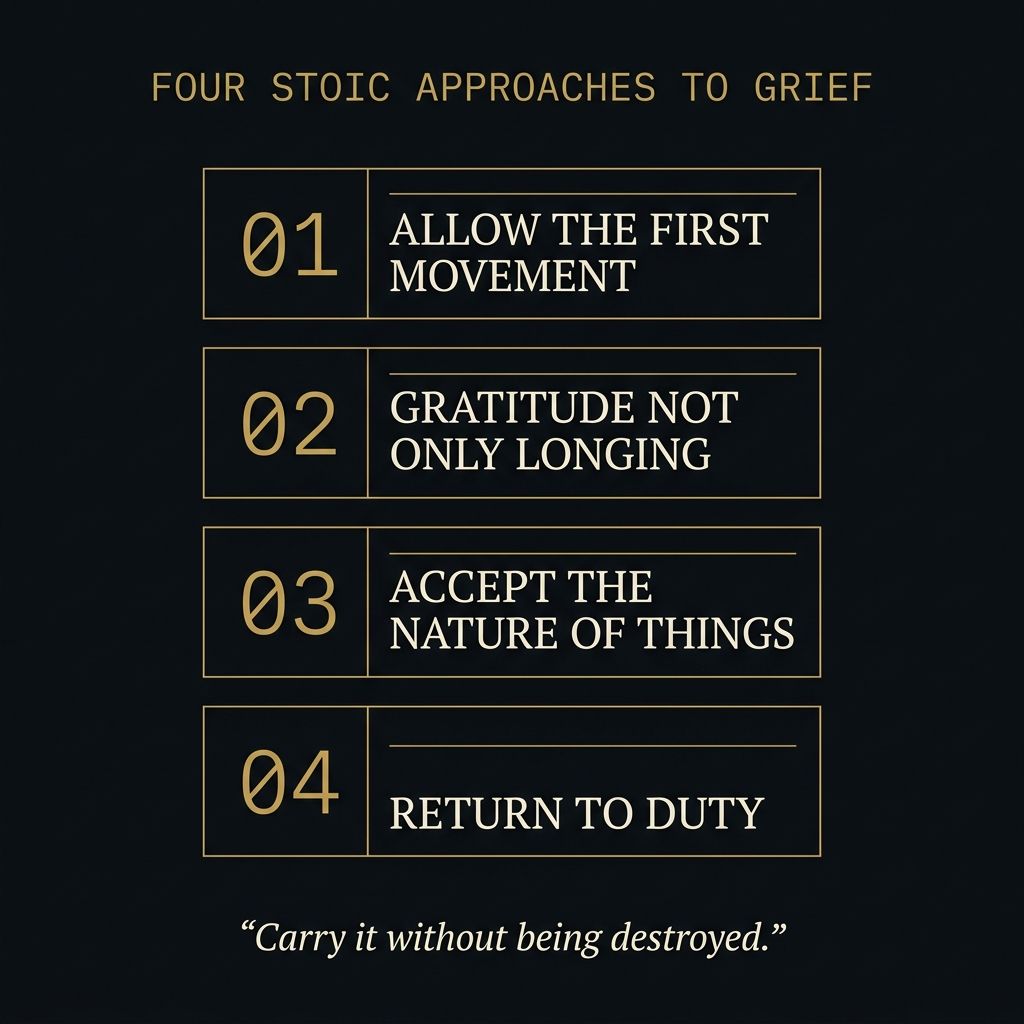
Four Stoic Approaches to Grief
These are not steps or stages. They are four things the Stoics returned to when grief was present — lenses to carry, each one addressing a different part of the experience.
Approach 01
Allow the First Movement
The involuntary pain is not the enemy. Trying to stop it makes it worse. What helps is letting it arrive, fully, without resistance — and then, when it has passed, not chasing it back to make it stay. Grief comes in waves. The Stoic discipline is to ride the wave without clinging to it when it recedes.
Seneca told Lucilius: if a friend dies, let your grief be “neither too great nor too small.” He was not prescribing a dosage — he was warning against the two common errors: denying the grief, or building a monument to it.
Approach 02
Reframe: Gratitude, Not Only Longing
Seneca’s single most powerful move in the Consolation to Marcia is a reframe. He asks Marcia: would you rather have never had your son at all? The answer is no — and in that answer, the shape of the loss changes. It is no longer something was taken from me; it is something was given to me, and I had it for a time.
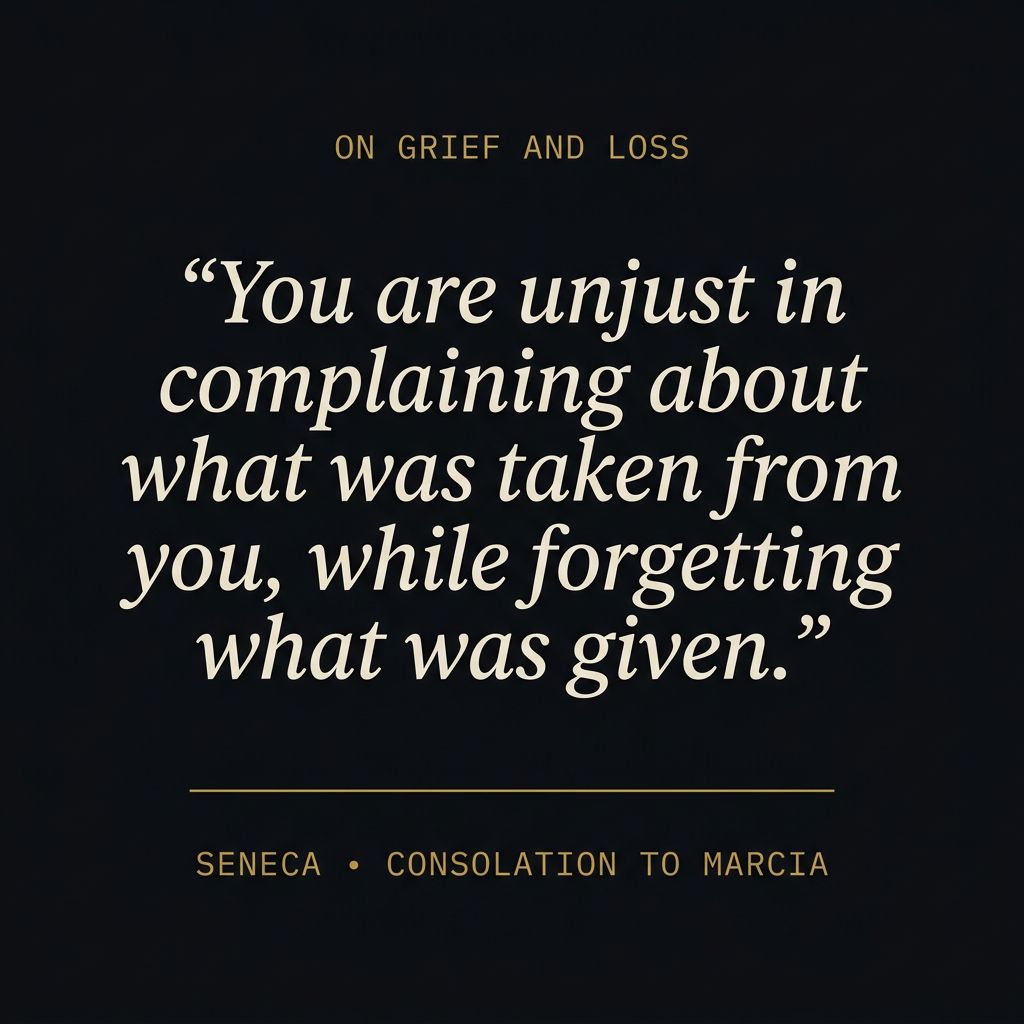
“You are unjust in complaining about what was taken from you, while forgetting what was given.” — Seneca, Consolation to Marcia
The reframe does not make the pain smaller. It makes it more accurate. You lost someone because you had them. The greater the love, the greater the grief — and the Stoics refused to wish the love away just to avoid the grief.
Approach 03
Accept the Nature of Things
The Stoic argument is not “death is fine.” It is “death is the condition under which everything we love exists.” Mortality is not a bug in the universe — it is the price of entry. The specific loss feels like a violation because we expected permanence; the Stoics say the violation was the expectation, not the loss.
“When you kiss your child, say to yourself: perhaps tomorrow you will die.” — Epictetus, Discourses 3.24
That line looks cold out of context. In context, it is an instruction to see the child while you can — to love with awareness rather than the unconscious assumption that this will last forever. The premeditation does not remove the grief when the loss comes; it removes the additional shock of believing it was impossible. For the full practice, see our guide on negative visualization.
Approach 04
Return to Duty — Because the Living Need You
Marcus Aurelius lost children, a co-emperor, friends, generals — and governed through every one of those losses. Not because he didn’t feel them, but because the empire still needed governing, his soldiers still needed leading, and the people who remained still needed him present. His philosophy was: grief has a right to visit, but duty has a right to call you back.
This is the Stoic version of what modern grief counselors call “re-engagement with life.” It is not callousness — it is the decision that honoring the dead means living well, not stopping. If the person you lost could see you, they would not want you to follow them into the dark. They would want you to get up.
Seneca’s Consolation to Marcia
If you are grieving and want to read one Stoic text, read this one. Seneca wrote it to Marcia, a Roman noblewoman whose son Metilius had died — but he waited three years before writing. He said explicitly that grief too fresh will not hear philosophy. The timing is itself a lesson: do not rush to reframe. Let the acute pain be what it is. The Stoic approach enters later, when the mind can hear it.
The letter is roughly twenty-five chapters. Its core arguments:
- Your son lived. The time you had with him was real and valuable, not erased by its ending.
- You were given time with him — not guaranteed it. Nature lent him to you; nature recalled the loan.
- Grief is honorable; endless grief is not. At some point, sustaining the pain becomes its own project — and that project dishonors what was given.
- Other people need you now. Your grief is valid, but so is the world that remains.
It is the most compassionate thing Seneca ever wrote — and the most useful. The Penguin or Oxford edition includes it with his other moral essays.
When Stoicism Is Not Enough
This is important. Stoic philosophy is a complement to grief support, not a replacement for it. If your grief is traumatic, sudden, complicated, or has lasted long enough that it is interfering with your ability to function day-to-day, please talk to a professional — a therapist, a grief counselor, a doctor. Seneca himself waited three years before writing to Marcia because he knew philosophy can’t speak to someone still inside the acute blast. There is no Stoic virtue in suffering alone when help exists.
What Stoicism can do well, for most people, is provide a framework for the long middle — the months and years after the acute phase, when the loss is real and permanent but the question shifts from how do I survive this to how do I carry this and still live well. That question is where the four approaches above earn their keep.
The Stoics did not promise that philosophy would make grief painless. They promised that it could make grief bearable — and that bearing it, without being consumed, is one of the most difficult and worthwhile things a person can do.
“Think of yourself as dead. You have lived your life. Now take what’s left and live it properly.” — Marcus Aurelius, Meditations 7.56
For the broader Stoic relationship with death — including why they talked about it so constantly and how that habit produces gratitude rather than despair — see 20 Stoic quotes about death and what is memento mori.
Carry the philosophy with you
Join the WaitlistFAQ
Does Stoicism say you shouldn’t grieve?
No. The Stoics made a clear distinction between “first movements” (involuntary emotional reactions, including tears and pain at loss) and “passions” (sustained states driven by false judgments). First movements are natural, unavoidable, and not condemned. The Stoic aim is not to eliminate grief, but to prevent it from becoming a permanent, destructive state that stops you from living.
What did Marcus Aurelius say about grief?
Marcus lost at least eight of his thirteen children. He wrote in Meditations 9.3 that grief must be handled “without drama, without pretense” and that the dead would not want the living to be consumed by it. He did not prescribe numbness — he practiced continuing to function, to govern, and to care, while carrying the weight.
What is Seneca’s Consolation to Marcia about?
Seneca wrote it to Marcia, a Roman noblewoman whose son Metilius had died. He waited three years before writing — he said grief too fresh will not hear philosophy. The argument: your son lived a full life; you were given time with him, not ownership of him; grief that lasts forever dishonors what was given. It is the most tender thing Seneca wrote.
How did the Stoics actually deal with loss?
Four approaches: allow the first movement (cry, feel pain — it is human); recall the person with gratitude rather than only with longing; accept the nature of mortality and impermanence as the condition of life, not a violation of it; and return to your duties when the acute phase passes, because the living still need you.
Is Stoicism helpful during bereavement?
For many people, yes — particularly after the acute phase. Stoic frameworks help reframe the loss from “this was taken from me” to “this was given to me for a time.” But Stoicism is not a substitute for professional grief support, especially in cases of traumatic, sudden, or complicated grief. Use both.
What should I read if I’m grieving and interested in Stoicism?
Start with Seneca’s Consolation to Marcia — it is written directly to a grieving person and strikes the right balance between honesty and compassion. Then read Meditations 7.56 and 9.3. Donald Robertson’s How to Think Like a Roman Emperor has a chapter specifically on Stoic grief. Avoid jumping into philosophy too soon after a loss — Seneca himself said fresh grief does not listen.

Marcus Adler
Founder & Lead Writer, StoicNow
Marcus Adler is the founder of StoicNow. For over a decade he has applied Stoic philosophy to daily life — testing the practices of Marcus Aurelius, Seneca, and Epictetus against modern problems and translating them into simple, repeatable routines. More about the author →