Quick answer
Not to be morbid — to be free. The Stoics held that the fear of death distorts every other decision: we defer real living, chase the wrong things, and avoid risk out of an unexamined dread.
The Stoics talked about death constantly — not because they were morbid, but because they had noticed something most people spend a lifetime avoiding: the fear of death quietly runs almost every bad decision we make.
Defer the real life until retirement. Chase status you won’t care about on your deathbed. Avoid the risk, skip the conversation, postpone the apology. Underneath a surprising amount of human behavior sits one unexamined dread — and the Stoics’ bet was that facing it directly, on purpose, regularly, would set you free rather than crush you.
So these quotes aren’t grim. Read in context, they’re some of the most life-affirming lines in philosophy. Here are twenty, from Marcus Aurelius, Seneca, and Epictetus, grouped into five themes — followed by why the Stoics dwelt on death in the first place.
Jump to a theme
- Death Is Natural, Not Terrible — 4 quotes
- Death Gives Life Urgency — 4 quotes
- Why Fear What You Won’t Experience — 4 quotes
- Death the Equalizer — 4 quotes
- How to Die Well — 4 quotes
1. Death Is Natural, Not Terrible
Theme One · 4 Quotes
The Stoic starting point: death is a natural process, no more to be feared than birth or the turning of seasons. What terrifies us, they argued, is not death itself but our opinion about it.
Quote 01
“Death, like birth, is a secret of Nature.”
— Marcus Aurelius, Meditations 4.5
He places death in the same category as birth — a natural transformation, not a catastrophe. Both are processes of nature we did not author and need not dread.
Quote 02
“It is not death that a man should fear, but rather he should fear never beginning to live.”
— Marcus Aurelius (attributed)
The reframe in one line. The real loss isn’t dying — it’s reaching death without having lived. Fear is pointed at the wrong target.
Quote 03
“Men are disturbed not by things, but by their opinions about things. Death is nothing terrible, else it would have appeared so to Socrates. The terror consists in our notion of death, that it is terrible.”
— Epictetus, Enchiridion 5
Epictetus applies his core principle directly to mortality. Death has no built-in horror; the horror is a judgment we add, and judgments can be examined and dropped.
Quote 04
“No evil is honorable; but death is honorable; therefore death is not evil.”
— Zeno of Citium (founder of Stoicism)
The founder’s syllogism. Stripped of emotion, death cannot be classed as an evil — it is a neutral, natural fact, and facing it well can even be honorable.
2. Death Gives Life Urgency
Theme Two · 4 Quotes
This is the engine of memento mori. The certainty of death is not a reason to despair — it is the sharpest possible tool for deciding what deserves your finite, non-refundable time.
Quote 05
“You could leave life right now. Let that determine what you do and say and think.”
— Marcus Aurelius, Meditations 2.11
The single most useful death quote in Stoicism. It converts an abstract fact into an immediate filter. Read it before any decision you’ve been overthinking.
Quote 06
“Let us prepare our minds as if we’d come to the very end of life. Let us postpone nothing. Let us balance life’s books each day.”
— Seneca, Letters 101
Postponement is the disease; death-awareness is the cure. Seneca’s “balance the books each day” is the ancestor of the evening reflection.
Quote 07
“Begin at once to live, and count each separate day as a separate life.”
— Seneca, Letters 101
If each day is a whole life in miniature, you cannot afford to sleepwalk through it waiting for the real one to begin. The real one is today.
Quote 08
“You act like mortals in all that you fear, and like immortals in all that you desire.”
— Seneca, On the Shortness of Life 3
The contradiction we live inside. We dread death constantly yet plan as if time were infinite — deferring, accumulating, waiting. Seneca catches us in the act.
3. Why Fear What You Won’t Experience
Theme Three · 4 Quotes
The Stoics dismantled the fear logically as well as practically. Much of the dread, they showed, dissolves under simple examination — we fear a thing we will never actually be present to suffer.
Quote 09
“It is uncertain where death awaits you; therefore expect it everywhere.”
— Seneca, Letters 26
Not a threat — a release. If death can come at any time, then waiting for a “safe” time to live is incoherent. Expect it everywhere, and live everywhere.
Quote 10
“We are dying every day, for every day takes away a part of our life; even when we are growing, our life is shrinking.”
— Seneca, Letters 24
Death isn’t a single future event — it’s happening now, in installments. Once you see that, the line between living and dying stops being a wall and becomes a slope you’re already on.
Quote 11
“The day which we fear as our last is but the birthday of eternity.”
— Seneca, Letters 102
A rare lyrical turn from Seneca. Whatever your metaphysics, the reframe stands: the feared endpoint can be seen as a threshold rather than a wall.
Quote 12
“He who fears death will never do anything worthy of a living man.”
— Seneca, Letters
The cost of the fear, named plainly. Courage, honesty, love, risk — all of it requires being willing to lose the thing you’re clutching. Fear of death shrinks the life it’s trying to protect.
4. Death the Equalizer
Theme Four · 4 Quotes
A recurring Stoic move: zoom out far enough and death levels everything — rank, wealth, fame, the things we spend our lives competing over. The view from above makes the small stuff small again.
Quote 13
“Alexander the Great and his mule driver both died, and the same thing happened to both.”
— Marcus Aurelius, Meditations 6.24
An emperor reminding himself that conquest buys no exemption. The great and the obscure arrive at the identical destination. Status is a costume you take off at the end.
Quote 14
“Think of yourself as dead. You have lived your life. Now take what’s left and live it properly.”
— Marcus Aurelius, Meditations 7.56
A radical thought experiment: treat the past as already finished and everything from here as a bonus. What would you stop tolerating? What would you finally do?
Quote 15
“All things fade and quickly turn to myth… what once seemed so important is now forgotten. Such is the nature of all that the world esteems.”
— Marcus Aurelius, Meditations 4.33 (condensed)
Even the famous are forgotten. Once you absorb that, the hunger for recognition loosens its grip — freeing you to act for better reasons than being remembered.
Quote 16
“Death is a release from the impressions of sense, and from desires that make us their puppets, and from the vagaries of the mind, and from the hard service of the flesh.”
— Marcus Aurelius, Meditations 6.28
A startling angle: death framed not as loss but as release. Whatever you make of it metaphysically, it dissolves the idea that death is purely a thing done to you.
5. How to Die Well
Theme Five · 4 Quotes
For the Stoics, dying well wasn’t a separate skill from living well — it was the same skill, tested at the end. The way you meet death is the final exam on the life you built.
Quote 17
“It is not that we have a short time to live, but that we waste much of it.”
— Seneca, On the Shortness of Life
The most famous Stoic line on time. Death isn’t the thief — waste is. Life is long enough, if you stop spending it on what doesn’t matter.
Quote 18
“It is not the man who has too little, but the man who craves more, that is poor… Life is long if you know how to use it.”
— Seneca, On the Shortness of Life
Length of life isn’t the variable that matters — depth of use is. A short life lived fully beats a long one sleepwalked.
Quote 19
“A man who does not know how to die well will live badly.”
— Seneca, Letters 61 (paraphrase)
The two skills are one. If you haven’t made peace with the ending, the fear leaks backward into every day before it. Learn to die, and you’re free to live.
Quote 20
“Let us strive to make our lives, like a finished tale, complete — it matters not how long, but how good.”
— Seneca, Letters 77 (paraphrase)
The closing image: a life is a story, judged by quality, not page count. A complete short tale beats a sprawling, half-finished one. Make yours good, however long it runs.
Why the Stoics Talked About Death So Much
If you only skim the quotes, the Stoics can look obsessed with mortality to the point of gloom. They weren’t. The constant return to death served three specific, practical purposes — and none of them is despair.
1. To remove its power. A fear you never look at runs your life from the shadows. By turning toward death deliberately and often, the Stoics aimed to defuse it — the same logic as modern exposure therapy. What you face repeatedly, in small controlled doses, loses its grip.
2. To create urgency. Nothing clarifies priorities like a deadline, and death is the only one that’s certain. “You could leave life right now” is not a threat — it’s a filter. It makes the trivial obviously trivial and the important suddenly unmissable.
3. To produce gratitude. The awareness that this could be the last time — the last spring, the last conversation, the last ordinary Tuesday — is the fastest known route to actually seeing what you have. This is the bridge between Stoic death-contemplation and the practice of negative visualization.
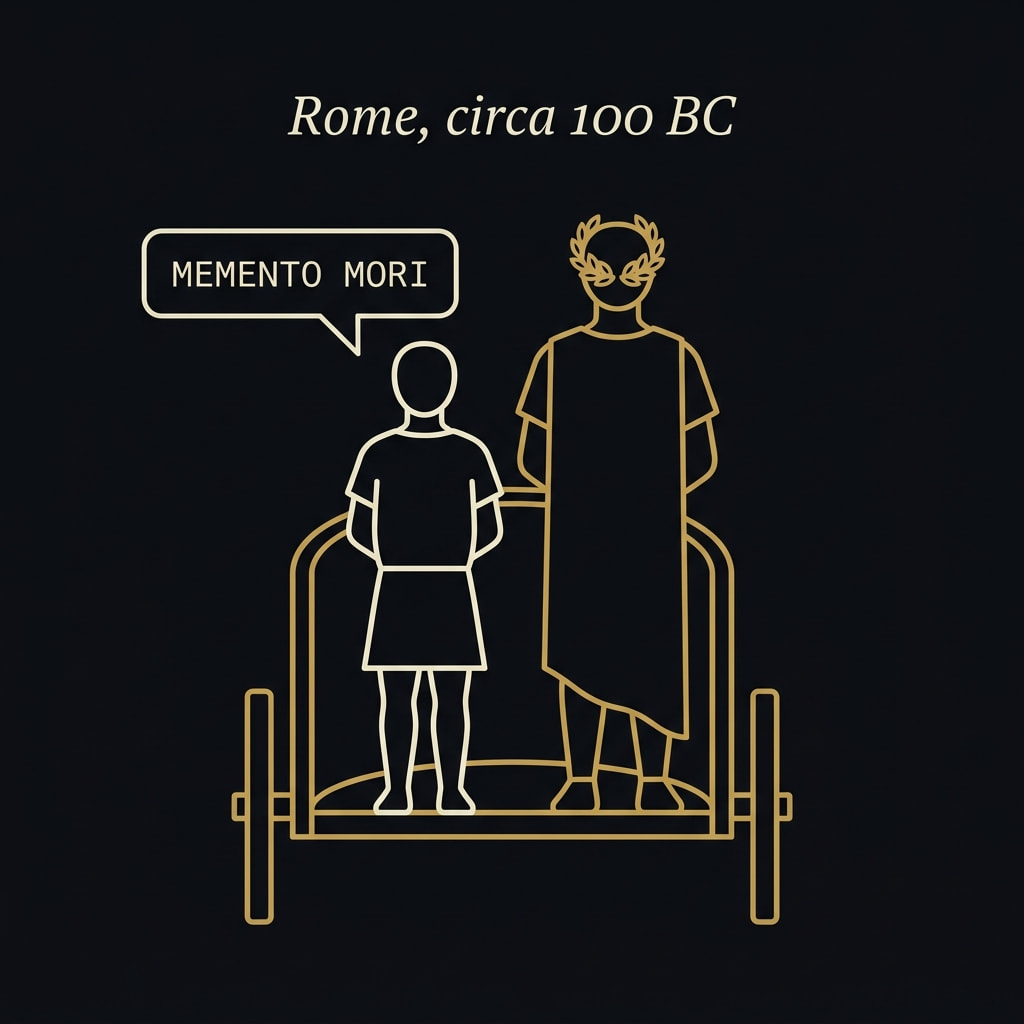
The whole apparatus has a name: memento mori — remember that you must die. It is not a death wish. It is a life tool. For the full practice, including the life-in-weeks visualization, see what is memento mori and our memento mori calendar.
Modern psychology has caught up: studies on structured mortality awareness consistently find it increases meaning, gratitude, and prosocial behavior — provided it’s reflective rather than panicked. The Stoics arrived at the same finding nineteen centuries early, and built a daily practice around it.
Practice memento mori in StoicNow
Join the WaitlistFree Tool
Your Life in Weeks
See exactly how many weeks you have left — a Memento Mori calculator.
FAQ
Why did the Stoics talk about death so much?
Not to be morbid — to be free. The Stoics held that the fear of death distorts every other decision: we defer real living, chase the wrong things, and avoid risk out of an unexamined dread. By contemplating death directly and regularly (memento mori), they aimed to remove its power and use the awareness of mortality as a tool for living more fully and urgently now.
What did Marcus Aurelius say about death?
Marcus treated death as natural and impersonal — “a secret of Nature” (Meditations 4.5), no more to be feared than birth. His most quoted line is from Meditations 2.11: “You could leave life right now. Let that determine what you do and say and think.” He used the certainty of death as a daily filter for what actually matters.
What did Seneca say about death?
Seneca wrote about death more than any other Stoic. His central claim, from On the Shortness of Life, is that life is not too short — we waste it. In Letters 101 he urges: “Begin at once to live, and count each separate day as a separate life.” He saw rehearsing death as the path to living without anxiety.
Is the Stoic view of death depressing?
The opposite. The Stoics found that facing death squarely produces gratitude, urgency, and calm — not despair. The depressing thing, in their view, is an unlived life spent avoiding the topic. Modern psychology agrees: structured mortality awareness tends to increase meaning and prosocial behavior, not anxiety.
What is memento mori?
Memento mori is Latin for “remember that you must die.” It is the Stoic (and broader classical) practice of deliberately keeping mortality in view — through reflection, objects, or images — so that the awareness sharpens how you live. It is the practical engine behind most Stoic quotes about death.
Which Stoic death quote is the most useful?
Marcus Aurelius, Meditations 2.11: “You could leave life right now. Let that determine what you do and say and think.” It converts an abstract fact into an immediate filter for the next decision you make. Read it before any choice you’ve been overthinking.

Marcus Adler
Founder & Lead Writer, StoicNow
Marcus Adler is the founder of StoicNow. For over a decade he has applied Stoic philosophy to daily life — testing the practices of Marcus Aurelius, Seneca, and Epictetus against modern problems and translating them into simple, repeatable routines. More about the author →