Quick answer
Yes. The core Stoic techniques are structurally identical to Cognitive Behavioral Therapy (CBT), the most evidence-based treatment for anxiety disorders. Aaron Beck and Albert Ellis both cited Stoic philosophy as a primary influence on modern cognitive therapy.
Marcus Aurelius governed the Roman Empire through a plague that killed roughly 5 million people. Seneca lived under Nero — a ruler who could (and eventually did) order his death on a whim. Epictetus spent his youth as a slave whose master once broke his leg.
All three men dealt with uncertainty, danger, and conditions that would put modern anxiety to shame. And all three wrote extensively about how to handle it. Not with medication or therapy sessions — those didn’t exist yet — but with a set of mental exercises that psychologists would rediscover 1,800 years later and call Cognitive Behavioral Therapy.
This isn’t a coincidence. CBT was directly inspired by Stoic philosophy. Aaron Beck, the founder of cognitive therapy, cited Epictetus. Albert Ellis, who created Rational Emotive Behavior Therapy (REBT), explicitly credited the Stoics as his primary influence.
The techniques in this article aren’t self-help platitudes. They’re the same principles that modern therapy is built on — stated more clearly and practiced more rigorously by people who faced worse circumstances than most of us ever will.
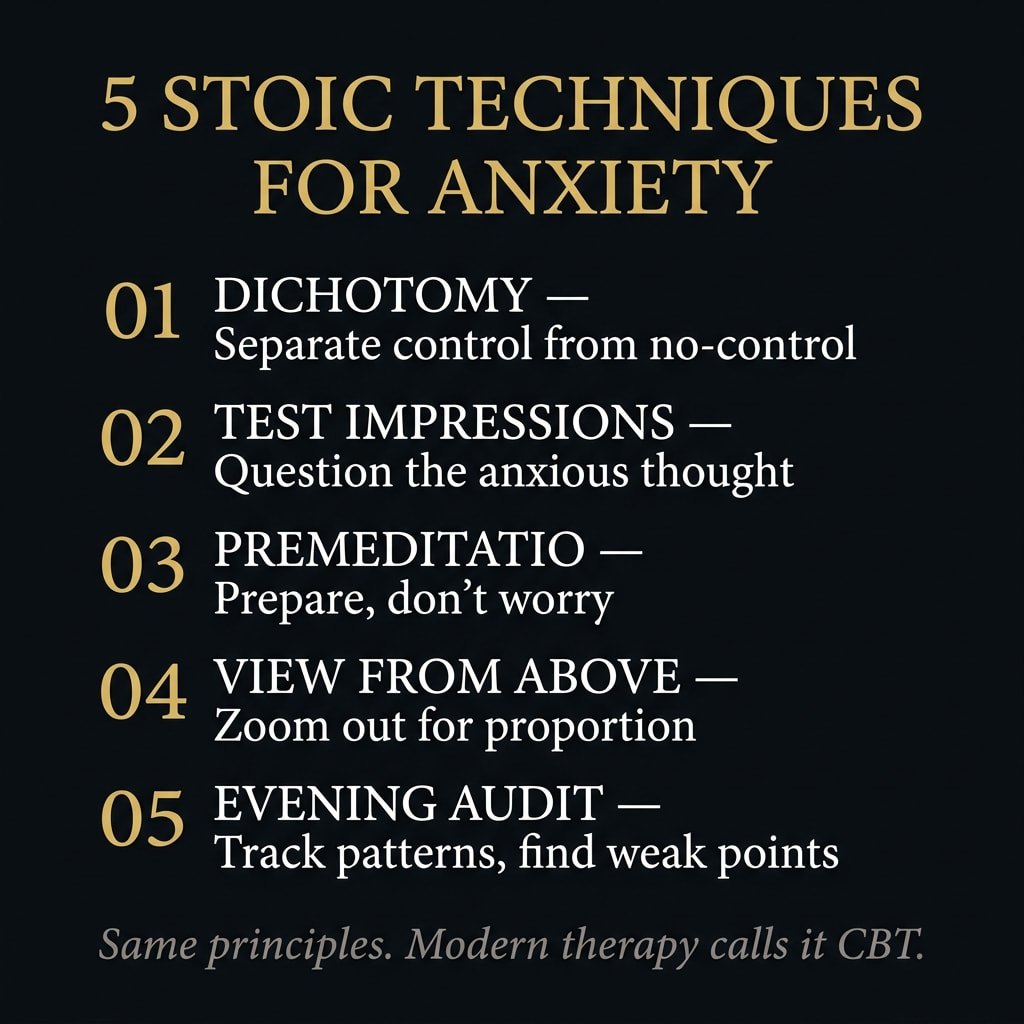
Here are five Stoic techniques for anxiety that you can use today.
Why the Stoics Were Obsessed With Anxiety
The Stoics had a specific diagnosis for anxiety. They saw it as a passion — not in the romantic sense, but in the original Greek meaning: pathos, a state of suffering caused by false beliefs about what matters.
Their argument went like this: anxiety comes from wanting to control things you can’t control. The job interview result. Other people’s opinions. The future. Your body’s health. None of these are fully in your power. When you attach your wellbeing to outcomes you can’t guarantee, you create a permanent state of tension — because the outcome could always go wrong.
“When I see an anxious person, I ask myself, what do they want? For if a person wasn’t wanting something outside of their own control, why would they be stricken by anxiety?” — Epictetus
This isn’t victim-blaming. The Stoics weren’t saying anxiety is your fault. They were saying that anxiety has a structure — a pattern of thought that can be identified and changed. And that’s exactly what CBT does: identify the distorted belief, test it against reality, and replace it with something more accurate.
The difference between the Stoics and modern therapy is that the Stoics turned this into a daily practice, not an occasional intervention. They didn’t wait for a crisis. They trained every morning.
Technique 1: The Dichotomy of Control
Technique 01
The Dichotomy of Control
How it works for anxiety:
Most anxiety is generated by trying to control outcomes that aren’t yours to determine. You rehearse conversations hoping the other person will respond a certain way. You worry about health results before they arrive. You stress about whether people like you.
The Stoic fix: when you notice anxiety rising, ask two questions.
- “What part of this situation is within my control?” (Usually: your preparation, your effort, your response.)
- “What part is outside my control?” (Usually: the outcome, other people’s reactions, timing.)
Then make a deliberate choice: put your energy into column one and let go of column two. Not “pretend column two doesn’t exist” — but accept that worrying about it can’t change it.
This single exercise accounts for roughly half of what happens in a CBT session. The therapist helps you identify which of your worries are about controllable vs. uncontrollable things. The Stoics just skipped the therapist and did it themselves, every morning.
For a deeper dive into this practice, see our guide on how to practice Stoicism every day.
Technique 2: Testing Your Impressions
Technique 02
Testing Your Impressions
How it works for anxiety:
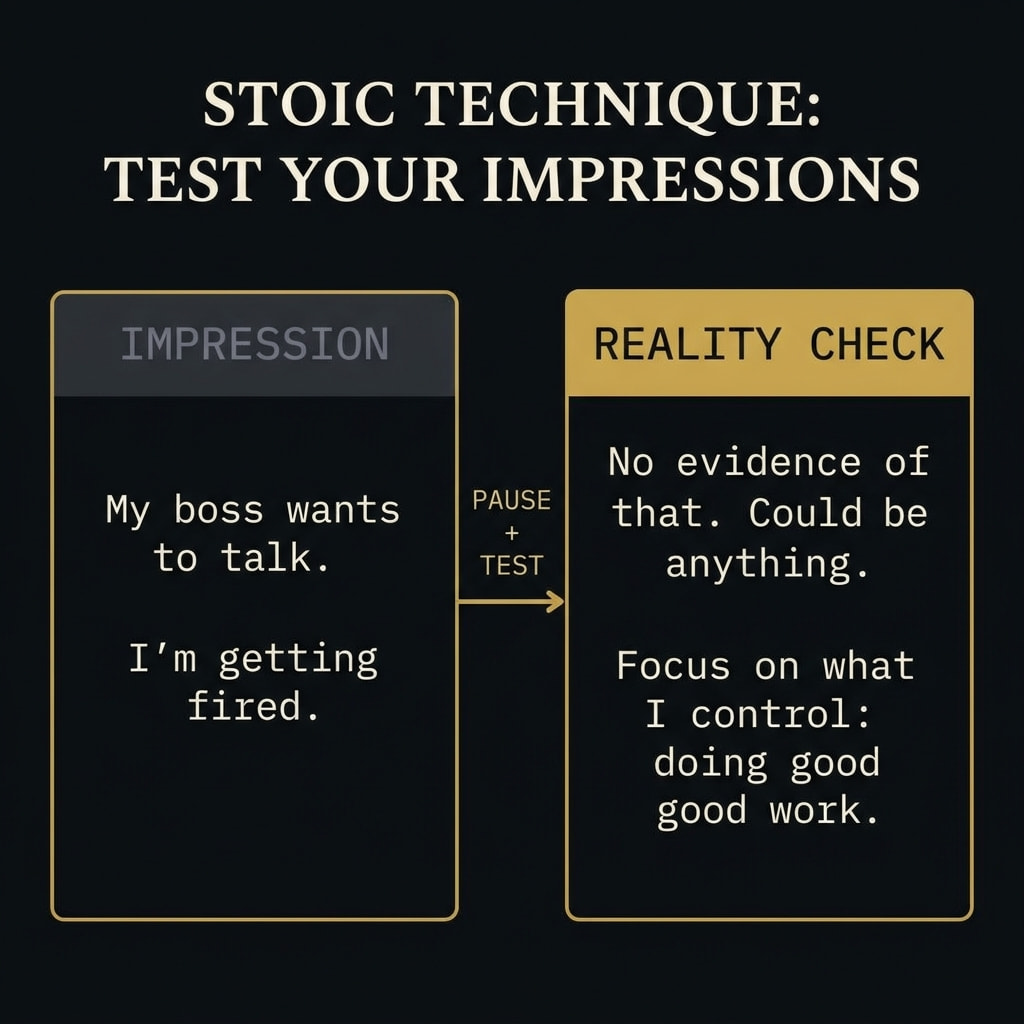
When something triggers anxiety — a message from your boss, a weird symptom, a social interaction that felt awkward — your mind instantly generates a story. “I’m going to get fired.” “Something is seriously wrong.” “Everyone thinks I’m weird.”
The Stoics called these phantasiai — impressions. They’re automatic. You can’t stop them from appearing. But you can stop yourself from agreeing with them.
Impression
“My boss wants to talk. I’m getting fired.”
Reality Check
“No evidence of that. Could be anything. Focus on what I control: doing good work.”
The practice: when an anxious thought appears, pause and ask:
- “Is this actually true, or am I assuming?”
- “What evidence do I have?”
- “What’s the most likely explanation (not the worst-case one)?”
This is almost word-for-word the CBT technique of “cognitive restructuring” — identifying automatic negative thoughts and testing them against evidence. Beck developed it in the 1960s. Epictetus was teaching it in 100 AD.
Technique 3: Premeditatio Malorum
Technique 03
Premeditatio Malorum (Premeditation of Adversity)
How it works for anxiety:
This one sounds counterintuitive. If you’re already anxious about the future, why would you deliberately imagine bad outcomes?
Because there’s a difference between worrying and preparing. Worry is uncontrolled, repetitive, and produces no plan. Premeditatio is deliberate, bounded (you do it for 2–3 minutes, then stop), and always ends with: “And if this happens, here’s what I’ll do.”
The exercise:
- Name the thing you’re worried about.
- Imagine the worst realistic outcome (not cartoonish — realistic).
- Ask: “If this actually happened, what would I do? How would I cope?”
- Notice: you can cope. The scenario is survivable.
This is structurally identical to “exposure therapy” in modern psychology — gradually facing feared scenarios to reduce their emotional charge. The Stoics did it daily, mentally, as a 2-minute morning exercise.
“We suffer more often in imagination than in reality.” — Seneca
Most of what you’re anxious about will never happen. And the things that do happen are usually more manageable than the imagined version.
Technique 4: The View from Above
Technique 04
The View from Above
How it works for anxiety:
Anxiety narrows your focus. It makes the problem feel like it fills the entire frame. The View from Above is a deliberate widening — a mental zoom-out that puts the problem in proportion.
Close your eyes. Imagine floating up from where you’re sitting — above your building, your city, your country, the planet. Look down. See the billions of people going about their days, the centuries that have passed, the millennia ahead.
From up there, ask: does my problem still feel the same size?
This isn’t dismissal. Real suffering is real. But most daily anxiety — the email you’re dreading, the comment someone made, the meeting you’re nervous about — shrinks dramatically when placed against the scale of existence.
Marcus Aurelius did this constantly. It wasn’t escapism. It was calibration — adjusting the emotional weight of something to match its actual importance.
Technique 5: Evening Audit
Technique 05
Evening Audit
How it works for anxiety:
Anxiety often feels like a fog — formless and everywhere. The evening audit turns it into data. Specific data you can work with.
Each evening, spend 3 minutes answering:
- Where did anxiety show up today? (Name the specific moment.)
- What was the thought behind it? (Usually a “what if” or a judgment about something outside your control.)
- Was the thought accurate? (Did the feared thing actually happen? If it did, was it as bad as you imagined?)
- What will I do differently tomorrow? (One specific adjustment.)
Over time, you’ll start noticing patterns: certain triggers, certain thought distortions, certain times of day. This is self-administered CBT — literally the same homework a therapist would assign you.
The compounding effect matters: one evening review changes nothing. Thirty consecutive evening reviews will show you exactly how your anxiety works — its structure, its triggers, its weak points.
The CBT Connection: This Isn’t Ancient History
It’s worth being explicit: the techniques above are not just philosophically interesting. They are clinically validated.
Aaron Beck developed cognitive therapy in the 1960s based on the insight that distorted thoughts cause emotional suffering — not the events themselves. This is Epictetus’ principle from 100 AD, nearly verbatim.
Albert Ellis, creator of REBT, was even more direct. He cited Epictetus and Marcus Aurelius as primary influences and called his approach “essentially Stoic.”
Donald Robertson, a CBT therapist and author of How to Think Like a Roman Emperor, has documented the Stoic-CBT connection extensively. His research shows that Stoic exercises and CBT techniques overlap in structure, sequence, and therapeutic mechanism.
This matters because it means you’re not choosing between “ancient philosophy” and “modern science.” They’re the same thing — expressed in different language, separated by 2,000 years.
If you’re currently in therapy, these Stoic exercises complement CBT perfectly. If you’re not in therapy but want a daily practice that builds the same skills, the Stoics offer a proven framework.
Building a Daily Anti-Anxiety Practice
Here’s the minimum effective dose:
3 min MorningDichotomy of control. Name today’s biggest worry. Separate what you can control from what you can’t. Decide one specific action within your control.
10 sec TriggerWhen anxiety spikes, test the impression. “Is this thought true? What’s the evidence? What’s the most likely outcome?”
3 min EveningAudit. Where did anxiety show up? Was the feared thing accurate? What will you change tomorrow?
Total time: under 10 minutes. Total equipment: none.
If you want this structure delivered to your phone, StoicNow sends a morning quote + daily challenge (setting your focus), and offers an evening reflection prompt. The AI Stoic Mentor can help you work through specific anxious situations in real time — applying the dichotomy of control and impression-testing to your actual problems, not theoretical ones.
Your AI Stoic mentor
Try StoicNow — Free on iOS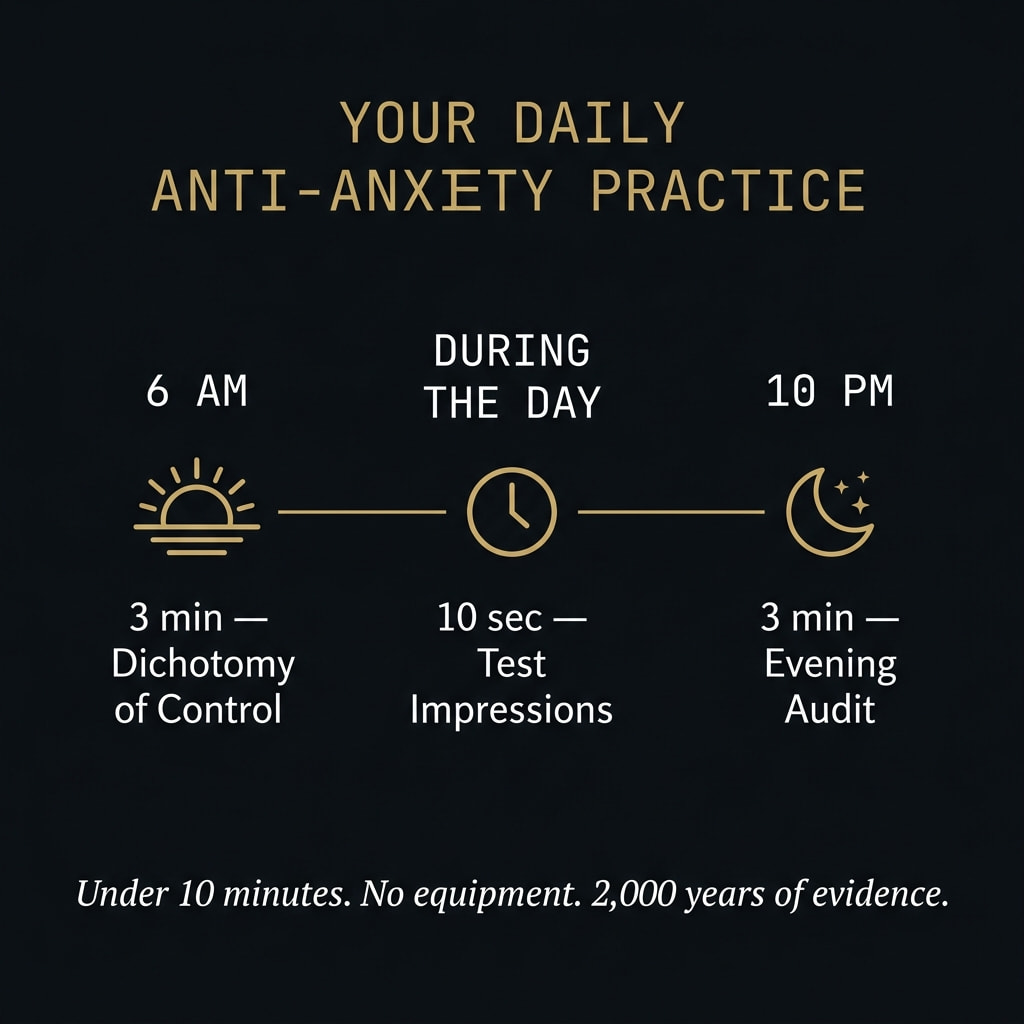
A Note on Serious Anxiety
The Stoics offer powerful tools for managing everyday anxiety — the worry, the overthinking, the stress of uncertainty. These techniques are safe, free, and proven to help.
But if you’re experiencing persistent, debilitating anxiety that interferes with daily life — panic attacks, inability to leave the house, physical symptoms that won’t stop — please talk to a mental health professional. Stoic philosophy complements therapy; it doesn’t replace it. Seneca himself acknowledged that some conditions require more than philosophy. There’s no weakness in getting help. A Stoic would call it practical wisdom.
Free AI Tool
Dichotomy of Control Tool
Describe a worry and let AI sort what you can and can't control.
FAQ
Can Stoicism really help with anxiety?
Yes. The core Stoic techniques — separating controllable from uncontrollable, questioning automatic thoughts, and preparing for adversity — are structurally identical to Cognitive Behavioral Therapy (CBT), which is the most evidence-based treatment for anxiety disorders. Aaron Beck and Albert Ellis, who founded modern cognitive therapy, both explicitly cited Stoic philosophy as a primary influence.
What is the Stoic approach to anxiety?
The Stoic approach has three parts: first, identify whether your anxiety is about something within your control or outside it (dichotomy of control). Second, question whether the anxious thought is actually true (testing impressions). Third, if the feared scenario is possible, mentally prepare for it and plan your response (premeditatio malorum). This shifts anxiety from uncontrolled worry to structured preparation.
Is Stoicism the same as CBT?
Not exactly, but they share the same core principle: that emotional suffering is caused by distorted thoughts about events, not by the events themselves. CBT formalizes this into a clinical framework with structured sessions. Stoicism presents it as a daily philosophical practice. Donald Robertson’s book How to Think Like a Roman Emperor explores the Stoic-CBT connection in depth.
Does Stoicism mean suppressing emotions?
No. The Stoics distinguished between first movements (involuntary emotional reactions, which are natural and unavoidable) and passions (sustained emotional states driven by false judgments). They never aimed to eliminate feelings — they aimed to respond wisely rather than react impulsively. Marcus Aurelius himself clearly struggled with frustration and grief throughout his Meditations.
What did Marcus Aurelius say about anxiety?
Marcus Aurelius wrote in Meditations 9.13: “Today I escaped anxiety. Or no, I discarded it, because it was within me, in my own perceptions — not outside.” His approach was to recognize that anxiety is generated by our interpretation of events, not by the events themselves — and that we have the power to change that interpretation.
Can I use Stoic techniques alongside therapy?
Absolutely. CBT therapists often assign “homework” that mirrors Stoic exercises — thought records (like the evening audit), cognitive restructuring (like testing impressions), and exposure (like premeditatio malorum). Practicing Stoic techniques between therapy sessions can accelerate progress.

Marcus Adler
Founder & Lead Writer, StoicNow
Marcus Adler is the founder of StoicNow. For over a decade he has applied Stoic philosophy to daily life — testing the practices of Marcus Aurelius, Seneca, and Epictetus against modern problems and translating them into simple, repeatable routines. More about the author →
Further reading
- Cognitive behavioral therapy (Wikipedia) Wikipedia