Quick answer
The Stoics treated anger as the most dangerous of the passions and the one most worth eliminating. Seneca devoted three books to it (De Ira), calling it a 'brief madness' that does more harm to the angry person than to its target.
Seneca thought anger was the most dangerous emotion a person could carry — not because of what it does to its targets, but because of what it does to its owner. He called it a “brief madness,” wrote three full books on how to dismantle it, and built a set of techniques that anger-management researchers, eighteen centuries later, would rediscover under different names.
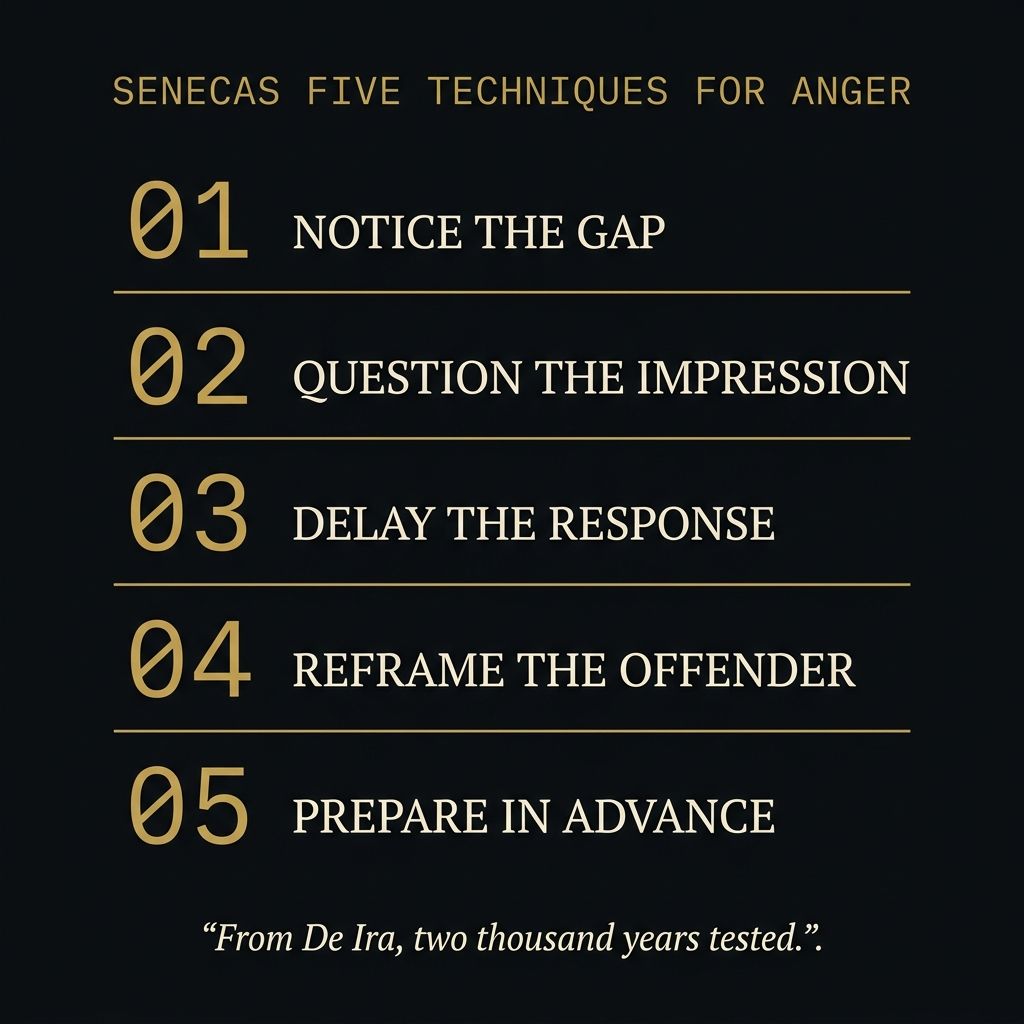
This is a guide to those five techniques — what Seneca actually said in De Ira, how each one works, and why modern psychology has converged on almost exactly the same answers.
Why Seneca Wrote Three Books About Anger
Most Stoic writing on a single passion fits in a chapter. Seneca gave anger three full books, because he considered it categorically worse than the others. His argument runs roughly:
- It is voluntary. Fear is reactive; anger requires a judgment that someone has done you wrong and ought to be punished. That judgment is something you make, which means it is something you can refuse to make.
- It is self-destructive. “No plague has cost the human race more dear,” he wrote in De Ira 1.2. The angry person damages themselves long before they damage anyone else — physiologically, socially, strategically.
- It is contagious. “Whenever I have spent a day amongst men, I come back less a man.” Anger spreads, and one ungoverned temper coarsens an entire household, office, or city.
His diagnosis is famously sharp:
“Anger is a short madness.” — Seneca, De Ira 1.1
Notice the precision. Not a feeling. Not a passion. A madness. For its duration, you are not yourself — you are a worse version of yourself, making decisions a sane version of you would refuse. The entire Stoic project on anger is structured around staying sane long enough to not let the madness move.
Two technical distinctions matter before the techniques.
First movements vs. assent. The Stoics knew you can’t stop the initial surge — the spike of irritation when someone cuts you off in traffic, the heat in the chest when you read a hostile email. Those involuntary reactions they called “first movements.” They are physiology; they happen before you can vote. What you can control is what comes next: whether you assent to the surge, agree that it’s justified, and let it drive your behavior. Stoicism is not about preventing the first movement. It is about refusing the assent.
Not catharsis. The popular idea that venting helps — the “let it out” school — Seneca anticipated and rejected in book 3. Modern research, most influentially Carol Tavris’s Anger: The Misunderstood Emotion, confirms it: expressing anger reinforces the neural circuits that produce more anger. Suppressing the expression while doing the cognitive work is what actually reduces it.
Technique 1: Notice the Gap
Technique 01
Notice the Gap Between Event and Reaction
How it works. Someone says something cutting. The first movement fires — spike of heat, mental flash of the perfect retort. In most people, the next millisecond is automatic: agreement, escalation, response. The Stoic intervention is to see the gap that exists right after the first movement and before the assent — and to use it.
In practice this looks like silently labelling what just happened: first movement. That single act of naming is enough to start moving the response from automatic to deliberate. You are no longer the anger; you are the person observing it. This is, almost word-for-word, what modern Acceptance and Commitment Therapy calls “cognitive defusion” — the separation of I am angry from I notice anger arising.
Automatic
“They cut me off — how dare they” (assent already given; anger now running you)
Stoic Pause
“Surge of irritation rising. First movement. Let’s see what I do next.”
Technique 2: Question the Impression
Technique 02
Question the Impression Before You Believe It
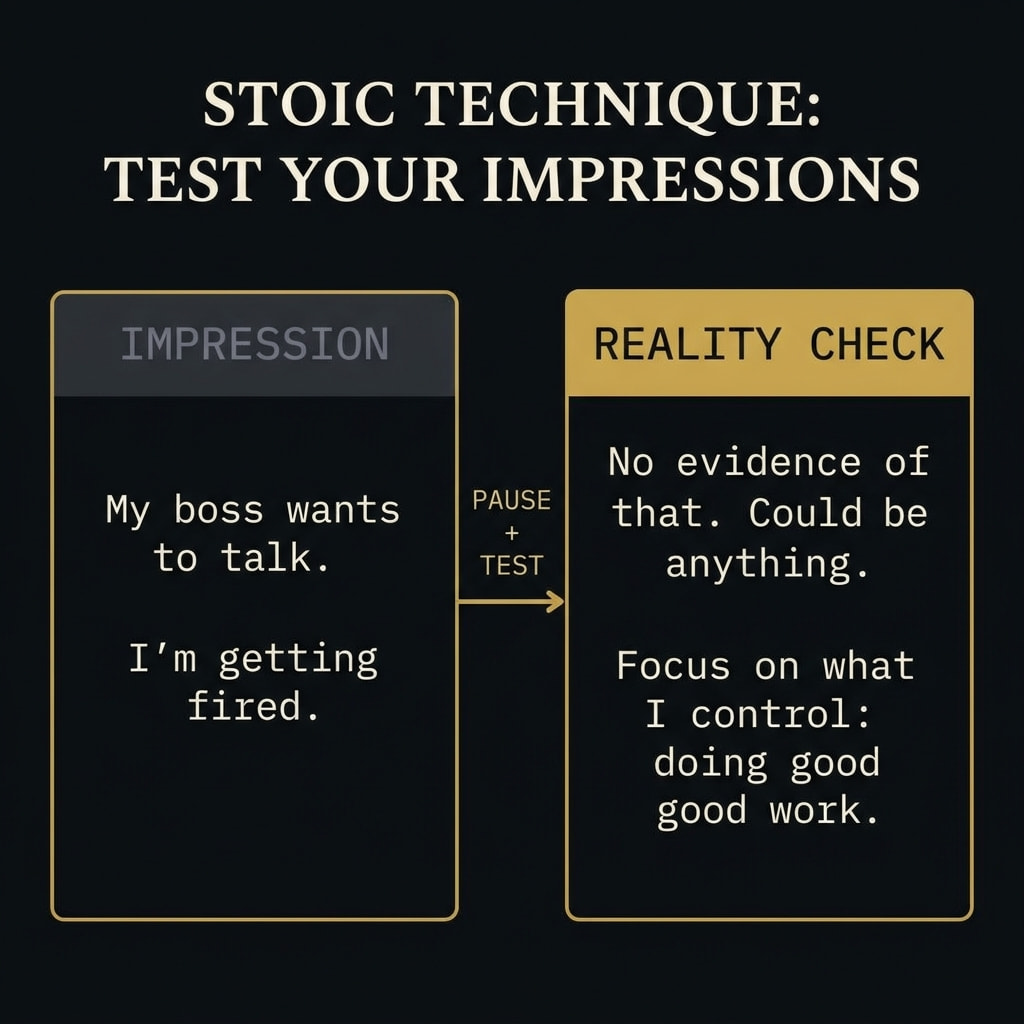
How it works. Anger needs three beliefs to fire: that you’ve been wronged, that the wrong was deliberate, and that something must be done about it. Knock out any one and the anger collapses on its own.
Seneca’s prompts:
- Did they actually do what I think they did? Or am I supplying motive?
- If they did, was it deliberate — or careless, exhausted, ignorant?
- Have I ever done something similar without meaning harm?
Marcus Aurelius’s version in Meditations 11.18 is essentially a pre-written script: they did it because they didn’t know better; this is happening for the common good; you yourself behave this way; you can’t even be sure they did it; anger costs you more than the original offense; nature gave us the antidote — kindness. He kept the list available for use, like a CBT thought record.
This is structurally identical to what Beck’s anger therapy calls cognitive restructuring. Identify the automatic thought; test it against evidence; replace it with something more accurate. The Stoics formalized it 1,800 years before the clinical trials.
Technique 3: Delay the Response
Technique 03
Delay — the Single Best Remedy
How it works. If Seneca had to choose one technique and discard the other four, he would keep this one. Anger has a physiological half-life. Once the surge passes, the catastrophic story usually deflates with it. The single highest-leverage skill in the entire Stoic anger toolkit is buying that interval before you do anything.
Concrete tactics he recommends: leave the room, postpone the reply, sleep on the letter, count, breathe, refuse to speak for a fixed interval. The specific method doesn’t matter much; what matters is the delay itself.
Modern neuroscience supplies the mechanism. An amygdala-driven anger surge takes roughly 20 to 90 seconds for the prefrontal cortex to override — the “90-second rule” popularized by neuroscientist Jill Bolte Taylor. Acting in the first 90 seconds is acting from the part of the brain Seneca was warning you about. Acting after is acting from the part of the brain that wrote De Ira.
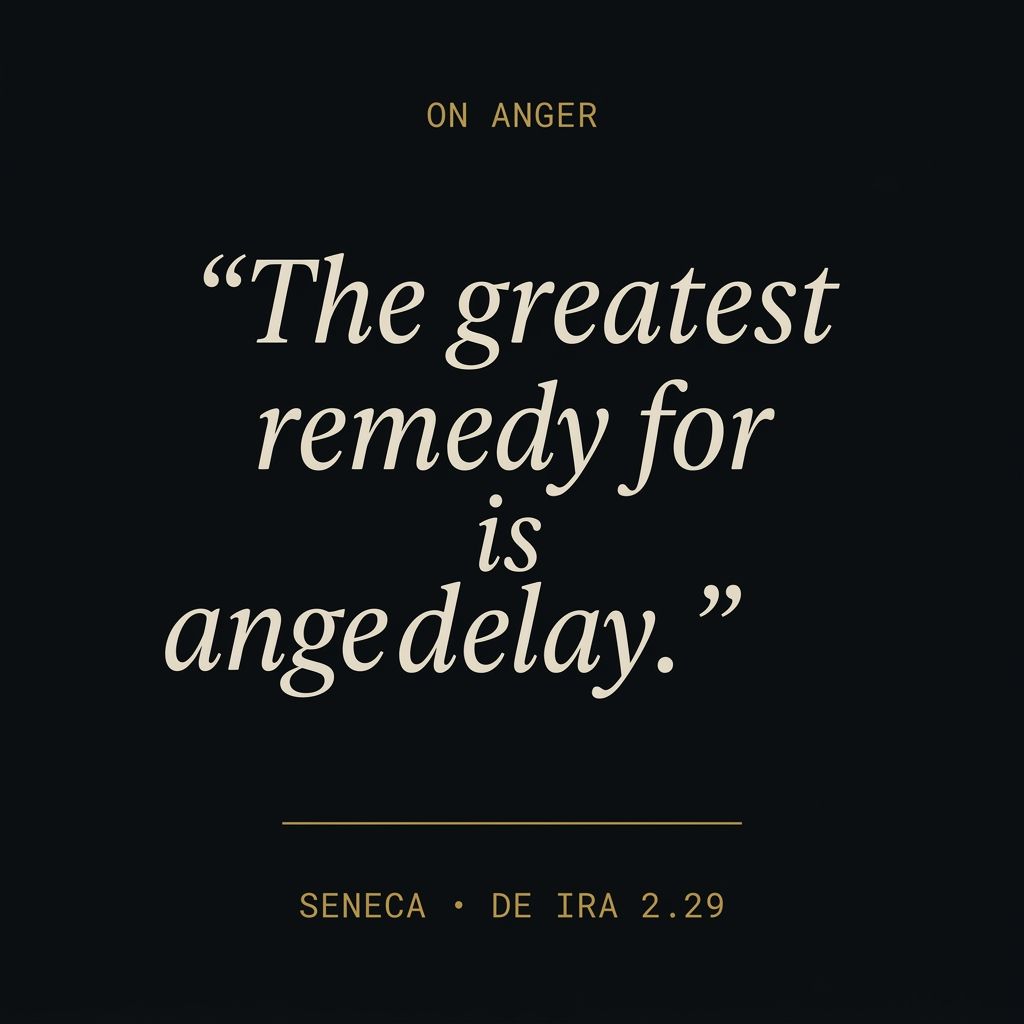
“The best cure for anger is delay. Beg this concession from anger at the outset, not in order that it may pardon the offense, but that it may form a right judgment.” — Seneca, De Ira 2.29
Technique 4: Reframe the Offender
Technique 04
Reframe the Person Who Wronged You
How it works. The Stoic move here is not forgiveness — it’s diagnosis. They held that wrongdoing is, in nearly every case, ignorance about the good. Nobody chooses evil as evil; they choose what they wrongly believe will serve them. Seen that way, the angering person looks less like a villain and more like a confused or wounded one.
Marcus opens Meditations 2.1 with this technique in operational form: Today I will meet people who are interfering, ungrateful, arrogant, dishonest, jealous, surly — all of these because they cannot tell good from evil. I, who have seen the nature of the good and the bad, cannot be harmed by any of them.
This is not naive. Marcus governed an empire; he met genuinely bad people regularly. The point is not to pretend they aren’t harmful — the point is to deny them the additional power of your fury. Action against bad behavior is still required; the action just runs on cooler fuel.
Technique 5: Prepare in Advance
Technique 05
Prepare for Provocations Before They Happen
How it works. Each morning, mentally walk through the kinds of irritation likely to arrive that day. The colleague who interrupts. The driver who tailgates. The relative who pushes the old button. Rehearse, in advance, the response you would want to give — not the one that will fire automatically.
This is the anger-specific application of premeditatio malorum, the Stoic practice of mentally rehearsing adversity. When the provocation actually lands, the response is no longer an improvisation under pressure; it’s a rehearsed move you’ve already chosen. The first movement still fires, but the next step has been pre-installed.
This pairs naturally with the Stoic morning routine: read one anger-related passage from De Ira or Meditations Book 2 before the day starts. Five minutes of preparation costs less than one badly handled flare-up.
Why Modern Anger Science Agrees
Three lines of modern research validate, with surprising precision, what Seneca worked out from intuition and observation.
1. The catharsis myth is dead. Decades of research, summarized by Carol Tavris and Brad Bushman, show that “letting it out” — hitting pillows, ranting, smashing things — reliably increases aggression, not decreases it. The act of expression reinforces the neural pattern. Seneca said this in De Ira 3.
2. The 90-second window is real. The acute physiological cascade of anger has a measurable half-life of roughly 90 seconds. Surviving it without acting is most of the battle — the same delay Seneca prescribed.
3. Cognitive restructuring works. Aaron Beck’s anger therapy, the most evidence-based intervention available, is built on the same structure as De Ira: identify the anger-producing thought, test it, replace it. The clinical name is different; the move is the same.
Three Mistakes (And When Not to Use This)
Mistake 01 — confusing this with suppression. Stoic anger control is cognitive, not emotional gagging. You are not pretending the feeling isn’t there; you are refusing to let an unexamined feeling drive your behavior. People who try to suppress feel worse and rebound harder.
Mistake 02 — using it on legitimate harm. The techniques are for everyday irritation and over-reaction. Real harm — abuse, injustice, threats to safety — calls for protective action, sometimes including anger as a signal that something must change. Don’t Stoic yourself into staying in a damaging situation.
Mistake 03 — trying all five at once. Start with delay. Just delay. Get a week of consistent 60-second pauses before adding the others. Stacking five new techniques in one week is how this practice fails before it begins.
Practice the Stoic playbook in StoicNow
Join the WaitlistFree AI Tool
Dichotomy of Control Tool
Describe a worry and let AI sort what you can and can't control.
FAQ
What did the Stoics say about anger?
The Stoics treated anger as the most dangerous of the passions and the one most worth eliminating. Seneca devoted three books to it (De Ira), calling it a “brief madness” that does more harm to the angry person than to its target. Their approach combines diagnosing the false judgments behind anger, building a deliberate gap between event and reaction, and applying specific techniques (delay, reframe, prepare) that prevent the spiral.
What is Seneca’s most famous quote on anger?
From De Ira: “The greatest remedy for anger is delay.” One sentence, two thousand years validated. Modern neuroscience confirms it: the prefrontal-cortex circuits that override an amygdala-driven anger response need 20–90 seconds to come back online. Buying that time is most of the battle.
Does Stoicism mean suppressing anger?
No. The Stoics distinguished between “first movements” (involuntary surges of irritation, which are natural and cannot be stopped) and the act of “assent” (where you actually decide the anger is justified and act on it). They aimed to prevent the assent, not to deny the first movement. The Stoic ideal is not numbness — it is not handing the steering wheel to the surge.
Where can I read Seneca’s writing on anger?
De Ira (On Anger) — three short books, often published together with other Senecan dialogues. The John Davie translation (Oxford World’s Classics, Dialogues and Essays) is the standard modern English version. About 80 pages total. Practical, direct, and surprisingly readable for a Roman text.
Are Stoic anger techniques the same as modern anger management?
Closely. Modern cognitive anger-management programs (Beck, Novaco) rest on the same three pillars Seneca laid out: identify the trigger thought, dispute it with evidence, delay the response. Carol Tavris’s research on anger explicitly debunked the catharsis myth (the idea that venting helps), confirming what Seneca argued in book 3 of De Ira: expressing anger reinforces, not relieves, it.
How do I start practicing Stoic anger control?
Start with the delay. The next time you feel the surge, do one thing: pause for 60 seconds before reacting. No advanced technique, no quotes to memorize. Sixty seconds. Most anger that survives that pause is real and needs addressing; most that doesn’t was never worth the cost. Layer the other four techniques in over weeks.

Marcus Adler
Founder & Lead Writer, StoicNow
Marcus Adler is the founder of StoicNow. For over a decade he has applied Stoic philosophy to daily life — testing the practices of Marcus Aurelius, Seneca, and Epictetus against modern problems and translating them into simple, repeatable routines. More about the author →