Quick answer
A memento mori tattoo permanently marks the Stoic idea that you will die — not to be morbid, but to force clearer decisions about how you spend the time you have left. The skull, hourglass, or wilted flower is shorthand for a 2,000-year-old practice, not a fashion statement about death.
Someone gets a skull inked on their forearm and the first reaction is usually the same: isn’t that dark? Isn’t that inviting bad luck? The honest answer runs the other way. A memento mori tattoo is built to sharpen how you live, not to court how you die. Here is what the symbol actually means, where the phrase comes from, and how to tell a design with real intent behind it from one that’s just decoration.

What a Memento Mori Tattoo Actually Means
“Memento mori” is Latin for “remember that you [must] die.” As a tattoo, it’s a permanent version of that instruction — worn somewhere you’ll see it, so the fact of your mortality can’t be closed like a browser tab or scrolled past like an app notification. That’s the whole mechanism. It isn’t a death wish, a superstition, or an aesthetic borrowed from horror films. It’s a cue, and the cue is meant to change behavior: fewer wasted afternoons, less energy spent on things you don’t control, more urgency about the things that actually matter to you. For the full background on the idea itself, see what memento mori means and where it sits in the broader Stoic tradition.
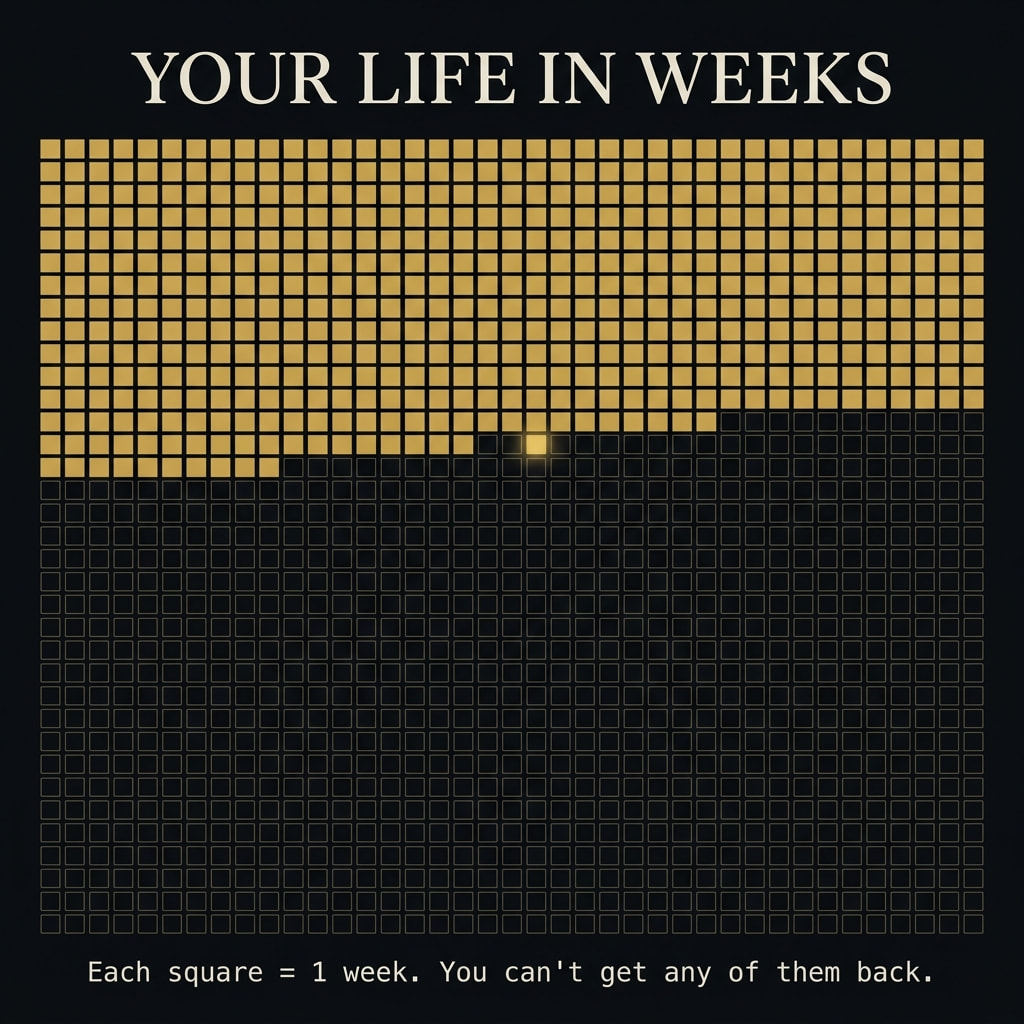
There’s a meaningful difference between memento mori as a tattoo and memento mori as a decorative skull. A skull tattoo can mean anything — rebellion, style, a nod to a subculture. A memento mori tattoo is specifically doing the work of a reminder: it exists to be looked at and to prompt a thought, the same job done by a written date, a daily app notification, or a life-in-weeks calendar. The tattoo is just the version that can’t be uninstalled.
Where the Phrase Comes From
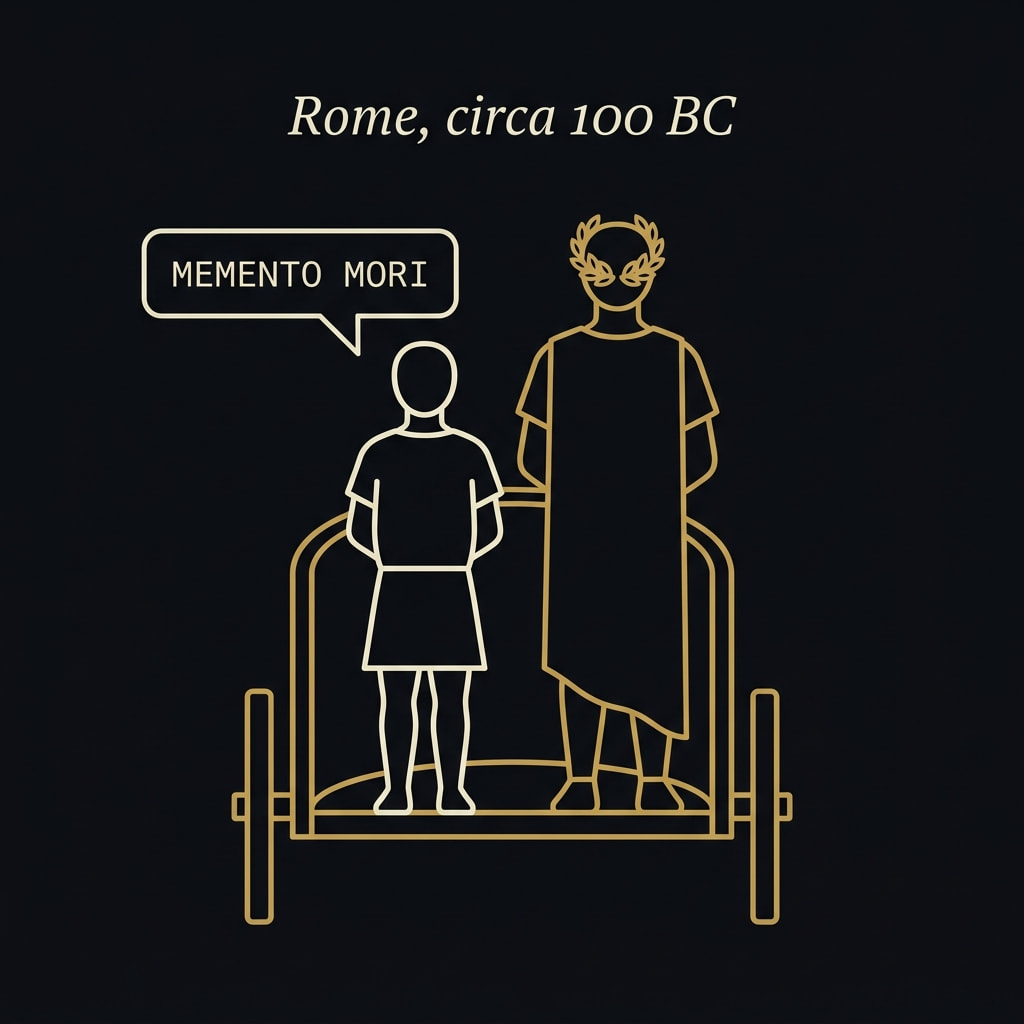
The Latin phrase itself is not found verbatim in the writing of the Stoics who made the idea famous — Marcus Aurelius, Seneca, and Epictetus never wrote the words “memento mori.” The most commonly cited origin story comes from the early Christian writer Tertullian, in his Apologeticus (chapter 33): a slave rides behind a victorious Roman general during his triumph, whispering some version of “look behind you; remember you are [only] a man.” Modern historians treat that account with some caution — it was written centuries after the supposed practice and may be more legend than record. But the idea it captures is exactly what the Stoics were already writing about, more directly and much earlier.
“Do not act as if you were going to live ten thousand years. Death hangs over you. While you live, while it is in your power, be good.” — Marcus Aurelius, Meditations 4.17
Epictetus went further, making the practice explicit rather than incidental:
“Let death and exile and every other thing that appears dreadful be daily before your eyes; but chiefly death: and you will never think of anything mean, nor will you desire anything extravagantly.” — Epictetus, Enchiridion 21
A memento mori tattoo takes Epictetus’s instruction — keep it “daily before your eyes” — and makes it literal. You can read more of his framework in the Enchiridion summary.
The Symbols People Actually Ink, and What Each One Means
There’s no single official memento mori design. Over centuries of vanitas painting, medieval jewelry, and modern tattoo work, a handful of symbols have become shorthand for the same idea.
The Skull
The most literal symbol — mortality without metaphor. In vanitas painting and now in tattoo work, a skull isn’t meant to be frightening; it’s meant to be plain. It strips away the illusion that you’re exempt.
The Hourglass
Represents time running, not time stopped — the sand is usually shown mid-fall. It's less about death itself and more about the finite resource death puts a hard limit on: your remaining hours.
The Wilted Flower or Rose
A softer variant, often paired with a skull. The flower's bloom-and-decay cycle stands in for a life span, and its wilting state is the visual argument for acting now rather than later.
The Stopped Clock or Watch
A watch face frozen at a specific time — sometimes a real date significant to the wearer. It functions the same way a gravestone date does: a fixed point that makes an abstract idea concrete.
Roman Numerals or Dates
A birth date, an anniversary of a loss, or simply a number of years — inked as plain text rather than imagery. This is the most personal version, closer to a private note than a universal symbol.

Is a Memento Mori Tattoo Morbid? Three Misconceptions
The most common pushback on memento mori ink comes from three assumptions that don’t hold up.
- “It means you’re obsessed with death.” The Stoics used death as a lens on time, not as a subject in itself. Seneca made the point sharply in On the Shortness of Life: it is not that we have a short time to live, but that we waste a great deal of it. The tattoo is about the waste, not the ending.
- “It's bad luck — you're tempting fate.” No Stoic or historical tradition treats contemplating mortality as inviting it. If anything, the argument runs the opposite direction: Epictetus claims keeping death in view daily makes you less anxious and less reckless, not more.
- “It's basically a 'YOLO' tattoo.” “You only live once” is usually shorthand for indulgence — do whatever, now. Memento mori argues the opposite conclusion from the same premise: because you only live once, choose deliberately. Compare it to how the Stoics frame urgency in stoicism and procrastination — the finite clock is a reason to act well, not a permission slip to act carelessly.

How to Choose a Memento Mori Tattoo That Actually Means Something
A few decisions separate a design with real intent from one that's just borrowed imagery.
- Wording: The Latin phrase itself, a line from Epictetus or Marcus Aurelius, or your own words — pick the version you'd actually want to reread daily, not the one that photographs best. See more source lines in Stoic quotes about death.
- Symbol: Match the image to what you're actually reminding yourself of — an hourglass for wasted time, a date for a specific loss, a plain skull if you want no ambiguity at all.
- Placement: A design you'll see daily (wrist, forearm) does more work than one hidden away. The whole mechanism depends on visibility.
- Restraint: The strongest examples in this genre are simple. An overcrowded design with five symbols and three quotes dilutes the reminder into decoration.
- Test the commitment first: If you're not sure a permanent version is right yet, the life-in-weeks calendar or one of the best Stoic apps gives you the daily-reminder effect without the needle.

Where It Fits Into Actual Stoic Practice
Memento mori is one tool in a small kit, not a standalone philosophy. It pairs naturally with the dichotomy of control — once you accept the clock is finite and largely outside your control, the only sane response is to focus effort on what actually is: your judgments, your actions, your attention. It also pairs with negative visualization, the practice of briefly imagining loss to restore gratitude for what you still have, and with the view from above, which shrinks daily anxieties by widening the frame.
None of this requires a tattoo. The ink is optional; the daily habit of remembering isn't. If you want the fuller toolkit rather than a single symbol, start with how to practice Stoicism every day — the tattoo, if you get one, becomes one more prompt inside a practice you're already running, not a substitute for it.
“You could leave life right now. Let that determine what you do and say and think.” — Marcus Aurelius, Meditations 2.11
Get a daily memento mori reminder in StoicNow
Join the WaitlistFree Quiz
Which Stoic Are You?
A 3-minute personality quiz — Marcus, Seneca, Epictetus, or Cato.
FAQ
What does a memento mori tattoo mean?
A memento mori tattoo is a permanent visual reminder that you will die, drawn from the Latin phrase meaning “remember that you must die.” It functions as a daily cue to spend time deliberately rather than as decoration about death itself — a Stoic practice, described by Marcus Aurelius and Epictetus, made literal on skin.
Is a memento mori tattoo bad luck or morbid?
No. There is no tradition, Stoic or otherwise, that treats contemplating death as inviting it. The Stoics argued the opposite: keeping death “daily before your eyes,” as Epictetus put it in the Enchiridion, reduces fear and pettiness rather than causing harm. The symbol is about clarifying priorities, not courting misfortune.
What are the most common memento mori tattoo symbols?
The most common are a skull, an hourglass, a wilted flower or rose, a stopped clock or watch, and Roman numerals marking a birth date or a meaningful moment. Each represents the same idea — that time is finite — through a different visual shorthand.
Where does the phrase ‘memento mori’ come from?
The Latin phrase itself dates to medieval usage, but the concept is older. The early Christian writer Tertullian (Apologeticus, chapter 33) describes a slave whispering to a triumphant Roman general to remember he was only a man — a story historians treat with some caution, though it echoes ideas the Stoics had already written centuries earlier.
What’s a good memento mori tattoo quote?
Epictetus's line from the Enchiridion is a common choice: “Let death and exile and every other thing that appears dreadful be daily before your eyes.” Marcus Aurelius's “Death hangs over you. While you live, while it is in your power, be good” (Meditations 4.17) is another frequently inked source.
Is memento mori a Stoic or Christian concept?
It's originally Stoic, later adopted heavily by Christian art and practice, including vanitas paintings and memento mori jewelry in medieval Europe. Marcus Aurelius, Seneca, and Epictetus all wrote about keeping death in view centuries before the Latin phrase became associated with Christian memento mori imagery.

Marcus Adler
Founder & Lead Writer, StoicNow
Marcus Adler is the founder of StoicNow. For over a decade he has applied Stoic philosophy to daily life — testing the practices of Marcus Aurelius, Seneca, and Epictetus against modern problems and translating them into simple, repeatable routines. More about the author →
Further reading