Quick answer
Meditations is a private journal written by Roman emperor Marcus Aurelius between roughly 170 and 180 AD, during military campaigns on the northern frontiers. It is a collection of twelve short books of Stoic reflections — notes to himself on mortality, duty, rational self-control, dealing with difficult people, and how to live a good life under pressure.
The most powerful book in Western philosophy was written by a man who did not want you to read it.
Meditations is not really a book. It is a Roman emperor’s private journal — twelve short notebooks of reminders to himself, written in Greek, on campaign, while managing plague, war, and the death of most of his children. Marcus Aurelius never titled it, never shared it, and never prepared it for publication. The manuscript survived by accident. It has been continuously read for nearly 1,900 years.
This guide gives you a practical summary: what the book is, the seven core themes that run through all twelve volumes, which translation to read first, and how to actually approach it without bouncing off by page 20. If you have never read Meditations before, start here.
What’s inside
What Meditations Actually Is
Marcus Aurelius ruled Rome from 161 to 180 AD — the last of the so-called Five Good Emperors, at the peak of the empire and at the moment it started to fracture. He spent most of his rule on the northern frontier, fighting Germanic tribes along the Danube. He also lived through the Antonine Plague (probably smallpox), a catastrophic flood of the Tiber, a near-civil-war revolt by his own general Cassius, and the deaths of at least eight of his children.
Sometime during the last decade of his life, probably beginning around 170 AD, he started keeping a private journal. The Greek title his later editors gave it was Ta eis heauton — literally, “things to himself.” He wrote in Greek, not Latin, because Greek was the philosophical language of the Stoics he studied. The notebooks survived through a chain of Byzantine scribes, lost and rediscovered multiple times, until the first printed edition in 1559.
The Basics
Written: c. 170–180 AD, on military campaign
Structure: 12 books (each is a short notebook, not a chapter)
Length: ~250 pages in modern translations
Language: Koine Greek (even though Marcus was Roman)
Intended audience: Marcus Aurelius. That is it.
School: Stoicism, shaped especially by Epictetus
This last detail — that the book was not meant for anyone — is the thing that makes Meditations strange and useful. There is no argument, no arc, no rhetoric. Marcus is not trying to convince you. He is arguing with himself, losing his temper at himself, encouraging himself, and repeating the same lessons because repeating them is the only way they stick. You are reading somebody work at becoming a better person, in private, on the bad days as well as the good ones.
The book is famously repetitive. That is because it is a practice journal, not a treatise. Marcus returns to the same seven or eight ideas because those are the ideas he needed to return to. We have inherited the notes.
The 7 Core Themes
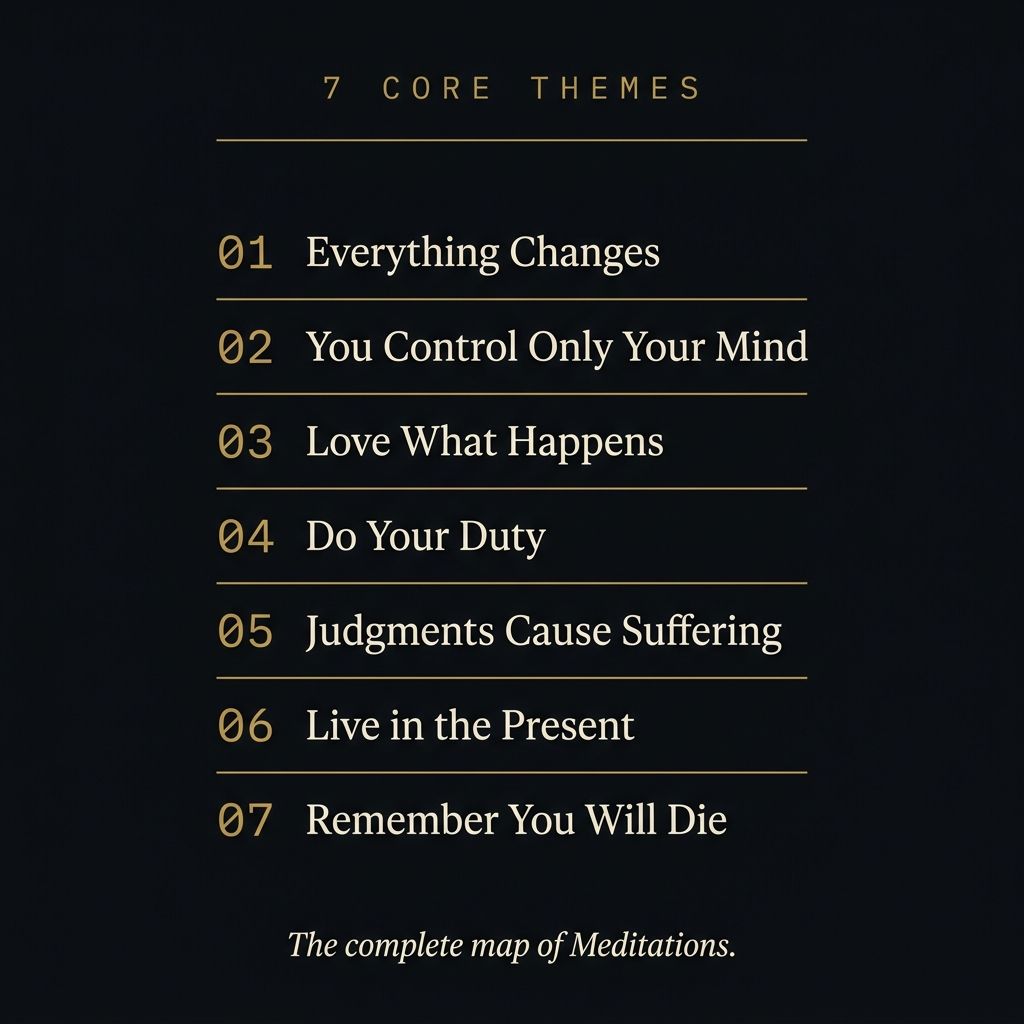
You do not need to read Meditations cover to cover to grasp what it is doing. The whole book runs on seven ideas, each one circled from different angles in different books. If you know these, you can open any page and place it inside the larger architecture.
Theme 01
Everything Changes (Impermanence)
Nothing — status, body, memory, empire — lasts. Marcus returns to this so often that the book sometimes reads as one long meditation on flux. The argument is not depressing; it is clarifying. If nothing lasts, the things you are clinging to were never yours to keep. The loss has been built into the gift from the start.
“Time is a river of passing events, and its current is strong. No sooner is a thing brought to sight than it is swept by and another takes its place — and this too will be swept away.”— Meditations 4.43
“Loss is nothing else but change, and change is nature’s delight.”— Meditations 9.35
Theme 02
You Control Only Your Mind
The foundation of all Stoic ethics, which Marcus inherited from Epictetus. You do not control events, outcomes, other people, or the past. You do control your judgments, your effort, and your response. Freedom, for Marcus, is not the absence of constraint — it is the acknowledgment of where the real locus of control actually sits. For a deeper dive, see the dichotomy of control.
“If you are distressed by anything external, the pain is not due to the thing itself, but to your estimate of it — and this you have the power to revoke at any moment.”— Meditations 8.47
“You always own the option of having no opinion.”— Meditations 6.52
Theme 03
Love What Happens (Amor Fati)
Once you accept you cannot control what happens, the next move is radical: welcome it. Marcus pushes past resignation into something more active — the willingness to love even the hard thing, because it is the thing that actually happened. Nietzsche would later name this amor fati. Marcus was already practising it 1,700 years earlier. More on this in our guide to amor fati.
“Accept the things to which fate binds you, and love the people with whom fate brings you together — and do so with all your heart.”— Meditations 6.39
“Whatever happens at all happens as it should; you will find this true, if you watch narrowly.”— Meditations 4.10
Theme 04
Do Your Duty for the Common Good
Marcus, uniquely among philosophers, had to run an empire. His Stoicism is not retreat or solitude — it is oriented outward, toward obligation. Humans exist for each other, he argues again and again. The point of your self-discipline is not personal peace; it is being useful to the shared enterprise of human life.
“At dawn, when you have trouble getting out of bed, tell yourself: ‘I have to go to work — as a human being.’”— Meditations 5.1
“Men exist for the sake of one another. Teach them then, or bear with them.”— Meditations 8.59
Theme 05
Judgments Cause Suffering, Not Events
This is the single most influential claim in the book. Events are neutral. Your suffering comes from the story you layer on top of them. Cognitive Behavioral Therapy — the most evidence-based treatment for depression and anxiety — is essentially this idea, operationalised. Aaron Beck and Albert Ellis both cited Stoicism directly.
“Reject your sense of injury and the injury itself disappears.”— Meditations 4.7
“Choose not to be harmed — and you won’t feel harmed. Don’t feel harmed — and you haven’t been.”— Meditations 4.7
Theme 06
Live Fully in the Present
The past is gone. The future is hypothetical. Your life happens, strictly, in the present moment — and that is also the only place you can act. Marcus treats the present not as a mindfulness concept but as a logical one: it is the entire inventory of what you actually own.
“Confine yourself to the present.”— Meditations 7.29
“No one loses any other life than this one he is living now, nor lives any other than this one he is losing.”— Meditations 2.14
Theme 07
Remember You Will Die
Marcus did not use death to scare himself. He used it as a filter. If you could die today — and you could — trivial things stop running the day. Memento mori is not morbid; it is a scheduling tool. See our full piece on memento mori.
“You could leave life right now. Let that determine what you do and say and think.”— Meditations 2.11
“Do every act of your life as though it were the very last act of your life.”— Meditations 2.5
If you want fifty representative passages from Marcus organised by exactly these themes, we wrote a 50 Marcus Aurelius quotes guide that pairs with this summary.
Which Translation Should You Read?
The choice of translation is the single biggest predictor of whether you will finish Meditations. The book is already 1,800 years old; a bad English translation makes it feel like it. A good one makes it feel like Marcus is in the room with you. Here are the four you will encounter, ranked by how we recommend them for a first-time reader.
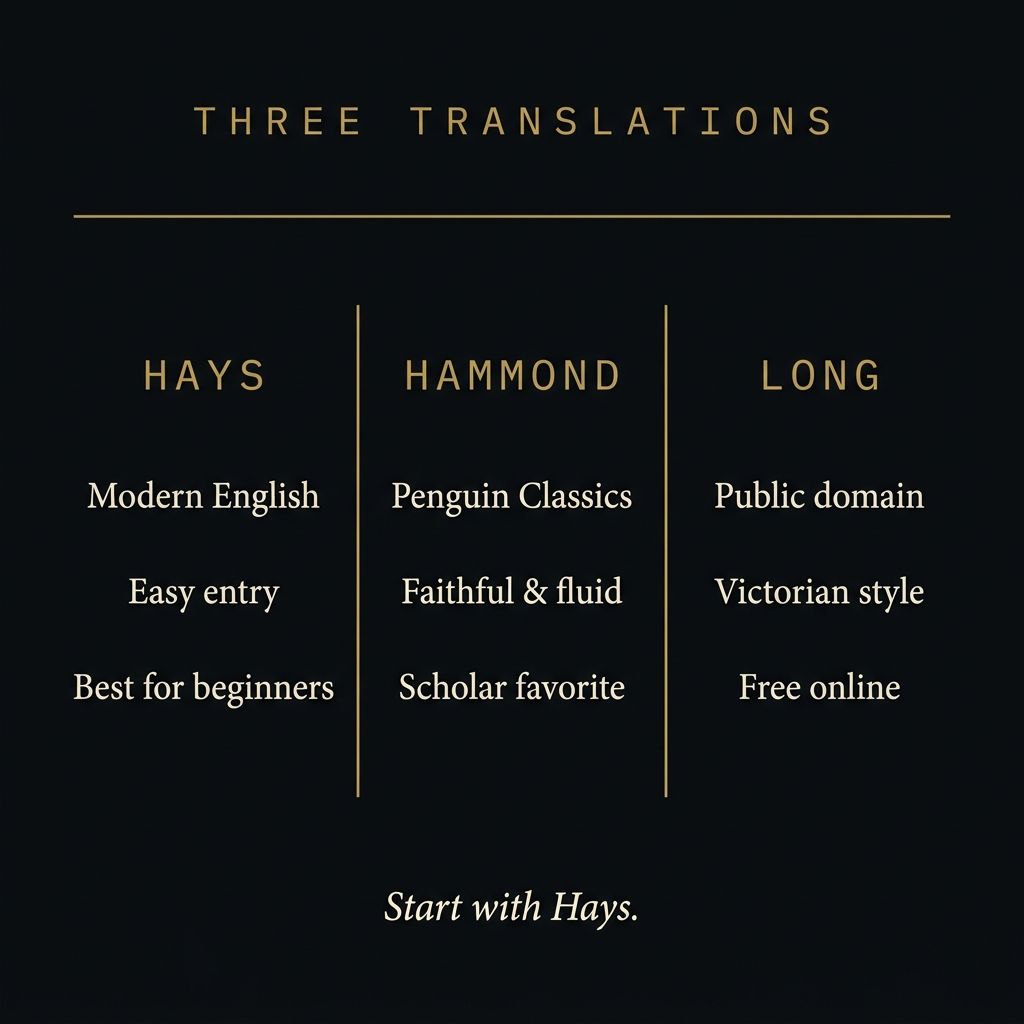
| Translation | Year | Strength | Best for |
|---|---|---|---|
| Gregory Hays (Modern Library) | 2002 | Direct modern English, short sentences, zero Victorian filler. Reads like a contemporary journal. | First-time readers. Default pick. |
| Martin Hammond (Penguin Classics) | 2006 | Faithful and fluid. More detail than Hays, still very readable. Great notes. | Readers who want slightly more nuance. |
| Robin Hard (Oxford World’s Classics) | 2011 | The scholar’s choice. Excellent apparatus. Prose is clear if slightly more formal. | Students and careful readers. |
| George Long (Public Domain) | 1862 | Free everywhere, 19th-century English, thee/thou, long sentences, occasionally obscure. | Skip on first read. Use later for comparison. |
If you are pulling quotes for a project or want the easiest possible entry, buy Hays. It is the version that has converted more new readers to Stoicism than any other single book.
How to Actually Read It
Most people who give up on Meditations do so in the first twenty pages. It is not because the book is bad; it is because they are reading it wrong. Meditations is a journal, not an argument. Here is the approach that works for almost everyone.
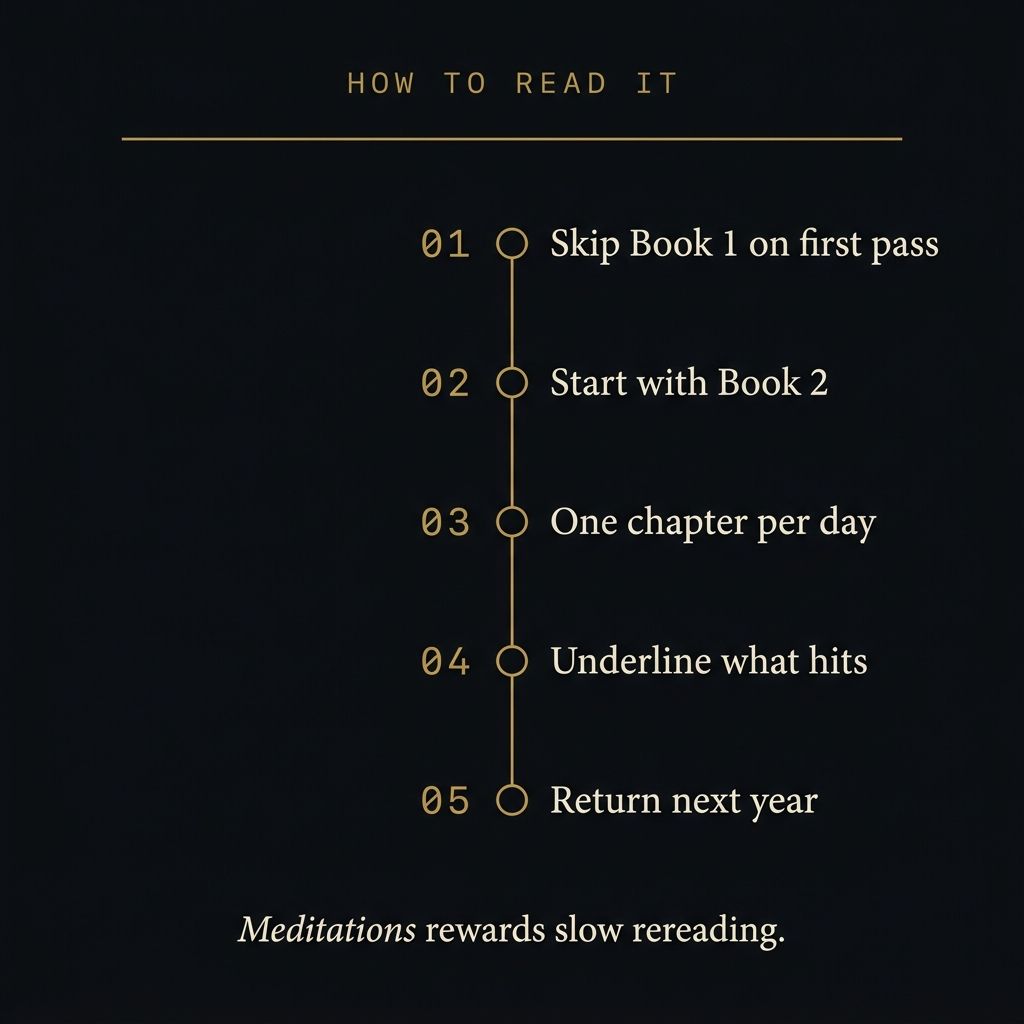
1. Skip Book 1 on your first pass
Book 1 is Marcus’s list of thank-yous to his teachers, family, and mentors. It is a beautiful piece of writing, but almost nothing in it will hit on a first read — you will not know who any of these people are, and none of the famous lines are in it. Come back to Book 1 on your second pass. Start with Book 2.
2. Start with Book 2 — the morning meditation
Book 2 opens with arguably the most famous single passage Marcus wrote:
“When you arise in the morning, think of what a precious privilege it is to be alive — to breathe, to think, to enjoy, to love. Today I shall meet with interference, ingratitude, insolence, disloyalty, ill-will, and selfishness… but none of them can injure me.”— Meditations 2.1
This passage tells you, in one paragraph, what the book is doing and what Marcus is practising. If it does not hit you, the book probably is not for you — and that is good to know early.
3. Read one short chapter per day
Meditations is the worst possible binge-read. The chapters are short, repetitive, and often mundane on the surface. They reward slow reading because the same idea lands differently on different days. Try one chapter per morning for a month. If you miss a day, pick up where you left off — the book does not care.
4. Underline what hits. Skip what doesn’t.
Some passages will feel written for you. Most will not. That is fine. Underline the lines that stop you. Skim past Marcus’s debates with his own Stoic physics (atoms vs providence — he returns to this constantly, and it is not the part of the book that has aged well). Come back for those later, if ever.
5. Return next year
Meditations is not a book you finish. It is a book you return to. A passage that felt vague at 25 lands like a punch at 35, and a different one at 45. Most lifetime readers keep a single copy nearby and revisit specific books during hard stretches of life. You will see Book 10 very differently after a real loss than before one.
Reading Marcus? Track it daily.
Try StoicNow — Free on iOSWhat to Read After Meditations
If Meditations hooks you, there are two obvious next stops. Both feed directly into what Marcus was doing.
Epictetus — the Enchiridion. Marcus was heavily influenced by Epictetus, a former Roman slave who became one of the most important Stoic teachers. The Enchiridion is a short handbook (about 30 pages) of his core teachings, distilled by his student Arrian. Read this next. It is the cleanest, most actionable Stoic text in existence.
Seneca — Letters from a Stoic. Seneca wrote 124 short letters to a friend named Lucilius, each one addressing a practical question about living well — wealth, friendship, grief, time, death. Warmer and more conversational than Marcus. Start with Letters 1, 4, 13, and 28 if you do not want to read all 124.
If you want practice, not more reading. The risk with the Stoic canon is that you read it and feel wise without practising any of it. Pair Meditations with a daily routine. We have written a short Stoic morning routine and a seven-exercise beginner’s guide that map directly onto what Marcus is telling himself to do.
FAQ
What is Meditations by Marcus Aurelius about?
Meditations is a private journal written by Roman emperor Marcus Aurelius between roughly 170 and 180 AD, during military campaigns on the northern frontiers. It is a collection of twelve short books of Stoic reflections — notes to himself on mortality, duty, rational self-control, dealing with difficult people, and how to live a good life under pressure. It was never intended for publication.
How long does it take to read Meditations?
The book is about 250 pages in modern translations. A focused reader can finish a first pass in 6 to 8 hours, but Meditations rewards slow reading more than speed. Most people who love the book read one short chapter per day over several weeks, then return to passages again over the following years. It is closer to a daily devotional than a novel.
What are the main themes of Meditations?
Seven themes run through the whole book: the impermanence of all things, the dichotomy of control, loving your fate (amor fati), acting from duty for the common good, the power of rational judgment over suffering, living fully in the present, and using the thought of death as a tool for better living. Marcus returns to each of these from dozens of angles.
Which translation of Meditations should I read first?
For first-time readers, the Gregory Hays translation (Modern Library, 2002) is the easiest entry — direct modern English, short sentences, no Victorian filler. Martin Hammond (Penguin Classics, 2006) is more faithful and still very readable. Robin Hard (Oxford, 2011) is the scholar’s choice. Skip the free George Long translation unless you enjoy stiff 19th-century prose.
In what order should I read Meditations?
Meditations is not a structured argument — it is a journal. You can open any chapter and start. A practical plan for first-time readers: skip Book 1 on the first pass (it is a list of thank-yous to his teachers), start with Book 2 which opens with his famous morning meditation, and read one short chapter per day. Underline what hits, close the book, come back tomorrow.
Is Meditations still relevant today?
Yes — strikingly. Meditations is one of the foundational texts behind Cognitive Behavioral Therapy. Aaron Beck and Albert Ellis both cited Stoicism as a direct influence. The book’s central claim — that your suffering comes from your judgments about events, not the events themselves — is now the most evidence-based principle in modern clinical psychology. The language is 1,800 years old; the mechanism is the same.
What should I read after Meditations?
Two obvious next steps. Epictetus — either the short Enchiridion (about 30 pages, the distilled version) or the fuller Discourses. Marcus was deeply influenced by Epictetus, and the connection is unmistakable. Then Seneca — Letters from a Stoic is 124 short letters on practical ethics, written to a friend.

Marcus Adler
Founder & Lead Writer, StoicNow
Marcus Adler is the founder of StoicNow. For over a decade he has applied Stoic philosophy to daily life — testing the practices of Marcus Aurelius, Seneca, and Epictetus against modern problems and translating them into simple, repeatable routines. More about the author →
Further reading