Quick answer
No, Stoics are not emotionless. Stoicism targets destructive passions built on false judgments — not feeling itself. Joy, affection, and caution were considered rational and worth keeping.
Marcus Aurelius wept. Seneca wrote entire letters about grief. Even the word "stoic" — lowercase, the personality type — has drifted so far from the philosophy that most people picture a man with no pulse. The ancient Stoics never asked for that. They asked for something harder: to feel accurately.

What Stoicism Actually Says About Emotion
The confusion starts with a false binary: either you feel everything, unfiltered, or you feel nothing. Stoic philosophy rejects both. Its actual claim is that most of what we call "emotion" is really a judgment wearing a feeling's clothes — and judgments can be examined, corrected, and, with practice, changed.
Fear of public speaking isn't a raw sensation dropped on you from outside. It's the belief that this audience's opinion threatens something essential about you, followed instantly by a bodily reaction. Change the belief — this is one evening, their opinion doesn't touch your character — and the fear loses most of its grip, even though the room hasn't changed at all. That's the whole mechanism. It's closer to what the dichotomy of control does for external events than to anything resembling emotional shutdown.
What Stoicism opposes is a specific category: passions (in Greek, pathe) — excessive, irrational impulses that override reason and push you toward harm. It never asked anyone to stop loving their children, stop enjoying a good meal, or stop feeling the pull of grief at a funeral.
Where the "Emotionless" Myth Comes From
Two things did the damage. First, the English word "stoic" — lowercase — entered the language centuries after the philosophy, describing anyone who endures hardship without visible complaint. That's a personality trait, not a philosophical position, but the two got fused in popular use until "being stoic" and "being a Stoic" sound like the same claim.
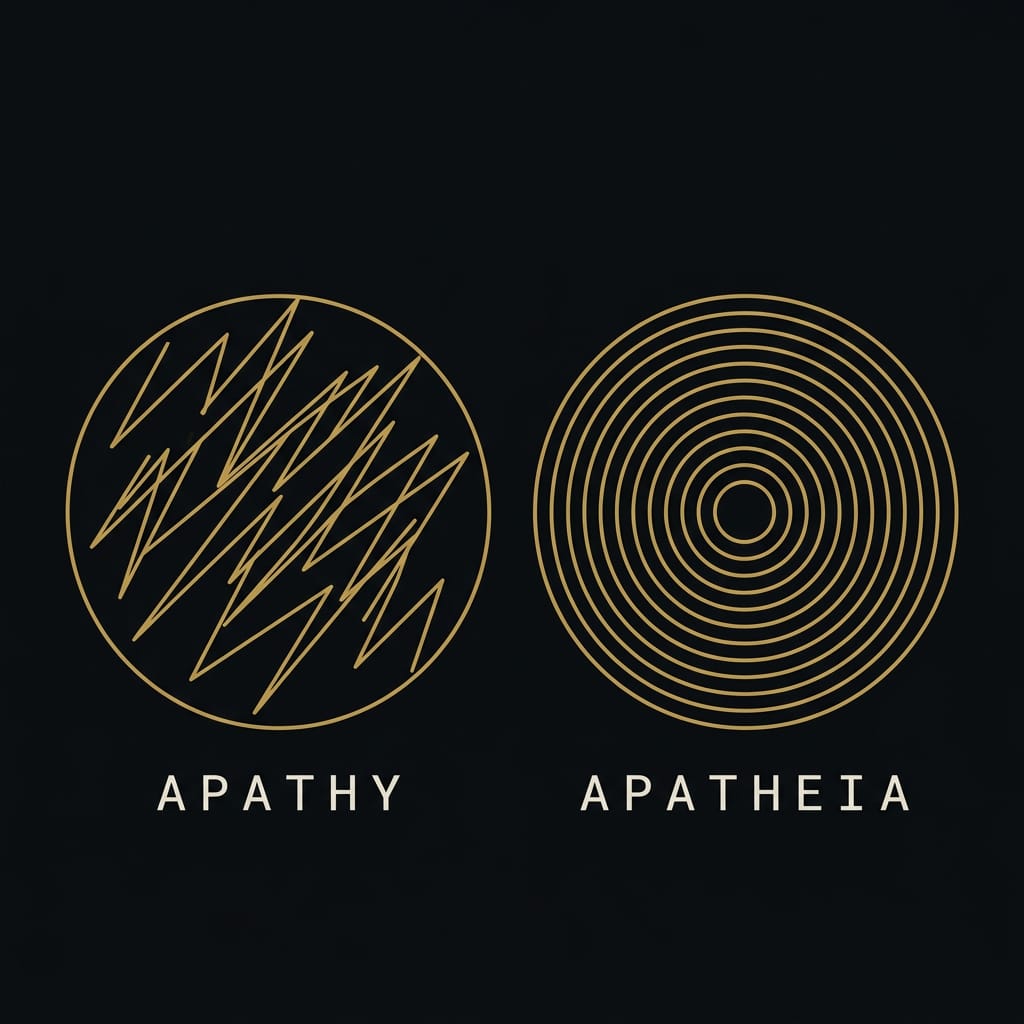
Second, the central Stoic goal — apatheia — is the direct root of the English "apathy." They are not the same idea. Apatheia meant freedom from destructive passion: no longer being yanked around by irrational fear, rage, or grief-driven despair. Apathy means not caring. A Stoic who has achieved apatheia cares intensely — about virtue, about the people close to them, about doing the right thing under pressure — while no longer being hijacked by panic when things go wrong.
Popular culture reinforced the mix-up further with icons of unfeeling logic — coldly rational characters built for drama, not philosophy. None of that comes from the Stoa. Zeno, Cleanthes, and Chrysippus, who founded and developed Stoicism in Athens starting around 300 BC, never described the wise person as cold. They described someone whose feelings finally tracked reality instead of distorting it.
The Ancient Stoics on Grief, Anger, and Joy
The primary texts settle this more directly than any modern summary can.
Marcus Aurelius, writing privately in what became the Meditations, returns often to anger — not to deny feeling it, but to catch it early. In one of the collection's sharper lines on the subject, at 11.18, he reminds himself how much more damage anger does to the angry person than whatever provoked it. That's not the voice of someone incapable of anger. It's the voice of someone who has felt it enough times to distrust it.
Seneca went further and wrote an entire treatise on the subject, On Anger (De Ira). His argument there is that the shudder before a threat, the quickened pulse before confrontation, are not yet passions at all — he called these "first movements," involuntary bodily responses that arrive before reason has judged anything. The passion only forms afterward, when the mind assents to the reaction and builds a story on top of it. This is the closest the Stoics came to modern research on the gap between stimulus and response, arrived at without a laboratory.
Grief gets the same honest treatment. Seneca's consolation letters — including one written to a friend mourning the death of a son — permit tears outright. His objection was never to sorrow itself, only to sorrow that never resolves or that a person actively feeds rather than works through. Epictetus made a related point in the Enchiridion: it's appropriate to sit with a grieving friend, share their words, even grieve alongside them outwardly — the caution is only against letting the despair take root in your own private judgment, where it can do more lasting damage. For a fuller look at how this plays out in practice, see how Stoicism approaches grief and Stoicism approaches anger specifically.
Passions, First Movements, and Good Feelings
The Stoics actually built a three-part framework for emotional life, and most modern summaries only mention one piece of it.
- First movements (propatheiai) — involuntary physical reactions: the startle at a loud noise, the blush of embarrassment, the racing heart before a difficult conversation. These happen before judgment and are not under direct control. The Stoics didn't count them as moral failures.
- Passions (pathe) — the excessive, irrational states that form when reason wrongly assents to a first movement: panic, uncontrolled rage, crushing despair, reckless craving. This is the actual target of Stoic training — not the spark, but the decision to let it become a fire.
- Good feelings (eupatheiai) — rational, accurate emotional responses the Stoics considered healthy and worth cultivating. The philosopher Diogenes Laërtius, cataloguing Stoic doctrine in his Lives of the Eminent Philosophers (book 7), lists three: joy at something genuinely good, caution toward something genuinely worth avoiding, and wish for something genuinely worth pursuing. Nothing about apatheia rules these out — the Stoics treated them as the emotional signature of a well-reasoned life.
That third category is the part almost every popular retelling drops. Stoicism doesn't have a plan for eliminating positive feeling. It has a plan for making sure your feelings — all of them — are responding to what's actually true, not to a story your mind invented under stress.

How to Practice Emotional Mastery, Not Suppression
This is where the philosophy becomes something you can actually do, and the difference from suppression matters in practice, not just in theory.
- Name the first movement without acting on it. When your pulse spikes or your face goes hot, notice it as data — "my body registered a threat" — rather than as a verdict on what to do next.
- Ask what judgment sits underneath the feeling. Anger at a canceled meeting usually hides a belief like "my time was disrespected." State the belief plainly and check whether it's actually true.
- Separate what's yours from what isn't. The other driver's recklessness isn't yours to control; your response to it is. This single move — central to the dichotomy of control — defuses more reactive emotion than any amount of willpower.
- Let the rational feelings run. Genuine joy at a friend's win, real caution before a risky decision, honest affection for people who matter — none of this needs editing. Stoic practice protects these, it doesn't ration them.
- Write it down at night. A short evening review of where a judgment ran ahead of the facts trains the skill faster than trying to catch it live, every time, in the moment.
None of these steps require going numb. They require slowing down the half-second between a trigger and a story, which is exactly the same terrain covered in a broader look at how to practice Stoicism day to day.
Common Misconceptions About Stoic Emotion
"Stoics don't cry." They do. Seneca's own consolation letters describe tears as a natural and appropriate response to real loss — his target was excess and permanence, never the tears themselves.
"Stoicism means bottling things up." Bottling up is suppression without examination — exactly what the philosophy warns against, since an unexamined feeling tends to resurface later, usually worse. Stoic practice is closer to interrogation than storage.
"A true Stoic never gets angry." Marcus Aurelius records his own anger repeatedly in the Meditations, precisely because he kept catching it in himself. The goal was never zero anger. It was catching it before it decided his behavior.
Where This Fits in Stoic Practice
Emotional judgment sits inside a larger structure, not off to the side of it. It connects directly to the four Stoic virtues — specifically temperance, the virtue of proportion, and wisdom, the virtue of judging correctly in the first place. A feeling handled well is really those two virtues doing their job in real time.
It also isn't a once-a-week insight. The Stoics treated it as daily maintenance, which is why morning intention-setting and evening review appear so often in the primary texts — the same rhythm behind a Stoic morning routine. The goal was never a permanent, effortless calm. It was a person who, faced with the same provocation for the hundredth time, responds a little better than the ninety-ninth.
Track your own reactions with a daily Stoic prompt
Join the WaitlistFree Quiz
Which Stoic Are You?
A 3-minute personality quiz — Marcus, Seneca, Epictetus, or Cato.
FAQ
Are Stoics emotionless?
No. Stoics are not emotionless — Stoicism does not ask anyone to stop feeling. It asks you to stop letting unexamined judgments about events turn into destructive passions like rage, panic, or despair, while still allowing rational, positive feelings such as joy, affection, and caution to remain fully in play.
Did the Stoics believe in suppressing all emotion?
No. Suppression was never the goal — the Stoics distinguished between involuntary physical reactions (called first movements), destructive passions built on false judgments, and healthy rational emotions they called the eupatheiai. Only the second category was the target of Stoic training; the other two were treated as normal or even good.
What is apatheia in Stoicism?
Apatheia is freedom from destructive passion, not the absence of feeling — the word is the root of "apathy" but does not mean the same thing. A Stoic with apatheia has stopped being controlled by irrational fear, rage, or grief-driven despair, while still experiencing joy, love, and caution, which the Stoics considered rational and worth keeping.
Is it normal for a Stoic to grieve?
Yes. Seneca wrote letters of consolation that explicitly permit tears and sorrow at real loss — his objection was to grief that overwhelms judgment or never ends, not to grief itself. A Stoic response to loss is to feel it honestly while refusing to let it collapse into despair or self-destruction.
What's the difference between a passion and a normal emotion in Stoicism?
A passion (pathos) in Stoic terms is an excessive, irrational impulse built on a false judgment — for example, believing a delayed flight is a catastrophe. A normal, rational feeling (eupatheia) responds accurately to what's actually happening, like feeling genuine joy at a friend's success or caution before a real risk.
How do Stoics deal with anger?
Stoics treat anger as a judgment error worth catching early, not a feeling to bottle up. Seneca's advice in On Anger was to notice the first spark — the racing pulse, the tightening jaw — and delay any response until reason has checked whether the anger is justified, since delay defuses most of it before it becomes destructive.


Marcus Adler
Founder & Lead Writer, StoicNow
Marcus Adler is the founder of StoicNow. For over a decade he has applied Stoic philosophy to daily life — testing the practices of Marcus Aurelius, Seneca, and Epictetus against modern problems and translating them into simple, repeatable routines. More about the author →
Further reading