Quick answer
No. Stoicism is a philosophy — a practical way of life built on reason and virtue — not a religion. It has no worship, no scripture, no clergy, and no doctrine of salvation or the afterlife, even though the ancient Stoics did believe in a divine cosmic order.
The question “is Stoicism a religion?” comes up constantly — from beginners trying to place it, and from religious people quietly worried it might compete with their faith. The short answer is no. The useful answer is to look at exactly where Stoicism touches religion and where it walks away.
Stoicism is a philosophy: a structured system for thinking and living well. The confusion is understandable, because the ancient Stoics talked about God, providence, and “the gods” in ways that sound religious to a modern ear. But talking about the divine is not the same as being a religion. Plenty of philosophers discuss God without founding a church.
This article gives you the clear answer first, then defines what actually makes something a religion, maps the overlap honestly, and answers the question most people are really asking: can I keep my faith — or my atheism — and still practice Stoicism?
The Short Answer, and Why People Ask
Stoicism is a school of philosophy founded by Zeno of Citium around 300 BC in Athens. Its purpose is to help you live a good life through reason, the cultivation of virtue, and the discipline of accepting what you cannot control. That is the whole project. There is no god you must worship, no ritual you must perform, and no congregation you must join.
So why does the question keep coming up? Three reasons. First, Stoicism has practices — morning routines, evening reflection, repeated readings — that feel a bit like spiritual discipline. Second, the ancient texts are saturated with talk of God, Nature, and fate. Third, in 2026 Stoicism has communities, influencers, and a vocabulary, which can superficially resemble a movement with believers.
None of that makes it a religion. To see why, you first have to be precise about what a religion actually is.
What Actually Makes Something a Religion
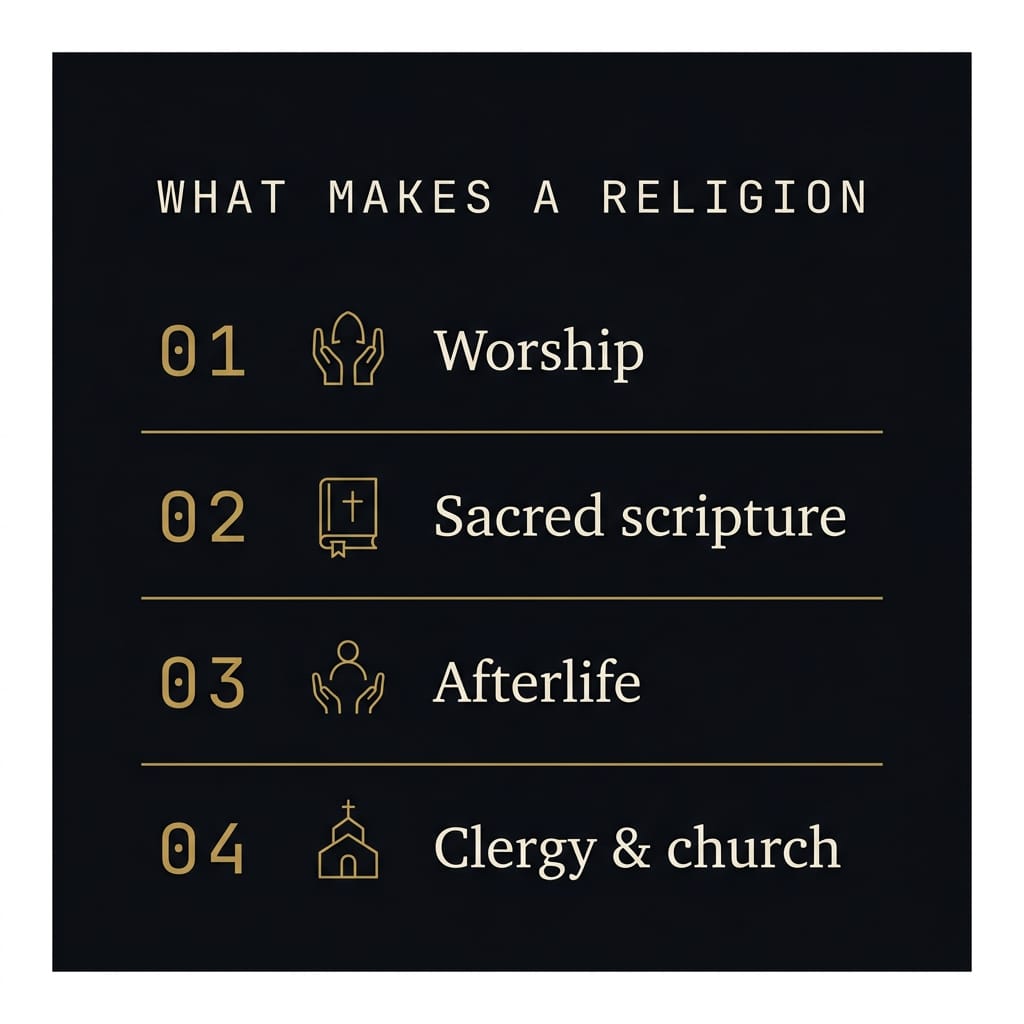
“Religion” is a contested word, but scholars generally agree on a cluster of features. No single one is decisive, but a tradition that checks most of these boxes is a religion; one that checks almost none is not. Here is the working checklist:
- A god or gods to worship — a supernatural being you direct devotion, prayer, or sacrifice toward.
- Revealed scripture — sacred, authoritative texts treated as divine revelation, not human argument.
- A doctrine of the afterlife — heaven, hell, reincarnation, judgment, or salvation.
- Ritual and worship — required ceremonies, sacraments, observances, holy days.
- Clergy and institution — priests, a church, a hierarchy with the authority to define belief.
- A creed of required beliefs — a set of dogmas you must accept to belong.
Run Stoicism through this list and the result is striking: it matches one item partially — the divine — and fails every other one outright. Let us take the one place it overlaps first, because it is real and worth understanding.
Where Stoicism Looks Religious: The Logos and the Stoic God
The ancient Stoics were not atheists. They believed the universe was governed by a rational, ordering principle they called the logos — reason itself, woven into the fabric of reality. They called this principle by several names: Nature, Zeus, Providence, or simply God. Crucially, this was pantheism: God was not a separate creator standing outside the world, but the rational structure of the world. To the Stoics, the cosmos was a single, living, intelligent system, and you were a small rational part of it.
This is why Marcus Aurelius and Epictetus both speak of “the gods.” Marcus repeatedly tells himself to live in harmony with the cosmic whole:
“Everything harmonizes with me which is harmonious to thee, O Universe. Nothing for me is too early nor too late, which is in due time for thee.” — Marcus Aurelius, Meditations 4.23
Epictetus goes further, treating gratitude toward the divine as a basic duty — but notice how he defines piety. It is not ritual; it is having correct judgments:
“In piety towards the gods… the chief thing is this, to have right opinions about them — as existing, and as governing the universe well and justly.” — Epictetus, Enchiridion 31
This is the overlap, and it is genuine. Stoicism has a concept of the divine, a belief in providence, and a sense of cosmic order that asks you to accept your place in it — the attitude later named amor fati, love of fate. If “believing in a divine principle” were enough to make something a religion, Stoicism would qualify. But it is not enough, and the rest of the checklist makes that clear.
Where Stoicism Is Clearly Not a Religion
Take the criteria one by one. This is where the “philosophy, not religion” verdict becomes obvious rather than asserted.
No worship. The Stoic God is the rational order of the universe, not a personality who answers prayers, demands sacrifice, or grants favors. Epictetus’s “piety” is right judgment about the cosmos, not devotion to a deity. You align with the logos; you do not petition it.
No revealed scripture. The Meditations, Seneca’s Letters, and Epictetus’s Discourses are human writings — arguments to be tested, not divine revelation to be obeyed. You are free to disagree with Marcus, and Stoics regularly do. No text claims a god as its author.
No doctrine of the afterlife. Stoicism offers no heaven, hell, or judgment. Most Stoics believed the soul simply dissolved back into the cosmos at death. Marcus treats death as a natural return, to be met calmly — a theme our memento mori practice draws on directly. There is no salvation to earn.
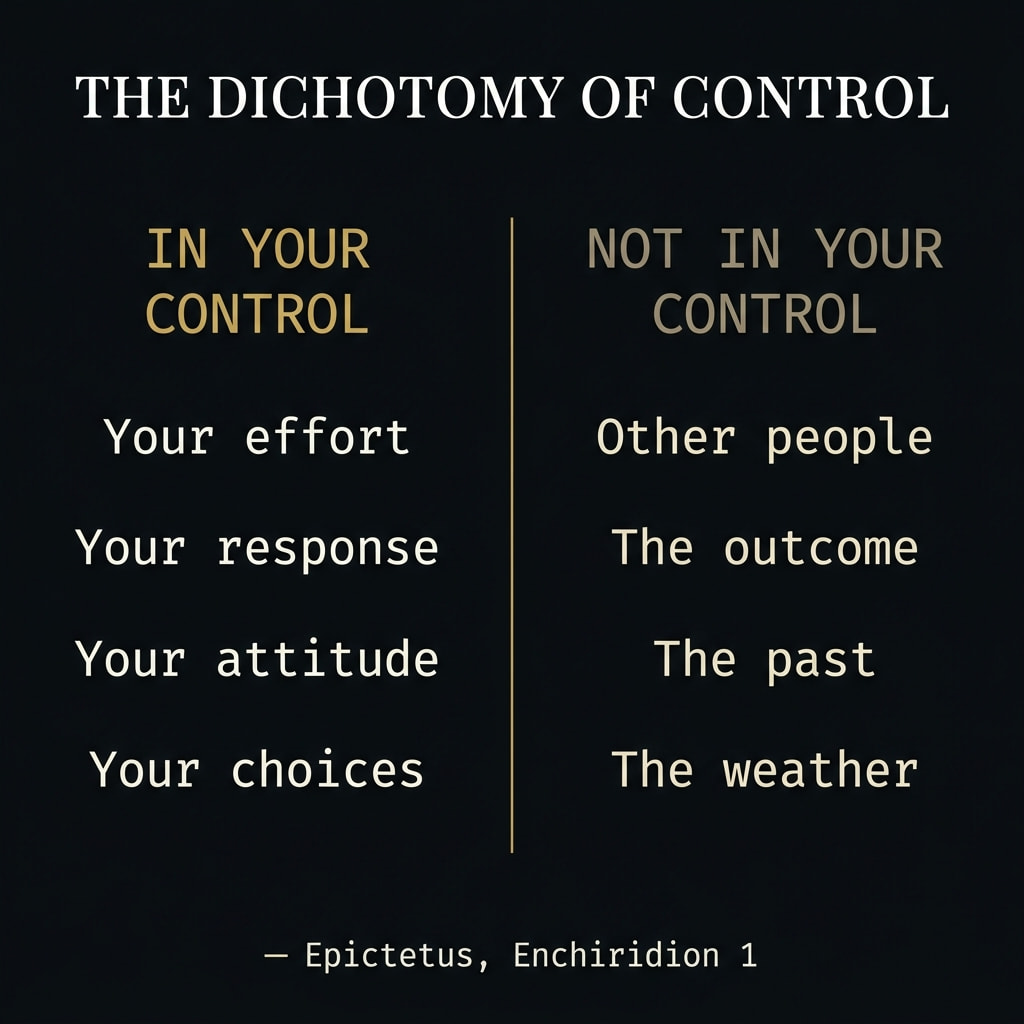
No clergy, church, ritual, or required creed. There is no Stoic priesthood, no building, no sacrament, no holy day, and no authority empowered to say who is a “real” Stoic. You can adopt the dichotomy of control and the four virtues without signing up to anything.
One genuine overlap, five clean misses. Stoicism is a philosophy that happens to include a theology — not a religion built around one.
Build the daily Stoic practice in StoicNow
Join the WaitlistCan You Be Religious — or Atheist — and Still Be Stoic?
This is the real question behind the search. And because Stoicism is a philosophy rather than a rival religion, the answer is almost always yes. A philosophy of how to live can sit alongside a faith about what is ultimately true. Here is how it lands across the major positions.
Christianity
Christianity and Stoicism have intertwined for two thousand years. Stoic ideas about self-control, providence, and the brotherhood of humanity shaped early Christian thinkers, and a forged correspondence between Seneca and Saint Paul circulated for centuries precisely because the two felt compatible. Many Christians today practice Stoicism as a discipline — governing anger, accepting what they cannot change, focusing on their own conduct — while keeping God, scripture, and worship as the religious core. The Serenity Prayer is, in effect, the dichotomy of control in Christian dress.
Islam and Judaism
Both traditions pair naturally with Stoic practice. The emphasis on patience and acceptance of God’s will (sabr in Islam) maps closely onto Stoic acceptance, and Jewish thought has a long history of engaging ethical philosophy. A Muslim or Jewish practitioner keeps the revealed elements their faith requires — which Stoicism does not provide — and uses the Stoic tools for daily temperament and resilience.
Buddhism
Buddhism is itself often debated as “philosophy or religion,” and it shares a great deal with Stoicism: managing desire, observing the mind, accepting impermanence. The two are highly compatible as practices, though their metaphysics differ. We compare them in depth in Stoicism vs Buddhism.
Atheism and Agnosticism
Here is the modern twist: a large share of today’s Stoics do not believe in God at all. Secular Stoicism simply reinterprets the ancient logos as the impersonal natural order — physics, cause and effect — rather than a divine intelligence. The core practices survive the swap completely intact, because they never depended on theology in the first place. Negative visualization, the four virtues, and the dichotomy of control work whether or not you think the universe is providential.
So What Is Stoicism, Then?
It is a practical philosophy — a way of life. The Greeks did not separate philosophy from living the way we do; for them, a philosophy was something you practiced daily, like a craft. Stoicism in particular is less a theory to believe than a set of disciplines to run: examine your judgments, separate what is yours to control from what is not, act with virtue, accept the rest.

This is precisely why the “philosophy, not religion” distinction matters so much, and why it is not mere pedantry. Because Stoicism makes no claim on your ultimate beliefs — demanding no god, no afterlife, no creed — it slots into a Christian’s life, a Muslim’s, an atheist’s, or a Buddhist’s without conflict. A religion asks “what should you believe about the universe?” Stoicism mostly asks “how should you behave inside it, today?” That narrower question is the secret to its reach.
If you want to test that for yourself, the entry point is not belief — it is practice. Start with how to practice Stoicism, run the disciplines for a few weeks, and judge the philosophy by its effects on your temperament, not by its theology. That, fittingly, is the most Stoic way to approach the whole question.
Free Quiz
Which Stoic Are You?
A 3-minute personality quiz — Marcus, Seneca, Epictetus, or Cato.
FAQ
Is Stoicism a religion or a philosophy?
Stoicism is a philosophy, not a religion. It is a structured way of life built on reason, virtue, and the practice of focusing only on what is within your control. While the ancient Stoics did believe in a divine cosmic order, Stoicism has no worship, no revealed scripture, no clergy, no church, and no doctrine of salvation or the afterlife — the defining features of a religion.
Did the Stoics believe in God?
The ancient Stoics believed in a divine, rational principle called the logos that orders the universe — sometimes called God, Nature, or Zeus, and often spoken of as “the gods.” This was pantheistic: God was not a separate creator but the rational structure of reality itself. Marcus Aurelius and Epictetus both address the gods, but modern Stoics frequently practice without any belief in God at all.
Can a Christian be a Stoic?
Yes. Many Christians practice Stoicism, and the two have deep historical ties — Stoic ideas shaped early Christian thought, and Seneca was even falsely rumored to have corresponded with Saint Paul. Because Stoicism is a philosophy rather than a competing religion, a Christian can adopt its practices — self-control, acceptance, focusing on what they can govern — while keeping their faith, scripture, and worship intact.
Is Stoicism compatible with atheism?
Yes. A large share of modern Stoics are atheists or agnostics. Because Stoicism is a philosophy, not a religion, its core practices — the dichotomy of control, the four virtues, negative visualization — stand on their own without any belief in God. Secular Stoicism simply reinterprets the ancient “logos” as the natural order of the universe rather than a divine intelligence.
Do Stoics believe in an afterlife?
Stoicism has no fixed doctrine of the afterlife, which is one reason it is not a religion. The Stoics generally believed the soul returned to the cosmos at death, with no heaven, hell, or judgment. Marcus Aurelius treated death as a natural dissolution to be accepted calmly, not a gateway to reward or punishment. Belief in an afterlife is left to the individual.
Is Stoicism a cult?
No. Stoicism is neither a religion nor a cult. It has no leader, no membership, no required beliefs, no rituals you must perform, and nothing to join or pay into. It is an open body of writing — Marcus Aurelius, Seneca, Epictetus — that anyone can read, test, and adopt in part or in whole. There is no authority that defines who counts as a “real” Stoic.

Marcus Adler
Founder & Lead Writer, StoicNow
Marcus Adler is the founder of StoicNow. For over a decade he has applied Stoic philosophy to daily life — testing the practices of Marcus Aurelius, Seneca, and Epictetus against modern problems and translating them into simple, repeatable routines. More about the author →
Further reading