Quick answer
Frases estoicas para el día a día are short lines pulled from Marcus Aurelius, Epictetus, and Seneca — used at a specific moment, not framed on a wall, to interrupt a bad judgment before it becomes a bad reaction. Fifteen of them, sorted by when you actually need each one, are below.
A Stoic phrase is not a decoration. It is the compressed conclusion of an argument that took Marcus Aurelius, Epictetus, or Seneca an entire chapter to build — built to survive contact with a bad morning, not to sit quietly in a caption. Used badly, a Stoic quote is a poster. Used well, it is a lever you pull the moment your judgment starts to slip.
Below are fifteen genuine lines from the three main Stoic texts, each with its real citation, organized by the moment you're most likely to reach for it — and, more useful than the list itself, a method for actually applying one instead of just reading it.

What “Frases Estoicas Para El Día a Día” Actually Means
The phrase translates plainly from Spanish: Stoic phrases for day-to-day life. It describes a specific kind of quote — not a generic motivational line, but a short sentence lifted from a primary Stoic text and repeated on purpose, on a schedule, at a moment of friction. The distinction matters. A wall poster gets read once and ignored forever. A daily Stoic phrase is meant to be used the way Stoic practice in general is meant to be used: repeatedly, in the exact situation it was written for.
Marcus Aurelius, Epictetus, and Seneca did not write inspirational one-liners. Each surviving phrase sits inside a longer argument — usually about the dichotomy of control, the shortness of time, or one of the four Stoic virtues. What makes a line worth memorizing is that it survives being pulled out of that argument intact. The fifteen below all do.
Where These Phrases Actually Come From
Every genuine Stoic phrase traces back to one of three texts, written in three different genres, for three different reasons.
None of the three set out to produce quotable lines. Marcus was arguing with himself; Epictetus was teaching students who would go on to repeat his lessons from memory; Seneca was corresponding with a specific man about a specific worry. The phrases that survived as daily lines did so because they compress an entire argument — usually about what is or isn't up to you — into a sentence short enough to remember mid-crisis.
“Some things are up to us, and some are not up to us.” — Epictetus, Enchiridion 1
That single line, the opening of the Enchiridion, is the root that almost every other Stoic phrase on this list grows from. Once it's internalized, the rest of the list is mostly variations on the same test applied to a different situation.
15 Frases Estoicas Para El Día a Día, By the Moment You Need Them
For the Morning
- “When you wake up in the morning, tell yourself: the people I deal with today will be meddling, ungrateful, arrogant, dishonest, jealous, and surly.” — Marcus Aurelius, Meditations 2.1. A pre-emptive lowering of expectations, not cynicism — it's the same move behind his broader morning routine.
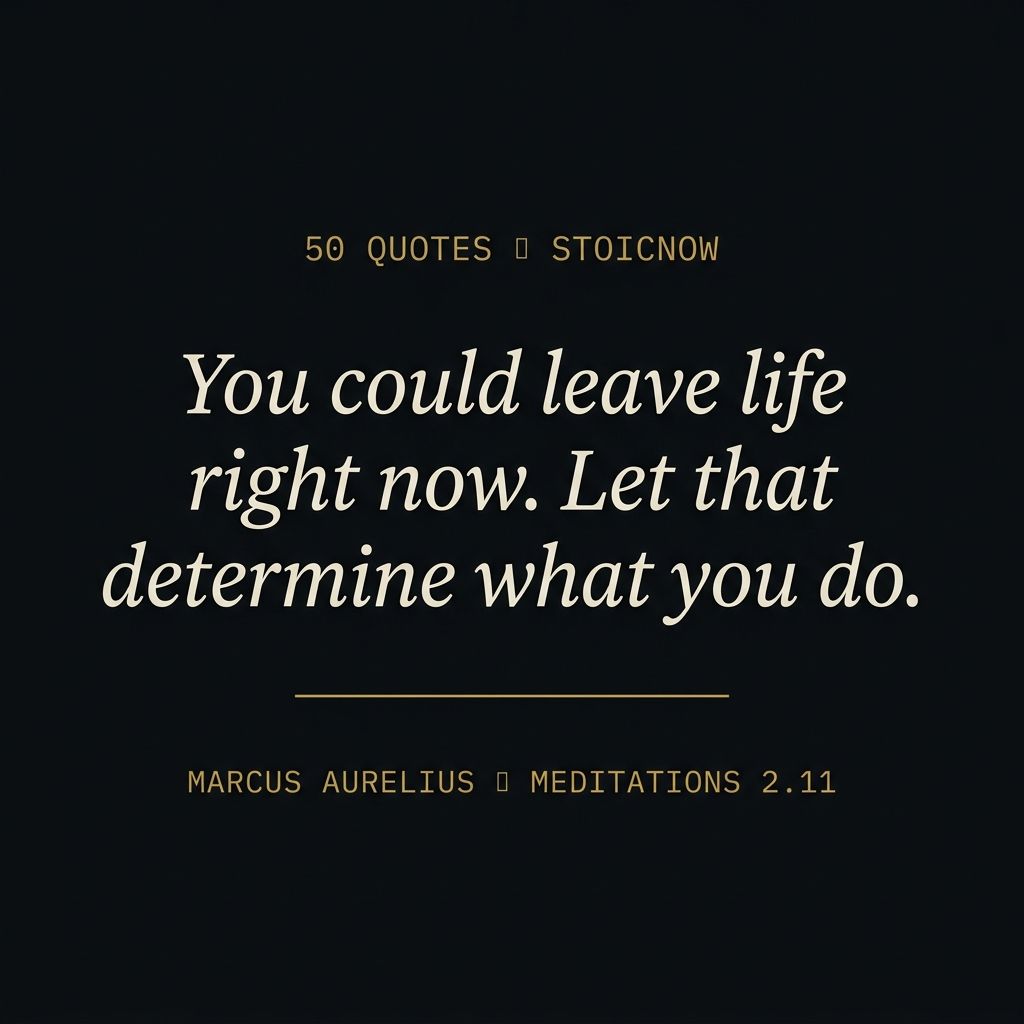
- “You could leave life right now. Let that determine what you do and say and think.” — Marcus Aurelius, Meditations 2.11. A daily dose of memento mori, used as a filter for the day ahead rather than a source of dread.
- “Do not seek to have events happen as you wish, but wish them to happen as they do happen, and you will go on well.” — Epictetus, Enchiridion 8. The Stoic version of amor fati as a working instruction, not a slogan.
- “While we are postponing, life speeds by.” — Seneca, Letters 1. Seneca's opening line to Lucilius, about the one asset — time — nobody can get back.
- “It is not that we have a short time to live, but that we waste a lot of it.” — Seneca, On the Shortness of Life 1. Less a complaint about mortality than an audit of how the previous day actually went.

For a Hard Moment
- “Some things are up to us, and some are not up to us.” — Epictetus, Enchiridion 1. The line every version of the dichotomy of control traces back to.
- “It is not events that disturb people, but their judgments about events.” — Epictetus, Enchiridion 5. The single most useful line to have ready during an argument, before you've finished reacting.
- “If you are pained by any external thing, it is not this that disturbs you, but your own judgment about it. And it is in your power to wipe out this judgment now.” — Marcus Aurelius, Meditations 8.47. The same idea, restated as an instruction you can act on immediately.
- “The impediment to action advances action. What stands in the way becomes the way.” — Marcus Aurelius, Meditations 5.20. Read more on the obstacle is the way for the fuller argument behind this one.
- “We suffer more often in imagination than in reality.” — Seneca, Letters 13. Worth pairing with a real check against what's actually happening versus what you're rehearsing.
- “Disease is an impediment to the body, but not to the will, unless the will itself chooses.” — Epictetus, Enchiridion 9. A hard-edged line for physical setbacks specifically, not just emotional ones.
At Night
- “Nowhere can a man find a quieter or more untroubled retreat than in his own soul.” — Marcus Aurelius, Meditations 4.3. A closing line for a stoic evening reflection more than a morning one.
- “He who has learned how to die has unlearned how to be a slave.” — Seneca, Letters 26.8. Blunt, but meant to be read at the end of a day, not the start of one.
- “Do not act as if you had ten thousand years to throw away. Death stands at your elbow. Be good for something while you live and it is in your power.” — Marcus Aurelius, Meditations 4.17.
- “Let death and exile, and all other things which appear terrible, be daily before your eyes; but most of all death: and you will never think of anything mean, nor desire anything extravagantly.” — Epictetus, Enchiridion 21. A direct instruction toward negative visualization, done as a nightly review rather than a one-time exercise.
How to Actually Use One (Not Just Read It)
A phrase that lives in a bookmarked tab does nothing. Four things turn it into something usable.
Pick one, not fifteen. Seneca often built an entire letter around a single line rather than stacking several. Choose the phrase from the list above that matches what you're actually dealing with this week — a hard conversation, a health scare, a wasted afternoon — and stay with it.
Write it on an index card or the lock screen, attach it to a fixed trigger — before opening email, before a specific meeting, before bed — and run it through a real test rather than just reciting it. The dichotomy of control worksheet is a direct way to do this: write down the thing bothering you, then split it into what's actually up to you and what isn't, using the phrase as the filter.

If a phrase isn't sticking, write about it rather than just repeating it. A handful of stoic journal prompts built around the same line will surface whether you actually understand the argument behind it or are just reciting words. And if the whole approach still feels abstract, a structured run like the 30-day Stoic challenge forces the repetition that makes a phrase automatic instead of decorative.
What These Phrases Are Not
Three things people get wrong about a daily Stoic line, each worth correcting before it undermines the practice.
Not suppression. “It is not events that disturb people, but their judgments” is not an instruction to stop feeling anything. See are Stoics emotionless? for what the texts actually say — the target is the judgment, not the emotion itself.
Not fatalism. “Wish [events] to happen as they do happen” sounds passive until you read what amor fati actually requires: full acceptance of the outcome, combined with full effort beforehand. The phrase governs your reaction, not your preparation.
Not a mood affirmation. “I am calm” describes a feeling you'd like to have. “Some things are up to us, and some are not” makes you do something — sort the situation into two columns. That structural difference is the whole reason one survives a real crisis and the other doesn't.

Where Daily Phrases Fit Into a Full Stoic Practice
A memorized line is a starting point, not the whole discipline. It sits alongside the broader set of exercises covered in how to practice Stoicism — morning preparation, evening review, and the recurring test of what's actually within your control. On its own, a phrase is a reminder. Combined with a worksheet, a journal habit, and a fixed daily trigger, it becomes closer to what Marcus, Epictetus, and Seneca actually meant it to be: a tool used under pressure, not a line read once and admired.
“The impediment to action advances action. What stands in the way becomes the way.” — Marcus Aurelius, Meditations 5.20
Get one Stoic phrase a day in StoicNow
Join the WaitlistFree Quiz
Which Stoic Are You?
A 3-minute personality quiz — Marcus, Seneca, Epictetus, or Cato.
FAQ
What are frases estoicas para el día a día?
Frases estoicas para el día a día are short lines drawn from Marcus Aurelius, Epictetus, and Seneca, meant to be repeated at a specific moment — on waking, mid-crisis, before sleep — to interrupt a bad judgment before it hardens into a bad reaction. Each phrase compresses a full Stoic argument, usually about the dichotomy of control or the shortness of time, into one recallable sentence.
Where do these Stoic phrases actually come from?
They come from three primary texts: Marcus Aurelius's Meditations (a private journal, c. 170–180 AD), Epictetus's Enchiridion and Discourses (compiled by his student Arrian, c. 108 AD), and Seneca's Letters to Lucilius (c. 62–65 AD). None were written as inspirational quotes — each line sits inside a longer argument about judgment, time, or virtue.
How many Stoic phrases should I actually use in a day?
One is usually enough. Stoic teachers returned to a single short principle across an entire letter or chapter rather than stacking many at once — Seneca often built a whole letter around one line. Pick the phrase that matches what you're facing that day, apply it at the moment of friction, and let it work before reaching for another.
Are Stoic phrases the same thing as affirmations?
No. An affirmation restates a feeling you want to have — “I am calm.” A Stoic phrase points at a judgment you're making and questions it directly: is this within my control? The Stoic line forces a decision. An affirmation just repeats a mood, and moods rarely survive contact with a real crisis.
What is the most famous Stoic phrase for daily life?
Epictetus's opening line of the Enchiridion is the most cited: “Some things are up to us, and some are not up to us.” It underlies nearly every other Stoic phrase — the dichotomy of control — and is usually the first line worth memorizing before any other.
How do I remember to actually use a phrase during the day?
Attach it to a trigger, not a mood. Write the phrase on an index card and read it at a fixed point — before opening email, before a difficult meeting, before bed — rather than waiting to feel like you need it. A Stoic evening reflection is also a reliable place to review whether you actually used it.

Marcus Adler
Founder & Lead Writer, StoicNow
Marcus Adler is the founder of StoicNow. For over a decade he has applied Stoic philosophy to daily life — testing the practices of Marcus Aurelius, Seneca, and Epictetus against modern problems and translating them into simple, repeatable routines. More about the author →
Further reading