Quick answer
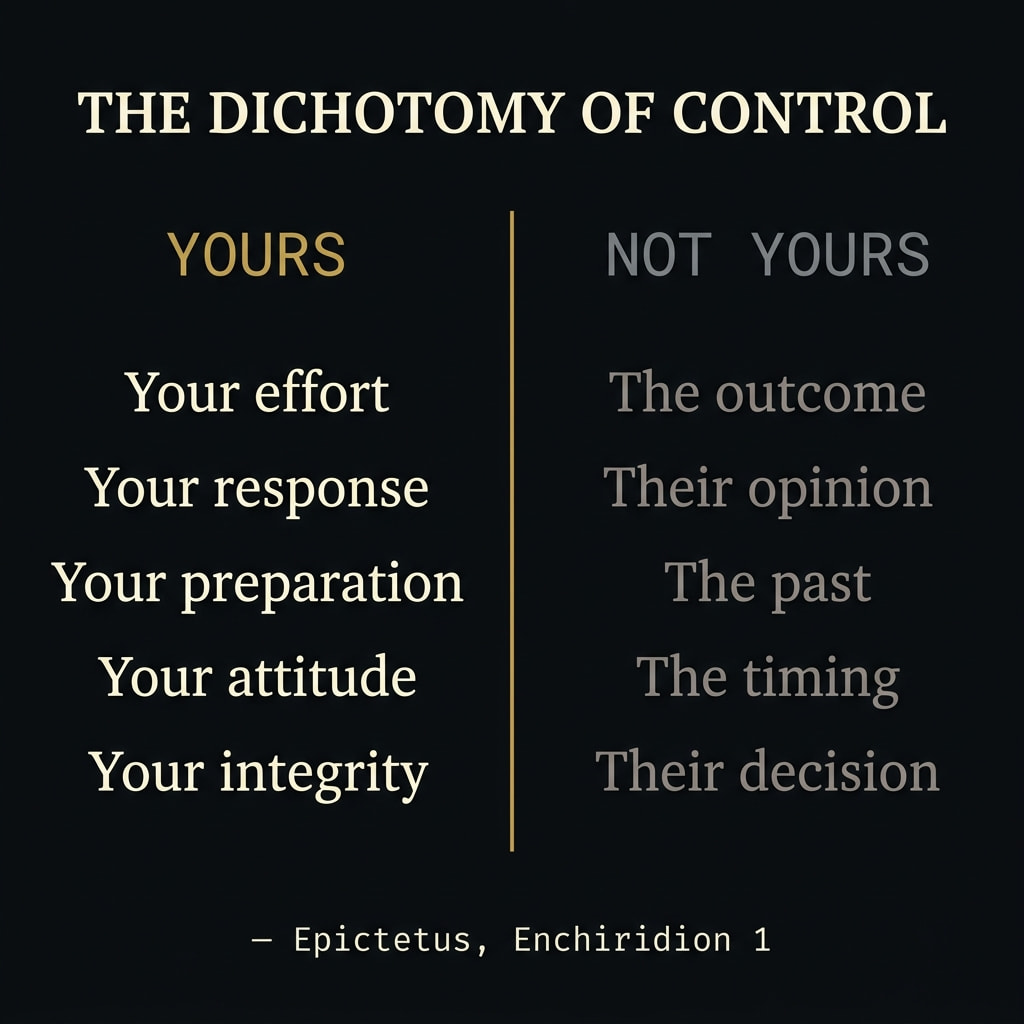
Chapter 1 of the Enchiridion draws Epictetus's foundational line: some things are in our power — our judgments, desires, and aversions — and everything else, including our body, property, and reputation, is not. Confusing the two, he argues, is the root of nearly all human disturbance.
The Enchiridion doesn't ease in. Its very first sentence draws a line down the middle of human experience and tells you that almost everyone gets which side they're standing on wrong. Get the line right, Epictetus says, and no one can touch you. Get it wrong, and you'll spend your life blaming gods and men for things that were never yours to control.
That single distinction — what later students of Stoicism call the dichotomy of control — is the whole of Chapter 1. Here is exactly what it says, where it comes from, and how to actually use it.

What Chapter 1 Actually Says
The chapter opens with a claim, not an argument. Epictetus states it as a fact about the world, the way a physicist might state a law:
“Of things some are in our power, and others are not. In our power are opinion, movement toward a thing, desire, aversion, and, in a word, whatever affairs are our own. Not in our power are the body, property, reputation, offices, and, in a word, whatever are not properly our own affairs.” — Epictetus, Enchiridion 1.1 (trans. W. A. Oldfather, Loeb Classical Library, 1925)
Plainly: your mind produces judgments, intentions, wants, and rejections, and those are entirely yours — no one and nothing outside you can force you to judge, want, or reject something you don't choose to. Your body, your bank balance, your job title, and what other people think of you are not yours in that sense. They can be taken, changed, or ruined by forces that have nothing to do with your will.
The chapter then spells out the stakes of mixing the two up, and closes with a warning about the effort the distinction actually requires. It is short — a page, at most — and it is the hinge the rest of the Enchiridion swings on.
Where the Enchiridion Comes From
Epictetus was born a slave in Hierapolis, in what is now Turkey, and was later freed in Rome. After the emperor Domitian expelled philosophers from the city around 89 AD, he settled in Nicopolis, in northwestern Greece, and taught there for the rest of his life. He never wrote a word of his own philosophy down.
What survives comes from a student, Arrian of Nicomedia, who sat in on Epictetus's lectures and took notes. Arrian later compiled the fuller lecture transcripts into the Discourses, and distilled the practical core of that teaching into a short manual he titled the Enchiridion — Greek for “handbook,” something meant to be kept close at hand rather than studied once and shelved. Chapter 1 is where that handbook begins, and Arrian clearly meant it as the entry point: everything else assumes you've absorbed this first.
The Two Lists
Epictetus is specific about what belongs on each side of the line. It helps to see both lists laid out plainly.
What's Up to You
- Your opinions and judgments — how you interpret an event, not the event itself.
- Your impulses — the pull toward or away from acting on something.
- Your desires — what you want and choose to pursue.
- Your aversions — what you reject or choose to avoid.
What's Not Up to You
- Your body — health, illness, aging, injury.
- Your property — money, possessions, anything that can be taken.
- Your reputation — what other people think or say about you.
- Rank and office — titles, promotions, positions that depend on others granting them.
Later Stoics gave the "up to us" category a name — prohairesis, the faculty of judgment and choice. It is the one thing Epictetus insists is truly, permanently yours, because it is the one thing no external force can seize by taking your body, your money, or your standing. See how this plays out concretely in our dichotomy of control examples, or work through it yourself with a dichotomy of control worksheet.

Why Epictetus Puts This First
Chapter 1 isn't a warm-up. It's load-bearing. Nearly every later chapter of the Enchiridion — on grief, insult, illness, the death of people we love — only makes sense if you've already accepted this division. Epictetus can tell you not to be disturbed by an insult only because he's already established, in Chapter 1, that another person's words are not yours to control; your reaction to them is.
He is also blunt about what happens if you get it backwards. If you treat things that aren't yours — your health, your reputation, other people's behavior — as though they were, he says you will inevitably be hindered, feel restless, and end up blaming both the gods and the people around you for outcomes that were never within your reach in the first place. Grief, resentment, and anxiety, in his account, are almost always downstream of this one mistake: claiming ownership of something you don't actually own.
Flip it the right way, and the promise is equally direct: claim only what's genuinely yours — your judgments and choices — and nothing can compel you against your will, you'll have no real enemy, and no one can harm the part of you that matters. That's a large claim for one paragraph of ancient Greek, and it's worth taking seriously precisely because Epictetus lived it: he taught this from a position of having lost, at various points, his freedom, his health, and his standing, and having kept, by his own account, the one thing the philosophy said he could keep.
How to Apply Chapter 1 Today
The idea is simple to state and hard to run in real time, mostly because most situations arrive pre-mixed — part yours, part not. A missed flight, a rude email, a diagnosis: each one bundles an external fact with your judgment about it. The practical skill Chapter 1 is asking you to build is the habit of separating the two before you react.
- Name the event, flatly. "My flight was cancelled" — not "my whole trip is ruined." The second sentence has already smuggled in a judgment.
- Sort it into the two lists. The cancellation, the airline's policy, other passengers' behavior: not yours. Your next decision, your tone with the gate agent, whether you spiral or adapt: yours.
- Spend your effort only on the second column. This is the entire discipline. Not suppressing frustration — redirecting your attention to the one lever that actually exists.
This is also the mechanism behind two of the Stoics' better-known exercises: negative visualization, which rehearses loss of externals in advance so the sorting happens before the crisis, not during it, and the discipline recommended for anxious rumination in our guide to Stoicism for anxiety. Both are Chapter 1 in practice, just applied to a specific feeling.

Common Misconceptions About Chapter 1
Three things people get wrong about this chapter, usually from encountering it as a quote rather than reading the actual page.
It's not a call to suppress emotion. Chapter 1 says nothing about not feeling things. It says your judgment about what happened is the lever, not that you should go numb. See our full answer on whether Stoicism is unemotional — it isn't, and Chapter 1 doesn't ask for that.
It's not fatalism or passivity. "Not in our power" doesn't mean "don't try." You can absolutely work to change your circumstances, your health, or your relationships — the chapter is about where your peace of mind should be anchored while you do that work, not about giving up. That's a different, related idea covered in our piece on amor fati.
It's not the "judgments disturb us" line. The famous sentence "Men are disturbed not by things, but by their judgments about things" is often misattributed to this opening chapter. It actually appears later in the Enchiridion, as Chapter 5 — a related but distinct point about how disturbance operates, built on top of the division Chapter 1 establishes.
Practice the dichotomy of control daily in StoicNow
Join the WaitlistFree Quiz
Which Stoic Are You?
A 3-minute personality quiz — Marcus, Seneca, Epictetus, or Cato.
Where Chapter 1 Fits in Stoic Practice
Chapter 1 is the seed of what modern readers now call the dichotomy of control — arguably the single most-cited idea to come out of Stoic philosophy, and the concept most people mean when they say a piece of advice is "Stoic." It shows up, restated, throughout Marcus Aurelius's private journal a century later, though he read it through Epictetus's teaching rather than inventing it himself — a relationship worth understanding on its own terms in Epictetus vs Marcus Aurelius.

If you're new to the tradition entirely, our overview of what Stoicism actually is is a better starting point than the Enchiridion itself — and if you've read this far, the natural next step is the full chapter-by-chapter Enchiridion summary, which picks up exactly where this one leaves off.
FAQ
What does Chapter 1 of the Enchiridion say?
Chapter 1 states that some things are in our power — our judgments, impulses, desires, and aversions — while everything else, including our body, property, reputation, and other people's actions, is not. Epictetus argues that peace of mind depends entirely on correctly sorting the two and never treating what belongs to others as if it were your own.
What is the dichotomy of control in Epictetus's Enchiridion?
The dichotomy of control is the idea, introduced in Chapter 1, that everything can be divided into what is "up to us" (our inner judgments and choices) and what is "not up to us" (external outcomes, other people, the body). Epictetus treats this division as the starting point for the entire handbook.
Who wrote the Enchiridion, and when?
The Enchiridion was compiled by Arrian of Nicomedia, a student of Epictetus, from notes on his teacher's oral lectures. Epictetus himself, born a slave in Hierapolis and later freed, taught philosophy in Nicopolis, Greece, after philosophers were expelled from Rome. Arrian assembled the handbook in the early second century AD.
What does "in our power" mean in Stoic philosophy?
"In our power" refers to what the Stoics called prohairesis — the faculty of judgment and choice. It covers your opinions, intentions, desires, and reactions: anything that happens strictly inside your own mind. It excludes your body, wealth, reputation, and other people, because all of those can be affected by forces beyond your control.
Why does the Enchiridion start with this idea?
Epictetus opens with the dichotomy of control because every other lesson in the Enchiridion depends on it. Chapters on desire, disturbance, and how to respond to insults or loss all assume you already know which parts of the situation are yours to manage and which aren't. Chapter 1 lays that foundation first.
How do I apply Enchiridion Chapter 1 today?
Before reacting to a frustrating event, ask what part of it is actually yours to control — usually your judgment and response, rarely the event itself. Direct your effort only there. This single pause, repeated daily, is the practical core of Stoic resilience, and the basis of most modern dichotomy-of-control exercises.

Marcus Adler
Founder & Lead Writer, StoicNow
Marcus Adler is the founder of StoicNow. For over a decade he has applied Stoic philosophy to daily life — testing the practices of Marcus Aurelius, Seneca, and Epictetus against modern problems and translating them into simple, repeatable routines. More about the author →
Further reading