Quick answer
The dichotomy of control is the foundational Stoic principle that everything falls into two categories: things within your control (thoughts, choices, effort) and things outside it (other people, outcomes, the past). Epictetus taught that peace comes from focusing on the first and accepting the second.
If you learn only one thing from Stoicism, make it this.
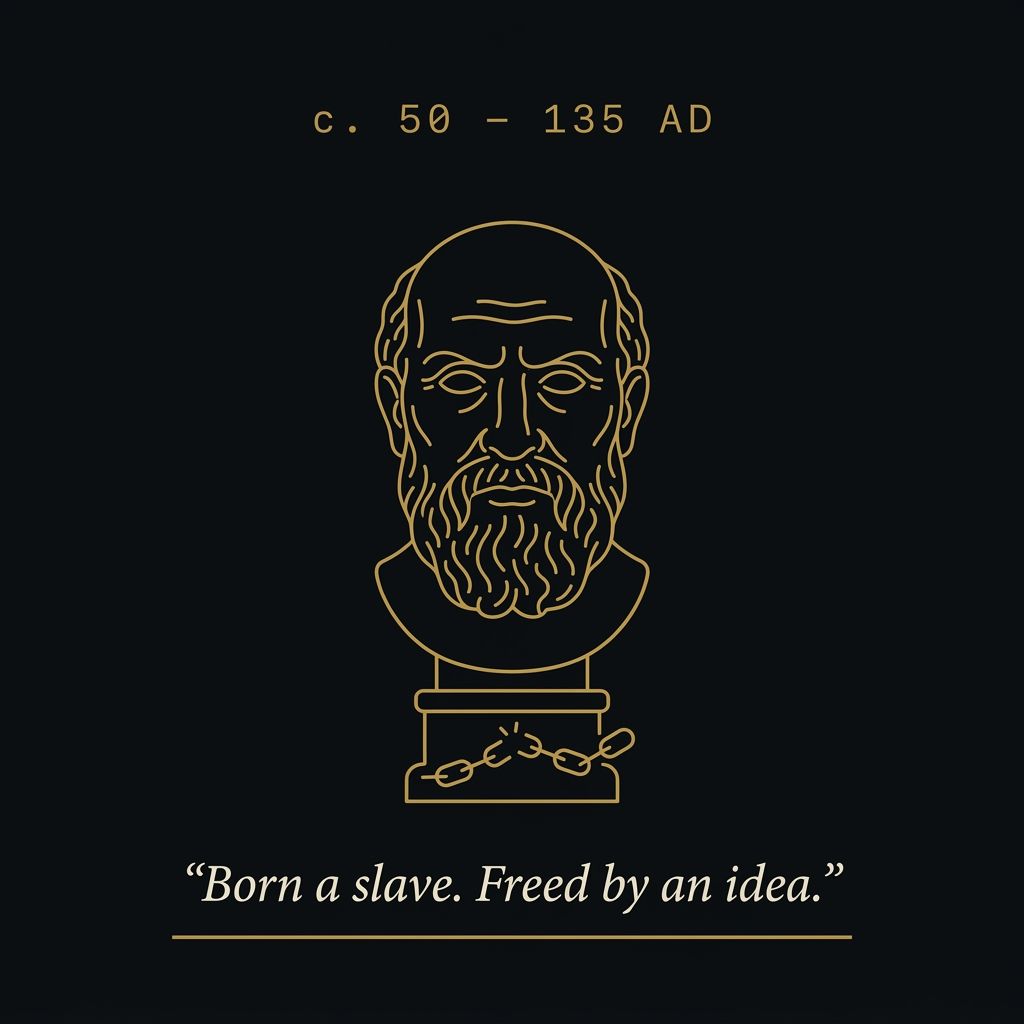
Almost 2,000 years ago, Epictetus — a former slave who became one of history’s most influential philosophers — opened his handbook with a single observation:
“Some things are within our power, while others are not.”
That’s it. That’s the dichotomy of control. Everything you encounter falls into one of two categories: things you can influence, and things you can’t. Your job is to tell the difference — then pour your energy into the first category and let go of the second.
This one idea is the foundation of Stoic philosophy. It’s also the foundation of Cognitive Behavioral Therapy (CBT), the most evidence-based treatment for anxiety and depression. Aaron Beck and Albert Ellis both built modern therapy on the Stoic insight that suffering comes from trying to control what you can’t.
Here’s how it works, with examples from the situations that actually stress you out.
What You Control vs. What You Don’t
Epictetus was specific. In your control: your opinions, your desires, your choices, your effort — “whatever is of your own doing.” Not in your control: your body, your property, your reputation, other people — “whatever is not of your own doing.”
The modern version:
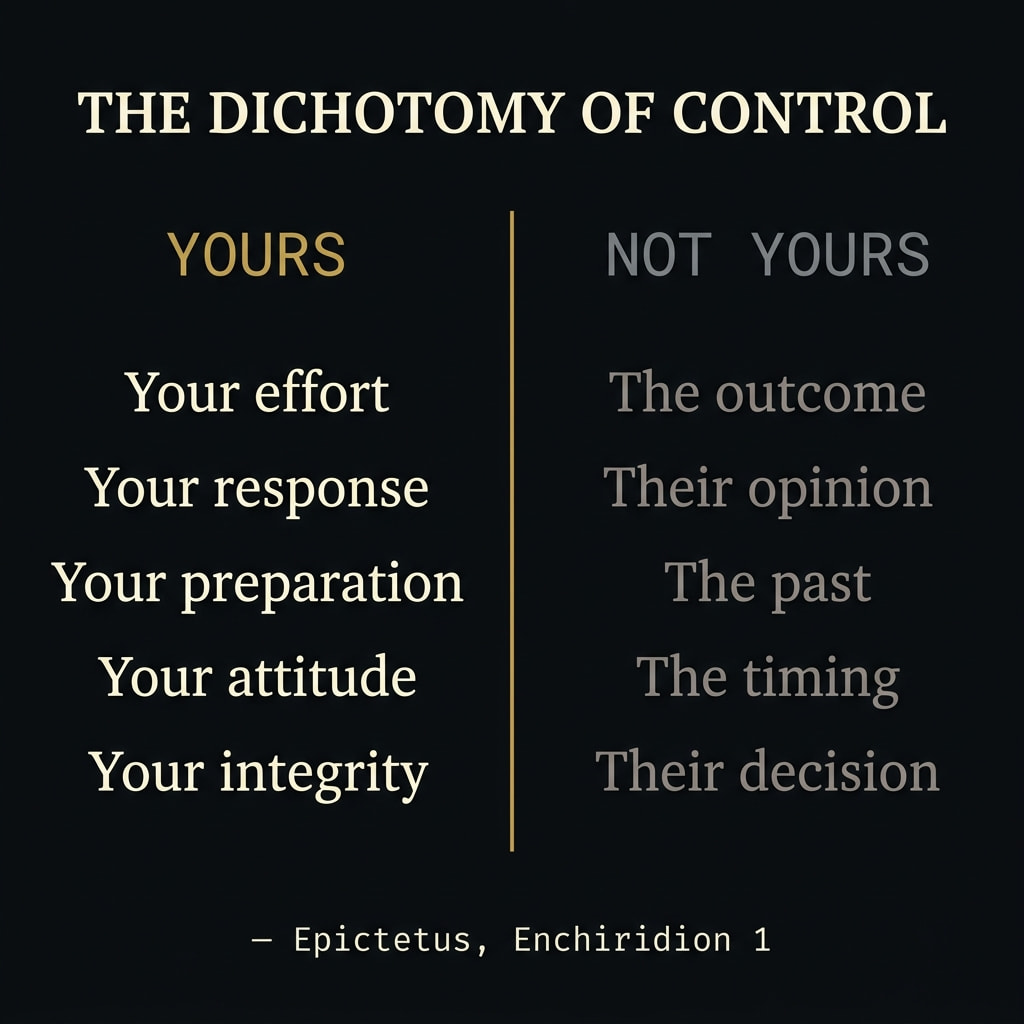
Yours
- Your attitude
- Your effort
- Your preparation
- How you respond
- What you say
- What you prioritize
- Whether you show up
- How you treat people
Not Yours
- Other people’s opinions
- The outcome of your effort
- The past
- The economy
- The weather
- Your genetics
- What someone else decides
- Whether your work gets recognized
The dividing line is clean: if it depends entirely on your choices, it’s yours. If it depends on anything external — another person, luck, timing, the universe — it’s not entirely yours, and attaching your peace of mind to it is a recipe for anxiety.
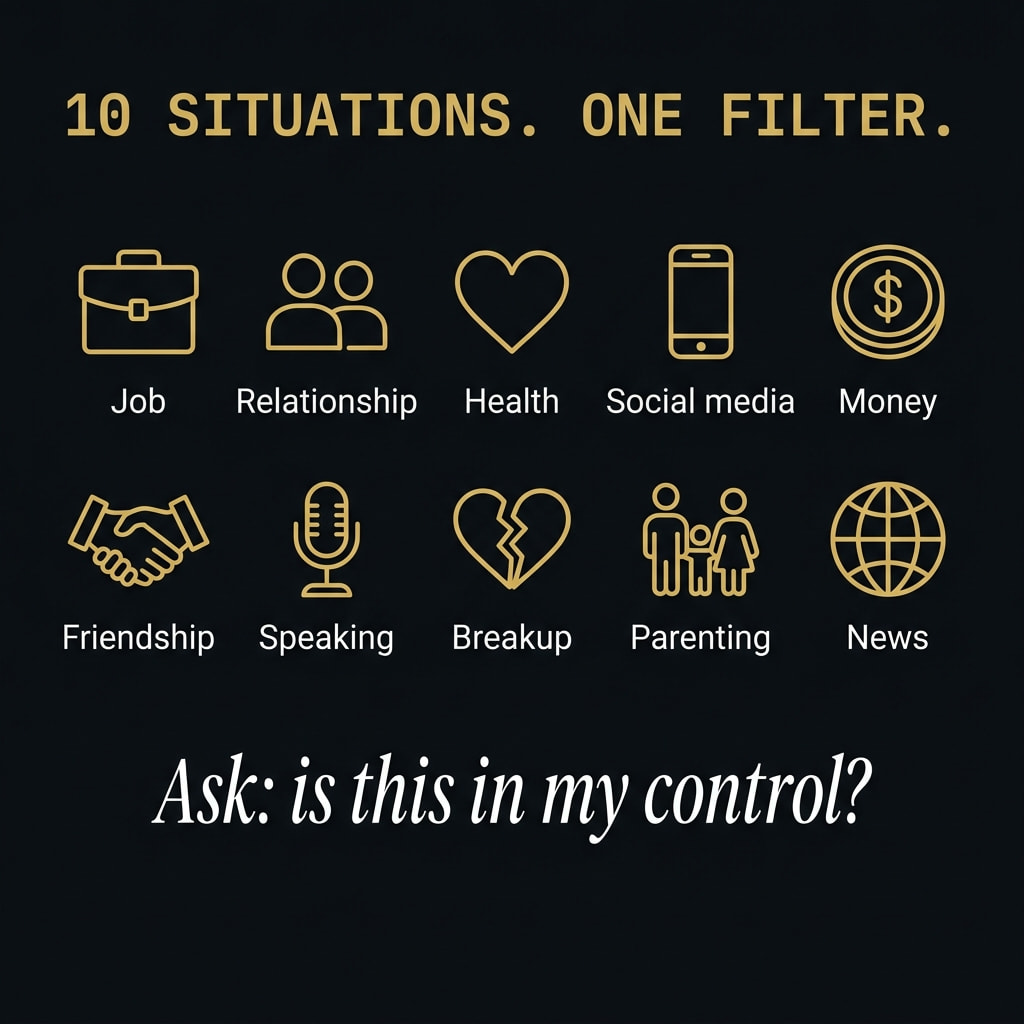
10 Real Situations, Broken Down
Situation 01
Job Interview
In your control
- How well you prepare
- Your answers
- Your body language
- Arriving on time
Not in your control
- Whether they hire you
- The other candidates
- The interviewer’s mood
- Internal politics
The Stoic movePrepare thoroughly. Give your best answers. Then let go. If you did everything in the left column well, the right column can’t diminish you — regardless of the outcome.
Situation 02
Relationship Conflict
In your control
- How you communicate
- Whether you listen
- Your willingness to compromise
- Apologizing if you’re wrong
Not in your control
- How they react
- Whether they change
- Their willingness to compromise
- Whether they forgive you
The Stoic moveSay what needs to be said, honestly and kindly. You can’t script the other person’s response. Marcus Aurelius prepared for this every morning: expect difficult people, respond with your own standards regardless.
Situation 03
Health Scare
In your control
- Going to the doctor
- Following medical advice
- Your diet and exercise
- How you respond mentally
Not in your control
- The diagnosis
- Your genetics
- Whether treatment works
- The timeline
The Stoic moveDo everything in the left column. The right column is where anxiety lives — and worrying about the diagnosis before it arrives is, as Seneca said, “suffering before it is necessary.”
Situation 04
Social Media and Comparison
In your control
- How much time you spend scrolling
- Whether you compare yourself
- What you post and why
- Unfollowing accounts that harm you
Not in your control
- What others post
- Who gets more likes
- The algorithm
- Other people’s highlight reels
The Stoic moveYour screen time is a choice. Every minute spent comparing yourself to curated images is a minute spent in the “not your control” column. The Stoics would call this voluntary slavery.
Situation 05
Money Worries
In your control
- Your spending habits
- How much you save
- Your skill development
- Asking for a raise
Not in your control
- The economy
- Stock market movements
- Your employer’s decisions
- Whether you get it
The Stoic moveFocus on the inputs (save more, spend less, build skills) rather than the outputs. Seneca was one of the richest men in Rome — and practiced sleeping on a hard surface and eating plain food regularly, to prove to himself he could lose it all and be fine.
Situation 06
A Friend’s Opinion of You
In your control
- Being a good friend
- Being honest
- Showing up when it matters
- Your character
Not in your control
- Whether they appreciate it
- Whether they agree
- Their judgment of you
- Their expectations
The Stoic moveBe the kind of friend you’d want. If they still don’t value it, that’s information about them, not about you. Epictetus: “If someone handed you their body, you’d be outraged. But you hand your mind to anyone who insults you and let them disturb it.”
Situation 07
Public Speaking or Performance
In your control
- Rehearsal
- Knowing your material
- Your pace and tone
- Starting on time
Not in your control
- The audience’s reaction
- Technical problems
- Whether people like it
- Whether it goes viral
The Stoic moveLike the Stoic archer (from Cicero): do everything you can to aim well. Once the arrow leaves the bow, the wind takes over. Your job ends at the release.
Situation 08
Breakup or Rejection
In your control
- How you handle the pain
- Whether you reach out or let go
- What you learn from it
- Who you become after
Not in your control
- Whether they come back
- Their feelings
- The timeline of healing
- What could have been
The Stoic moveAmor fati — love what happened, not because it was good, but because resisting reality costs more than accepting it. The breakup happened. Now what will you do with it?
Situation 09
Parenting
In your control
- The example you set
- The environment you create
- How you communicate
- Being present
Not in your control
- Who your child becomes
- Their choices as they grow
- Their personality
- Their peers’ influence
The Stoic moveMarcus Aurelius had 13 children. Most died before him. He still wrote daily about being a better person and doing his duty. You control the input. The output is a collaboration between your effort and everything else.
Situation 10
The News and World Events
In your control
- How much news you consume
- Whether you vote and participate
- Your local community involvement
- Your emotional response
Not in your control
- What happens in the world
- Election results
- Global politics
- Other countries’ decisions
The Stoic moveMarcus Aurelius governed during a pandemic, two wars, and constant political instability. Do your part, accept the rest. Not “ignore the world” — but don’t let the world you can’t control destroy the inner world you can.
The Archer Analogy
The ancient Stoics used a metaphor from Cicero that makes the dichotomy perfectly clear.
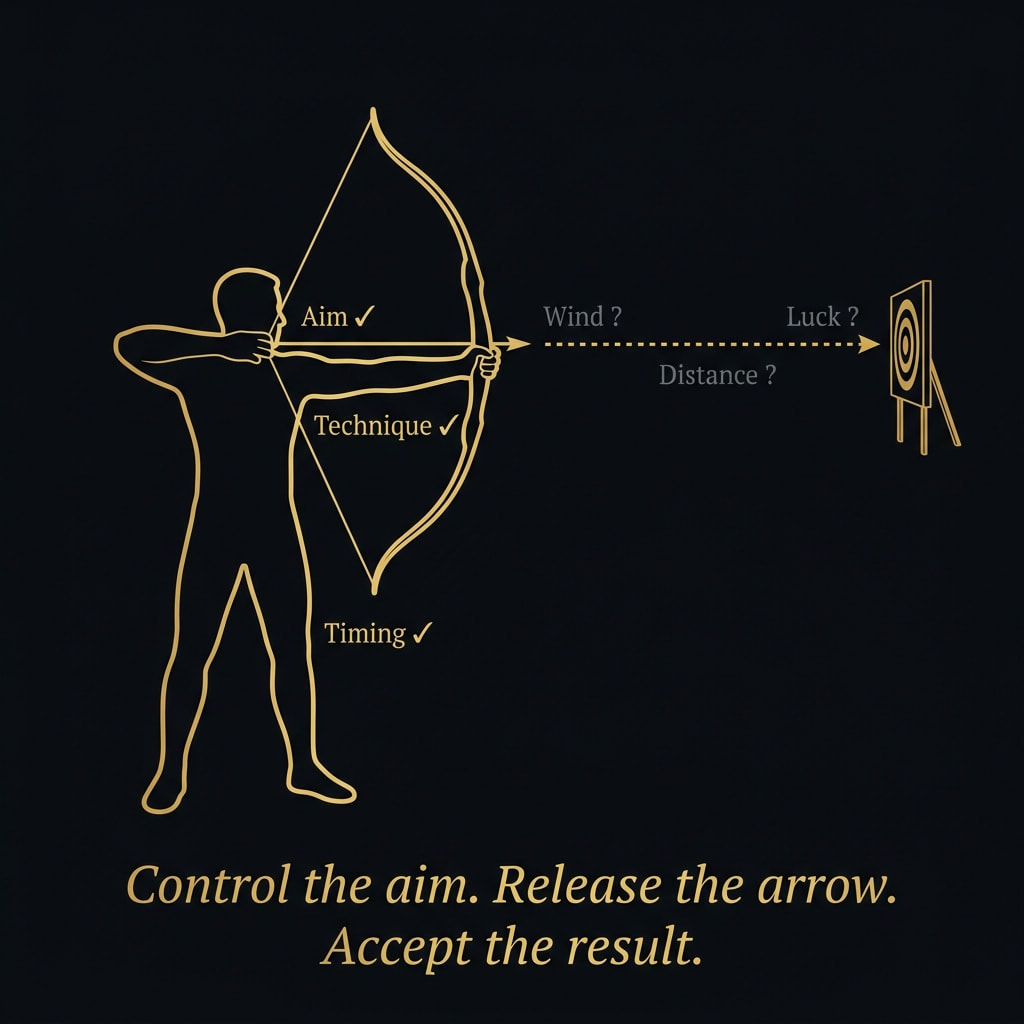
Imagine an archer aiming at a target. The archer controls: choosing the best bow, selecting the right arrow, training their technique, picking the right moment, aiming carefully, and releasing smoothly.
The archer does not control: a sudden gust of wind, a bird flying into the arrow’s path, the target moving unexpectedly.
The Stoic archer does everything possible to hit the target — then accepts the result without complaint. Their self-worth isn’t tied to the hit. It’s tied to the quality of the aim.
This is the key distinction most people miss: the dichotomy of control doesn’t mean “don’t try.” It means try your hardest at the things within your power — and then let go of the outcome. Effort is yours. Results are not.
The Common Mistake: “Just Let It Go”
People hear “focus on what you can control” and interpret it as “don’t care about outcomes.” That’s wrong.
Of course you want the job. Of course you want the relationship to work. Of course you hope the health result is clear. The Stoics didn’t teach indifference to outcomes. They taught non-attachment to outcomes — which is different.
Non-attachment means: I will do my absolute best, and I will be okay regardless of the result. Not because I don’t care, but because I know the result wasn’t entirely mine to determine. Epictetus again: “Make the best use of what is in your power, and take the rest as it happens.”
You’re not a robot. You’re allowed to feel disappointed. The dichotomy doesn’t eliminate emotion — it changes what you do with it. Feel the disappointment, then redirect your energy to the next thing within your control.
How to Practice This Daily
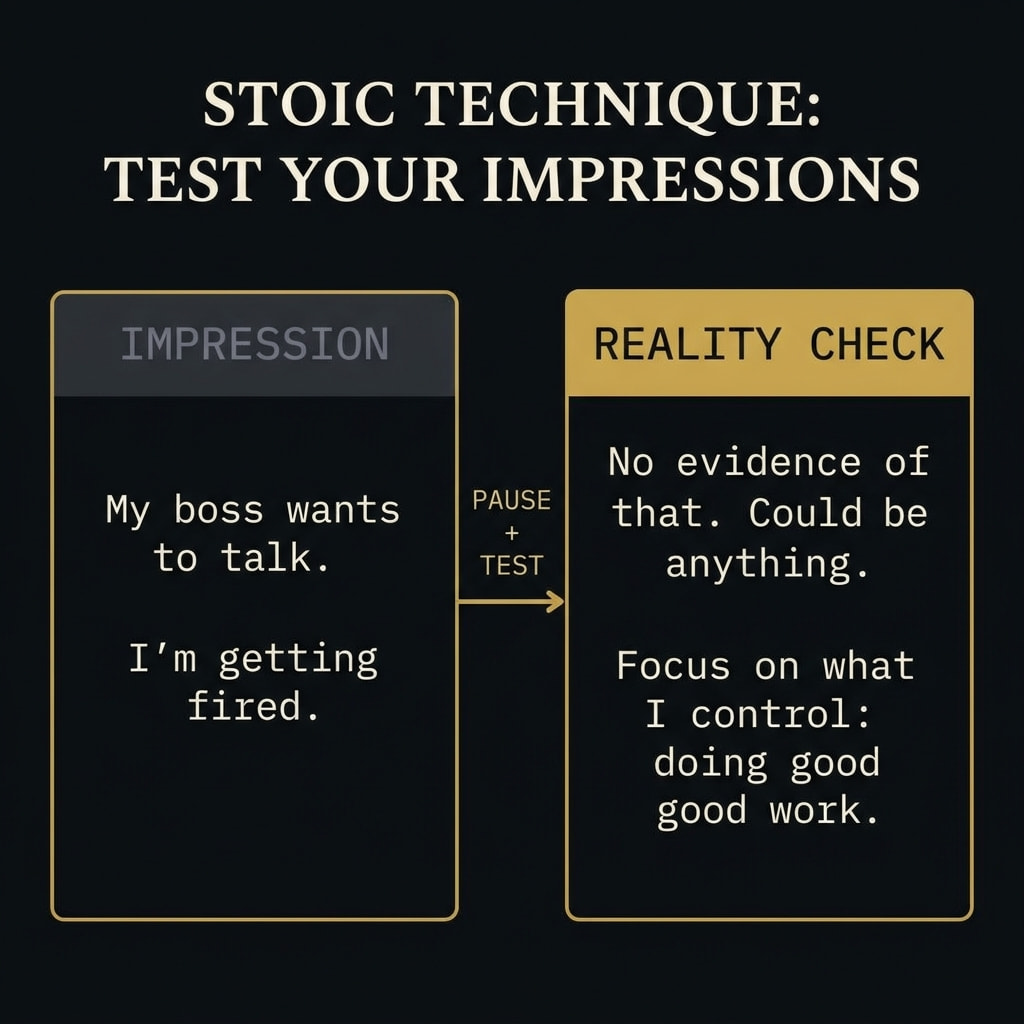
The 30-second check. Whenever you feel stressed, anxious, or frustrated, pause and ask: “Is the thing bothering me within my control or not?” If yes — act on it. If no — acknowledge it and redirect.
The morning sort. Each morning, as part of your Stoic morning routine, list your biggest concern for the day. Split it into two columns: what you control and what you don’t. Decide your action for the left column. Release the right.
The evening review. At night, reflect: “Where did I waste energy on things outside my control today?” Name one moment. Plan to catch it earlier tomorrow. Over weeks, this builds the habit of automatic sorting — you’ll start catching yourself in real time.
These practices connect directly to the other Stoic exercises: testing your impressions and premeditatio malorum use the dichotomy as their foundation. The dichotomy tells you what to focus on; the other techniques tell you how.
If you want this structure built into your phone, StoicNow delivers a daily challenge that’s always within your control, a Memento Mori grid that puts your time in perspective, and an AI Stoic Mentor who can help you sort specific situations in real time.
Stoic practice, automated
Try StoicNow — Free on iOSFree AI Tool
Dichotomy of Control Tool
Describe a worry and let AI sort what you can and can't control.
FAQ
What is the dichotomy of control in Stoicism?
The dichotomy of control is the foundational Stoic principle that everything in life falls into one of two categories: things within your control (your thoughts, choices, effort, and attitudes) and things outside your control (other people, outcomes, the past, external circumstances). Epictetus taught that peace of mind comes from focusing energy on the first category and accepting the second. The concept appears in the opening line of his Enchiridion.
What is an example of the dichotomy of control?
In a job interview, you control your preparation, your answers, and your attitude. You don’t control whether they hire you, who the other candidates are, or the interviewer’s internal biases. The Stoic approach: prepare thoroughly, give your best, then accept the outcome without attaching your self-worth to it. The quality of your effort is yours; the result is not.
Is the dichotomy of control the same as “don’t care about anything”?
No. The Stoics cared deeply about outcomes — they preferred health over sickness, success over failure, connection over isolation. What they didn’t do was attach their happiness to those outcomes. The distinction is between preference (healthy) and dependence (unhealthy). You can want something without needing it to be okay.
How does the dichotomy of control relate to CBT?
CBT’s core technique is identifying thoughts that cause suffering and testing whether they’re rational. This comes directly from Epictetus’ teaching that “it is not things that disturb us, but our judgments about things.” The dichotomy of control adds a practical filter: if the thing you’re worrying about is outside your control, the worry itself is the problem — not the situation.
Did Marcus Aurelius use the dichotomy of control?
Yes. Marcus Aurelius practiced the dichotomy throughout his Meditations, though he used different language than Epictetus. He wrote about accepting fate, focusing on duty over outcome, and not being disturbed by things beyond his power. His famous morning exercise — imagining the difficult people he’d face — is the dichotomy applied to social situations.
What is the “trichotomy of control” and how is it different?
Some modern Stoic writers (notably William Irvine in A Guide to the Good Life) propose a trichotomy: things fully in your control, things partially in your control, and things not in your control at all. This adds nuance for situations like health (where you control your habits but not your genetics). The classical Stoics didn’t use this three-part division, but some practitioners find it more practical for daily life.

Marcus Adler
Founder & Lead Writer, StoicNow
Marcus Adler is the founder of StoicNow. For over a decade he has applied Stoic philosophy to daily life — testing the practices of Marcus Aurelius, Seneca, and Epictetus against modern problems and translating them into simple, repeatable routines. More about the author →
Further reading