Quick answer
The 30-Day Stoic Challenge is a structured month-long program designed to build a Stoic daily practice. It is divided into four weeks — foundations, practices, deepening, and integration — with one task per day, each tied to a specific Stoic source (Marcus Aurelius, Seneca, or Epictetus). Most tasks take 5 to 20 minutes.
Thirty days. One task per day. Five to twenty minutes. The goal is not to master Stoicism — it is to build the reflexes that make Stoicism part of how you live.
Most people read about Stoicism, underline a few sentences, and never actually practise any of it. That is the wrong move. The Stoics were explicit: philosophy is a training regimen, not a body of beliefs. Marcus Aurelius did not write Meditations because he understood Stoicism — he wrote it because he kept forgetting it and needed reminders. The reminders became the book.
This challenge gives you one small, specific thing to do every day for a month, structured into four themed weeks:

What’s inside
How the Challenge Works
Four weeks, four themes. Each week builds on the previous one.
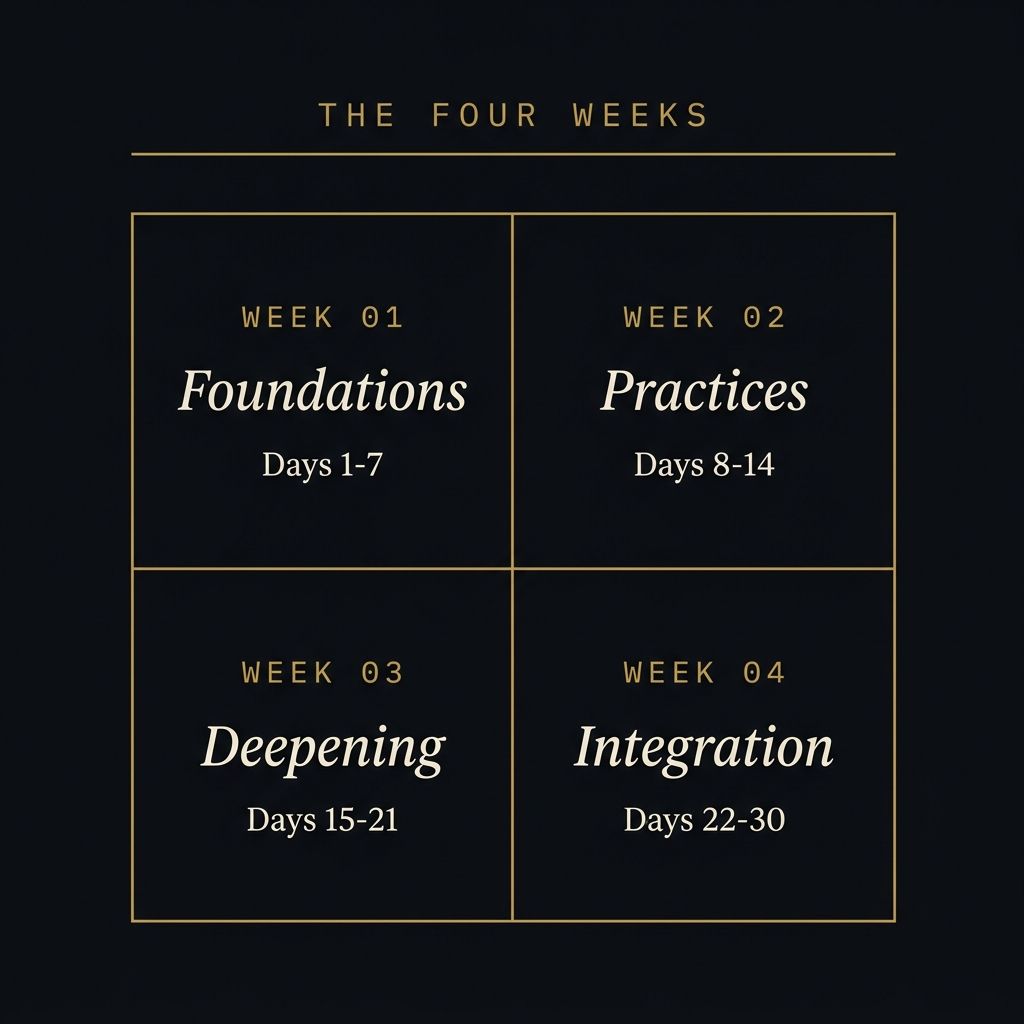
Week 1 — Foundations. You learn the core concepts well enough to reference them in real life. Dichotomy of control, memento mori, amor fati, the virtues, the reserve clause.
Week 2 — Practices. You layer in daily habits: morning preparation, evening review, voluntary discomfort, negative visualization, saying no.
Week 3 — Deepening. Harder exercises: confronting one of your faults, doing the task you’ve been avoiding, no-complaints day, sitting in silence.
Week 4 — Integration. You decide what stays. The month ends with a letter to yourself on Day 1 and a single daily practice you commit to keeping forever.
Three rules for the challenge:
- No perfection. Miss a day, pick up where you left off. Never restart.
- Write it down. Most exercises ask you to journal. A cheap notebook is enough. For structure, use our Stoic journal prompts.
- One day at a time. Do not read Day 12 until you’re on Day 12. The sequence matters.
Week 1: Foundations
Week 01 · Days 1–7
Learn the core concepts well enough to use them.
Seven days, seven ideas. Short exercises, mostly reading and thinking. This week is scaffolding — if you skip it, Week 2 will not hold.
Sort Your Worries
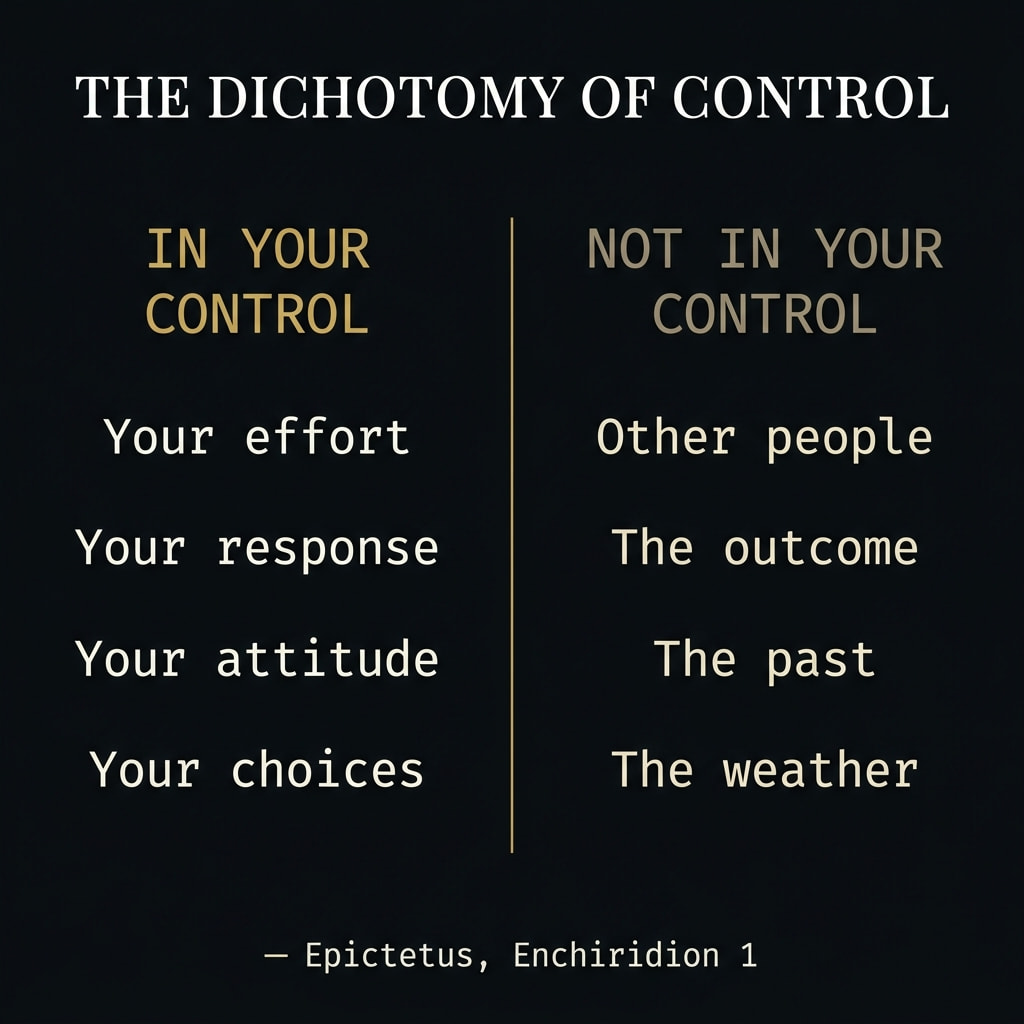
Task: List three worries that have been in your head this week. Next to each, write two columns: what is mine to control, what is not. Keep the list somewhere you can see it.
Source: The Dichotomy of Control · Epictetus, Enchiridion 1
Do One Thing You’ve Been Putting Off
Task: Pick a task you have avoided for longer than a week. Do it today. It does not have to be big — it has to be the one you’ve been delaying. Memento mori applied to your to-do list.
Source: Memento Mori · Marcus Aurelius, Meditations 2.11
Read Meditations, Book 2
Task: Read Book 2 of Meditations today. Fifteen minutes. Skip Book 1 — come back to it later. Underline anything that lands.
Source: Meditations Summary · Marcus Aurelius, Meditations 2.1
Pick Today’s Virtue
Task: Choose one of the four cardinal virtues — wisdom, courage, justice, or temperance. Write which one. Act on it once today. Tonight, note where.
Source: The Four Cardinal Virtues · Core Stoicism
Amor Fati
Task: Pick one bad event from your past — something you would have preferred did not happen. Write one way it made you stronger, kinder, or wiser. The point is not silver linings; the point is noticing what was actually there.
Source: Amor Fati · Marcus Aurelius, Meditations 4.49
The Reserve Clause
Task: Add “fate permitting” to one plan you make today. Out loud, in writing, or just in your head. Notice how it slightly loosens your grip on the outcome without killing your effort.
Source: Seneca, De Tranquillitate Animi 13
Week 1 Review
Task: Write one sentence per day. What did you learn? What surprised you? What was harder than expected? Keep it honest. This becomes your anchor for the midpoint check on Day 15.
Source: Stoic Journal Prompts · Seneca, De Ira 3.36
Week 2: Practices
Week 02 · Days 8–14
Build the habits Stoics practised daily.
This is where thinking becomes behaviour. Each of these is a small practice that can outlive the challenge — and several probably will.
Morning Preparation
Task: Before email or phone, write: “Today I may meet with…” List three difficult things likely to happen today — a tense conversation, a task you don’t want, a person who annoys you. Beside each, write one sentence about how you will respond.
Source: Stoic Morning Routine · Marcus Aurelius, Meditations 2.1
Evening Review (3-2-1)
Task: Before bed, write three things you are grateful for, two things you did well today, and one thing you could do better tomorrow. Seneca called this the examen. Keep it tonight; try it for a week.
Source: Stoic Journal Prompts · Seneca, De Ira 3.36
Walk Without Phone
Task: Twenty-minute walk. No phone. No headphones. No podcast. Practice confining yourself to the present — the only place life is actually happening.
Source: Marcus Aurelius, Meditations 7.29
Voluntary Discomfort
Task: Choose one: cold shower, skip a meal, or sleep on the floor tonight. The Stoics practised small doses of discomfort to reduce the fear of losing comforts they had. One night will not damage you; it may surprise you.
Source: Seneca, Letters 18
Negative Visualization
Task: Imagine losing one thing you currently have — health, a person, a job, a body part. Sit with it for ten minutes. Write what you would feel, what you would miss, how you would adjust. Then return to the present. Notice the gratitude that shows up uninvited.
Source: Seneca, Letters 91
Say No Once
Task: Decline one non-essential request today — a meeting, a favour, a social ask you’ve been saying yes to out of habit. Do it politely. Notice where it frees your attention for the rest of the day.
Source: Marcus Aurelius, Meditations 3.4
One Hour Offline
Task: One full hour — no internet, no phone, no notifications. Not while sleeping. Pick an hour you’re normally online. Do something real instead: read, walk, write, cook, talk.
Source: Seneca, On the Shortness of Life
Week 3: Deepening
Week 03 · Days 15–21
Harder exercises. Honest ones.
Weeks 1 and 2 were training wheels. This is where the challenge starts to confront you. Nothing is extreme, but nothing is comfortable either.
Midpoint Reflection
Task: Re-read your Day 7 review. Write what has actually changed in the past week. No need to be dramatic — subtle shifts count. If something is not changing, that is information too.
Source: Stoic Journal Prompts
Confess One Fault
Task: Write one honest fault in your journal. No excuses, no defending, no explaining. Just: here is something I do that I should not. Marcus did this constantly.
Source: Marcus Aurelius, Meditations 10.30
Do the Hard Task
Task: Pick the one task you’ve been avoiding most — bigger than Day 2, the real one. Begin it today. Not finish. Begin.
Source: Marcus Aurelius, Meditations 4.17
The View from Above
Task: Five minutes. Close your eyes. Imagine zooming out from your day — your room, your building, your city, your country, your planet. Hold the view. Return. Decide what, from up there, still actually matters.
Source: Marcus Aurelius, Meditations 7.48
No Complaints Day
Task: Twenty-four hours without complaining out loud. Traffic, weather, colleagues, news. Count each slip. You will be surprised how many there are.
Source: Marcus Aurelius, Meditations 8.50
Forgive One Person
Task: Write a forgiveness entry in your journal. To one person, alive or dead, near or far. Nothing to send. The point is not for them; the point is for you.
Source: Marcus Aurelius, Meditations 9.27
Ten Minutes of Silence
Task: Ten minutes. No music, no phone, no book, no task. Just sit. Let whatever surfaces surface. This is harder than any exercise so far.
Source: Marcus Aurelius, Meditations 4.3
Week 4: Integration
Week 04 · Days 22–30
Decide what stays.
The final nine days turn the challenge into a habit. Each exercise is lighter, but the week ends with the hardest one: writing to the person you were before you started.
Re-read Your Best Entries
Task: Open your journal. Re-read the five entries that meant the most. Notice which ones still hit. Underline what you want to remember.
Source: Stoic Journal Prompts
Teach One Idea
Task: In one conversation today, share one Stoic idea you’ve learned — the dichotomy of control, amor fati, memento mori, or another. Teach it once. You’ll find out which parts you actually understand.
Source: Seneca, Letters 7
Skip One Habit
Task: Pick one consumption habit — coffee, social media, snacks, news, alcohol. Skip it for the full day. Notice the discomfort. Notice how fast it passes.
Source: Epictetus, Discourses 3.12
Write Your Eulogy
Task: Twenty minutes. Write what you would want said at your funeral. Not what you have done — what you want to have been. Compare it to what you actually spent this month doing.
Source: Memento Mori · Marcus Aurelius, Meditations 4.48
Specific Gratitude
Task: List three specific moments from today. Not “I’m grateful for my family.” “I’m grateful my daughter laughed at 7:14pm when I made a bad joke.” Specificity trains attention.
Source: Marcus Aurelius, Meditations 6.13
Respond Gracefully
Task: Catch one reactive moment today — the email that annoys you, the comment that stings. Before responding, count five seconds. Notice what changes.
Source: Marcus Aurelius, Meditations 6.11
Let Someone Be Right
Task: In one conversation today, let someone be right — even if you disagree, even if they’re not fully right. Say “good point” and stop. Notice what the silence feels like.
Source: Marcus Aurelius, Meditations 6.21
Pick Your Keeper
Task: Identify which single practice from these 28 days you will keep forever. Most people pick evening review, morning preparation, or the 10-minute silence. Write yours down. Commit.
Source: Core Stoicism · Epictetus, Discourses 4.4
Letter to Day 1
Task: Re-read your whole journal. Then write a letter to the person you were on Day 1. What would you tell them? What did they not see yet? What would you protect them from, and what would you let them learn the hard way? Thirty minutes. No performance.
Source: Seneca, Letters 1 · Marcus Aurelius, Meditations 1

What Happens on Day 31
The trap most 30-day challenges fall into: Day 30 is the finish line, and on Day 31 people stop. Then nothing sticks.
This one is designed differently. Day 29 asked you to pick one practice worth keeping forever. Day 31 is that practice, repeated. Just the one. The Stoic point is not that you keep doing all thirty exercises for the rest of your life — it is that you leave this month with one permanent daily anchor and the knowledge that you can pick up any of the others when life calls for them.
Most people keep the evening review — Seneca’s examen. It is short, it ends each day cleanly, and it compounds over years. Others keep morning preparation or the 10-minute silence. Whichever you pick, commit to it for 60 more days before considering changes. Habits need time.
The other practices stay in your toolkit: the dichotomy when you’re anxious, negative visualization before hard events, memento mori when your priorities drift. You don’t need to do them every day. You need to know where they are when the day needs them.
Track your streak · 30 days at a time
Try StoicNow — Free on iOSMistakes That Break the Streak
Restarting after one missed day
The biggest killer. Missing Day 8 is not failure — quitting on Day 9 because you missed Day 8 is. Pick up from Day 9. The calendar did not care when you started and will not care when you finish.
Reading ahead
If you read Day 19 on Day 2, it becomes abstract philosophy again. The sequence is doing work: Week 1 gives you the vocabulary Week 3 uses. Keep yourself in the current day.
Skipping the journaling
Most of the transformation happens in the writing, not the reading. The thinking you do without writing evaporates. The thinking you put on paper stays. Journal even badly. A one-sentence entry beats none.
Treating it as performance
Do not post about it. Do not explain it to colleagues. Do not tell your friends you’re ‘doing a thing.’ The Stoic goal is self-correction, not a personal brand. Marcus never told anyone. Start there.
FAQ
What is the 30-Day Stoic Challenge?
The 30-Day Stoic Challenge is a structured month-long program designed to build a Stoic daily practice. It is divided into four weeks — foundations, practices, deepening, and integration — with one task per day, each tied to a specific Stoic source (Marcus Aurelius, Seneca, or Epictetus). Most tasks take 5 to 20 minutes. The point is not to master Stoicism in a month but to build the reflexes that make it part of your life.
How much time does each day require?
Most days take five to ten minutes. A handful take longer — the reading day (15 min), the eulogy exercise (20 min), and the final review (30 min). A few are ‘practice all day’ exercises that require no extra time — like no-complaints day or letting someone be right — they just require attention.
What if I miss a day?
Pick up where you left off. Do not restart. The worst version of this challenge is the one you quit on Day 8 because you broke a streak on Day 7. Missing one day is neutral; quitting because you missed one is the real failure. Marcus Aurelius did not keep a perfect streak either — he kept coming back.
Do I need to read Meditations before starting?
No. The challenge is designed for beginners. Day 3 includes reading Book 2 of Meditations — if you already have, pick any other chapter. If you want a fast overview first, our Meditations summary covers the seven core themes in about 15 minutes.
Can I do this challenge without journaling?
You can, but it will be half as effective. Many of the tasks explicitly ask you to write — the review days, the forgiveness exercise, the eulogy. Writing externalises thinking, which is the whole mechanism. A cheap notebook or a notes app on your phone is enough; no special equipment is required.
What happens on Day 31?
The challenge is designed so that by Day 29 you have identified one practice worth keeping permanently. Day 31 onwards is that practice, repeated. Most people who complete the challenge keep the evening review (Seneca’s examen) as their permanent daily anchor, adding the other practices as life calls for them — negative visualization before hard events, the dichotomy of control during anxious moments, memento mori when their priorities drift.

Marcus Adler
Founder & Lead Writer, StoicNow
Marcus Adler is the founder of StoicNow. For over a decade he has applied Stoic philosophy to daily life — testing the practices of Marcus Aurelius, Seneca, and Epictetus against modern problems and translating them into simple, repeatable routines. More about the author →