Quick answer
Stoicism is an ancient Greek philosophy, founded by Zeno of Citium around 300 BC, that teaches you to focus your effort on what you control — your judgments, choices, and actions — and to accept everything else with equanimity.
Stoicism is 2,300 years old, has no central church, and keeps getting rediscovered by soldiers, executives, therapists, and anyone who has just had a genuinely bad week. That staying power is not an accident — the philosophy was built by people solving the same problem you have: how to act well when most of life is out of your hands. Here is what Stoicism actually says, where it came from, and how to practice it without turning into a stereotype.

What Stoicism Actually Means
Stoicism is a school of ancient Greek philosophy that treats living well as a skill, not a feeling, a belief, or a personality type. Its central claim is straightforward: your well-being depends entirely on the quality of your judgments and choices, not on what happens to you. Everything else — your health, your reputation, other people’s opinions, the outcome of your effort — is classified as an “indifferent”: worth caring about, but never worth your peace of mind.
That last part is the piece modern usage strips out. In everyday English, calling someone “stoic” means they don’t show emotion. The philosophy is not that. Stoicism does not ask you to feel nothing; it asks you to examine why you feel what you feel, and to stop outsourcing your peace of mind to things outside your power. (More on that distinction in Are Stoics Emotionless?)
The name itself is architectural, not emotional. Zeno of Citium, the philosophy’s founder, taught in a public colonnade in Athens called the Stoa Poikile — the “Painted Porch” — and his students became known as Stoikoi, “men of the porch.” The word had nothing to do with a flat affect until English borrowed it centuries later and flattened the meaning.
Where Stoicism Came From
Stoicism is not one person’s idea; it is roughly five centuries of continuous argument, refinement, and rewriting by a handful of major thinkers across two civilizations. The biographer Diogenes Laertius, writing in the third century AD, devotes Book VII of his Lives of Eminent Philosophers to Zeno and the school he built — the earliest connected account we have of how it started.
Two things stand out in that list. First, almost everything that survives from the school’s founding period comes to us in fragments and later summaries, not intact books. Second, the version most people read today is almost entirely Roman: Seneca, Epictetus, and Marcus Aurelius wrote for practical use, not academic system-building, which is exactly why their work still reads like advice instead of a textbook.

The Core Idea: What You Can and Can’t Control
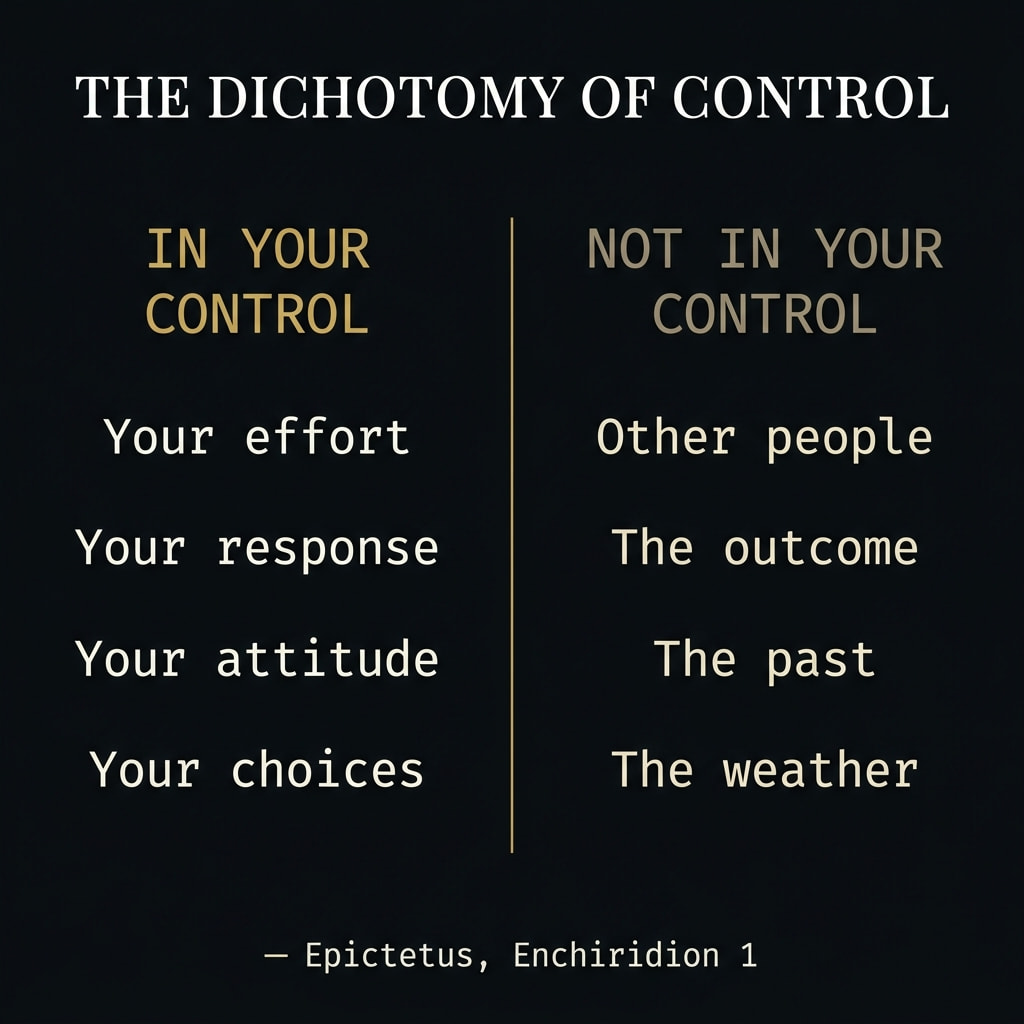
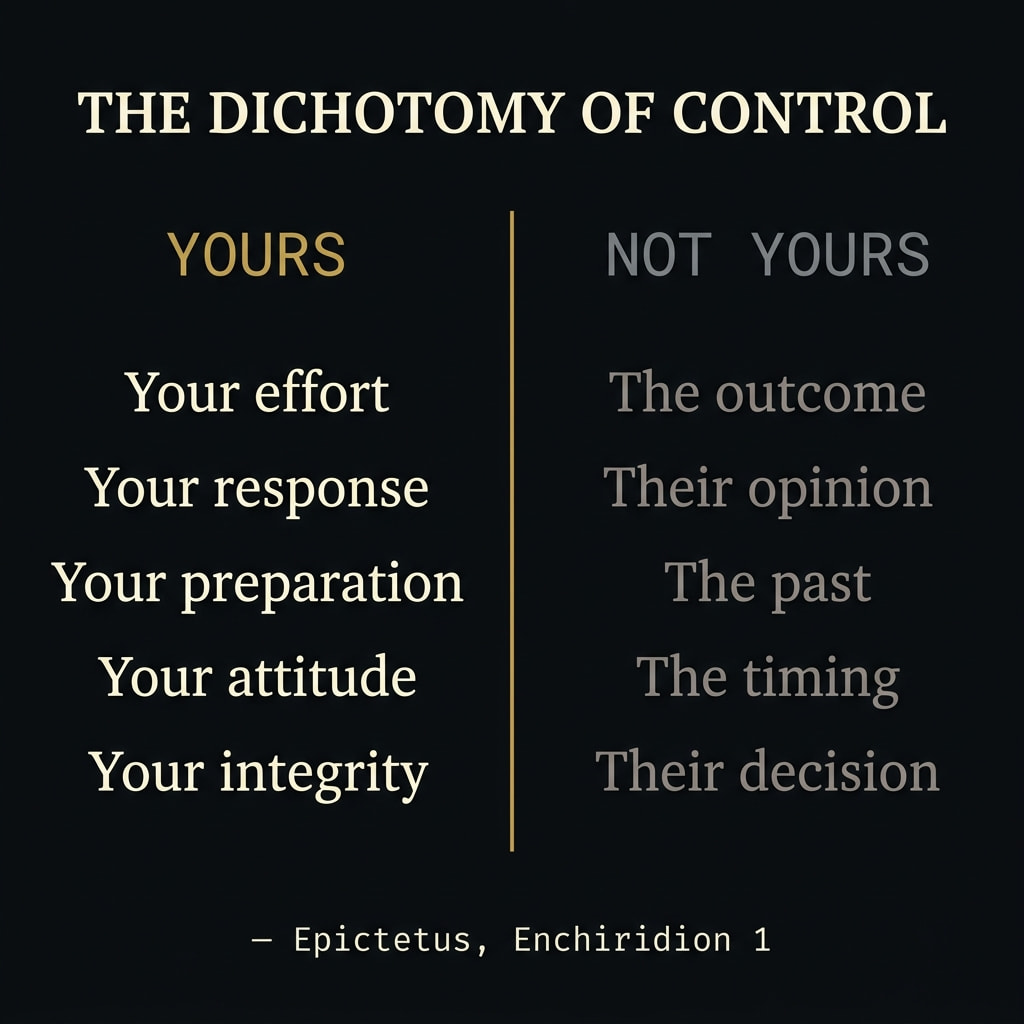
Strip away the history and one idea carries the whole philosophy: some things are within your power, and some things are not. Epictetus opens his entire surviving handbook with this line:
“Of things some are in our power, and others are not. In our power are opinion, movement toward a thing, desire, aversion… in a word, whatever are our own acts. Not in our power are the body, property, reputation, offices… and, in a word, whatever are not our own acts.” — Epictetus, Enchiridion 1
Read literally, this is a filing system for your attention. Your judgments, intentions, and effort go in one folder. Everything else — other people’s choices, the market, the weather, a diagnosis, your boss’s mood — goes in the other. Stoic practice is the discipline of putting your energy only in the first folder, which is why this idea is now generally called the dichotomy of control.

The Four Stoic Virtues
If the dichotomy of control tells you where to aim, the four cardinal virtues tell you what “acting well” looks like once you get there. The Stoics inherited these from earlier Greek ethics and made them the entire measure of a good life:
- Wisdom — seeing a situation clearly, without self-serving distortion.
- Courage — acting rightly under fear, pressure, or social cost.
- Justice — treating other people fairly, since humans are fundamentally social.
- Temperance — self-control over appetite, impulse, and excess.
Nothing else on the traditional Stoic list — not health, not money, not comfort, not even survival — counts as good or bad in itself. Those are “preferred” or “dispreferred” indifferents: reasonable to want, but never worth trading virtue for. A full breakdown of each virtue, with modern examples, is in The Four Stoic Virtues.
How to Practice Stoicism Today
Stoicism was never meant to stay in a book. Every major Stoic author left behind a set of concrete exercises, and most of them take under ten minutes:
- Morning intention-setting — before the day starts, naming what is likely to go wrong and deciding in advance how you’ll respond. (Stoic Morning Routine)
- Evening review — Seneca describes asking himself three questions every night: what fault did I cure, what did I resist, in what respect am I better. (Stoic Evening Reflection)
- Negative visualization — briefly imagining loss to strip entitlement out of what you already have. (Negative Visualization)
- Written self-examination — the private habit behind Marcus Aurelius’s own Meditations, which he never intended anyone else to read. (Stoic Journal Prompts)
None of these require believing in anything supernatural, joining a group, or restructuring your schedule. That is by design — Marcus Aurelius wrote:
“Nowhere can a man find a quieter or more untroubled retreat than in his own soul.” — Marcus Aurelius, Meditations 4.3
For a longer, structured version of these habits, see How to Practice Stoicism Every Day.

Common Misconceptions About Stoicism
Three misreadings account for most of the resistance to Stoicism, and all three come from judging the philosophy by the modern adjective instead of the ancient school.
“Stoicism means suppressing emotion.” It doesn’t. The Stoics wrote extensively about grief, anger, and fear precisely because they took emotion seriously as something to understand, not silence. See Are Stoics Emotionless? for the full case.
“Stoicism is a religion.” It has no god that must be worshipped, no clergy, and no required afterlife doctrine. It is closer to a practical ethics, compatible with most religious beliefs or none. (Is Stoicism a Religion?)
“Stoicism means passive acceptance.” Loving your fate is not the same as giving up on changing it. The Stoics were senators, soldiers, and advisers who acted constantly — they just refused to let the outcome own their mood. (Amor Fati)
Stoicism vs Other Philosophies
Stoicism is often placed next to Buddhism, since both treat attachment and desire as sources of suffering. The overlap is real but partial: Buddhism generally aims to dissolve the self and the wanting behind it, while Stoicism keeps the self intact and tries to redirect its wanting toward virtue instead of outcome. A full side-by-side is in Stoicism vs Buddhism.
It also helps to separate the philosophy from its most famous writers. Reading Seneca, who was by his own admission no sage, Epictetus, a former slave who became one of Rome’s most respected teachers, and Marcus Aurelius, an emperor who wrote his most famous work only for himself, side by side shows the same ideas tested in three completely different lives — a large part of why the philosophy has outlasted every empire that produced it.
Practice the dichotomy of control every day in StoicNow
Join the WaitlistFree Quiz
Which Stoic Are You?
A 3-minute personality quiz — Marcus, Seneca, Epictetus, or Cato.
FAQ
What is Stoicism, in one sentence?
Stoicism is an ancient Greek philosophy holding that a good life comes from focusing entirely on what you control — your judgments, intentions, and actions — while accepting everything else, including outcomes and other people’s opinions, without letting it disturb your peace of mind.
Who founded Stoicism?
Zeno of Citium founded Stoicism around 300 BC, teaching in the Stoa Poikile, a public colonnade in Athens, which gave the school its name. Cleanthes and then Chrysippus led the school after him and built out its logic and physics, but the version most people read today comes from later Roman Stoics: Seneca, Epictetus, and Marcus Aurelius.
Is Stoicism about suppressing your emotions?
No. Stoicism does not ask you to feel nothing; it asks you to examine why you feel what you feel and to stop letting things outside your control run your mood. Seneca, Epictetus, and Marcus Aurelius all wrote openly about grief, anger, and fear rather than pretending those feelings don’t exist.
Is Stoicism a religion?
No. Stoicism has no required god, clergy, scripture, or afterlife doctrine — it is a practical ethical framework, not a faith. Its ancient version did include a physics and a view of nature, but modern Stoic practice is generally compatible with any religion, or with none at all.
What are the four Stoic virtues?
The four Stoic virtues are wisdom (seeing situations clearly), courage (acting rightly under pressure), justice (treating other people fairly), and temperance (self-control over impulse and excess). The Stoics treated these as the entire measure of a good life — nothing else, including health or money, counted as good in itself.
How do I start practicing Stoicism today?
Start with one small habit rather than the whole system: a two-minute morning check-in on what’s actually in your control, or Seneca’s three-question evening review. Both take under ten minutes and require no equipment, group, or belief system — just a few minutes of honest attention at the edges of your day.

Marcus Adler
Founder & Lead Writer, StoicNow
Marcus Adler is the founder of StoicNow. For over a decade he has applied Stoic philosophy to daily life — testing the practices of Marcus Aurelius, Seneca, and Epictetus against modern problems and translating them into simple, repeatable routines. More about the author →
Further reading