Quick answer
Stoicism and Buddhism agree more than they differ: both teach that suffering comes from the mind’s reactions, that everything is impermanent, and that peace is internal. The big difference is direction — Stoicism engages the world to live virtuously in one life; Buddhism aims to transcend the cycle of suffering and rebirth entirely.
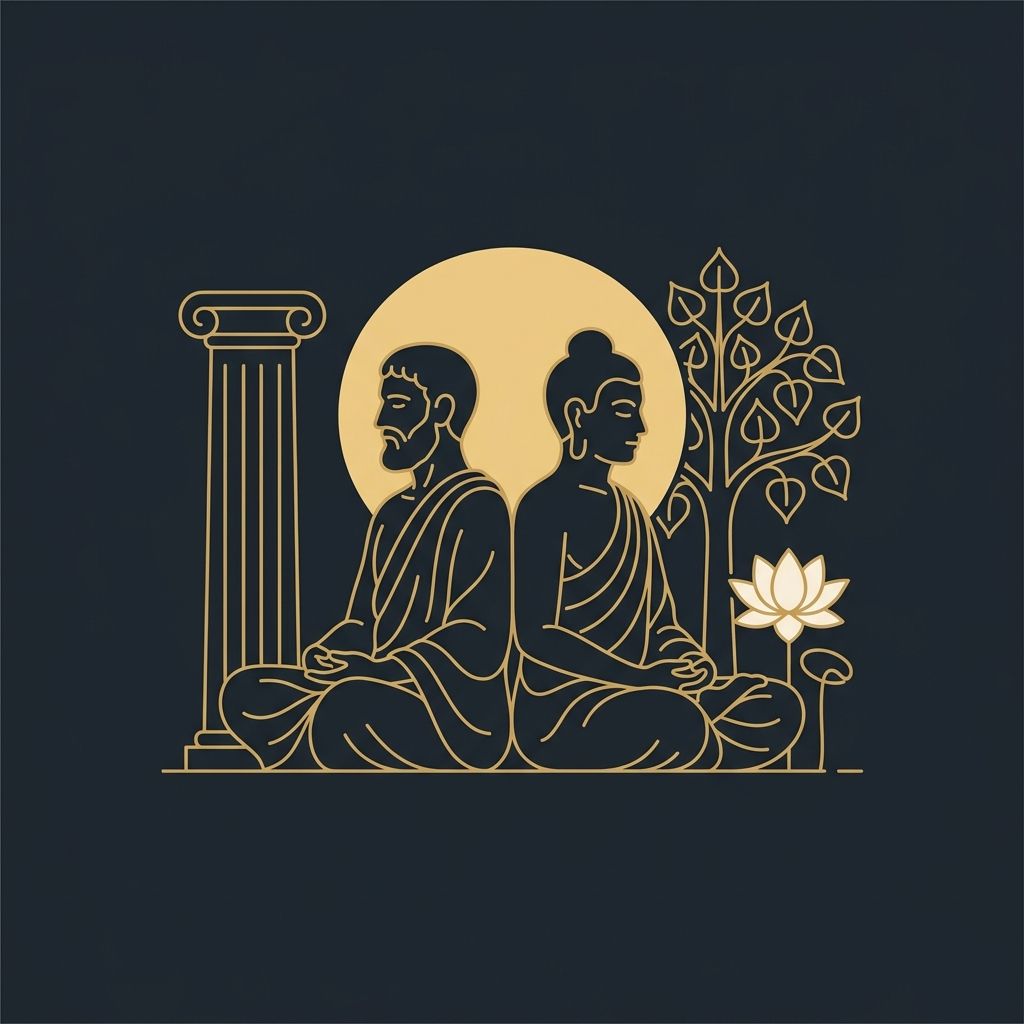
Two philosophies, born roughly two centuries and three thousand miles apart, arrived at almost the same diagnosis of the human condition: most of our suffering is self-made, manufactured by the mind’s reaction to things rather than the things themselves. Then they prescribed strikingly similar cures — and one very different destination.
The Buddha taught in northern India around the fifth century BCE. Zeno of Citium founded Stoicism in Athens around 300 BCE. There’s no evidence either tradition borrowed from the other; they converged independently on the same insight. That convergence is exactly what makes the comparison so useful — when two unrelated traditions reach the same conclusion, it’s worth paying attention.
5 Surprising Similarities
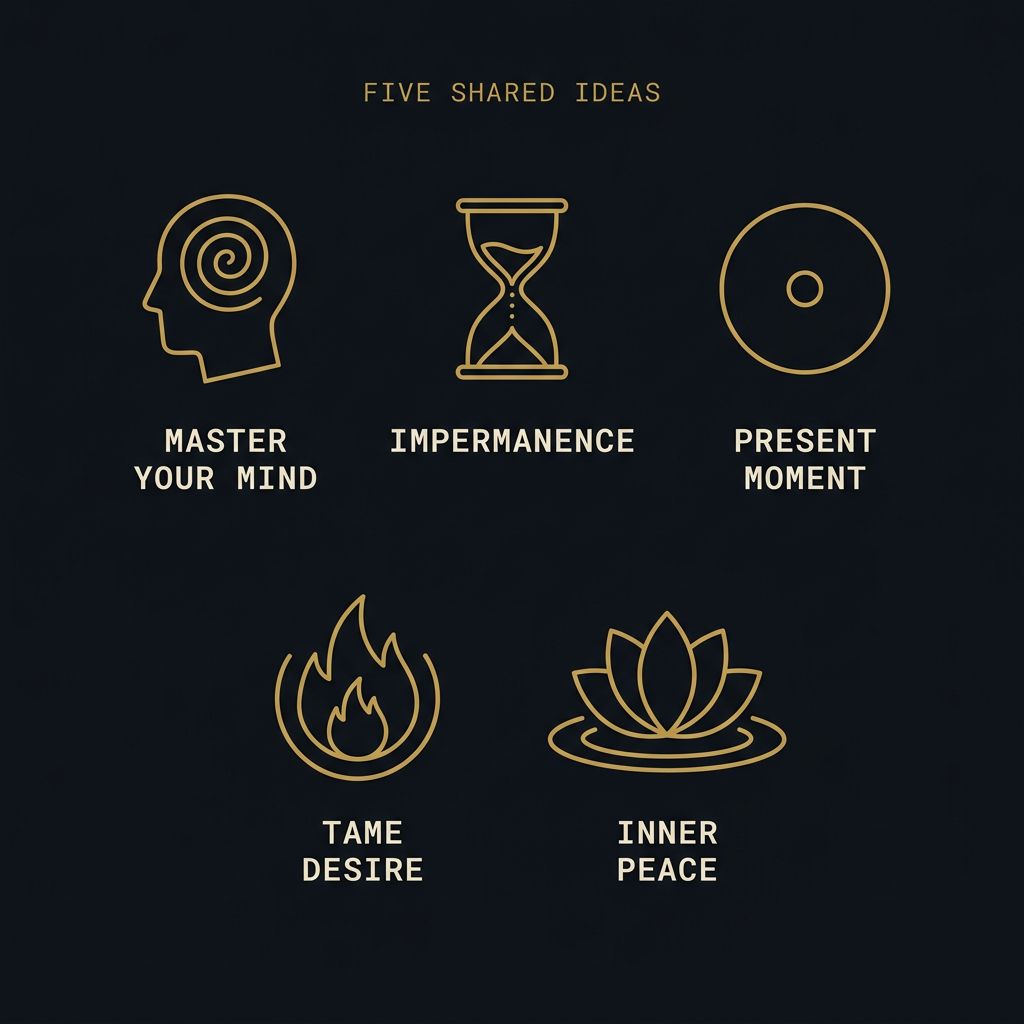
Start with the overlap, because it’s larger than most people expect. On the practical psychology of suffering, Epictetus and the Buddha are close to interchangeable.
1. Suffering is made by the mind, not the event
Both traditions locate the source of suffering inside us. Epictetus opens his handbook by saying we’re disturbed not by things but by our judgments about them. The Buddha’s second noble truth says suffering (dukkha) arises from craving and the mind’s grasping. Same move: the event is neutral; the suffering is added by how we relate to it.
2. Everything is impermanent — so stop clinging
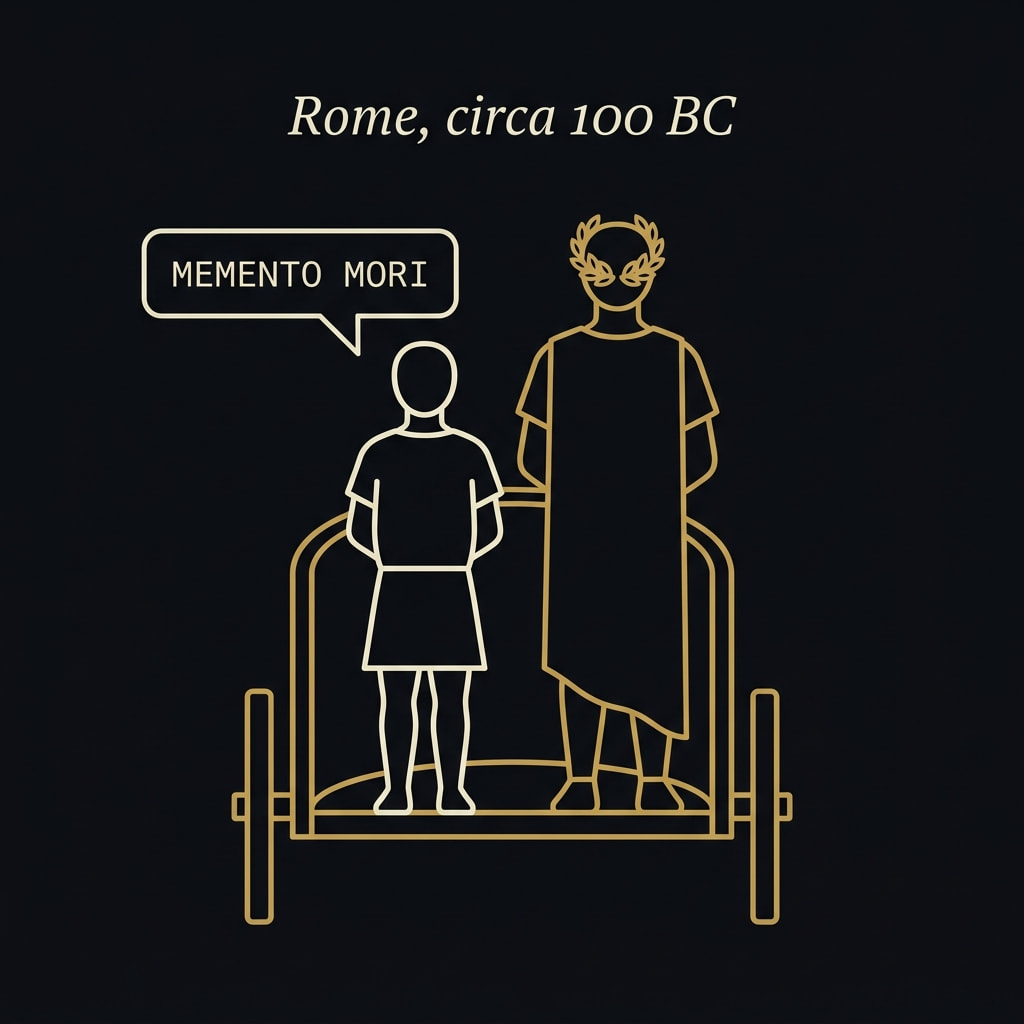
Buddhism calls it anicca: all things arise and pass. Stoicism has its own version in memento mori and Marcus Aurelius’s constant reminders that everything is in flux, that whatever you love is “a leaf that the wind drives earthward.” Both conclude that clinging to impermanent things is a recipe for pain, and that accepting impermanence is the way out.
3. Live in the present moment
Mindfulness of the present is the heart of Buddhist meditation. Marcus made the same point: “Confine yourself to the present.” Both traditions treat anxiety about the future and regret about the past as mental noise, and both train the same skill — bringing attention back to the only moment you can actually act in.
4. Freedom comes from mastering desire, not feeding it
Buddhism aims to extinguish craving (tanha); Stoicism aims to want only what is up to you and to be indifferent to the rest. Neither says enjoy nothing — they say don’t be enslaved by wanting. The free person, in both systems, is the one who isn’t jerked around by appetite and aversion.
5. Lasting peace is internal
Neither tradition believes a better job, more money, or applause will fix you. The Stoic apatheia (freedom from destructive passion) and the Buddhist equanimity (upekkha) point at the same target: an unshakable inner calm that doesn’t depend on circumstances cooperating. Build it inside, or you don’t have it at all.
Stoicism vs Buddhism: The Comparison Table
A side-by-side on the eight dimensions people most often ask about:
| Aspect | Stoicism | Buddhism |
|---|---|---|
| Origin | ~300 BCE, Athens. Founded by Zeno of Citium. | ~500 BCE, northern India. Taught by Siddhartha Gautama, the Buddha. |
| Core problem | Disturbance caused by false judgments about externals. | Dukkha — suffering, dissatisfaction, unease. |
| Root cause | Valuing things outside our control. | Craving and attachment (tanha). |
| The self | A real self / ruling faculty to perfect through virtue. | No fixed, permanent self (anatta). |
| Goal | Eudaimonia — flourishing by living virtuously. | Nirvana — liberation from suffering and rebirth. |
| Death | One life; accept death as natural and return to the cosmos. | A cycle of rebirth (samsara), ended at awakening. |
| The cosmos | Rational and providential, ordered by the Logos. | No creator god; an impersonal moral law (karma). |
| Method | Reason, the dichotomy of control, the four virtues. | Meditation, mindfulness, the Noble Eightfold Path. |
3 Key Differences That Actually Matter
Difference 01
Engage the World vs. Transcend It
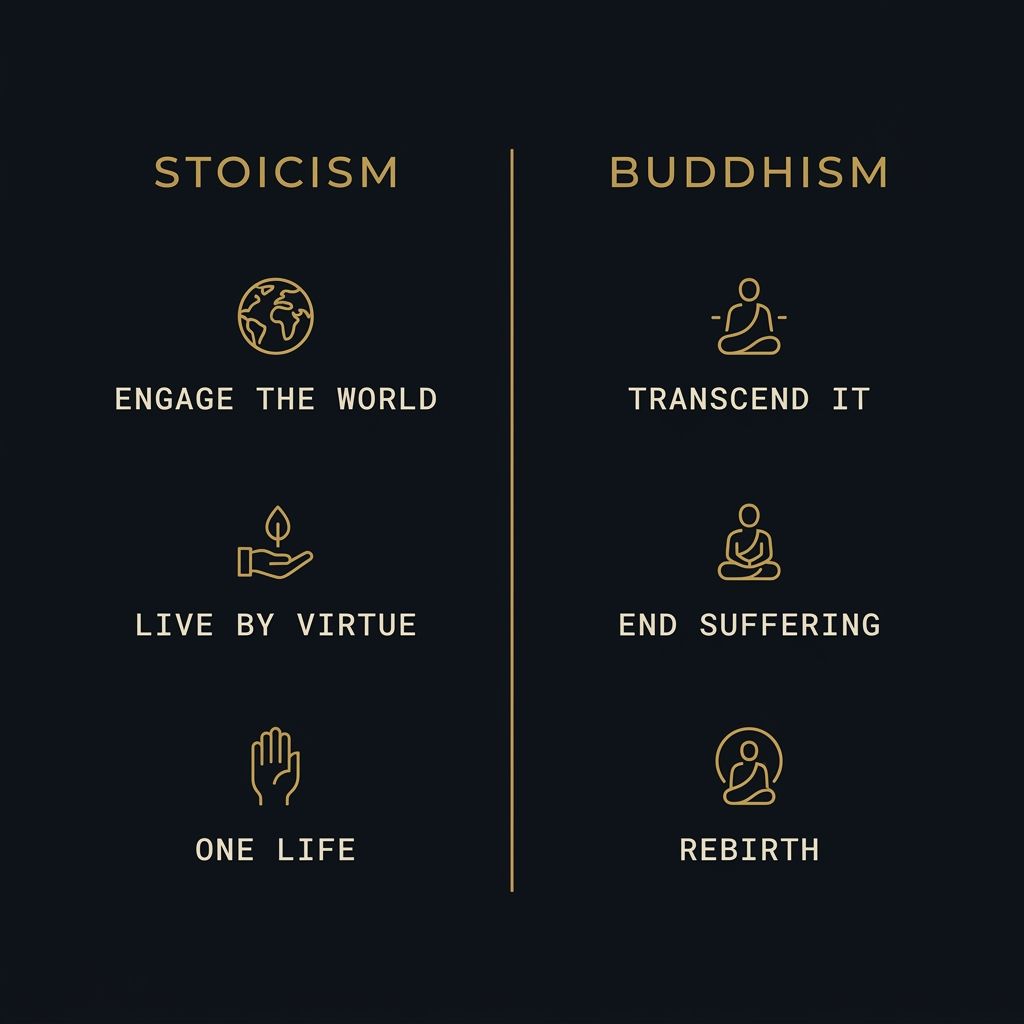
This is the most practical fork. Stoicism is fundamentally world-affirming: Marcus ran an empire, Seneca managed estates, and both saw that involvement as the arena of virtue. Classical Buddhism, at its deepest level, treats worldly existence as something to be ultimately liberated from. You can be a fully engaged Stoic CEO; the monastic ideal pulls the other way.
Difference 02
A Self to Perfect vs. No-Self
This is the deepest philosophical divide. Stoicism wants to strengthen the self; Buddhism wants to see through it. One polishes the ruling faculty into something excellent; the other questions whether there’s a permanent owner of experience to begin with. They can feel similar in practice — both reduce ego-driven suffering — but the underlying claim about who you are is genuinely opposed.
Difference 03
One Life vs. Rebirth
This metaphysical difference reshapes everything downstream — the urgency of Stoic memento mori comes from believing this is your only shot, while the Buddhist long game is measured across lifetimes. If you hold either tradition primarily as a practical philosophy rather than a religion, you can bracket this question and still use almost all of the psychology.
Where They Meet
For all the metaphysical distance, listen to the two founders on the power of the mind and you can barely tell them apart.
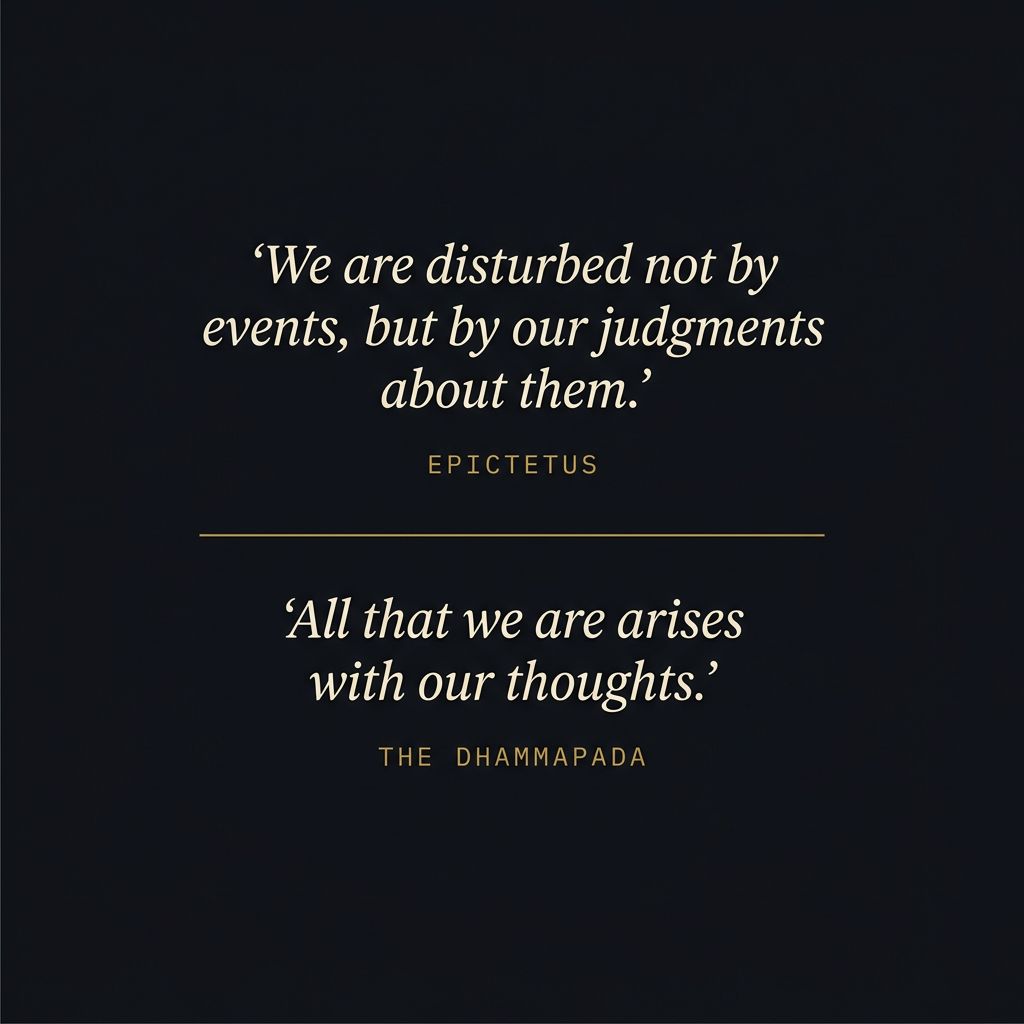
“Men are disturbed not by things, but by the views which they take of things.” — Epictetus, Enchiridion 5
“All that we are is the result of what we have thought; it is founded on our thoughts, it is made up of our thoughts.” — Dhammapada, verse 1
Two unrelated sages, five centuries and a continent apart, pointing at the same lever: the mind is where the work happens. That shared starting point is why a modern reader can take the dichotomy of control from one tradition and mindfulness from the other and feel no friction at all.
Which Should You Practice?
You don’t actually have to choose. But if you’re deciding where to start:
- Start with Stoicism if you want practical resilience for daily life with a gentle on-ramp — clear rules of thumb, no required beliefs about rebirth, and tools you can use at your desk in thirty seconds. It maps cleanly onto modern cognitive behavioral therapy.
- Lean Buddhist if you want a deeper contemplative training and a more thorough map of the mind, and you’re willing to invest real time in meditation practice.
- Do both if — honestly, this is what many people land on. Stoic reflection in the morning and evening, Buddhist mindfulness on the cushion. They reinforce rather than contradict each other at the level of practice.
For the academic deep-dive, the Stanford Encyclopedia of Philosophy entry on Stoicism is the gold standard, and its entry on Buddhist ethics covers the other side. For daily practice, our guide on how to practice Stoicism is the place to begin.
The honest summary. Stoicism and Buddhism are different religions of the mind that happen to share a gym. The metaphysics — self vs. no-self, one life vs. rebirth, engaged world vs. transcendence — genuinely diverge. But the daily training, watching your reactions and refusing to be ruled by them, is nearly identical. Most people benefit from the practices long before the metaphysics ever comes up.
Free tool
Curious which Stoic thinker fits how you already see the world? Take our 2-minute Stoic philosopher quiz — Marcus, Seneca, or Epictetus — and get a starting reading list.
Build the daily practice with StoicNow
Join the WaitlistFAQ
Are Stoicism and Buddhism the same thing?
No, but they overlap strikingly. Both teach that suffering comes mostly from the mind’s reaction to events rather than the events themselves, both stress impermanence, and both aim at a calm, unshakable inner state. The core difference is direction: Stoicism engages the world to live virtuously within one life, while Buddhism ultimately seeks to transcend the entire cycle of suffering and rebirth. They arrived at similar psychology from very different metaphysics.
What do Stoicism and Buddhism have in common?
Five big things: (1) suffering is created by our judgments and cravings, not by events alone; (2) everything is impermanent and clinging causes pain; (3) attention belongs in the present moment; (4) freedom comes from mastering desire rather than satisfying it; and (5) lasting peace is internal, not dependent on external success. Epictetus and the Buddha would have agreed on nearly all of the practical psychology.
What is the main difference between Stoicism and Buddhism?
Metaphysics and end-goal. Stoicism assumes a rational, ordered cosmos (the Logos), a real self to perfect through virtue, and a single life to live well. Buddhism teaches no creator god, no fixed self (anatta), and a cycle of rebirth (samsara) driven by karma, with liberation (nirvana) as release from that cycle. Stoicism perfects the self; Buddhism dissolves the illusion of a permanent self.
Is the dichotomy of control like Buddhist non-attachment?
They’re close cousins. The Stoic dichotomy of control says focus only on what’s up to you and release the rest; Buddhist non-attachment says cling to nothing, because clinging to impermanent things causes suffering. Both loosen the grip on outcomes. The difference is framing: Stoicism keeps acting purposefully in the world while detaching from results, whereas Buddhism more radically questions whether there’s a self doing the grasping at all.
Can you practice both Stoicism and Buddhism?
Yes, and many people do. The practices are largely compatible: Stoic morning and evening reflection sits comfortably alongside Buddhist mindfulness meditation, and both train the same skill of watching your reactions without being ruled by them. Conflicts only appear at the level of metaphysical belief (one life vs. rebirth, self vs. no-self), which you can hold lightly if you’re using either tradition primarily as a practical philosophy of living.
Which is easier for a beginner, Stoicism or Buddhism?
For most secular Westerners, Stoicism has a gentler on-ramp: it’s framed around clear rules of thumb (the dichotomy of control, premeditation of adversity) and doesn’t ask you to adopt beliefs about rebirth or sit in long meditation. Buddhism offers deeper contemplative training and a more thorough analysis of the mind, but typically asks for more time on the cushion. Many start with Stoicism for daily resilience and add Buddhist meditation for depth.

Marcus Adler
Founder & Lead Writer, StoicNow
Marcus Adler is the founder of StoicNow. For over a decade he has applied Stoic philosophy to daily life — testing the practices of Marcus Aurelius, Seneca, and Epictetus against modern problems and translating them into simple, repeatable routines. More about the author →