
Quick answer
Stoic self-discipline is the trained ability to act on reason rather than impulse — doing what you judge is right regardless of comfort, fear, or craving. The Stoics called it temperance (sōphrosynē), one of their four cardinal virtues.
Self-discipline is usually sold as willpower: grit your teeth, push harder, white-knuckle through the craving until it passes or you cave. The Stoics had a stranger and far more durable idea. For them, discipline was not force — it was clarity, the habit of seeing what is actually in your control and acting on it before impulse takes the wheel. That single shift turns discipline from something exhausting into something repeatable.
Most modern advice about stoic self-discipline gets the order backwards. It treats the appetite as the enemy and the will as the weapon, then wonders why the will keeps losing. The Stoics started somewhere else entirely: with your judgments. Change what you believe is worth wanting, and the urge loses most of its grip before you ever have to fight it.
Here is what the Stoics actually meant by self-discipline, where the idea comes from, the mechanism that makes it work, and a short list of practices you can start today.
What Stoic Self-Discipline Actually Is
The Stoics did not have a word for “willpower” in the modern sense of a fuel tank you drain by resisting cookies. What they had was temperance — in Greek, sōphrosynē — the virtue that governs your appetites and impulses. It is the trained sense of how much is enough, and the steadiness to stop there.
Self-discipline, in this frame, is temperance in motion. It is the moment-to-moment choice to act from your considered judgment rather than be dragged by desire, fear, or the pull of comfort. The Stoic does not white-knuckle the second drink. He has already decided, in calmer hours, what kind of person he intends to be — and the decision does most of the work when the moment arrives.
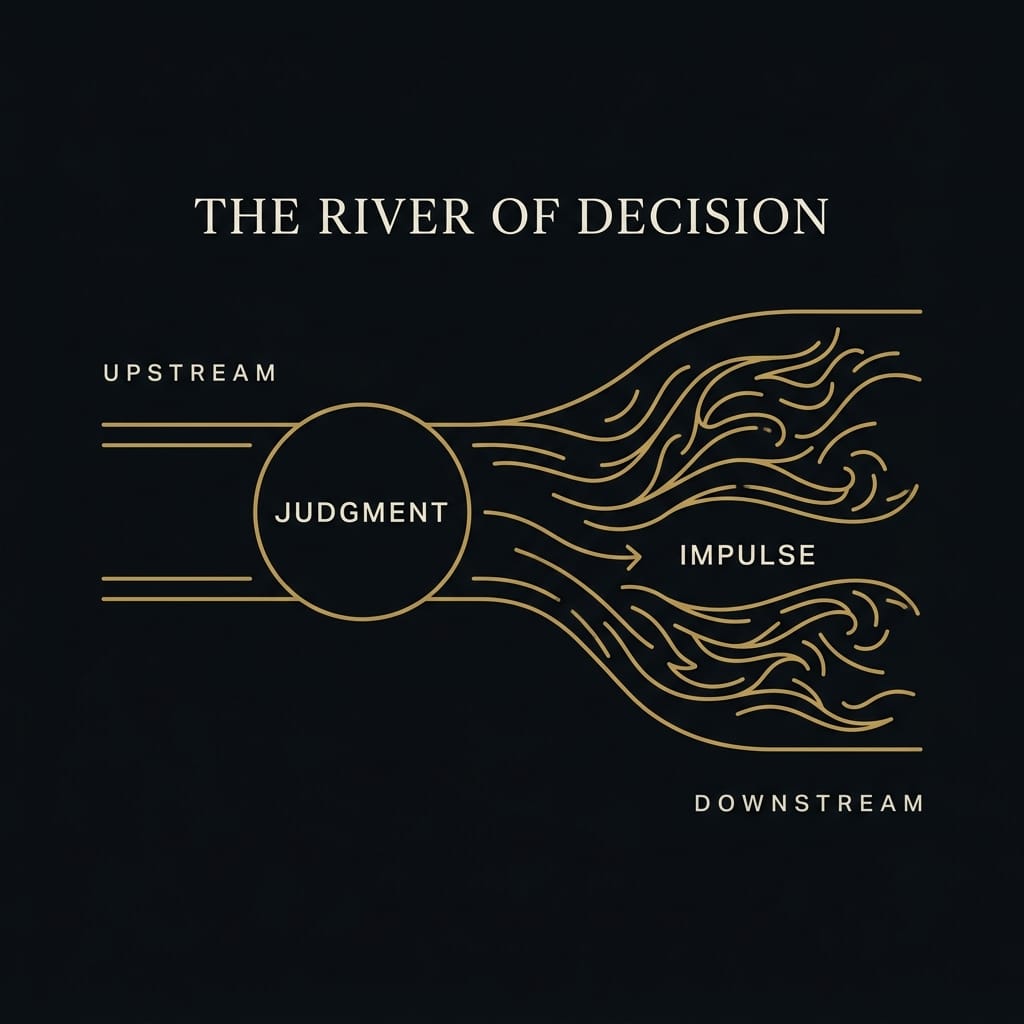
This matters because it relocates the whole struggle. Conventional willpower is a contest between “I want” and “I shouldn’t,” fought in real time, when you are tired and the want is loud. Stoic discipline moves the contest upstream, into how you label things before they tempt you. Win there, and the moment of temptation is half-decided already.
Where the Idea Comes From
Temperance is one of the four Stoic virtues, alongside wisdom, courage, and justice — a scheme the Stoics inherited from Socrates and Plato and made the spine of their ethics. If you want the full map, the four Stoic virtues explains how they fit together. Discipline is the practical edge of temperance: the virtue applied to your own impulses rather than to abstract questions.
The clearest portrait of stoic self-discipline as lived practice comes from a man who had every excuse not to bother. Marcus Aurelius ruled an empire, and he still had to argue himself out of bed. In the Meditations, written privately to no audience but himself, he writes:
“At dawn, when you have trouble getting out of bed, tell yourself: ‘I have to go to work — as a human being. What do I have to complain of, if I’m going to do what I was born for — the things I was brought into the world to do?’” — Marcus Aurelius, Meditations 5.1
Notice the method. He does not summon raw willpower. He reasons with himself — reframes the warm bed as a small comfort and the day’s work as the thing he exists to do. The discipline is downstream of the argument. This is the Stoic template in miniature: think first, then the action follows with much less friction.
Epictetus, a former slave who became one of the most influential teachers in Rome, sharpened the same point into a tool. Everything, he taught, divides into what is up to us and what is not — the dichotomy of control. Your impulses, your judgments, your chosen actions are yours. Outcomes, other people, and the comfort the body craves are not fully yours. Self-discipline begins by aiming your effort only at the part you actually govern.
“It is not things that disturb us, but our judgments about things.” — Epictetus, Enchiridion 5
How It Works: The Pause Between Impulse and Act
The engine of stoic self-discipline is a single, trainable gap — the space between an impression and your reaction to it. An impression is the raw signal: the alert on your phone, the smell of the bakery, the urge to refresh the feed. By default, the impression and the action fuse into one reflex. You see the notification; you tap it. Discipline is the act of prying those two apart.
Epictetus described the practice directly: when an impression arrives, do not be swept off by it. Say to it, “Wait for me a little. Let me see what you are and what you represent. Let me test you.” That test is the whole game. Most impulses cannot survive a few seconds of honest examination, because the urgency they carry is borrowed from a false belief — that this comfort is a good you must have, rather than a preference you can decline.
The core move: an impulse is not a command. It is a proposal your mind submits for review. Self-discipline is the habit of actually reviewing it — asking “is this in my control, and does acting on it serve who I want to be?” — instead of rubber-stamping it.
This is also why the Stoic approach holds up where pure willpower collapses. Willpower fights the urge at full strength. The Stoic dissolves part of the urge first, by correcting the judgment underneath it. When you stop believing the snooze button is a real good, hitting it loses its appeal — and you need far less force to skip it. Modern cognitive behavioral therapy rests on the same insight that thoughts shape feeling and action; the Stoics simply got there first.

How to Build Stoic Self-Discipline Today
Discipline is assembled from small, repeatable acts, not declared in one grand resolution. Below are five practices the Stoics used, ordered from easiest to hardest. Pick one. Run it for a week before adding another.
1. Name the impression
The next time you feel pulled — toward the phone, the snooze, the second helping — pause and label it: this is just an impression, not a command. Naming it restores the gap. You are no longer the impulse; you are the one observing it. This is the foundational rep, and it costs two seconds.
2. Decide in advance
Don’t leave decisions to the moment of weakness. Set the rule when you are calm: lights out at eleven, no phone before the first task, one drink at dinner. A pre-made decision spends almost no willpower in the moment because the work was already done. Building this into a stoic morning routine gives the day a disciplined spine before the first temptation arrives.
3. Practice voluntary discomfort
Seneca advised setting aside days to live on the barest food and roughest clothing, then asking, “Is this the condition that I feared?” Deliberately taking the cold shower, skipping the snack, or walking instead of riding trains your appetites to take “no” for an answer. Each small refusal makes the next one easier. The full method is in voluntary discomfort.
4. Rehearse the obstacle
Before a hard task, picture what will tempt you off course — the urge to quit, the easier alternative — and decide now how you will meet it. This Stoic exercise, negative visualization, removes the surprise that derails discipline. You can’t be ambushed by an impulse you already saw coming.
5. Review at night
Seneca closed each day by asking himself three questions: what did I do badly, what did I do well, and what could I do better? Two minutes of honest self-audit turns scattered failures into data. You catch the patterns — the hour you always cave, the trigger that always wins — and adjust. The practice is laid out in the stoic evening reflection.
One at a time. The fastest way to fail at discipline is to install five habits on Monday. Stack them and they all collapse together. Run one practice until it’s automatic, then add the next. Discipline compounds; it does not arrive.
If you want a structured way to string these together over a few weeks, the 30-day Stoic challenge sequences them so each builds on the last.
Common Misconceptions
Stoic self-discipline gets distorted in a few predictable ways. Each one quietly defeats the practice.
Myth 01
It Means Suppressing Everything You Want
Myth 02
It’s Pure Willpower
Myth 03
Discipline Means Controlling Outcomes
Where Self-Discipline Sits in Stoic Practice
Discipline is not the goal of Stoicism. It is the gatekeeper for everything else. The Stoics taught that virtue is the only true good, and you cannot practice courage, justice, or wisdom if you cannot first govern your own impulses long enough to act on them. A person ruled by appetite never gets to the higher virtues; he is too busy being pulled around.
That is why temperance shows up everywhere in the system. The dichotomy of control is useless without the discipline to actually withdraw attention from what you can’t change. Amor fati — the embrace of what happens — demands the self-mastery not to thrash against it. Even grief, anger, and anxiety, which the Stoics addressed at length, are handled by the same core skill: pausing between the impression and the reaction, and choosing.
Practically, this means you don’t pursue discipline for its own sake, like a trophy. You build it because it is the toll you pay to live deliberately — to act from your values when the easier path is right there and the harder one is the one you respect. Marcus put the standard plainly:
“If it is not right, do not do it; if it is not true, do not say it.” — Marcus Aurelius, Meditations 12.17
Discipline is what stands between knowing that line and crossing it anyway. It is small, daily, unglamorous, and it is the difference between admiring Stoicism and living it.

Build the daily habit with StoicNow
Join the WaitlistFree Quiz
Which Stoic Are You?
A 3-minute personality quiz — Marcus, Seneca, Epictetus, or Cato.
FAQ
What is stoic self-discipline?
Stoic self-discipline is the trained ability to act on reason rather than impulse — to do what you judge is right regardless of comfort, fear, or craving. The Stoics called it temperance (sōphrosynē), one of their four cardinal virtues. It is less about forcing yourself and more about seeing clearly what is in your control, then acting on it before impulse takes over.
How did the Stoics build self-discipline?
Through daily practice, not heroic effort. They paused between an impression and a reaction, rehearsed hardship in advance (premeditatio malorum), practiced voluntary discomfort to weaken cravings, and reviewed each day at night to catch failures. Marcus Aurelius literally argued himself out of bed in Meditations 5.1. Discipline, for them, was a habit assembled from small, repeatable acts.
Is Stoic self-discipline the same as willpower?
No. Willpower is force — gritting your teeth against a craving until it wins or you do. Stoic self-discipline is clarity: removing the false belief that makes the craving feel urgent in the first place. When you stop judging the comfort as a “good” you must have, resisting it takes far less effort. Force exhausts; clarity lasts.
Which Stoic virtue is self-discipline?
Temperance (sōphrosynē), one of the four Stoic virtues alongside wisdom, courage, and justice. Temperance governs your appetites and impulses — knowing how much is enough and stopping there. Self-discipline is temperance in action: the moment-to-moment choice to act from reason rather than be pulled by desire, fear, or comfort.
How do I start practicing Stoic self-discipline today?
Start with the pause. Next time you feel pulled toward something — the snooze button, the phone, the second drink — name it as just an impression, not a command, and ask whether acting on it serves the person you want to be. Add one act of voluntary discomfort daily and a two-minute evening review. Three small habits beat one grand resolution.
Can Stoicism help with procrastination and bad habits?
Yes. Procrastination is impulse winning over judgment — exactly what Stoic self-discipline targets. By separating the urge to delay from your reasoned plan, treating the urge as an impression you can decline, and shrinking the next action to something you can start now, Stoicism gives a practical method for acting despite reluctance rather than waiting to feel ready.

Marcus Adler
Founder & Lead Writer, StoicNow
Marcus Adler is the founder of StoicNow. For over a decade he has applied Stoic philosophy to daily life — testing the practices of Marcus Aurelius, Seneca, and Epictetus against modern problems and translating them into simple, repeatable routines. More about the author →
Further reading