Quick answer
Stoic character traits are the specific dispositions the Stoics believed made up a good character: the four cardinal virtues (wisdom, courage, justice, temperance) plus supporting traits like equanimity, self-discipline, and acceptance of what you can't control. The Stoics treated all of them as trained skills, not qualities you're born with.
Ask ten people what a "Stoic" looks like and most will describe a mood — unbothered, hard to rattle, a little cold. The Stoics themselves described something more specific: a short list of trainable character traits, organized around the four virtues Zeno began teaching from a covered porch in Athens around 300 BC. Here is that list in full, with the ancient sources behind each trait and how to actually start building one.

What "Stoic Character" Actually Means
The Stoics didn't use "character" the way we do now, as a synonym for personality or temperament. Their word was closer to ēthos — a settled disposition built from repeated judgments, grounded in aretē, virtue, meaning excellence of the reasoning mind. Personality, in their view, is mostly given to you. Character is made.
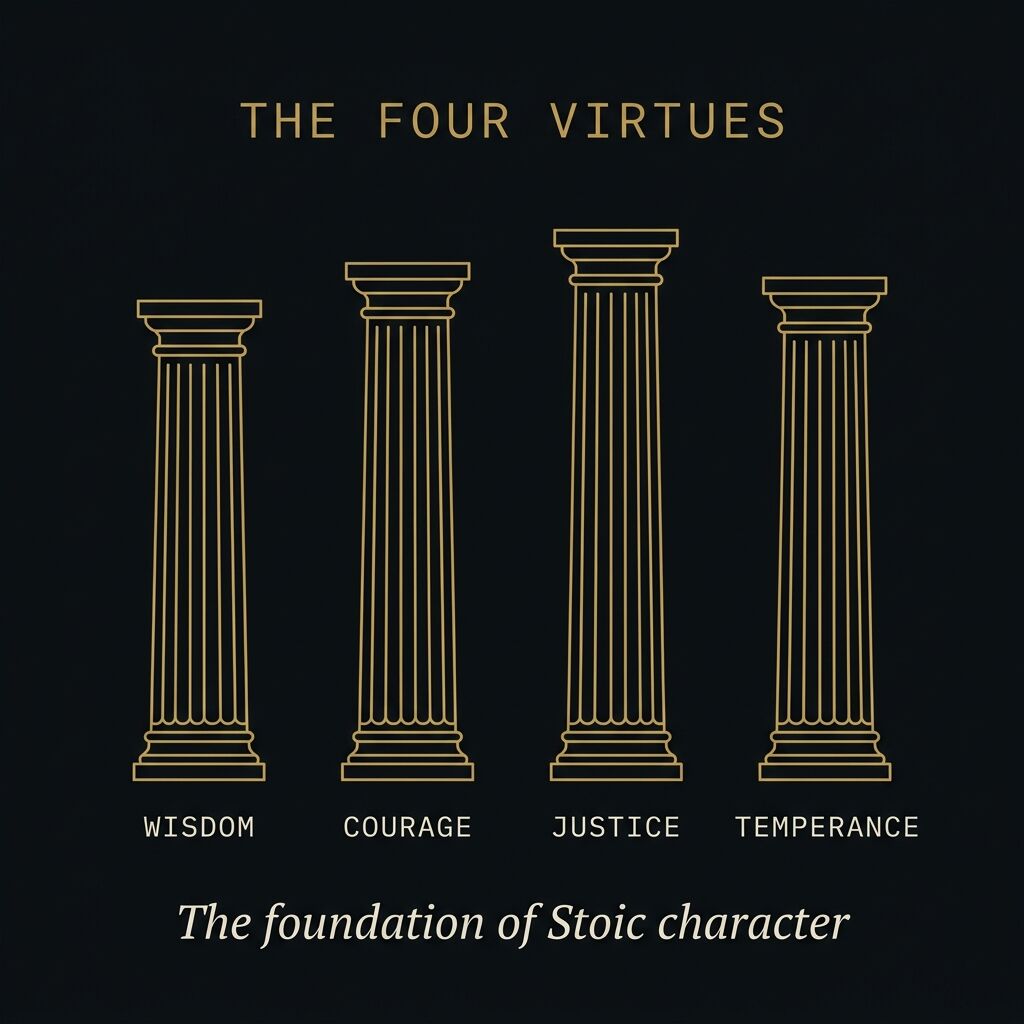
Diogenes Laertius, the ancient biographer whose Lives of the Eminent Philosophers (Book Seven) is our main surviving source for early Stoic doctrine, records how Zeno and his successor Chrysippus organized this excellence into four heads — wisdom, courage, justice, and temperance — each a different application of the same underlying skill: seeing clearly and choosing well. Everything the later Stoics wrote about character branches off that root, and it's worth understanding the four virtues in full before going further.
The most direct evidence of how a Stoic actually built character survives in an unusual place: Book One of Marcus Aurelius's Meditations. Rather than argue theory, he does something almost no other ancient philosopher does — he lists, person by person, the specific traits he tried to absorb from the people who raised and taught him: his grandfather's mildness of temper, his mother's generosity, his teacher Rusticus's plain and direct way of dealing with people, his adoptive father Antoninus's steadiness under pressure. It reads less like philosophy and more like a training log, which is exactly what the Stoics believed character was.
The 10 Stoic Character Traits, at a Glance
Four of these are the classical cardinal virtues. The other six are traits that show up constantly across Stoic texts as the practical, everyday expressions of those virtues.
- Wisdom (phronesis) — the ability to tell what is actually good, bad, or neither, and to act on that distinction consistently.
- Courage (andreia) — steadiness in the face of danger, hardship, or social pressure, without recklessness.
- Justice (dikaiosynē) — giving other people and the wider community their due, including honesty and fair dealing.
- Temperance (sōphrosynē) — self-restraint with pleasure, appetite, and impulse.
- Equanimity — a settled, even mind that isn't hijacked by fear, rage, or excessive craving.
- Self-discipline — the follow-through that turns a judgment about what's right into an actual habit.
- Indifference to externals — treating wealth, reputation, and outcomes as things to use well, not things your worth depends on.
- Acceptance of fate (amor fati) — meeting what actually happens without wasting energy wishing it hadn't.
- A focus on what's up to you — directing effort at your own judgments and actions instead of outcomes you don't control.
- Honest self-examination — the daily habit of reviewing your own conduct without flattery or excuse.
The Four Cardinal Virtues, Explained
These four aren't a checklist so much as one capacity viewed from different angles. The Stoics called this the unity of the virtues: a well-ordered mind applied to danger looks like courage; applied to what you owe other people, it looks like justice; applied to pleasure and appetite, it looks like temperance. Wisdom is the root skill — seeing situations clearly — that the other three express in specific contexts.
Marcus Aurelius put the whole project in a single line he reportedly told himself on hard mornings: "I am rising to do the work of a human being" (Meditations 5.1). That's wisdom and self-discipline collapsed into one sentence — the clear judgment about what the day requires, followed immediately by the willingness to act on it.

Why this matters in practice: if the virtues are unified, you can't cultivate one while ignoring the others without it eventually showing. Courage without justice becomes recklessness at other people's expense; temperance without wisdom becomes rigid self-denial for its own sake.
The Six Supporting Traits, Explained
These aren't a separate system. They're the four virtues showing up as specific, recognizable behavior — the traits people actually notice when they describe someone as having a "Stoic" character.
Equanimity
Equanimity is not the absence of feeling; it's the absence of being run by bad judgments. The Stoics distinguished ordinary emotional life from pathē — irrational, excessive passions caused by mistaken beliefs about what matters. This distinction is the single most misread part of Stoicism, and it's worth reading in full: see whether Stoicism is really about being unemotional.
Self-discipline
Wisdom tells you what's right; self-discipline is what makes you actually do it. Seneca described the Stoic project as watching yourself constantly, writing to a friend that "a holy spirit indwells within us, one who marks our good and bad deeds, and is our guardian" (Letters 41). That internal watchfulness, repeated daily, is what builds the trait — see the full practical breakdown of Stoic self-discipline.
Indifference to externals
The Stoics called wealth, health, and reputation "preferred indifferents" — worth pursuing sensibly, but not the measure of a good life. This is different from not caring; it means not staking your character on things outside your control, a distinction that runs directly into the dichotomy of control, arguably the single most useful idea in the whole system.
Acceptance of fate
Where equanimity is about your inner state, amor fati is about your relationship to events themselves — not just tolerating what happens but meeting it without the wasted energy of wishing it were otherwise. The full case for this trait, including how it differs from simple resignation, is in how to love your fate, even when it's terrible.
A focus on what's up to you
Epictetus opened his handbook with the line the whole system rests on: "Of things, some are within our power, and others are not" (Enchiridion 1). Judgment, effort, and choice are yours; outcomes, other people, and reputation are not. Treating that split as a daily practice, not a slogan, is covered in the full Enchiridion summary.
Honest self-examination
None of the above traits build themselves. They require a daily audit — the practice of reviewing, without excuses, where you acted well and where you didn't. Seneca described writing this review each night before sleep, and the modern version of it is one of the simplest habits to start with; see Stoic journal prompts for self-reflection.

How These Traits Show Up in Daily Practice
None of this stays abstract for long in Stoic writing. Marcus Aurelius, Epictetus, and Seneca all describe character as something built at specific points in an ordinary day.

The full structure of this daily rhythm, morning to night, is laid out in the Stoic daily routine, and the underlying method behind all of it — why repetition works where willpower alone doesn't — is covered in how to practice Stoicism every day.
Common Misconceptions About Stoic Character
Myth 01
Stoics don't feel anything
Myth 02
Some people are just born Stoic
Myth 03
Character traits are about controlling outcomes
Build these traits one day at a time in StoicNow
Join the WaitlistFree Quiz
Which Stoic Are You?
A 3-minute personality quiz — Marcus, Seneca, Epictetus, or Cato.
FAQ
What are the main Stoic character traits?
The core Stoic character traits are the four cardinal virtues — wisdom, courage, justice, and temperance — plus six supporting traits: equanimity, self-discipline, indifference to externals, acceptance of fate (amor fati), a focus on what's within your control, and honest self-examination. All ten flow from the same idea: character is a pattern of judgment, not a fixed personality.
Are Stoic character traits the same as the four virtues?
Not exactly. The four cardinal virtues — wisdom, courage, justice, and temperance — are the foundation the early Stoics organized everything else around. Character traits like equanimity, self-discipline, and acceptance are specific expressions of those virtues in daily situations. Think of the virtues as the root system and the traits as what actually shows up in your behavior.
Can you actually build Stoic character traits, or are you born with them?
The Stoics insisted these traits are trained, not inherited. Epictetus was born enslaved and became one of Stoicism's sharpest teachers; Marcus Aurelius wrote openly about traits he had to work at his whole life. The Stoic position is that character is built through repeated, deliberate judgment and action — closer to a practiced skill than a fixed personality type.
Is being Stoic the same as being emotionless?
No. The Stoics distinguished healthy responses from destructive passions — fear, rage, and irrational grief — that come from bad judgments about what actually matters. The goal was equanimity, not numbness: fewer judgments that hijack you, not fewer feelings. Marcus Aurelius wrote about grief and frustration throughout Meditations without pretending he didn't feel them.
What's the difference between a virtue and a character trait in Stoicism?
In Stoic doctrine, virtue is a single unified state of a well-ordered mind — the Stoics called this the "unity of the virtues." A character trait is that same state applied to a specific situation: wisdom applied to danger looks like courage; wisdom applied to what you owe others looks like justice. The traits are how one underlying disposition shows up across different circumstances.
How do I start building Stoic character traits?
Start small and daily: a short morning intention, an evening review of where you acted well or poorly, and a habit of pausing before reacting to ask what's actually in your control. Consistency matters more than intensity — the Stoics saw character as built the same way a habit is built, through repetition, not through one dramatic decision.

Marcus Adler
Founder & Lead Writer, StoicNow
Marcus Adler is the founder of StoicNow. For over a decade he has applied Stoic philosophy to daily life — testing the practices of Marcus Aurelius, Seneca, and Epictetus against modern problems and translating them into simple, repeatable routines. More about the author →
Further reading