Quick answer
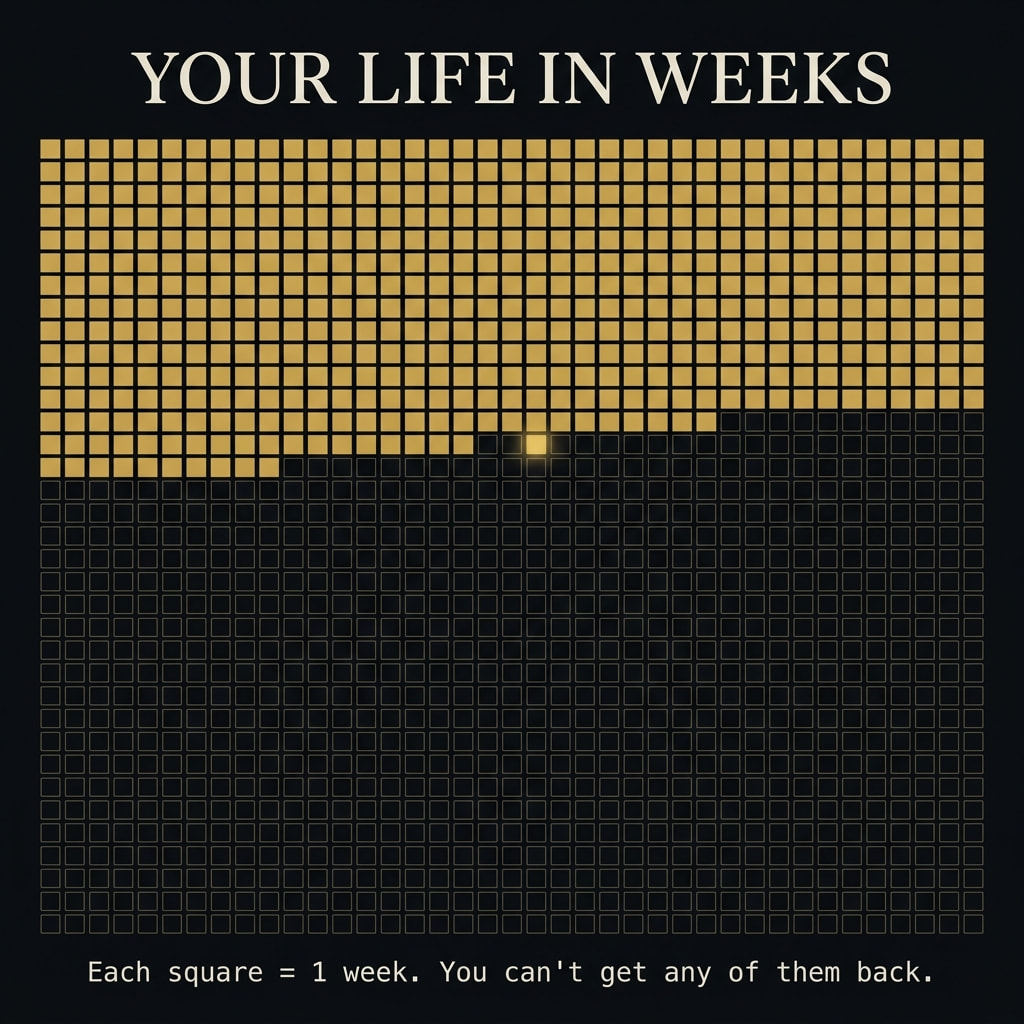
A "life in weeks" calculator turns your estimated lifespan into a single grid — one dot per week, roughly 4,000 dots for an 80-year life — so you can see, at a glance, how many weeks you've already spent and how many are realistically left.
Most people know, in the abstract, that life is finite. A life in weeks calculator makes that fact impossible to ignore. Instead of a number on a page, you get a grid you can actually point at — this dot is this week, and there are not many left. That shift, from abstraction to image, is the entire mechanism, and it happens to be one of the oldest tools in Stoic philosophy wearing a modern outfit.

What a "Life in Weeks" Calculator Actually Shows
The mechanics are simple. You enter a birth date and an assumed life expectancy, and the tool renders a grid: one row per year, 52 dots or squares per row, one dot per week. Weeks you've already lived get filled in — usually in a solid color — and the weeks still ahead of you stay empty.
That's it. There's no forecasting model, no health data, no attempt to predict your actual date of death. It's a visualization of an assumption, not a diagnosis. The value isn't in precision — it's in scale. A sentence like "you have about 40 years left" barely registers. A grid where more than half the dots are already filled in registers instantly, because you can see it the way you see anything else: all at once.
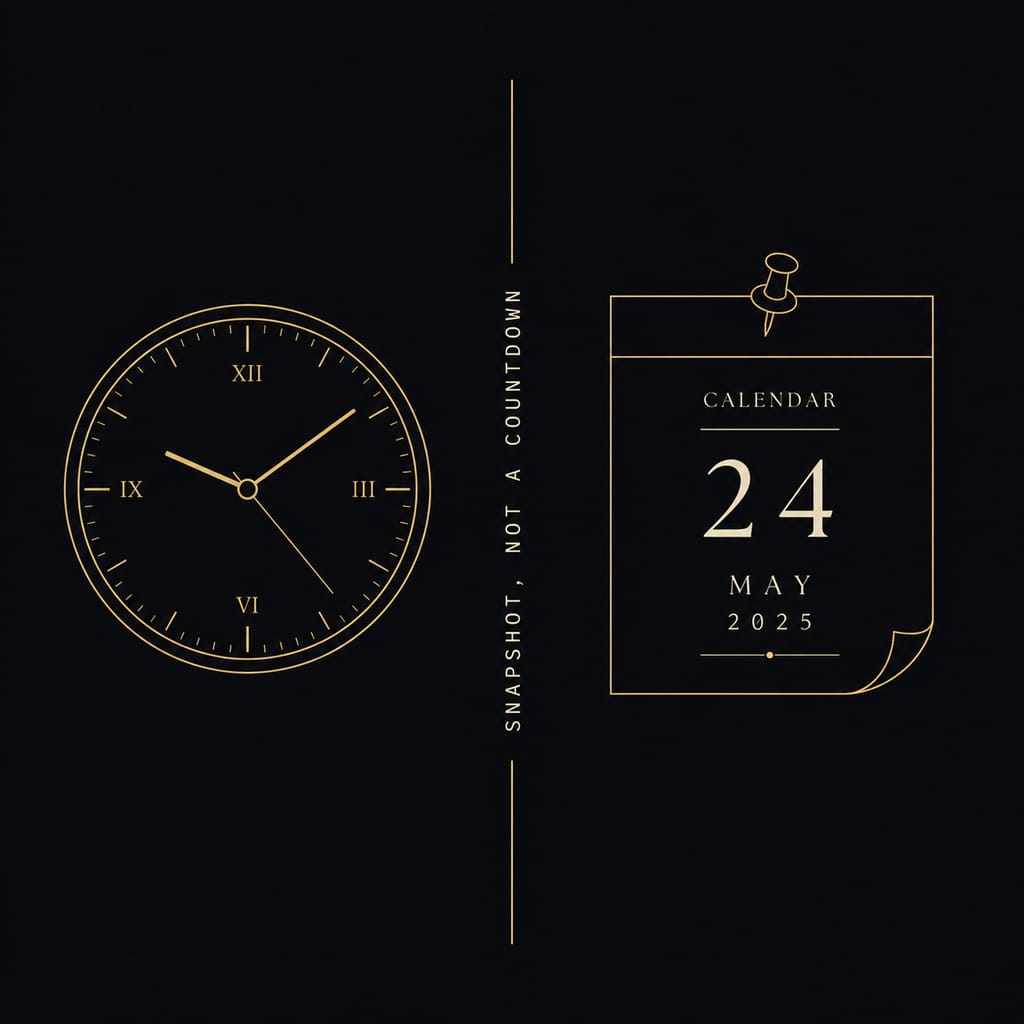
This is different from a live countdown clock, which ticks down in real time and can feel more like a gimmick than a practice. A life in weeks grid is a snapshot you're meant to sit with, the same way you'd sit with a memento mori calendar — not something to refresh anxiously, but something to return to on a schedule.
Where the Idea Comes From
The specific grid format most people picture today comes from a 2014 essay called "Your Life In Weeks," written by Tim Urban on his blog Wait But Why. The post laid out a human life as a literal grid of squares and argued, bluntly, that most of us are worse at estimating how much time we actually have than we think we are. It spread widely, and "life in weeks" has been shorthand for that specific visualization ever since.
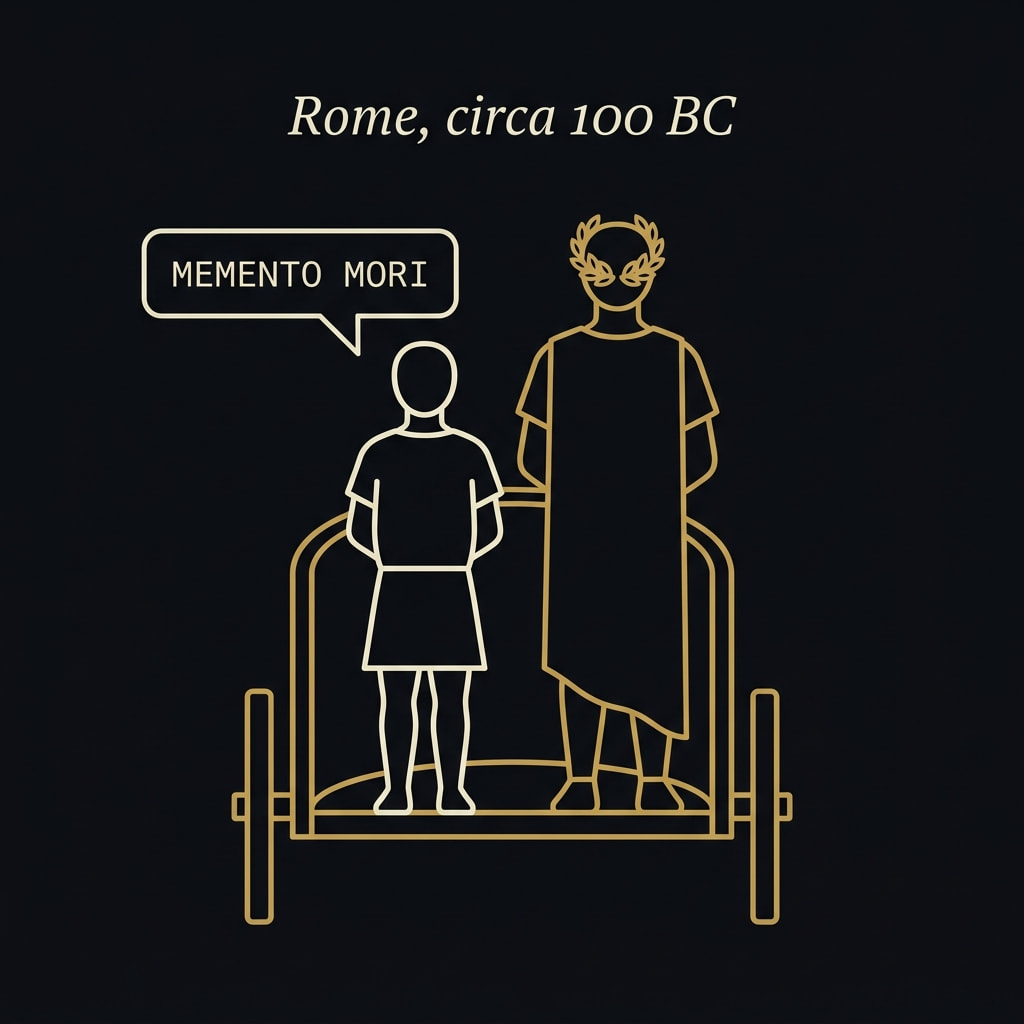
But Urban didn't invent the underlying idea — he gave an old one a new interface. Counting your remaining days deliberately, rather than living as if the supply were unlimited, is a core piece of memento mori practice, and the Stoics were doing a version of it two thousand years earlier. Seneca opened his essay On the Shortness of Life with almost exactly this complaint: that people act as though time is the one resource they have in infinite supply, when it's actually the only one they can never get back.
“It is not that we have a short time to live, but that we waste a lot of it.” — Seneca, On the Shortness of Life, 1
Read Seneca's full argument in our summary of On the Shortness of Life — it's the closest thing the ancient world has to a life in weeks calculator, just written in prose instead of dots.
The Math Behind the Grid
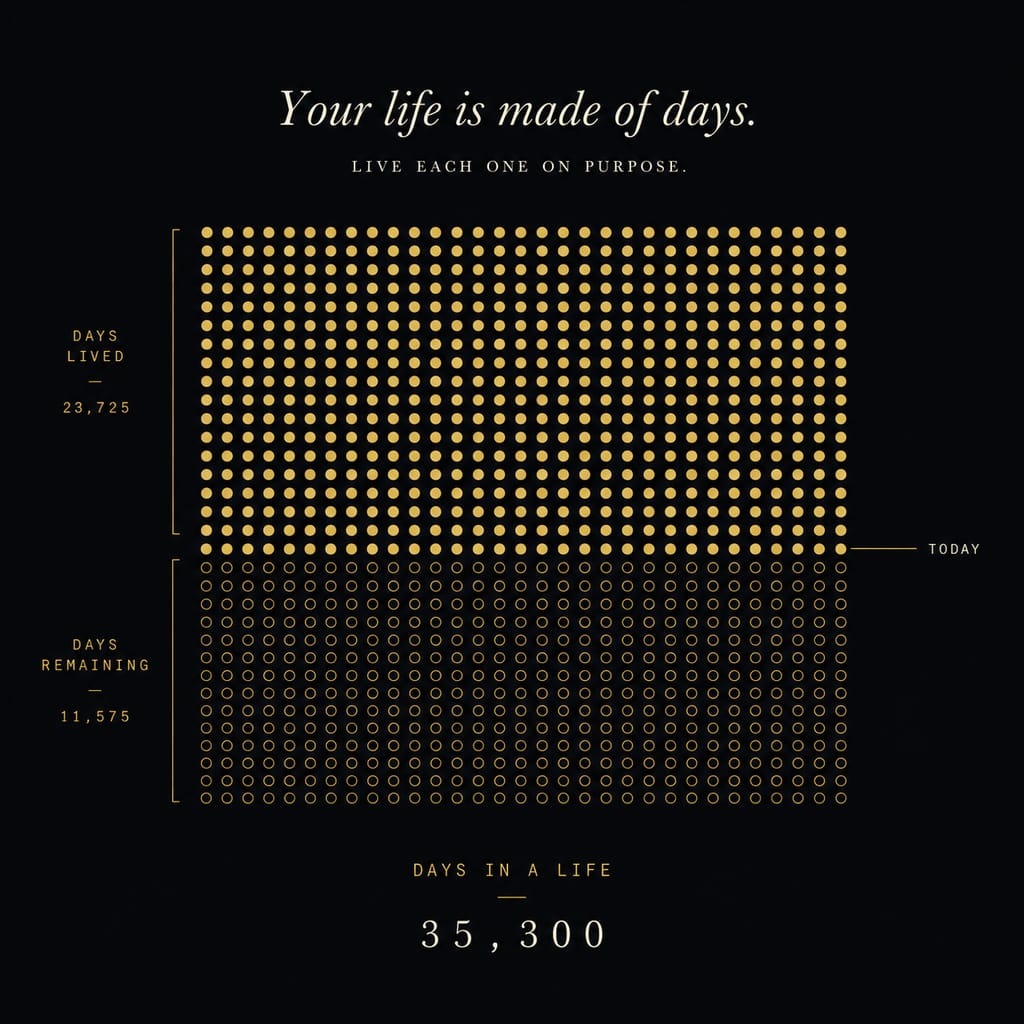
Most calculators default to a life expectancy somewhere between 75 and 90 years, depending on the tool and the country you tell it you're in. Run the multiplication and you land somewhere between roughly 3,900 and 4,700 weeks for a full life. That's why "around 4,000 weeks" has become the popular round number — it's close enough to the middle of that range to be useful, and easy enough to remember that it stuck.
The number got a second wave of attention in 2021, when writer Oliver Burkeman published a time-management book literally titled Four Thousand Weeks: Time Management for Mortals, built around the same math. The point both the calculator and the book make is the same: 4,000 sounds huge until you draw it as a grid you can see in one glance, at which point it looks uncomfortably small.
Your own number will move depending on your current age, your health, and where you live — the calculator is only ever a working estimate, not a prophecy. That's a feature, not a bug: the goal isn't an accurate countdown, it's a felt sense of scarcity, which is exactly what a raw statistic fails to produce on its own.
How to Use One as a Stoic Practice, Not a Wall Decoration
A grid you look at once and forget is just a poster. The Stoics never treated mortality awareness as a one-time realization — it was a daily discipline, repeated on purpose until it actually changed behavior. Three ways to make the calculator do the same:
- Pair it with a recurring calendar, not a static image. A memento mori calendar fills in one dot automatically as each week passes, so the grid stays current instead of going stale in a browser tab.
- Use it before you plan, not after you panic. Look at the grid at the start of a week, when you're deciding what to prioritize — not at 11 p.m. as a source of anxiety.
- Combine it with negative visualization. After looking at the grid, spend two minutes on negative visualization: imagine losing something you currently take for granted. The grid supplies the scarcity; the exercise supplies the gratitude.
A related technique worth pairing with the calculator is the view from above, which zooms out spatially the way a life in weeks grid zooms out temporally. Used together, they cover both dimensions Stoics cared about: how small you are in the world, and how limited your time in it actually is.
Common Misconceptions
Three things people get wrong about this tool, worth clearing up before you use one.
It's not meant to be depressing. The instinct is to read a mostly-filled grid as bad news. The Stoics used the same information for the opposite purpose — not to induce dread, but to sharpen gratitude and cut through procrastination. If it only ever produces anxiety for you, pair it with Stoic techniques for anxiety rather than dropping the practice.
It's not a prediction. The calculator uses an average life expectancy, not your medical file. It can't tell you when you'll die — it can only tell you, roughly, how many weeks a life your length typically contains. Treat the number the way you'd treat a weather forecast, not a court date.
Looking once isn't the point. A single glance produces a jolt that fades within a day. The practice only works as a repeated habit — which is why the ancient version was daily, not annual.

“Let death and exile, and all other things which appear terrible, be daily before your eyes, but chiefly death, and you will never think of anything mean, nor desire anything extravagantly.” — Epictetus, Enchiridion, 21
Where It Fits Among Stoic Memento Mori Practices
A life in weeks calculator isn't a separate idea from Stoic philosophy — it's one modern implementation of a practice that's roughly two thousand years old. Marcus Aurelius, writing privately and never intending publication, told himself the same thing the grid tells you:
“Do not act as if you had ten thousand years to throw away. Death stands at your elbow. Be good for something while you live and it is in your power.” — Marcus Aurelius, Meditations, 4.17
The calculator is a doorway, not a destination. A one-time look at the grid is worth having, but the actual behavior change comes from making the awareness routine — the way you'd build any other habit, like a Stoic daily routine anchors reflection to the same point in the day, every day.
Turn your weeks into a living calendar, not a one-time grid
Join the WaitlistFree Quiz
Which Stoic Are You?
A 3-minute personality quiz — Marcus, Seneca, Epictetus, or Cato.
FAQ
What does a "life in weeks" calculator mean?
It means visualizing your estimated lifespan as a grid of individual weeks — usually one dot per week, roughly 4,000 dots for an 80-year life — so the abstract fact "life is finite" becomes a concrete image you can look at. Weeks already lived are typically shaded in; the rest sit empty, waiting to be spent.
Who invented the life in weeks concept?
Writer Tim Urban popularized the modern version in a 2014 essay called "Your Life In Weeks" on his blog Wait But Why. But the underlying idea — deliberately counting your remaining time to sharpen how you spend it — is far older, going back to the Stoic practice of memento mori and Seneca's writing on the shortness of life.
How many weeks are in an average human life?
A life expectancy around 76 to 80 years works out to roughly 3,950 to 4,160 weeks, which is why most life-in-weeks calculators and Oliver Burkeman's book Four Thousand Weeks both settle on "about 4,000" as a round, memorable figure. The exact number shifts with your actual age, location, and health data.
Is a life in weeks calculator supposed to be depressing?
No — the Stoic tradition it borrows from used mortality awareness to produce gratitude and urgency, not despair. Seeing how few weeks remain is meant to clarify what actually matters and cut through procrastination, the same way Marcus Aurelius used the reminder that "death stands at your elbow" to stay focused rather than fearful.
How is a life in weeks calculator different from memento mori?
Memento mori — "remember you will die" — is the ancient principle; a life in weeks calculator is one modern tool for practicing it. Where a memento mori calendar fills in a dot each week as it passes, a one-time calculator just shows you a static snapshot of where you stand right now.
How often should I look at my life in weeks calendar?
Weekly works best, paired with an existing habit like a Sunday reflection, so the awareness stays current instead of fading after the first look. A calculator you check once and forget is just a poster; a calendar you update weekly is closer to the Stoic practice it's based on.

Marcus Adler
Founder & Lead Writer, StoicNow
Marcus Adler is the founder of StoicNow. For over a decade he has applied Stoic philosophy to daily life — testing the practices of Marcus Aurelius, Seneca, and Epictetus against modern problems and translating them into simple, repeatable routines. More about the author →
Further reading