Quick answer
Sympatheia stoicism is the Stoic principle that the entire cosmos — people, animals, and nature — functions as one interconnected, rational organism, so that harming another is, in a real sense, harming a part of the same whole you belong to.
Marcus Aurelius began some mornings by reminding himself that the people who would irritate him that day were not separate from him at all. Stoic ethics rests on a claim most modern readers skip past: that you are not an isolated individual weighing your interests against everyone else's, but one part of a single, interconnected whole. This is sympatheia — and understanding it changes how the rest of Stoicism, from the dichotomy of control to the four virtues, actually fits together.

What Sympatheia Actually Means
The word comes from the Greek syn ("together") and pathos ("feeling" or "being affected"). Literally, it means "feeling together" or "affected together" — but the Stoics used it in a stronger, more literal sense than the English word "sympathy" suggests today.
For the early Stoics, sympatheia wasn't a moral sentiment you were supposed to cultivate toward other people. It was a physical description of the universe. They held that the cosmos is a single living, rational being, held together by pneuma — an active tension or "breath" running through everything, the way a nervous system connects distant parts of a body into one organism. Because everything shares this pneuma, events in one part of the cosmos are "in sympathy" with events elsewhere — connected, not isolated. Human beings, on this view, are not separate atoms bumping into each other. They are organs of one body.
That distinction matters. Sympatheia isn't primarily about how you should feel toward strangers. It's a claim about how reality is structured — and the ethics follows from the physics, the same way Stoic ethics generally follows from Stoic views about nature and reason.
Where the Idea Comes From
Sympatheia isn't a late addition to Stoicism — it's built into the school's physics from the start, and it develops across four centuries of Stoic thought before landing in the most famous Stoic text ever written.
Marcus states the idea plainly. In Meditations 9.9, he writes that "all things are implicated with one another, and the bond is holy; and there is hardly anything unconnected with any other thing." The universe, for him, is "one substance, and one law, one common reason in all intelligent animals, and one truth." That's sympatheia stated as cosmology, not sentiment.

Hierocles gave the idea a practical shape. He pictured a person standing at the center of a set of concentric circles: the innermost holding the self and body, then immediate family, then extended family, then the local community, fellow countrymen, and finally the whole of humanity. The Stoic task, he argued, is to actively "draw" the outer circles inward — to treat a stranger a little more like a cousin, and a cousin a little more like a sibling — narrowing the emotional distance without pretending the circles don't exist.
Cooperation as the Practical Upshot
Sympatheia would be an interesting piece of ancient physics if it stopped at cosmology. What makes it central to Stoic ethics is that Marcus draws a direct behavioral conclusion from it — and he draws it every morning, before he's even out of bed.

"We are made for co-operation, like feet, like hands, like eyelids, like the rows of the upper and lower teeth." — Marcus Aurelius, Meditations 2.1
The full passage in Meditations 2.1 is a morning rehearsal: Marcus tells himself he will meet the meddling, the ungrateful, the arrogant that day, and that being angry at them would be like a hand being angry at a foot — a category error, since both exist to work together as parts of one body. This is sympatheia applied directly to the problem of anger: if you and the person who wronged you are parts of the same whole, resentment is, in a sense, self-directed.
He makes the political version of the same point in Meditations 4.4: "If the intellectual capacity is common to all men, common too is the reason… if this is so, we are all fellow-citizens… the world is in a manner a state." Shared reason is what makes sympatheia binding on rational beings specifically — it's the basis for what later thinkers call Stoic cosmopolitanism, the idea that everyone is a citizen of one world before they're a citizen of any city. Epictetus makes a related claim about human kinship built on shared reason, teaching that a person who truly grasps it stops treating strangers as fundamentally other.
Notice what sympatheia does not ask of you here. It doesn't ask you to control how the other person behaves — that's outside your power, per the dichotomy of control. It asks you to control how you interpret and respond to them, given that you're structurally on the same side. Cooperation is also one expression of justice, the social virtue in the four Stoic virtues — sympatheia is, in a sense, justice's metaphysical foundation.
What Sympatheia Is Not
The word gets loosely borrowed by modern wellness culture, usually stripped of the physics that gave it teeth. Three corrections worth making.
It is not selflessness. Sympatheia doesn't erase your individual judgment or ask you to dissolve into the group. The Stoics were emphatic that your reason and your choices remain your own responsibility — sympatheia describes your connection to others, not a demand to abandon yourself. Stoicism's reputation for coldness is itself a common misreading worth clearing up separately.
It is not passive tolerance. Recognizing that you're bound to another person doesn't mean accepting harm from them, or refusing to set boundaries. A hand can push a hand away without ceasing to be part of the same body. Sympatheia governs your internal reaction, not your external conduct.
It is not the same as empathy. Empathy is a feeling that rises and falls with mood, closeness, and fatigue. Sympatheia was meant by the Stoics as a fact about the structure of the cosmos — true whether or not you happen to feel warmly toward someone in the moment. That's what makes it more durable, and harder to fake.
How to Practice Sympatheia Today
None of this requires believing in ancient Stoic physics literally. The exercises the Stoics built around sympatheia work as psychological tools on their own terms.
- Rehearse the co-operation frame each morning. Before the day starts, name the kind of person who is likely to frustrate you, and remind yourself — as Marcus did — that you're both "parts" built to work together, not opponents.
- Actively narrow Hierocles' circles. Pick one relationship in an outer circle — a coworker, a neighbor, someone online — and deliberately extend it a small amount of the consideration you'd give family. This is the "drawing in" exercise in its original form.
- Use the view from above. Zooming out to see yourself as one small, connected part of a much larger whole is the same move made concrete as a visualization — see the view from above exercise for the full method.
- Apply it to a specific relationship under strain. Sympatheia is most useful exactly where it's hardest — with people you're currently annoyed at. See how it changes the tone of a hard conversation in Stoicism for relationships.

Where Sympatheia Fits in Stoic Practice
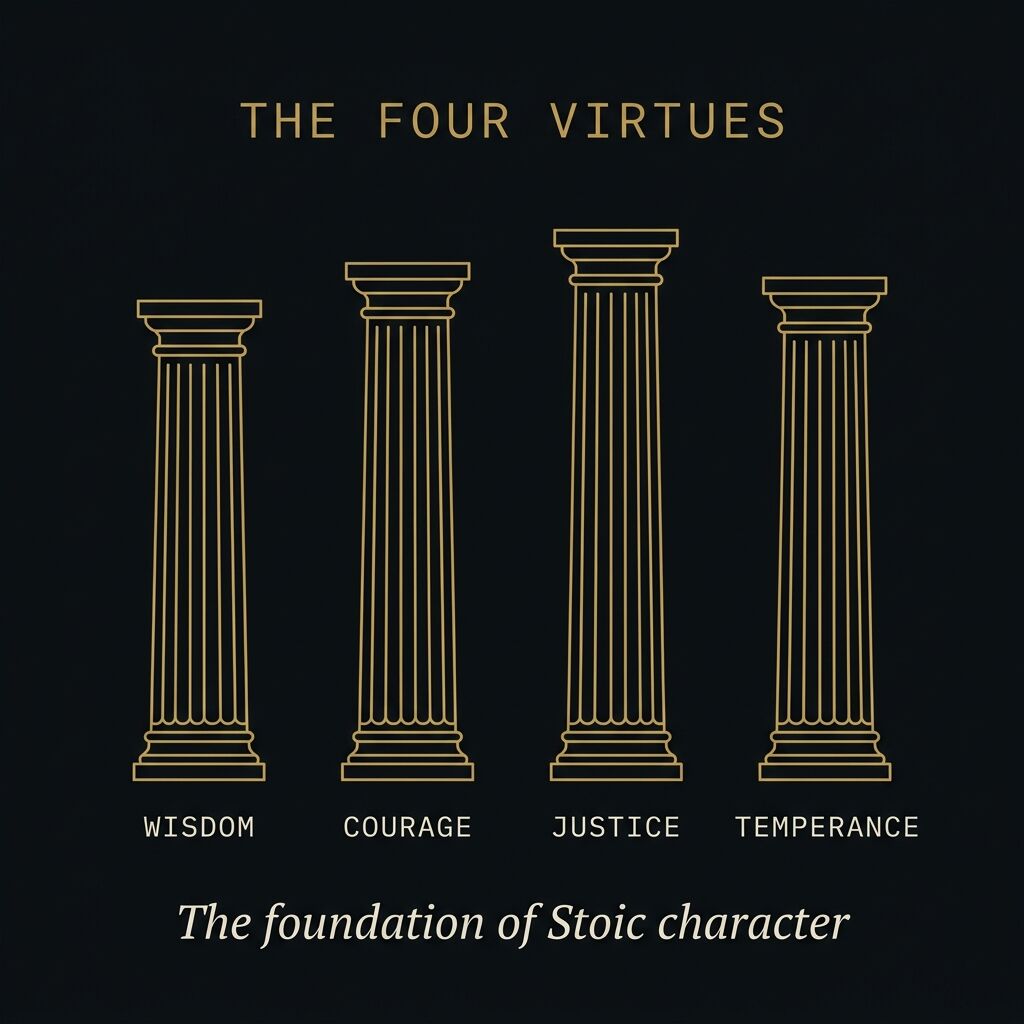
Sympatheia is easy to miss because it isn't one of the famous, standalone Stoic techniques the way negative visualization or the dichotomy of control are. It works underneath the others — the reason cooperation is treated as a duty rather than a nicety, the reason justice counts as a cardinal virtue alongside wisdom, courage, and temperance rather than an optional add-on.
It's also the least individualist part of a philosophy often flattened, in modern retellings, into pure self-management. Reading how to practice Stoicism without sympatheia gives you a set of techniques for staying calm. Reading it with sympatheia gives you a reason those techniques exist: staying calm toward other people isn't just good for you, it's a recognition of what they actually are to you — not obstacles, parts.
The clearest single place to see it argued in full is in Marcus's own notebook, written for no audience but himself, which is worth reading directly rather than only summarized.
Get a daily sympatheia reflection in StoicNow
Join the WaitlistFree Quiz
Which Stoic Are You?
A 3-minute personality quiz — Marcus, Seneca, Epictetus, or Cato.
FAQ
What does sympatheia mean in Stoicism?
Sympatheia (from the Greek for "feeling together") is the Stoic idea that everything in the cosmos — humans, animals, plants, even the stars — forms one interconnected, rational whole, held together the way organs cooperate inside a single living body. For the Stoics it wasn't a metaphor for kindness; it described how the universe is actually structured.
Where does the concept of sympatheia come from?
Sympatheia has roots in early Stoic physics, where the cosmos was described as a single living organism bound by pneuma, an active "breath" running through all things. Marcus Aurelius applies the idea directly in Meditations 9.9, writing that "all things are implicated with one another, and the bond is holy." Chrysippus and later Stoics developed the physics behind it.
How is sympatheia different from empathy?
Empathy is an emotional response to another person's feelings. Sympatheia is a metaphysical claim about how reality is put together — that you and everyone else are literally parts of one rational whole, like hands and feet on the same body. Empathy can fade with distance or fatigue; sympatheia is meant to hold regardless of how you feel.
What did Marcus Aurelius say about sympatheia?
In Meditations 2.1, Marcus reminds himself each morning that "we are made for co-operation, like feet, like hands, like eyelids" and that anger at others betrays this nature. In 4.4 he argues that shared reason makes all people "fellow citizens" of one cosmic state. Both passages treat sympatheia as a fact to act on, not a sentiment to feel.
How can I practice sympatheia in daily life?
Start small: before reacting to someone who irritates you, remember you're both "parts" of the same whole and that their failure doesn't require your anger. Widen your circle of concern deliberately — family, neighbors, strangers — the way the Stoic Hierocles described. Practicing the view from above, and applying the dichotomy of control to how you treat others, both reinforce it.
Is sympatheia the same as Stoic cosmopolitanism?
They're closely linked but not identical. Sympatheia is the underlying physical and metaphysical claim — that the cosmos is one interconnected organism. Cosmopolitanism is the ethical and political conclusion the Stoics drew from it: that all humans are citizens of one world-state (kosmopolis) with duties to each other regardless of nationality. Cosmopolitanism is sympatheia applied to human society specifically.

Marcus Adler
Founder & Lead Writer, StoicNow
Marcus Adler is the founder of StoicNow. For over a decade he has applied Stoic philosophy to daily life — testing the practices of Marcus Aurelius, Seneca, and Epictetus against modern problems and translating them into simple, repeatable routines. More about the author →
Further reading