Quick answer
No — this is the most common misconception. The Stoics were not cold. Marcus Aurelius wrote tenderly about his family; Seneca's letters are full of warmth; Epictetus taught deep care for others.
There’s a stubborn myth that Stoicism means going cold — that the path to peace is caring less, needing no one, building walls. It’s the exact opposite of what the Stoics actually taught, and getting this wrong ruins relationships in their name.
Marcus Aurelius opened his private journal with thanks to the people who loved and shaped him. Seneca’s letters drip with affection for his friend Lucilius. Epictetus taught that we’re born into webs of obligation — parent, child, neighbor, citizen — and that meeting those obligations well is the whole point. These were not men who’d emotionally checked out. They cared enormously. They just refused to let their inner peace depend on things they couldn’t control.
That’s the distinction this whole article rests on: non-attachment, not detachment. Love fully. Just don’t build your foundation on another person’s mood, choices, or whether they stay. Here’s how the Stoics did it.

The Detachment Myth (And Where It Comes From)
The misreading is understandable. The Stoics did talk about not being “disturbed” by externals, and a person is about as external as it gets. Take that out of context and you arrive at a caricature: the Stoic as a self-sufficient island who shrugs at a partner’s pain and feels nothing at a funeral.
But read what they actually wrote. Epictetus, supposedly the most austere of the three, told his students that the right response to a friend’s grief is to share in it outwardly — just not to let your own core be destabilized in the process. Marcus filled Meditations Book 1 with specific, loving gratitude for dozens of named individuals. Seneca married, grieved, and wrote a tender consolation to a mother who’d lost her son.
What they opposed was not love. It was disordered love — the kind that makes your serenity a hostage. If your wellbeing collapses the moment someone is in a bad mood, that isn’t deep love; it’s dependency wearing love’s clothes. The Stoic project is to love from a stable center, so that you can actually show up for the person instead of needing them to manage your emotional state.
“Whatever someone does or says, I’m bound to be good — the way gold or emerald or purple keeps repeating: whatever anyone does or says, I must be what I am and show my true colors.” — Marcus Aurelius, Meditations 7.15
The Dichotomy of Control in Every Relationship
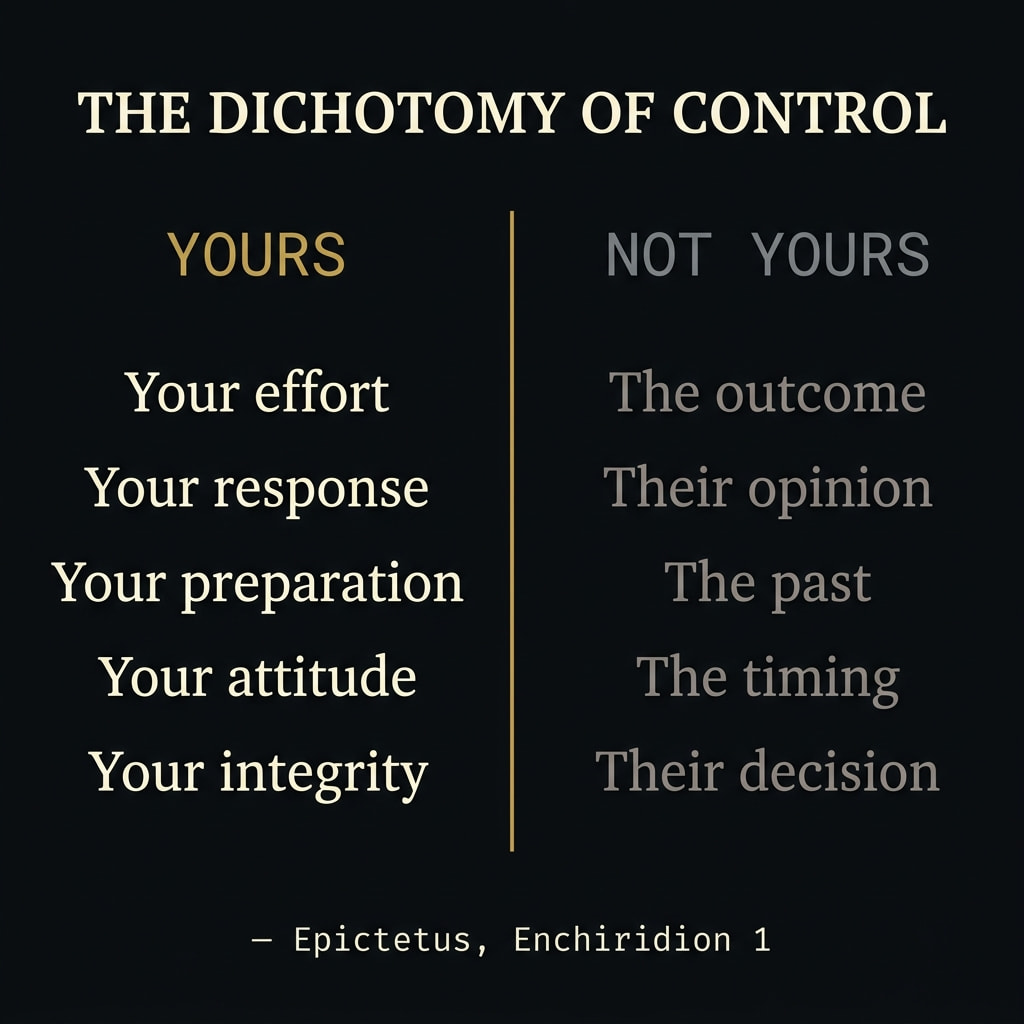
The single most useful Stoic tool for relationships is the dichotomy of control. Every relationship divides cleanly into two columns, and almost all relational suffering comes from working the wrong one.

Up to you: your honesty, your patience, how you show up, whether you listen, whether you forgive, the example you set. Not up to you: their mood, their choices, whether they change, whether they love you back, whether they stay.
Look at where you spend your emotional energy. Most people pour it into the second column — trying to manage, fix, convince, and control another adult — and then feel exhausted and resentful when it doesn’t work. It was never going to work. You were gripping something that isn’t in your hands.
The Stoic move is to relocate all that energy to the first column and do your half excellently. Be the most honest, patient, present version of yourself you can be — and then release the outcome. Paradoxically, this is also the thing most likely to actually influence the other person. Control loosens people; steadiness draws them. But you do it because it’s right, not because it works.
Marcus Aurelius on Difficult People
No passage in Stoicism is more useful for relationships than the opening of Meditations Book 2 — Marcus’s morning briefing to himself before facing the Roman court.

The passage is often quoted only for its first half — the list of difficult types — which makes Marcus sound like a misanthrope. The genius is in the second half. He doesn’t stop at “people are awful.” He works through it:
- They act this way because they can’t tell good from evil — not from malice, but from confusion. This is diagnosis, not excuse.
- They are his kin — sharing in the same reason, the same nature. He’s not separate from them.
- None of them can truly harm him, because the only real harm is to his own character, and that’s in his control, not theirs.
- To be angry at them is like being angry at a hand for being a hand. It’s a category error.
Run this before a hard conversation, a tense family dinner, a meeting with someone who gets under your skin. You’re not pretending they’re easy. You’re pre-deciding that their behavior won’t conscript your character. It’s the same engine behind Stoic anger management — reframe the offender before the surge arrives.
Four Stoic Practices for Love and Connection
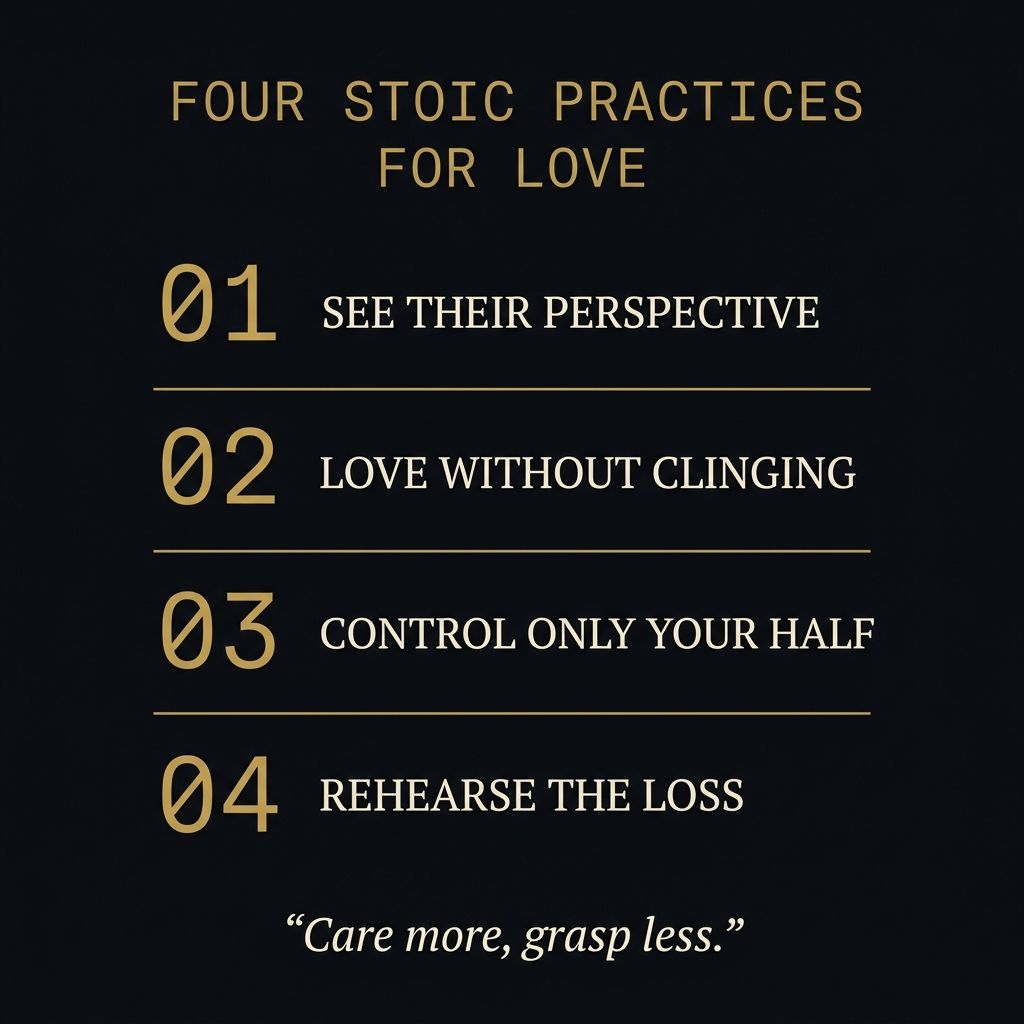
Practice 01
See It From Their Side First
Marcus instructed himself to actually enter the other person’s perspective — not to win the argument, but to understand it. Most conflict runs on a story we’ve built about the other person’s motives, and the story is usually less generous than the truth. Steelman them before you respond.
Practice 02
Love Without Clinging
Epictetus’s famous reframe sounds harsh until you live it. The person you love was never a possession; they were a gift, on loan, for an unknown length of time. Holding them that way doesn’t make you love less — it makes you grateful for every day instead of anxious about losing them. The grip is what poisons love. Loosen it and the love can breathe.
Practice 03
Work Only Your Half
This is the dichotomy made operational. When you catch yourself trying to control their feelings, their reaction, their growth — stop, and ask what your half of this looks like done well. Then do that. It’s the difference between a relationship that drains you and one that you can stay in with integrity, regardless of how the other person shows up.
Practice 04
Rehearse the Loss
The most counterintuitive practice and the most powerful. Periodically imagining the loss of someone you love is not pessimism — it’s the fastest known cure for taking them for granted. The couple who remembers they won’t have forever treats each other better than the couple who assumes they will. Awareness of impermanence is what makes love urgent instead of lazy.
How Stoics Handle Conflict
Three moves, in order, when a relationship hits friction:
1. Delay the reaction. Seneca’s “the greatest remedy for anger is delay” applies double in close relationships, where the surge is fastest and the damage longest-lasting. The words you fire in the first ninety seconds are the ones you spend weeks repairing. Buy the pause.
2. Assume confusion, not malice. Marcus’s reframe: they’re not evil, they’re operating from their own pain, fear, or blind spot. This isn’t about excusing genuinely bad behavior — it’s about not adding a story of villainy that escalates everything. Most hurt between people who love each other is friendly fire, not an attack.
3. Aim to win the relationship, not the argument. The Stoic asks: what outcome actually serves the bond here? Being right is in your control; being kind is in your control; the other person’s agreement is not. Drop the part you can’t control and the conflict usually deflates.
An important limit. Stoic relationship advice is for ordinary friction — the normal collisions of two imperfect people. It is not a reason to tolerate abuse, manipulation, or a pattern that’s harming you. “Work only your half” never means “absorb mistreatment.” The Stoics valued justice as a core virtue; protecting yourself and leaving a damaging situation is fully Stoic. Don’t use this philosophy as a reason to stay where you shouldn’t.
On Letting Go
Sometimes the Stoic answer is to release the relationship itself. Epictetus’s “I have given it back” applies to breakups, estrangements, and the slow drift of friendships as much as to death.
The reframe that helps most: you were given time with this person, not ownership of them. When it ends, the Stoic gratitude move is to focus on the having rather than the losing — not to deny the pain, but to refuse to let it curdle into bitterness. Bitterness is the tax you pay for believing you were owed permanence. You weren’t. Nobody is.
For the deeper version of this, our guide on Stoicism for grief covers loss in full, and amor fati covers the art of accepting what happened rather than fighting it.
“Never say of anything, ‘I have lost it,’ but, ‘I have given it back.’” — Epictetus, Enchiridion 11
Build the daily practice with StoicNow
Join the WaitlistFAQ
Does Stoicism teach emotional detachment in relationships?
No — this is the most common misconception. The Stoics were not cold. Marcus Aurelius wrote tenderly about his family; Seneca’s letters are full of warmth; Epictetus taught deep care for others. What Stoicism teaches is non-attachment, not detachment: love fully, but don’t build your inner peace on things outside your control — like another person’s choices, moods, or whether they stay. You care more, not less; you just stop trying to control what was never yours.
What did Marcus Aurelius say about difficult people?
Meditations 2.1 is his famous morning preparation: “When you wake up, tell yourself: the people I deal with today will be meddling, ungrateful, arrogant, dishonest, jealous and surly.” But he doesn’t stop at complaint — he reframes: they act this way because they can’t tell good from evil, they’re his kin, and none of them can truly harm him unless he lets them. It’s a tool for meeting difficult people without being dragged into resentment.
How does the dichotomy of control apply to relationships?
Split every relationship into two halves. Up to you: your honesty, patience, how you show up, whether you forgive. Not up to you: the other person’s mood, choices, whether they change, whether they stay. Almost all relationship suffering comes from trying to control the second column. Stoicism says pour your energy into your half — do it excellently — and release the rest.
What is the Stoic view of love?
The Stoics distinguished healthy love (philostorgia — natural affection and care) from disordered passion that makes your wellbeing hostage to another person. They encouraged deep love, marriage, friendship, and family — Hierocles wrote movingly about concentric circles of care. The Stoic ideal is to love generously while remembering the person is lent, not owned, which paradoxically lets you love more freely.
How do Stoics handle conflict?
Three moves: (1) pause before reacting — “the greatest remedy for anger is delay” (Seneca); (2) assume the other person isn’t acting from malice but from their own confusion or pain (Marcus); (3) separate the behavior you can address from the verdict you can’t control. The goal is to respond from your values, not from the reactive surge — to win the relationship, not the argument.
Can Stoicism help with a breakup or letting go?
Yes. The Stoic frame — “you were given time with this person, not ownership of them” (echoing Epictetus and Seneca’s Consolations) — reshapes loss from theft into gratitude. Negative visualization, rehearsing the loss while you still have someone, also softens the blow when it comes. Stoicism doesn’t make letting go painless; it makes it bearable, and keeps the grief from curdling into bitterness.

Marcus Adler
Founder & Lead Writer, StoicNow
Marcus Adler is the founder of StoicNow. For over a decade he has applied Stoic philosophy to daily life — testing the practices of Marcus Aurelius, Seneca, and Epictetus against modern problems and translating them into simple, repeatable routines. More about the author →