Quick answer
Stoicism helps at work by separating what you control (your effort, honesty, and response) from what you don’t (your boss’s mood, promotions, layoffs). You pour energy into your half, do it well, and refuse to let outcomes outside your control decide your peace of mind.
The three most-quoted Stoics all had day jobs. Marcus Aurelius ran an empire through plague and war. Seneca advised an emperor and managed a fortune. Epictetus taught a packed classroom for a living. None of them wrote from a monastery — they wrote in the margins of demanding, political, exhausting careers.
Which is exactly why Stoicism holds up so well at work. It wasn’t designed for a retreat. It was field-tested under deadlines, bad bosses, and office politics two thousand years before the open-plan office existed. The pressures have new names now — Slack pings, performance reviews, layoffs — but the underlying problem is unchanged: how do you stay steady when so much of your working life is decided by people who aren’t you?
Here are seven principles, each matched to a situation you’ve probably faced this month.

The One Idea the Other Six Rest On
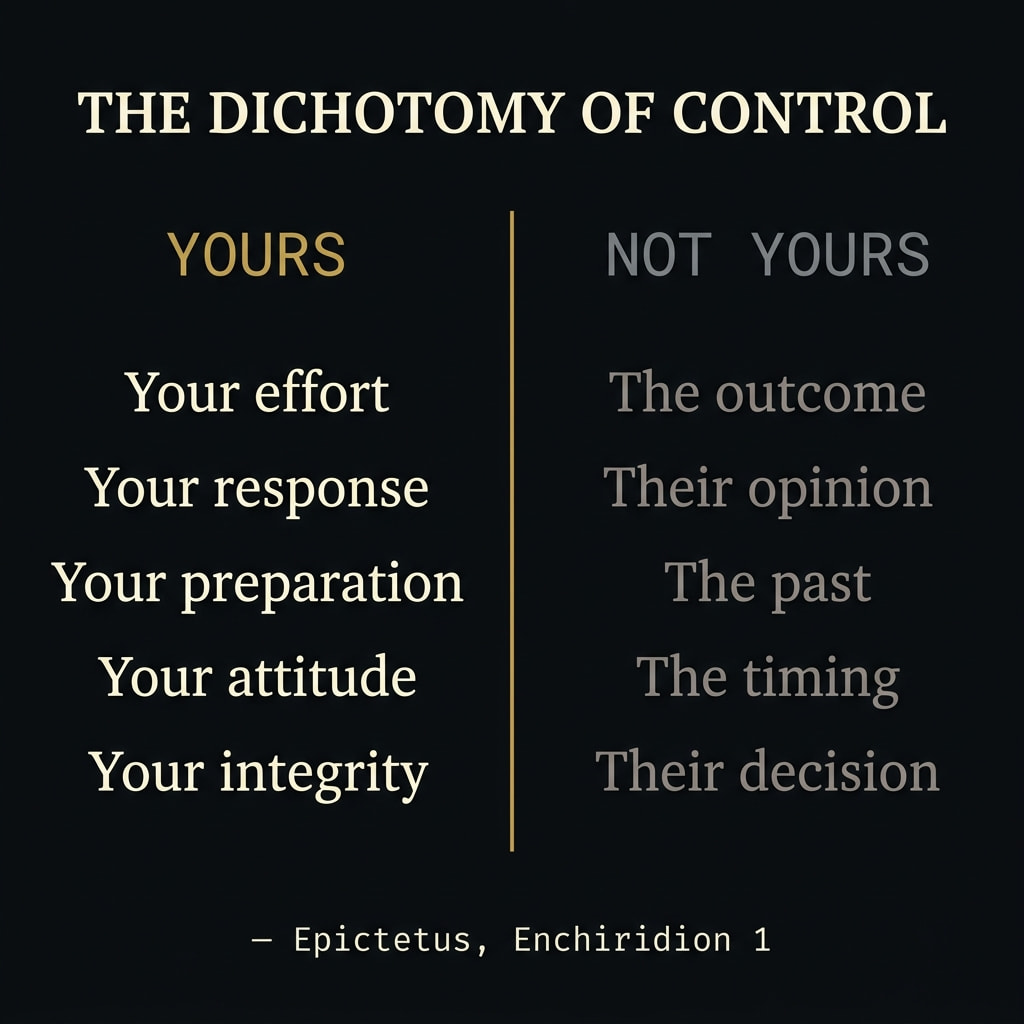
Before the seven situations, the engine underneath all of them: the dichotomy of control. Epictetus opens his handbook with it, and it’s the single most useful sentence ever written for a career.
Some things are up to you. Most things at work are not. Your effort, your honesty, your preparation, the way you treat people, how you respond when something goes wrong — those are yours. The promotion decision, your manager’s temperament, who gets credit, whether the company reorganizes, the market — those are not. They never were.

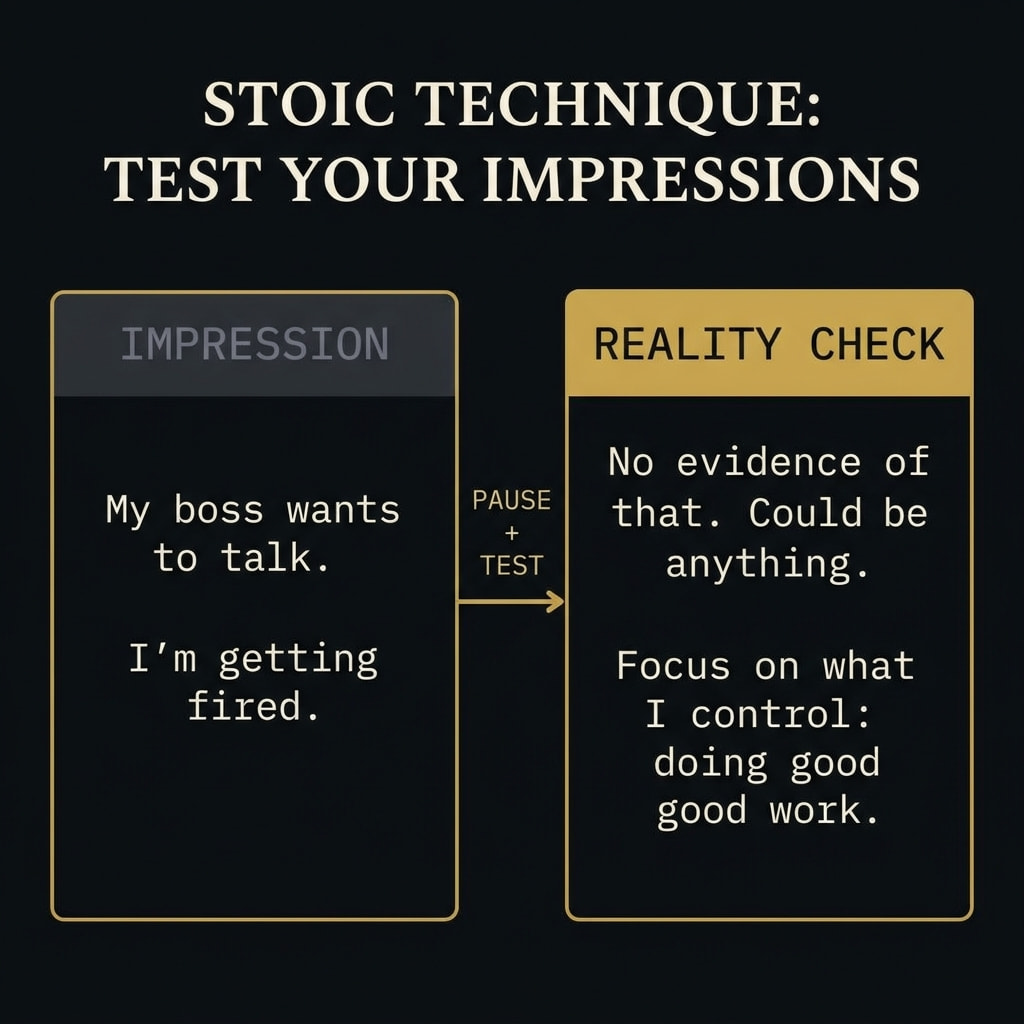
Nearly all work stress is the friction of trying to control the right-hand column. You replay a meeting you can’t change, rehearse arguments with a boss who won’t hear them, refresh the inbox for a decision that isn’t yours to make. The Stoic move is not to care less. It’s to move your energy left — into the part you actually own — and do that part excellently, then let the rest land where it will.
“Just that you do the right thing. The rest doesn’t matter.” — Marcus Aurelius, Meditations 6.2
7 Stoic Principles for the 7 Hardest Work Situations
Each card below pairs a common workplace pressure with the Stoic response and its source. They’re all applications of the dichotomy above — this is what it looks like on a Tuesday afternoon.
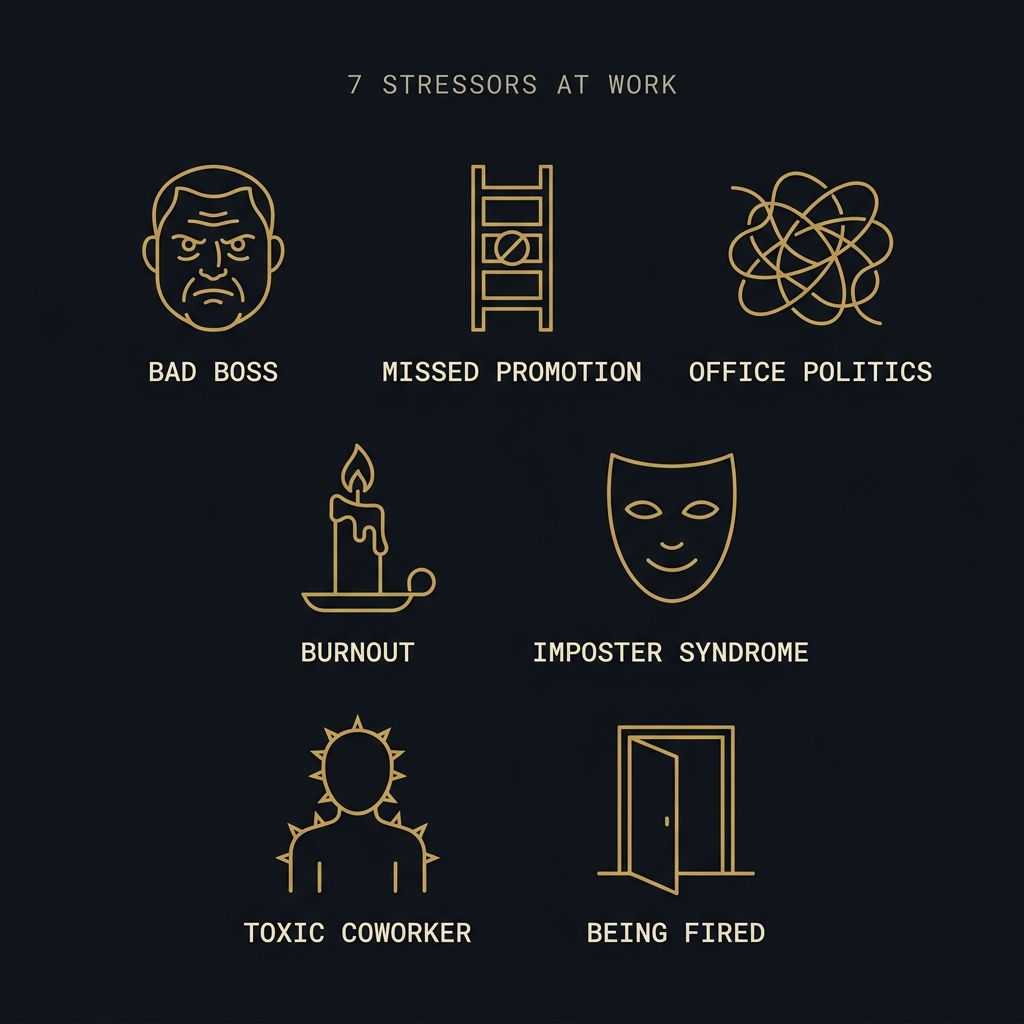
Principle 01 · The Bad Boss
Separate Their Character From Your Conduct
Principle 02 · The Missed Promotion
Treat Status as a “Preferred Indifferent”
Principle 03 · Office Politics
Mind Your Own Conduct
Principle 04 · Burnout
A Busy Life Is Not a Full One
Principle 05 · Imposter Syndrome
It’s a Judgment, Not a Fact
Principle 06 · The Toxic Coworker
Expect Them, Then Refuse the Bait
Principle 07 · Being Fired
It Was Given, Not Owned
The Hardest Part Is Starting
There’s one more passage worth keeping near your desk, and it’s about the smallest, most universal work problem of all: not wanting to start. Marcus wrote himself a note about getting out of bed that reads like it was written this morning.
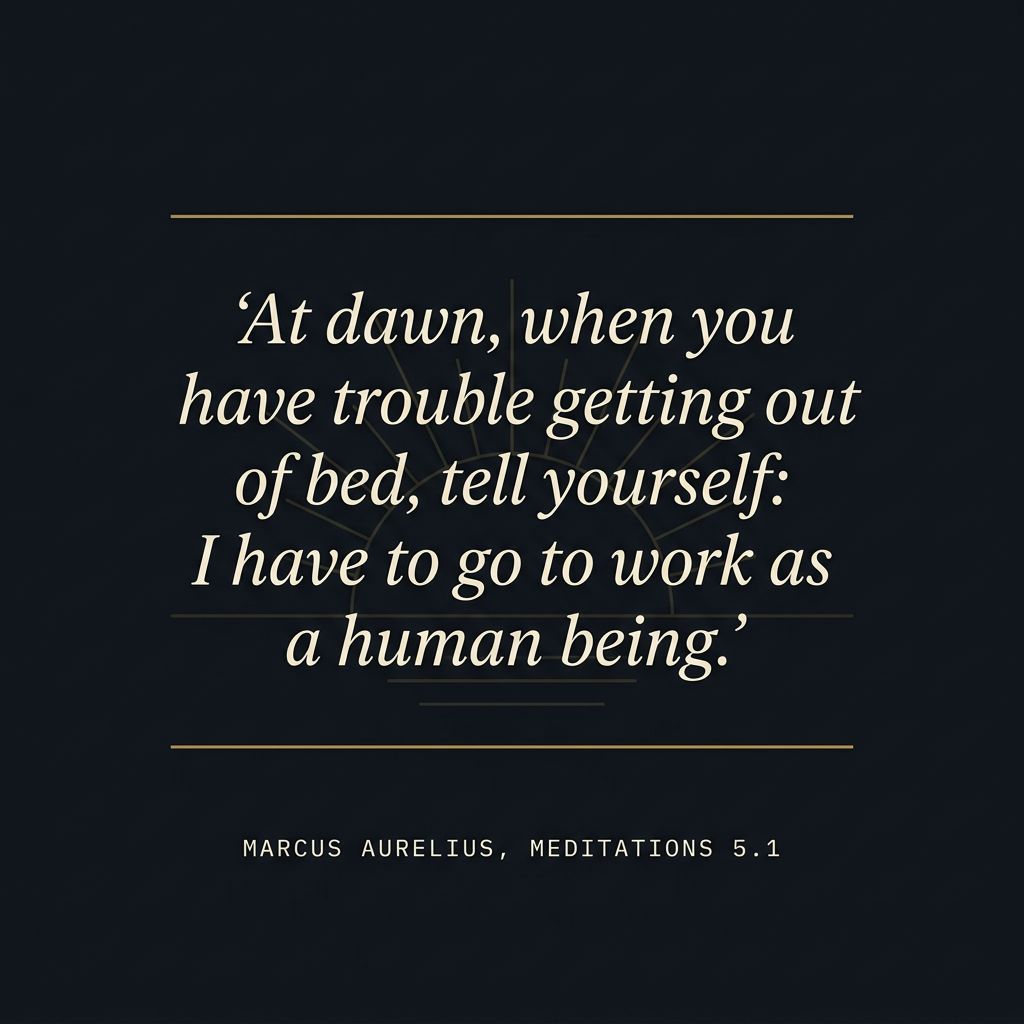
The full passage continues: “Is this what I was created for? To huddle under the blankets and stay warm? — But it’s nicer here… So you were born to feel ‘nice’? Instead of doing things and experiencing them?” The emperor of Rome had to talk himself out of bed like the rest of us. The point isn’t guilt — it’s recognition. The work is part of being a functioning human, not a punishment, and the resistance you feel in the morning is the most ordinary thing in the world. Name it and move.
The Obstacle Becomes the Path
The most career-shaped idea in Stoicism is also its most famous: the thing in your way is the way. A difficult project, an unfair setback, a problem nobody else will touch — the Stoic treats each as the raw material of the work, not an interruption to it.
“The impediment to action advances action. What stands in the way becomes the way.” — Marcus Aurelius, Meditations 5.20
This is not toxic positivity. It doesn’t pretend the obstacle is good. It says the obstacle is workable — that whatever blocks one path reveals where your effort is actually needed. The reorganization that killed your project is also the chance to build the next one. The brutal feedback is also the clearest map you’ll get. The Stoic doesn’t enjoy adversity; they refuse to waste it.
One honest limit. Stoicism is for the friction that comes with any job — difficult people, setbacks, pressure. It is not a reason to stay in a genuinely abusive, discriminatory, or unsafe workplace. “Control your response” never means “tolerate mistreatment.” The Stoics held justice as a core virtue; leaving a toxic situation, or naming it, is fully Stoic. Use the philosophy to stay steady, not to talk yourself into staying put.
Free tool
Not sure which work worries are worth your energy? Run them through our Dichotomy of Control sorter — drop in what’s stressing you and see, in two columns, what’s actually yours to act on.
Build the daily practice with StoicNow
Join the WaitlistFAQ
How does Stoicism help with work stress?
Stoicism helps at work by separating what you control (your effort, honesty, and response) from what you don’t (your boss’s mood, promotions, layoffs). You pour energy into your half, do it excellently, and refuse to let career outcomes outside your control determine your peace of mind. Most work stress is the friction of gripping the second column, and Stoicism is the practice of letting it go.
What would Marcus Aurelius say about a bad boss?
Marcus ran the Roman Empire surrounded by flatterers and rivals, and his advice was to separate another person’s character from your own conduct. You cannot control a manager’s competence, ego, or mood — only the integrity and quality of your own work. He would tell you to do your half excellently, refuse to let their behavior corrupt yours, and stop letting them live rent-free in your mind.
Is ambition compatible with Stoicism?
Yes. The Stoics called things like money, status, and promotions “preferred indifferents” — genuinely worth pursuing, but not where your character or worth resides. You can chase a promotion hard and still be unshaken if it doesn’t come, because you never staked your self-respect on the outcome. Ambition aimed at externals is fine; ambition that owns your peace of mind is the trap.
How do Stoics avoid burnout?
Seneca drew a sharp line between a busy life and a full one. Stoics guard their time as their most finite resource, treat rest as maintenance rather than laziness, and refuse to let work expand to consume every hour. Burnout is what happens when you spend a non-renewable resource — attention and energy — as if it were infinite. The Stoic answer is reserve: stop before empty.
How can Stoicism help with imposter syndrome?
Epictetus taught that it is not things that disturb us but our judgments about them. Imposter syndrome is a judgment — “I don’t belong here” — not a fact about your competence. The Stoic move is to do the work in front of you to the best of your ability and refuse to keep issuing a verdict on yourself while you do it. Action is in your control; the self-rating is optional.
What does Stoicism say about losing your job?
Epictetus’s reframe is “never say you have lost anything, only that you have given it back.” A job is lent by circumstance, not owned. Losing it is painful, but the Stoic separates the event (out of your control) from your response (fully in your control). Premeditatio malorum — having quietly rehearsed the possibility in advance — softens the shock and lets you act on the next step instead of spiraling.

Marcus Adler
Founder & Lead Writer, StoicNow
Marcus Adler is the founder of StoicNow. For over a decade he has applied Stoic philosophy to daily life — testing the practices of Marcus Aurelius, Seneca, and Epictetus against modern problems and translating them into simple, repeatable routines. More about the author →