Quick answer
A stoic daily routine brackets your day with two short practices — a morning rehearsal and an evening review — and fills the hours between them with one discipline: sorting what happens into what you control and what you don’t.
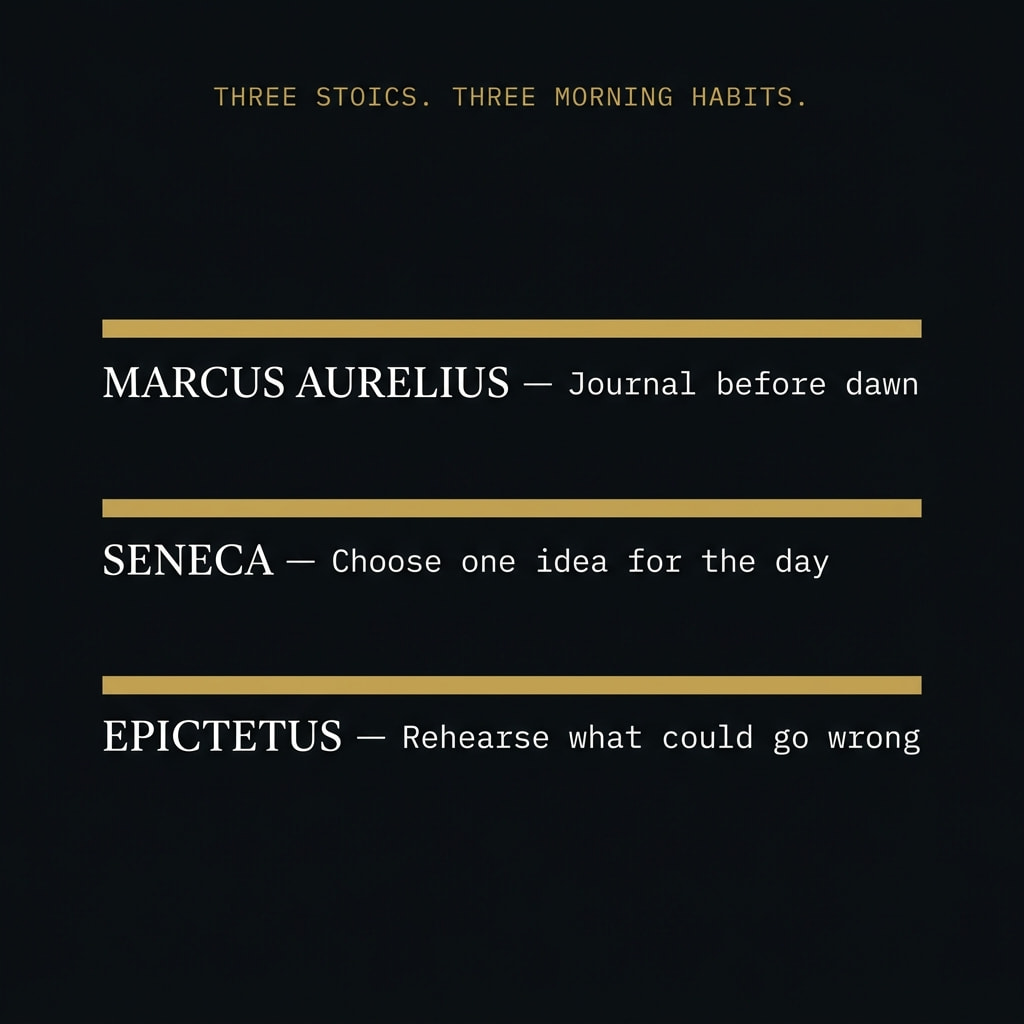
A stoic daily routine is not a morning checklist or a productivity stack. It is a 2,000-year-old method for training one thing: your judgment. The Stoics ran the practice in three movements — prepare the mind at dawn, hold a discipline through the working day, and audit your conduct before sleep. Marcus Aurelius did it as an emperor. You can do it in fifteen minutes.
What follows is the full structure, hour by hour, with the actual sources behind each part — not a modern repackaging, but what Marcus Aurelius, Seneca, and Epictetus describe doing in their own texts. Then a stripped-down version you can start today.
What a Stoic Daily Routine Actually Is
Strip away the aesthetics — the cold showers, the leather journals, the 5 a.m. wake-ups people now attach to the word “stoic” — and a stoic daily routine is structurally simple. It is a frame around the day. Two reflective bookends, and a single operating principle in between.
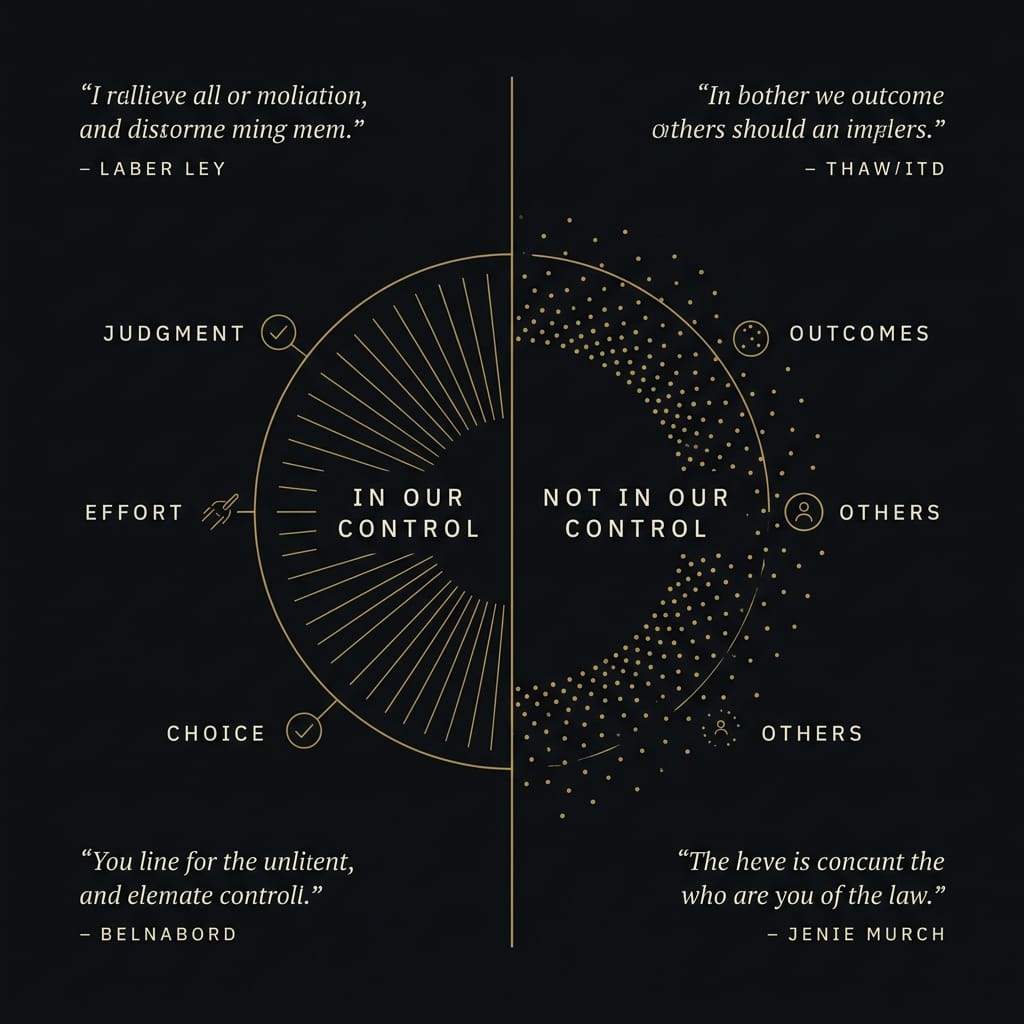
The principle is the dichotomy of control: some things are up to us — our judgments, choices, and effort — and some are not — outcomes, other people, the past. Epictetus opens his Enchiridion with exactly this division, and everything else in the routine is built to make that distinction automatic. The morning prepares you to apply it; the day is where you apply it; the evening checks whether you did.
That is the whole architecture. It maps cleanly onto how the Stoics actually wrote about their days, and — not coincidentally — onto the structure of cognitive behavioral therapy, which its founders Aaron Beck and Albert Ellis credited to Stoic thought. The routine is old, but it is not antique.
The point is not the schedule. A stoic routine asks what kind of person were you today, not did you hit your tasks. You can keep a perfect calendar and fail the only test the Stoics cared about: did you act with reason instead of reaction?
Where the Routine Comes From
This isn’t reconstructed from fragments. Three of the major Stoic sources describe daily practice directly.
The morning comes from Marcus Aurelius. Book 2 of the Meditations opens with him rehearsing the day ahead before it starts:
“When you wake up in the morning, tell yourself: the people I deal with today will be meddling, ungrateful, arrogant, dishonest, jealous, and surly.” — Marcus Aurelius, Meditations 2.1
It reads bleak out of context. In context it is the opposite of pessimism — it is a vaccine. If you have already met the difficult people in your mind, none of them can ambush you at noon. Elsewhere, in Meditations 5.1, Marcus talks himself out of bed by remembering he was made for work, “not to huddle under the blankets.” The morning is for setting the terms before the day sets them for you.
The evening comes from Seneca. In his essay On Anger, he describes a nightly self-examination he borrowed from his teacher Sextius:
“When the light has been removed and my wife has fallen silent… I examine my entire day and go back over what I have done and said.” — Seneca, On Anger 3.36
He asks himself three things: what did I do wrong, what did I do right, and what could I do better. No self-flagellation — an audit. The middle of the day belongs to Epictetus, whose entire teaching, recorded by his student Arrian in the Discourses, is about keeping the dichotomy of control live in real time, as events hit you. Put together, the three give you a day with a beginning, a middle, and an end.

The Stoic Day, Hour by Hour
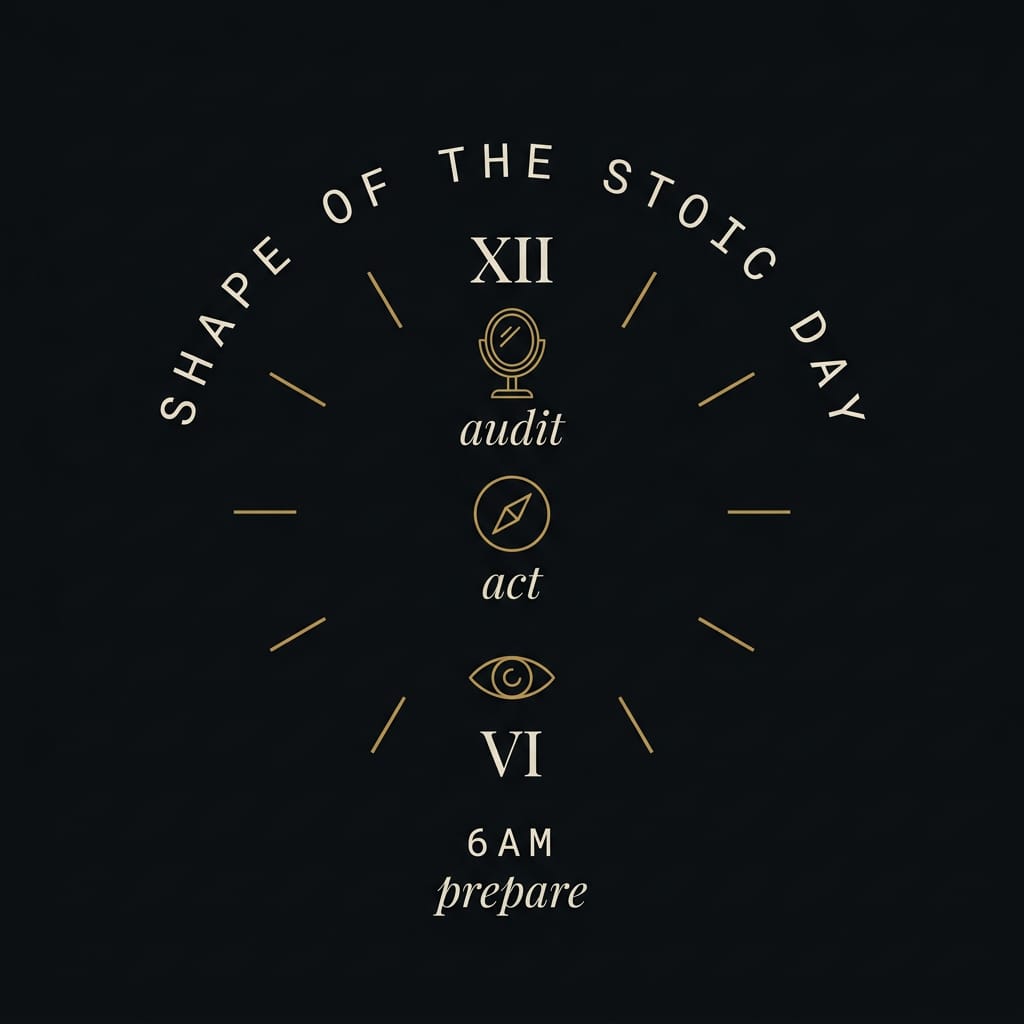
Here is the routine laid out across a real day. Times are illustrative — the sequence matters more than the clock.
Notice how little of this is “extra.” Only the bookends take dedicated time. The working-day discipline costs nothing because it happens inside events you were going to have anyway. That is the design genius of the thing: it scales to a busy life because most of it is a way of responding, not a list of new tasks.
Morning: Preparing the Mind
The morning practice has two moves, and they take about five minutes combined.
1. Premeditatio malorum — rehearse the difficulty
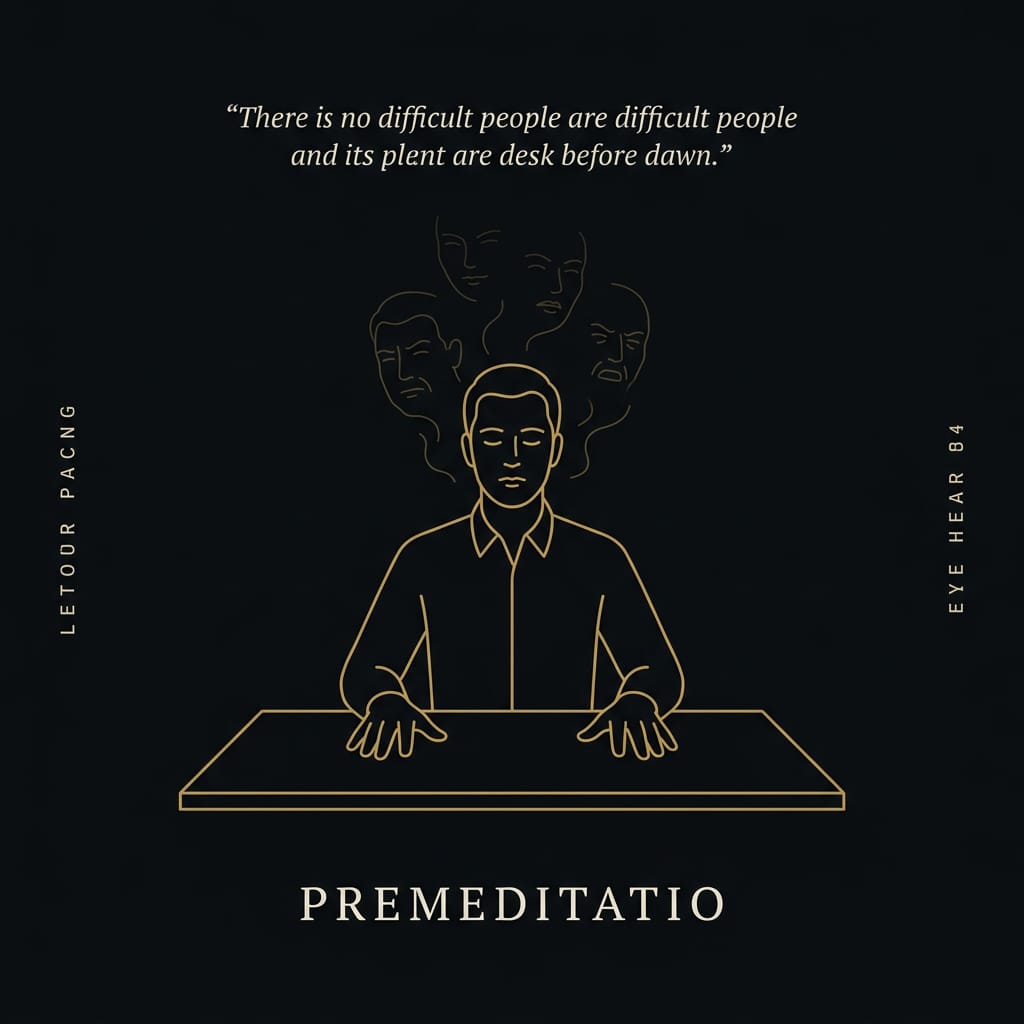
Before the day touches you, walk through what it might bring. The annoying commute, the colleague who interrupts, the email that doesn’t come. This is the practice the Stoics called negative visualization — not to manufacture dread, but to disarm it. A thing you’ve already pictured can’t blindside you, and most of what ruins a day is the surprise, not the event.
2. Set the intention you control
Then decide who you intend to be, in terms entirely within your power. Not “I will have a good meeting” — that depends on others. Rather: “I will prepare well and speak honestly, whatever the room does.” This is the dichotomy of control applied forward. You aim at your own conduct, which is yours, and let the result — which is not — be what it will. If you want this anchored to something concrete, the four Stoic virtues — wisdom, courage, justice, temperance — give you four standards to measure the coming day against.
The Working Day: The Discipline of Action
This is where most “stoic routines” quietly fail. They cover the photogenic morning and the cozy evening and leave the eight hours in between — the part that actually decides what kind of day you had — undefined. The Stoics did not. The day was the practice.
The whole working day runs on one question, asked at every point of friction: is this up to me? When it is — your effort, your tone, your choice — commit to it completely. When it isn’t — the traffic, the verdict, what someone thinks of you — spend no energy fighting it. Epictetus put the engine of the whole thing in a single line:
“It’s not things that disturb us, but our opinions about things.” — Epictetus, Enchiridion 5
The practical tool is the pause. Between something happening and you reacting to it, there is a gap — usually a fraction of a second — where the judgment gets made. The Stoic widens that gap. One breath, one question: what is actually in my control here? Then respond from that, not from the reflex. This is the skill that makes Stoicism useful for anxiety, for work stress, for an argument that’s about to get worse. It is the same muscle, trained all day.
You will fail at this often. That is expected — it is the point of having an evening review to catch it. The goal is not a day without slips. It is a day where you noticed the slips and corrected faster than yesterday.
Evening: The Review
At the end of the day, Seneca sat in the dark and went back over everything. The evening reflection is the most concrete, most journal-able part of the routine, and the one that does the most work, because it’s where the day becomes data.
His method, from On Anger 3.36, is three questions:
- What did I do badly? Where did I react instead of choose? Where did I let an indifferent thing — money, reputation, someone’s opinion — disturb me?
- What did I do well? The Stoics were not only self-critical. Mark the moments you held the line, so you know they’re possible.
- What will I do differently? Turn the failure into one specific adjustment for tomorrow. That adjustment becomes part of the next morning’s intention.
Done honestly, the loop closes: tonight’s review feeds tomorrow’s premeditation, which gets tested in tomorrow’s day, which gets audited tomorrow night. That cycle — not any single session — is what makes the routine compound. If you want structure for the writing, a set of Stoic journal prompts turns the three questions into a repeatable page.
“I scrutinize my whole day and retrace all my deeds and words… nothing is concealed from myself, nothing is passed over.” — Seneca, On Anger 3.36
Run the morning and evening practice with daily prompts in StoicNow
Join the WaitlistHow to Start Today (The 10-Minute Version)
Don’t build the full structure on day one — you’ll abandon it by Thursday. Start with the two bookends and let the middle develop on its own. Here is the minimum viable routine:
- Morning, 3 minutes. Before you reach for the phone, name one likely difficulty today and one thing about your conduct you control. That’s it.
- Day, 0 extra minutes. Once, when something irritates you, ask “is this up to me?” before reacting. One time is enough to begin.
- Evening, 5 minutes. Write Seneca’s three questions and answer them in a sentence each. Don’t skip the “what did I do well.”
Do that for two weeks and the working-day discipline starts appearing without effort — you’ll catch yourself asking the control question unprompted. When you want more structure, a 30-day Stoic challenge adds one practice at a time, and the right Stoic app can carry the reminders so you don’t have to remember the routine before you’ve internalized it.
Common Misconceptions
It is not a wake-up time. Nothing in Stoicism requires 5 a.m. Marcus talks himself out of bed in Meditations 5.1, but the lesson is about overcoming reluctance to do your work, not about the hour on the clock. Run the routine on whatever schedule your life has.
It is not cold showers and grit theater. Voluntary discomfort is one optional Stoic exercise among many — not the routine itself. A day spent enduring cold for its own sake, with no morning intention and no evening review, isn’t a Stoic day.
It is not suppressing emotion. The routine doesn’t ask you to feel nothing. It asks you to insert judgment between the feeling and the action — to be moved by things but not ruled by them. That distinction is the entire practice, and missing it is the most common way people get Stoicism wrong.
Done right, a stoic daily routine is quiet and unglamorous. No one watching you would notice it. That’s the proof it’s working — it lives in your judgments, not your aesthetics. Start with the three questions tonight, the two-minute rehearsal tomorrow, and let the day in between teach you the rest.
“Confine yourself to the present.” — Marcus Aurelius, Meditations 7.29
Free Quiz
Which Stoic Are You?
A 3-minute personality quiz — Marcus, Seneca, Epictetus, or Cato.
FAQ
What is a stoic daily routine?
A stoic daily routine is a repeatable structure built around three moments: a morning preparation that rehearses the day and its difficulties, a discipline of action through the day that sorts events into what you control and what you don’t, and an evening review where you audit your conduct. It is not a productivity schedule — it is a daily method for training judgment, drawn from Marcus Aurelius, Seneca, and Epictetus.
How did the Stoics structure their day?
The Stoics bracketed the day with reflection. Marcus Aurelius opens Meditations Book 2 with a morning rehearsal of the difficult people he would meet. Seneca describes an evening self-examination in On Anger 3.36, reviewing each action before sleep. Between those bookends, the work was practicing the dichotomy of control in real time — meeting each event with the question: is this up to me?
How long does a stoic daily routine take?
Five to fifteen minutes of dedicated practice. The morning rehearsal takes about five minutes, the evening review another five to ten. The middle of the day adds no time at all — it is a way of responding to what already happens, not an extra task. The Stoics were busy people; Marcus ran an empire. The routine was designed to fit a working life, not replace one.
What does a Stoic do first thing in the morning?
He prepares his mind before the day touches it. Marcus Aurelius wrote that on waking you should tell yourself you will meet the meddling, ungrateful, and arrogant — not as pessimism, but so none of it lands as a surprise. The morning practice is a short rehearsal: what is in my control today, what isn’t, and what kind of person I intend to be regardless.
Is a stoic daily routine the same as journaling?
Journaling is part of it, not all of it. The evening review is often written, and Meditations itself was Marcus Aurelius’s private journal. But the routine also includes the wordless morning rehearsal and the in-the-moment discipline of control that needs no notebook. Journaling is the tool; the routine is the full daily practice it sits inside.
Can I practice a stoic routine without believing in Stoicism?
Yes. The routine is method, not doctrine. The morning rehearsal and evening review map closely onto cognitive behavioral therapy, which Stoicism directly influenced. You can run the practice as a secular discipline for managing reaction and attention without adopting any metaphysics. Many people start there and read the philosophy later, or never.

Marcus Adler
Founder & Lead Writer, StoicNow
Marcus Adler is the founder of StoicNow. For over a decade he has applied Stoic philosophy to daily life — testing the practices of Marcus Aurelius, Seneca, and Epictetus against modern problems and translating them into simple, repeatable routines. More about the author →
Further reading