Quick answer
Marcus Aurelius was Roman emperor from 161 to 180 AD and the author of Meditations — a private journal of Stoic reflections never meant for publication. He is remembered as the last of the Five Good Emperors and as the clearest surviving voice of applied Stoic philosophy.
Marcus Aurelius wrote a private journal while running an empire. He never meant for you to read it. That is exactly why it is worth reading.
Meditations was written in twelve short books, in Greek, during military campaigns on the northern frontiers of Rome — probably between 170 and 180 AD. It was not a book. It was a ruler addressing himself: reminders, arguments against his own weaknesses, tactics for staying sane while plague, war, betrayal, and the deaths of his children kept landing on him.
Below are fifty passages, grouped into eight themes, each with the book and chapter number so you can find them in any translation. Under every quote is one paragraph of context — what he meant, what the situation was, and how to use it now.
What’s inside
1. On Life and Death
Marcus returns to mortality more than any other subject. Not as a morbid reflex, but as a filter. When you remember you will die, trivial things stop running your day. This is memento mori in action — a Stoic instrument, not a mood.
Quote 01
“You could leave life right now. Let that determine what you do and say and think.”
— Meditations 2.11
Possibly his most quoted line. It is not a threat. It is a scheduling tool. Every meeting, every argument, every scroll through your phone: would you still do this if you knew it was the last thing you did? If the answer is no, stop doing it.
Quote 02
“Think of yourself as dead. You have lived your life. Now take what’s left and live it properly.”
— Meditations 7.56
A thought experiment: your old life is over. Everything from this point on is unearned bonus time. What would you do with a second chance if you really had one? You do. Today.
Quote 03
“Do not act as if you had ten thousand years to throw away. Death hangs over you. While you live, while it is in your power, be good.”
— Meditations 4.17
Marcus addresses his own procrastination. The fantasy of having time — someday, when things settle down, when I’m ready — is the thing that keeps you from becoming who you want to be. The only window is the one open right now.
Quote 04
“Alexander the Great and his mule driver both died — and the same thing happened to both.”
— Meditations 6.24
The great democratiser. Status, accomplishments, net worth — death flattens them all. Marcus reminds himself of this not to demotivate himself, but to stop him caring too much about how he compares to other people.
Quote 05
“Do every act of your life as though it were the very last act of your life.”
— Meditations 2.5
Not urgency in the hustle sense — attention. If this were the last conversation you had with your mother, how would you show up? If this were the last email you sent, would you send it as written? The standard isn’t speed; it’s presence.
Quote 06
“Look at how quickly all things vanish away — their bodies in the world itself, the remembrance of them in time.”
— Meditations 2.12
Fame, legacy, being remembered — Marcus, of all people, was sceptical. The people who praised him yesterday would be gone tomorrow. Chasing their approval was chasing smoke. So is chasing yours.
Quote 07
“Everything’s destiny is to change, to be transformed, to perish. So that new things can be born.”
— Meditations 12.21
The comfort inside mortality: you are not being singled out. Everything ends. Atoms scatter, seasons turn, empires fall. Your ending is part of the same motion that produced you in the first place.
2. On Your Mind and Control
The Stoic idea everyone eventually encounters: you cannot choose what happens, only your judgment about it. Marcus states this in a dozen different ways. Two thousand years later, Aaron Beck would build cognitive behavioural therapy on the same insight. More in our guide to the dichotomy of control.
Quote 08
“If you are distressed by anything external, the pain is not due to the thing itself, but to your estimate of it — and this you have the power to revoke at any moment.”
— Meditations 8.47
The operating principle of all Stoicism, compressed. Between the event and your suffering sits a judgment. The judgment is yours. You can change it. Not always easily, not always quickly — but always.
Quote 09
“The happiness of your life depends upon the quality of your thoughts.”
— Meditations 5.16
Not your circumstances — his were often brutal. The quality of what you feed your mind, hour by hour, is what your life becomes. He chose his inputs carefully: texts, teachers, solitude. You are choosing too, whether you mean to or not.
Quote 10
“The soul becomes dyed with the colour of its thoughts.”
— Meditations 5.16
A quieter companion to the line above. Whatever you rehearse in your head — resentment, gratitude, fear, ambition — slowly stains you. Check what you’re staining with.
Quote 11
“Choose not to be harmed — and you won’t feel harmed. Don’t feel harmed — and you haven’t been.”
— Meditations 4.7
The boldest claim in the book. It sounds impossible — and in real cases of injury and injustice, the Stoics don’t ask you to deny reality. They ask you to notice where psychological harm lives: in your interpretation. That much you can revoke.
Quote 12
“Reject your sense of injury and the injury itself disappears.”
— Meditations 4.7
A more practical restatement of the previous. Marcus is not saying the offence didn’t happen. He is saying you hold the second arrow — the one you shoot at yourself afterwards — in your own hand.
Quote 13
“Very little is needed to make a happy life; it is all within yourself, in your way of thinking.”
— Meditations 7.67
He ruled the Roman Empire. He was saying this to himself, not to a reader looking for consolation. If the man with access to every pleasure concluded that contentment is internal, the external pursuit is probably a trap.
Quote 14
“You always own the option of having no opinion.”
— Meditations 6.52
An escape hatch most people never use. You can scroll past the argument. You can not weigh in. You can, quietly, decline to form a verdict. Try it, once, in a conversation that would have dragged you in. Notice what you get back.
3. On Other People
Marcus ran an empire. Most of his days were spent managing difficult humans. His advice on dealing with them is unusually grounded, because he was losing patience with real senators, not hypothetical ones.
Quote 15
“When you arise in the morning, think of what a precious privilege it is to be alive — to breathe, to think, to enjoy, to love.”
— Meditations 2.1
The opening of the book’s most famous morning meditation. Before he lists the difficult people he will face, he starts with gratitude. Order matters: gratitude first, then the hard stuff.
Quote 16
“When you wake in the morning, tell yourself: today I shall meet with interference, ingratitude, insolence, disloyalty, ill-will, and selfishness.”
— Meditations 2.1
The second half of the same passage. Not pessimism — preparation. If you brace for difficult people before you see them, their behaviour doesn’t land as a surprise. This is the Stoic technique of premeditatio malorum, applied to your calendar.
Quote 17
“The best revenge is not to be like your enemy.”
— Meditations 6.6
You can return cruelty with cruelty — and become the thing you hate. Or you can refuse. Refusal is the only revenge that doesn’t cost you something you wanted to keep.
Quote 18
“Whenever you are about to find fault with someone, ask yourself the following question: What fault of mine most resembles the one I am about to criticise?”
— Meditations 10.30
Before the tweet, before the complaint, before the gossip. Not a rule to shut up — a rule to check whether you would tolerate in yourself what you are condemning in them. Usually you would.
Quote 19
“Men exist for the sake of one another. Teach them then, or bear with them.”
— Meditations 8.59
Two options, no third. Either help the person change (patiently, without spite) or endure the behaviour. Resentment is not a third option — it is just a way of doing neither while feeling justified.
Quote 20
“Accept the things to which fate binds you, and love the people with whom fate brings you together — and do so with all your heart.”
— Meditations 6.39
You did not choose your family, your colleagues, your neighbours. You can either resent them for not being the people you imagined, or love them for who they are. The first path ends nowhere. The second is the only one that actually exists.
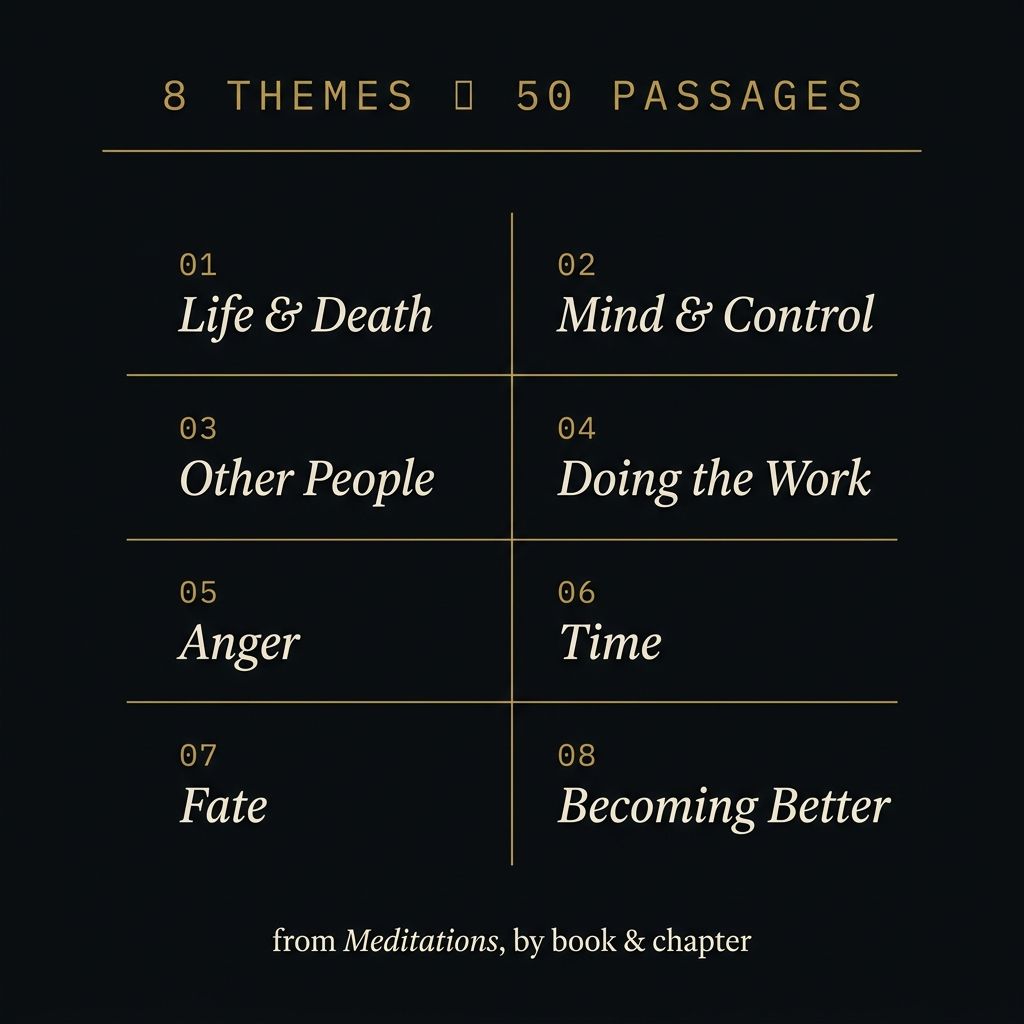
4. On Doing the Work
Marcus was not a monk. He wrote about duty, effort, and getting up in the morning more often than about serenity. These are the lines for the Mondays.
Quote 21
“At dawn, when you have trouble getting out of bed, tell yourself: ‘I have to go to work — as a human being.’”
— Meditations 5.1
Marcus, emperor of Rome, lecturing himself about not wanting to get up. There is deep relief in that. The instruction is simple: you were not made to stay under the blanket. The work is part of what you are.
Quote 22
“Concentrate every minute on doing what’s in front of you with precise and genuine seriousness, tenderly, willingly, and justly.”
— Meditations 2.5
A complete work ethic in one sentence. Precise (not sloppy). Serious (not performative). Tender (not harsh). Willing (not resentful). Just (not self-serving). Most failures fit one of those adjectives.
Quote 23
“Waste no more time arguing about what a good man should be. Be one.”
— Meditations 10.16
The shortest, sharpest line in the book. Discussion is easier than action. Reading about virtue is easier than practising it. Marcus catches himself and everyone else in the middle of that swap.
Quote 24
“If it is not right, do not do it. If it is not true, do not say it.”
— Meditations 12.17
A one-line integrity test. No carve-outs for business context, social pressure, strategic omission. You notice how often your life fails it, and how often you could quietly raise the bar.
Quote 25
“Don’t waste the rest of your time here worrying about other people — unless it affects the common good.”
— Meditations 3.4
The Stoic concept of oikeiosis — widening concern from self to family to city to humanity — is balanced by a clean stopping rule. Your limited life does not owe gossip or comparison a single minute.
Quote 26
“Never let the future disturb you. You will meet it, if you have to, with the same weapons of reason which today arm you against the present.”
— Meditations 7.8
Anxiety is the tax you pay on an event that may not happen. And if it does, you will bring everything you have then — not only what you have now. You do not need to pre-fight it.
Quote 27
“A man’s worth is no greater than the worth of his ambitions.”
— Meditations 7.3
Not a line about ambition in the modern success sense. Marcus means: what you chase reveals what you value. If your ambition is small — applause, comfort, approval — your life will match the size of it.
5. On Anger and Reaction
Marcus lost his temper. He talks about it too often for it not to have been a recurring problem. These lines are the ones he wrote to himself in the aftermath.
Quote 28
“How much more grievous are the consequences of anger than the causes of it.”
— Meditations 11.18
The thing that set you off — whatever it was — will always have caused less damage than what you do next in its name. The causes are usually small. The consequences last.
Quote 29
“When you are disturbed by events or by people, retire at once into yourself, and do not stay out of character longer than you must.”
— Meditations 6.11
Anger is a departure from who you are. Marcus treats it like stepping out of costume. You can put the costume back on — it is still yours — but you have to notice you left it first.
Quote 30
“The nearer a man comes to a calm mind, the closer he is to strength.”
— Meditations 11.18
A reversal of the culture that associates rage with power. Marcus, watching real power from the inside, concluded the opposite: the shouter has already lost control of himself, and can hold nothing else.
Quote 31
“It is the act of a madman to pursue impossibilities.”
— Meditations 5.17
Including the impossibility of a world that never frustrates you. Expecting people to behave as you wish, reality to cooperate, traffic to clear — these are not reasonable expectations being violated. They are, on inspection, demands for a universe that has never existed.
Quote 32
“Remember, as often as you are angry, that to be moved by passion is not manly, but that gentleness and tranquillity are more manly, as they are more human.”
— Meditations 11.18
Strength, for Marcus, is not the volume of your reaction. It is the distance between the provocation and the response. The longer that distance, the more of a human being — and the less of an animal — you are in that moment.
6. On Time and the Present
Marcus writes about the present moment as a Stoic, not as a meditator. It is not about emptying the mind — it is about refusing to live in a place (the past, the future) where you cannot act.
Quote 33
“Confine yourself to the present.”
— Meditations 7.29
Three words. No one has ever said it shorter. Past is gone; future is hypothetical. The only place anything is actually happening is here.
Quote 34
“No one loses any other life than this one he is living now, nor lives any other than this one he is losing.”
— Meditations 2.14
A logical argument, not a sentiment. Whatever you imagine losing at death — that thing only ever lives in the present. Your future is not yours yet. Your past is already spent. The present is the whole inventory.
Quote 35
“Each of us lives only in the present, this brief moment; the rest is either a life past or it is an uncertain future.”
— Meditations 3.10
The companion line to the one above. Marcus is not being poetic. He is giving you the exact boundary of what you own.
Quote 36
“Give thyself time to learn something new and good, and cease to be whirled around.”
— Meditations 2.7
The anti-doom-scroll. Two options: get whirled around by the noise, or carve out hours for what is actually worth knowing. Marcus was aware of how attention leaks — even without a phone.
Quote 37
“How much time he saves who does not look to see what his neighbour says or does.”
— Meditations 4.18
A forecast of social media, written in the second century. Every minute spent on what someone else is doing is a minute not spent on what you could be doing. The ledger is merciless and hidden.
Quote 38
“It is in our power to have no opinion about a thing, and not to be disturbed in our soul — for things themselves have no natural power to form our judgments.”
— Meditations 6.52
Returning to the dichotomy from the Time angle. A huge portion of your day is spent reacting to events that require no reaction — news items, someone’s remark, a stranger’s opinion. You can stay out of them. Time returned.
7. On Fate and Acceptance
Marcus believed in a rational, ordered universe — a cosmos whose events, including the ones you resent, were part of a whole. Whether or not you share the metaphysics, the practical effect is amor fati: loving what happened, because it is already what happened.
Quote 39
“Accept the things to which fate binds you.”
— Meditations 6.39
Not passivity. Accept means: stop negotiating with reality about what has already occurred. Once accepted, you can actually work with the situation instead of arguing with it.
Quote 40
“Whatever happens at all happens as it should; you will find this true, if you watch narrowly.”
— Meditations 4.10
Hard to believe during the bad parts. Marcus is reminding himself — amid plague, war, and personal loss — that events carry no verdict. They just happen. Your labelling of them as ‘wrong’ is an extra layer you apply.
Quote 41
“The impediment to action advances action. What stands in the way becomes the way.”
— Meditations 5.20
Probably the most quoted line from the book in the last decade. The obstacle isn’t an interruption of the path — it is new terrain to walk on. Illness, a layoff, a rejection: the thing you did not want becomes the thing you use.
Quote 42
“Nothing happens to any man that he is not formed by nature to bear.”
— Meditations 5.18
A bolder claim than it sounds. Not that bad things won’t happen, but that the specific bad thing that has happened to you, you are built to survive. The evidence: you are here, still reading.
Quote 43
“Be content with what has been allotted to you, and love the people with whom it is your lot to live with genuinely.”
— Meditations 6.39
Contentment as a choice, not a discovery. You are not waiting for the circumstances that justify being content. You are training yourself to give what you have the status of ‘enough’.
Quote 44
“Loss is nothing else but change, and change is nature’s delight.”
— Meditations 9.35
A reframe that takes the sting out of losing something you loved. The thing did not vanish — it became something else, the way a leaf becomes soil, or a person becomes a memory. Nature does not weep; it rearranges.
8. On Becoming a Better Person
Stoicism is not a belief system. It is a training regimen. Marcus ends where he begins: with the only project worth anything, which is the work on yourself.
Quote 45
“You have power over your mind — not outside events. Realise this, and you will find strength.”
— Meditations (commonly cited; core theme of Books 8 and 12)
The most famous line in the English-speaking Marcus canon, a compressed rendering of passages like 8.47 and 12.22. It is popular because it is true and because it is the only honest place to start.
Quote 46
“If anyone can refute me — show me I’m making a mistake or looking at things from the wrong perspective — I’ll gladly change. It’s the truth I’m after.”
— Meditations 6.21
The rarest thing in public life. An emperor saying, in private, that he would rather be corrected than be right. The whole Stoic project rides on this: you care more about the truth than about your image of yourself holding it.
Quote 47
“The best answer to anger is silence.”
— Meditations (paraphrased theme of 11.18)
Not because silence is noble — because words spoken in anger almost never survive the cooling down. Silence preserves your options. Speech forecloses them.
Quote 48
“Begin the morning by saying to thyself, I shall meet with the busy-body, the ungrateful, arrogant, deceitful, envious, unsocial… But I can neither be injured by any of them, for no one can fix on me what is ugly.”
— Meditations 2.1
The morning pre-briefing in full. Marcus accepts that his day will include difficult people — and inoculates himself in advance. Their behaviour cannot make him ugly. His reactions can. That is the only part he owns.
Quote 49
“The object of life is not to be on the side of the majority, but to escape finding oneself in the ranks of the insane.”
— Meditations (attributed; represents core themes of Books 4 and 6)
An often-cited English rendering whose exact Greek source is debated. The spirit is clearly Marcus’s: going along with the crowd is not neutral ground. Most of what the majority does at any given time is, on reflection, not worth imitating.
Quote 50
“The universe is change; our life is what our thoughts make it.”
— Meditations 4.3
A closing line that works as a summary of the book. Two facts, placed side by side. Change is the one thing you cannot prevent. Thought is the one thing you can control. Whatever life becomes is the product of those two.

How to Read Meditations (If You Want More)
Most first-time readers bounce off Meditations because they try to read it like a book. It is not. It is a journal, out of order, with no argument, no arc, and long stretches of Marcus talking to himself in shorthand. Here is how to get past the first attempt.
Choose the right translation. The Gregory Hays translation (Modern Library, 2002) is the easiest way in — short sentences, modern English, almost no jargon. Martin Hammond (Penguin Classics) is more faithful and still very readable. The free George Long translation is public domain but feels Victorian. Start with Hays.
Skip Book 1 on your first pass. It’s a list of thank-yous to his teachers. Valuable — but nothing will hit you on a first read. Come back to it later.
Read one short chapter a day. Morning or evening. Underline anything that hits. Close the book. Meditations rewards slow rereading more than speed — the same passage lands differently on a bad Tuesday than on a good Sunday.
Pair it with a practice. Marcus wrote his journal as a daily discipline. If you only read him, you get half of what he offers. Read about Stoic morning routines or pick a beginner exercise and actually try it alongside the reading.
Marcus’s ideas, in your pocket
Try StoicNow — Free on iOSFree Quiz
Which Stoic Are You?
A 3-minute personality quiz — Marcus, Seneca, Epictetus, or Cato.
FAQ
What is Marcus Aurelius best known for?
Marcus Aurelius was Roman emperor from 161 to 180 AD and the author of Meditations — a private journal of Stoic reflections never meant for publication. He is remembered as the last of the Five Good Emperors and as the clearest surviving voice of applied Stoic philosophy. He wrote Meditations while on military campaign, addressing himself, trying to live up to his own standards.
What is the most famous Marcus Aurelius quote?
The most widely cited line is: “You have power over your mind — not outside events. Realise this, and you will find strength.” It is a popular English rendering of ideas he returns to repeatedly, especially in Book 8.47 and 12.22 of Meditations. The core point — you cannot control events, only your judgments about them — is the foundation of Stoic thought.
Where do these Marcus Aurelius quotes come from?
All of them come from Meditations, the twelve-book journal Marcus kept during the last years of his life. Each quote above includes the book and chapter number so you can find it in any translation. The wording varies slightly between Gregory Hays, George Long, and Martin Hammond — we have used clear, faithful English renderings.
Which translation of Meditations should I read?
For beginners, Gregory Hays (Modern Library, 2002) is the easiest entry — direct modern English, short sentences, minimal jargon. For scholarly accuracy, Martin Hammond (Penguin Classics) and Robin Hard (Oxford) are excellent. The George Long translation is free and public domain but reads as stiff Victorian English. Start with Hays, then explore others if you fall in love with the book.
In what order should I read Meditations?
Meditations is not a structured book — it is a private journal. You can open any page and start. A good approach for first-time readers: skip Book 1 on first pass (it is a list of thank-yous to teachers) and start with Book 2, which opens with his famous morning meditation. Read one chapter per day, underline what hits you, and return.
Did Marcus Aurelius practice what he wrote?
As much as any human has. He ruled through the Antonine Plague that killed millions, a catastrophic flood, a near-civil-war revolt by his general Cassius, and the deaths of most of his children. His contemporaries described him as calm, just, and unshakable. Meditations is striking precisely because it shows him struggling — it is not the voice of a man who had it figured out, but a man who worked at it every day.

Marcus Adler
Founder & Lead Writer, StoicNow
Marcus Adler is the founder of StoicNow. For over a decade he has applied Stoic philosophy to daily life — testing the practices of Marcus Aurelius, Seneca, and Epictetus against modern problems and translating them into simple, repeatable routines. More about the author →
Further reading