Quick answer
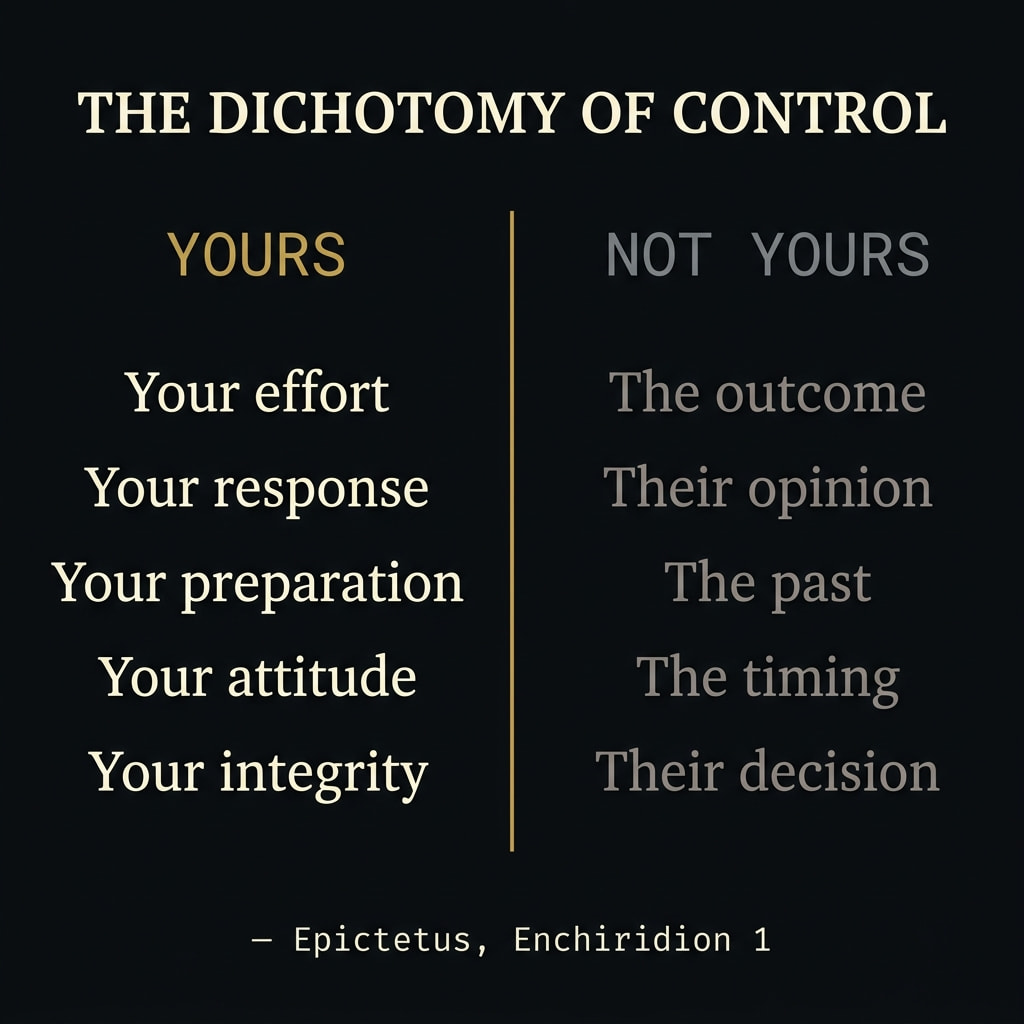
A dichotomy of control worksheet is a two-column exercise — built on the opening line of Epictetus’s Enchiridion — that splits a stressful situation into what is “up to you” (your judgment, effort, and reaction) and what is not (outcomes, other people, the past). You act only on the first column and consciously release the second.
Most advice for handling stress tells you to think positive. This tool does something narrower and more useful: it makes you sort, item by item, what you can actually change from what you can’t — then asks you to stop spending energy on the second list. It takes about five minutes and it is nearly two thousand years old.
If you already know the underlying idea, you can jump straight to the worksheet template below. If you want the philosophy behind it first, our full guide to the dichotomy of control covers the concept in depth. This piece is the practical companion: a worksheet you can actually fill out.

What a Dichotomy of Control Worksheet Actually Is
The worksheet has three parts. First, you name one specific situation — not “my career,” but “the promotion decision on Friday.” Second, you list every element of that situation that is bothering you: the outcome, what your boss thinks, how you’ll feel if it goes badly, whether a colleague is favored over you. Third, you sort each item into one of two columns — In My Control or Not In My Control — and write one concrete next action, but only for the items in the first column.
That last restriction is the entire point of the exercise. It is easy to say “focus on what you can control.” It is much harder to do it, because most worry hides inside items that feel controllable but aren’t — whether someone likes you, whether a project succeeds, whether a diagnosis turns out well. A worksheet forces the sorting into writing, where it’s harder to fudge.
Unlike a mood tracker or a gratitude list, this is not meant to make you feel better in the moment. It is meant to change where your effort goes for the next 24 hours.
Where the Idea Comes From: Epictetus and the Enchiridion
The dichotomy of control is not a modern self-help invention. It is the opening line of the Enchiridion (Greek for “handbook”), a short manual of Stoic practice compiled from the teachings of Epictetus, a man born into slavery in Hierapolis around 50 AD who later taught philosophy as a free man in Rome and Nicopolis.
“Some things are in our power, while others are not. In our power are opinion, motivation, desire, aversion — in a word, whatever is our own doing. Not in our power are our body, our property, reputation, office — in a word, whatever is not our own doing.” — Epictetus, Enchiridion, Chapter 1
A few sentences later he adds the line the worksheet is really built around:
“Men are disturbed not by things, but by the opinions about things.” — Epictetus, Enchiridion, Chapter 5
This distinction became foundational to twentieth-century psychology as well. The psychologist Albert Ellis, founder of Rational Emotive Behavior Therapy, credited Epictetus directly — he opened one of his major books with the same line about opinions disturbing us more than things do. The worksheet you’re about to fill out is, in effect, a paper version of that same reframe. For the full text and context, see our Enchiridion summary.

How to Fill Out the Worksheet in 4 Steps
- Name one specific situation. Not a category of your life — a single event, decision, or conversation. Vague inputs produce vague sorting.
- List everything about it that’s occupying your attention. Write it as it actually appears in your head, unfiltered: the outcome you fear, what people will think, whether you did enough, what happens next.
- Sort each line into a column. Ask of each item: “Is this my judgment, my effort, my honesty, my attention — or is it an outcome, another person’s choice, or the past?” The first goes left; the second goes right.
- Write one action — only for the left column. Every item in “Not In My Control” gets no action line. That absence is deliberate; it’s where you practice letting go.
The test that catches most people: if the item you’re sorting depends on someone else’s decision, a result, or something that already happened, it belongs on the right — even if you influenced it. Influence is not the same as control.
The Worksheet Template (Copy This)
Here is the reusable structure. Write your situation at the top, then fill each column with items specific to it — these are just the categories most people end up using.
In My Control
- My effort and preparation
- My honesty in the conversation
- My attention and focus right now
- My judgment about what this event means
- My reaction once the result is known
- My next action, regardless of outcome
Not In My Control
- The final decision or outcome
- Other people’s opinions of me
- Other people’s choices or timing
- What already happened
- Circumstances outside the room — traffic, the economy, the weather
- How long a result takes to arrive
Keep both lists short and specific to the one situation you named. A worksheet with twenty vague entries is harder to act on than one with six precise ones.

A Worked Example: A Missed Promotion
Say you were passed over for a promotion you prepared for. A filled-out worksheet might look like this:
In My Control
- How thoroughly I prepared for the review — action: ask for specific feedback this week
- How I speak about this to colleagues — action: no complaining in the office
- Whether I keep showing up at the same standard — action: same effort tomorrow as yesterday
Not In My Control
- The manager’s final decision
- Whether a colleague was favored
- The company’s budget for the role
- Whether this affects a future opportunity
Notice what the exercise doesn’t do: it doesn’t tell you the decision was fair, and it doesn’t tell you not to be disappointed. It tells you, in writing, exactly where your remaining leverage is — and it isn’t in re-litigating the decision. If this kind of situation tends to spiral into anxiety rather than simple disappointment, see our guide on stoicism for anxiety for a companion technique.

Common Mistakes People Make With the Worksheet
Treating “not in my control” as “doesn’t matter.” Epictetus never argued that outcomes are unimportant — only that your peace of mind shouldn’t depend on them. You can care about a result and still refuse to let it own your judgment.
Putting feelings in the wrong column. Your emotional reaction is not something that simply happens to you — Epictetus places “opinion” and “desire” firmly in the “our own doing” category. That makes your reaction one of the hardest, and most important, items to put in the left column.
Using it once and expecting it to stick. The worksheet is a rehearsal tool, not a one-time fix. The value compounds when it becomes a habit you reach for automatically, the way a regular journaling practice does.
Where This Fits Into a Daily Stoic Practice
The worksheet works best as a response tool, not a background habit — something you pull out when a specific worry is taking up more room than it deserves, rather than something you do on a fixed schedule. Some people keep a blank copy in a notes app for exactly that moment. Others fold it into an existing routine, using it as one prompt inside a broader daily Stoic practice.
It also pairs naturally with reflection at the end of the day. Reviewing which items you correctly sorted — and which ones you spent energy on that belonged in the right column — is close to what Seneca described doing each evening, and close to the structure of a good evening reflection practice. Over weeks, the sorting gets faster, and eventually you start doing it in your head before the situation is even over.
Run the dichotomy of control worksheet daily in StoicNow
Join the WaitlistFree Quiz
Which Stoic Are You?
A 3-minute personality quiz — Marcus, Seneca, Epictetus, or Cato.
FAQ
What is a dichotomy of control worksheet?
A dichotomy of control worksheet is a two-column exercise, based on Epictetus’s Enchiridion 1, that separates a stressful situation into what is up to you — your judgment, effort, and reactions — and what is not, such as outcomes, other people, and the past. You fill it in for a specific worry, then act only on the first column.
How do I fill out a dichotomy of control worksheet?
Write the specific situation at the top. List everything about it that concerns you. Sort each item into “In My Control” (your effort, honesty, attention, reaction) or “Not In My Control” (outcomes, other people’s choices, the past). Then write one concrete action for each item in the first column only.
Where does the dichotomy of control come from?
It comes from the opening line of the Enchiridion, a short manual of Stoic practice compiled from the teachings of Epictetus, a former slave turned philosopher in first-century Rome. He opens by dividing everything in life into what “is our own doing” and what is not — the foundation the worksheet turns into a repeatable exercise.
Is the dichotomy of control worksheet the same as a circle of control?
They are related but not identical. The “circle of control” popular in modern coaching usually has three rings — control, influence, no control — while the Stoic dichotomy of control worksheet uses only two categories and is stricter: it puts even outcomes you can influence, like how a conversation goes, in the “not fully in your control” column.
Can I use a dichotomy of control worksheet for anxiety?
Yes. Anxiety often comes from treating uncertain outcomes as things you must control. Sorting a worry with a dichotomy of control worksheet shows you, in writing, that most of what you’re anxious about was never yours to control in the first place — which narrows your focus to the few things that actually are.
How often should I use the worksheet?
Use it whenever a specific situation is taking up more mental space than it deserves — before a difficult conversation, after receiving bad news, or during a recurring worry. Some people keep it as a nightly journal prompt; others reach for it only when stress spikes. Either way, it works best applied to one real situation at a time.

Marcus Adler
Founder & Lead Writer, StoicNow
Marcus Adler is the founder of StoicNow. For over a decade he has applied Stoic philosophy to daily life — testing the practices of Marcus Aurelius, Seneca, and Epictetus against modern problems and translating them into simple, repeatable routines. More about the author →
Further reading