Quick answer
Ataraxia (Greek: ἀταραξια) means “freedom from disturbance” — a state of calm, untroubled clarity in which the mind isn’t agitated by irrational fear, excessive desire, or false judgments about events. It was the central goal of Epicureanism and Pyrrhonist skepticism, and it maps closely onto the Stoic idea of apatheia.
Ataraxia is a single Greek word for the thing most people are chasing without a name for it: a mind that doesn’t get jerked around by every piece of bad news, every rude email, every worry about tomorrow. The ancient schools that built their ethics around it disagreed sharply about how to reach it, and that disagreement is the part most quick definitions skip. Here is what ataraxia actually means, where the word came from, how it differs from the Stoic term apatheia, and how to work toward it using tools the Stoics actually left behind.
What Ataraxia Means
Ataraxia comes from two Greek pieces: the alpha-privative a- (“without”) and tarachē (“disturbance, trouble, turmoil”). Put together, it means, roughly, “un-disturbedness” — not the absence of thought or feeling, but the absence of the inner agitation that fear, craving, and false belief produce.
It shows up across several competing schools of Hellenistic philosophy, each proposing a different route to it: the Epicureans through moderated pleasure and freedom from unnecessary desire, the Pyrrhonist skeptics through suspending judgment on things we can’t know for certain, and the Stoics — who preferred a related term, apatheia — through correct judgment and virtue. All three are describing recognizably the same destination: a mind that stays level when circumstances don’t.
That detail is worth holding onto before anything else. Ataraxia isn’t a Stoic-only concept, and treating it like one flattens a genuinely interesting disagreement between three schools about what actually causes mental disturbance in the first place.
Where the Word Came From
The idea has a longer paper trail than the single word suggests.
By the time Seneca was writing his letters to his friend Lucilius, the word ataraxia itself had mostly receded from Stoic vocabulary — but the state it named never did.

Ataraxia vs. Apatheia: The Stoic Distinction
If you’ve read about Stoicism specifically, you’ve more likely run into apatheia than ataraxia — and mixing the two up is one of the more common errors in casual explanations of Stoic calm.
The two words point at a similar felt state — an undisturbed mind — but they diagnose the cause of disturbance differently, which matters for how you’d actually go about getting there:
- Ataraxia (Epicurean / Skeptic): disturbance comes from unnecessary desire, groundless fear, or overconfident belief about things we can’t verify. The fix is moderation, or suspended judgment.
- Apatheia (Stoic): disturbance comes from mistaken judgments about what is genuinely good, bad, and in our control. The fix is correcting the judgment, not avoiding the situation.
In practice, a Stoic aiming at apatheia and an Epicurean aiming at ataraxia can end up looking remarkably similar day to day — calm, undramatic, hard to rattle. The difference usually shows up in how each one explains a bad day, not in how either one behaves on it.
How the Stoics Pursued It
The Stoic route to an undisturbed mind starts from a claim that sounds simple and turns out to be difficult to actually live by: it is not events that disturb us, but our judgments about them.
“Men are disturbed not by the things which happen, but by the opinions about the things.” — Epictetus, Enchiridion 5
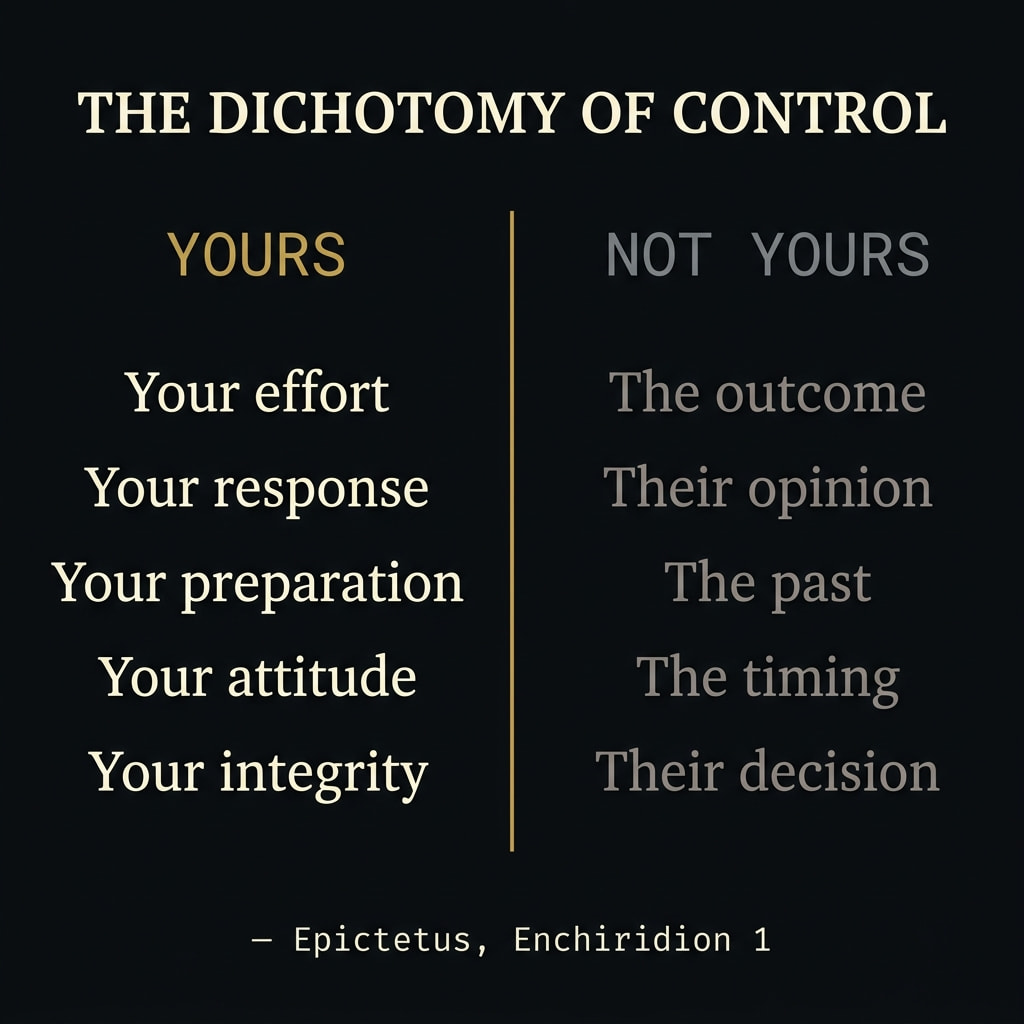
Epictetus built an entire practical system on that claim — what most modern Stoic writers call the dichotomy of control: sort everything in your experience into what is up to you (your judgments, intentions, effort, character) and what is not (other people’s actions, your reputation, your health, the outcome of anything once you’ve done your part). Disturbance, on this view, comes almost entirely from treating the second category as though it belonged in the first.
Behind that split sits a larger claim from Stoic physics — that the universe runs on a rational order the Stoics called logos, and that a disturbed mind is often just a mind resisting that order rather than working with it.
“Nowhere can a man find a quieter or more untroubled retreat than in his own soul.” — Marcus Aurelius, Meditations 4.3
Marcus wrote that note to himself, not for an audience — a reminder, in the middle of running an empire and fighting wars on the frontier, that the calm he wanted didn’t depend on his circumstances improving. It depended on where he put his attention.
How to Practice Ataraxia Today
None of the ancient schools thought ataraxia arrived by wanting it. Each one built a set of practices around it. Here are the Stoic ones that hold up best under modern use:
- Run the dichotomy of control before you react. Before responding to bad news, sort it: what part is actually yours to affect? Act only there. See how to practice Stoicism daily for the fuller version of this habit.
- Rehearse the bad outcome in advance. Negative visualization — deliberately imagining loss before it happens — blunts the shock when disturbance does arrive.
- Zoom out. The view from above exercise, borrowed directly from Marcus Aurelius, shrinks a disturbing problem by placing it against the size of everything else happening at once.
- Build a fixed morning check. A short morning routine that names what’s in your control for the day removes a lot of ambient disturbance before it starts.
- Close the day on purpose. An evening reflection that reviews what disturbed you, and why, trains the underlying skill faster than any single insight can.
Common Misconceptions About Ataraxia
The word gets misused almost as often as apatheia does, usually in the same direction.
Ataraxia is not the absence of feeling. Ancient philosophers who pursued it still felt joy, affection, and grief. See our full answer to whether Stoicism is unemotional — the goal was never numbness.
Ataraxia is not passivity. Sorting what’s in your control isn’t an excuse to stop acting on it — Marcus Aurelius ran an empire while writing about it. Disturbance is removed from the parts you can’t control, not from your effort on the parts you can.
Ataraxia is not guaranteed by circumstances. No amount of wealth, success, or comfort produces it automatically — several Stoic writers, including Seneca, argued that money and status often make disturbance worse, not better.
Where Ataraxia Fits in Daily Practice
Ataraxia isn’t a switch you flip once. In Stoic practice it functions more like a byproduct — the state you end up in after enough repetitions of judging correctly, not a target you aim at directly.
Most people who report something like it describe it after building a routine, not after one insight: a morning check-in, a habit of pausing before reacting, a review of where their judgments went wrong that day. Stoic journal prompts are one of the more direct ways to build that habit — writing down what disturbed you and testing whether the disturbance came from the event or from your judgment about it.
The ancient schools disagreed about the mechanism. They agreed, unusually for philosophers, on the diagnosis: an undisturbed mind is available to you now, not after your circumstances change. That’s the part worth taking from all three of them — ataraxia, apatheia, and whatever name you end up using for it.
Practice Stoic calm every day in StoicNow
Join the WaitlistFree Quiz
Which Stoic Are You?
A 3-minute personality quiz — Marcus, Seneca, Epictetus, or Cato.
FAQ
What does ataraxia mean?
Ataraxia (Greek: ἀταραξια) means “freedom from disturbance” — a state of untroubled calm in which the mind is not agitated by fear, desire, or negative judgment about events. It comes from a- (“without”) and tarachē (“disturbance, trouble”), and was a central goal in several schools of ancient Greek philosophy, including Epicureanism, Pyrrhonism, and (under a different name) Stoicism.
Is ataraxia the same as apatheia?
They describe closely related states but come from different schools. Ataraxia is the Epicurean and Skeptic term for freedom from mental disturbance; apatheia is the Stoic term for freedom from destructive passion, reached through judging correctly rather than avoiding pain or suspending belief. In practice, a Stoic pursuing apatheia and an Epicurean pursuing ataraxia are aiming at a similar untroubled calm by different roads.
How do you achieve ataraxia, according to the Stoics?
The Stoics held that disturbance comes from mistaken judgments, not from events themselves. Ataraxia-like calm follows from applying the dichotomy of control — focusing only on your own judgments, intentions, and actions — and letting go of outcomes you cannot control, such as other people’s opinions, health, or fortune.
Did the Stoics actually use the word “ataraxia”?
Rarely. The word belongs more properly to Epicurus and the Pyrrhonist skeptics. Stoic writers mostly used apatheia (freedom from destructive passion) and, in Seneca’s Latin, tranquillitas animi (“tranquility of mind” — the subject of his essay De Tranquillitate Animi). All three terms point at a similar untroubled state reached by different philosophical routes.
Is ataraxia the same as being emotionless?
No. Ataraxia describes freedom from disturbance, not the absence of all feeling. Ancient philosophers who pursued it still felt joy, affection, and appropriate concern — they aimed to remove irrational fear, excessive desire, and disturbance caused by things outside their control, not to stop caring about anything.
What’s the difference between ataraxia and happiness?
Ataraxia is a state of undisturbed calm; eudaimonia (often translated “happiness” or “flourishing”) is the broader goal ancient philosophers were ultimately after. For the Stoics, eudaimonia comes from living virtuously, and the calm of apatheia/ataraxia is a byproduct of that virtue — not a separate goal pursued for its own sake.

Marcus Adler
Founder & Lead Writer, StoicNow
Marcus Adler is the founder of StoicNow. For over a decade he has applied Stoic philosophy to daily life — testing the practices of Marcus Aurelius, Seneca, and Epictetus against modern problems and translating them into simple, repeatable routines. More about the author →
Further reading