Quick answer
Stoic journaling is the practice of writing short daily reflections based on Stoic philosophy — typically a morning preparation and an evening review. It is the practice Marcus Aurelius used to produce Meditations, and it is explicitly described by Seneca and Epictetus as the core discipline of becoming a better person. The goal is not literary output but self-correction over time.
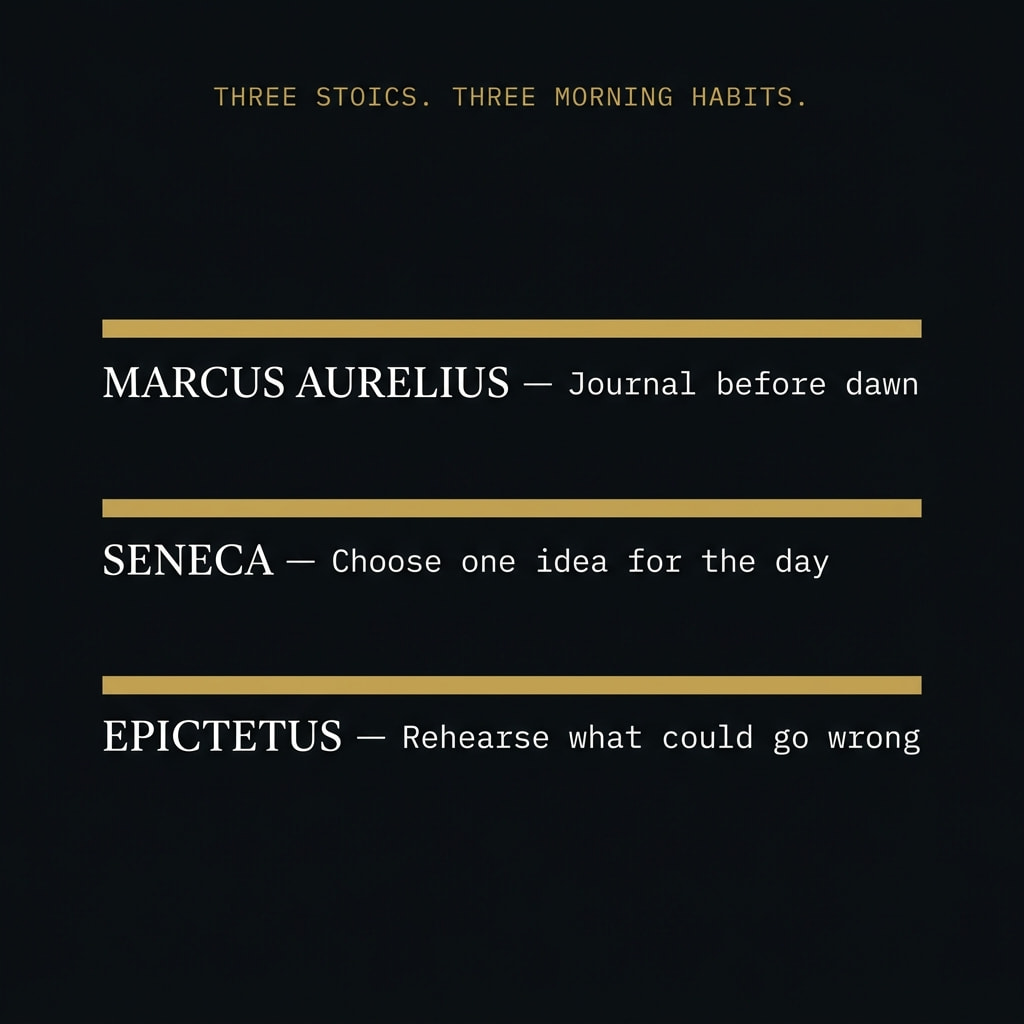
Marcus Aurelius did not write Meditations. He kept a journal — and the journal became Meditations.
The Stoics treated journaling not as a literary pastime but as the single most important daily practice for becoming a better person. Seneca explicitly describes it. Epictetus explicitly assigns it. Marcus produced the result. Almost two thousand years later, the mechanism has a new name — Cognitive Behavioral Therapy — but the mechanics are unchanged: identify what you are thinking, test it against reality, and adjust.
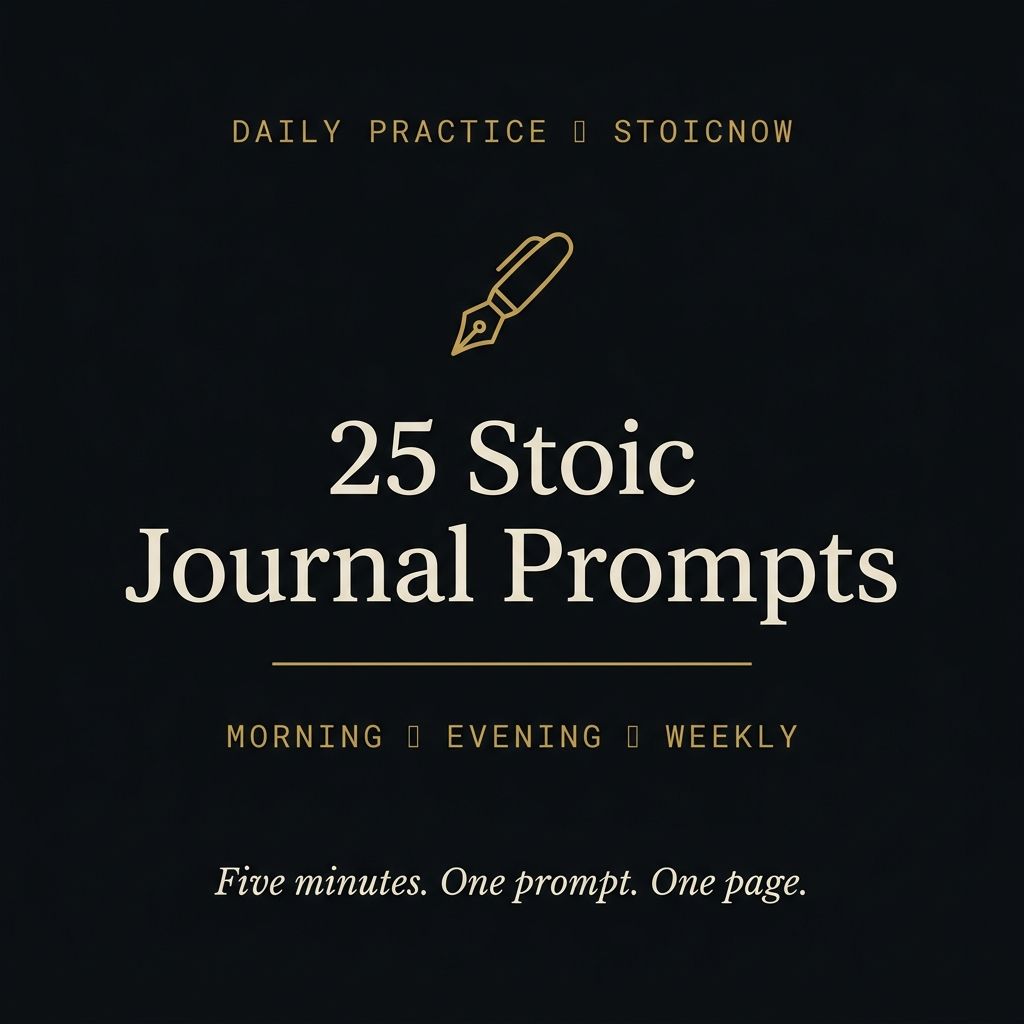
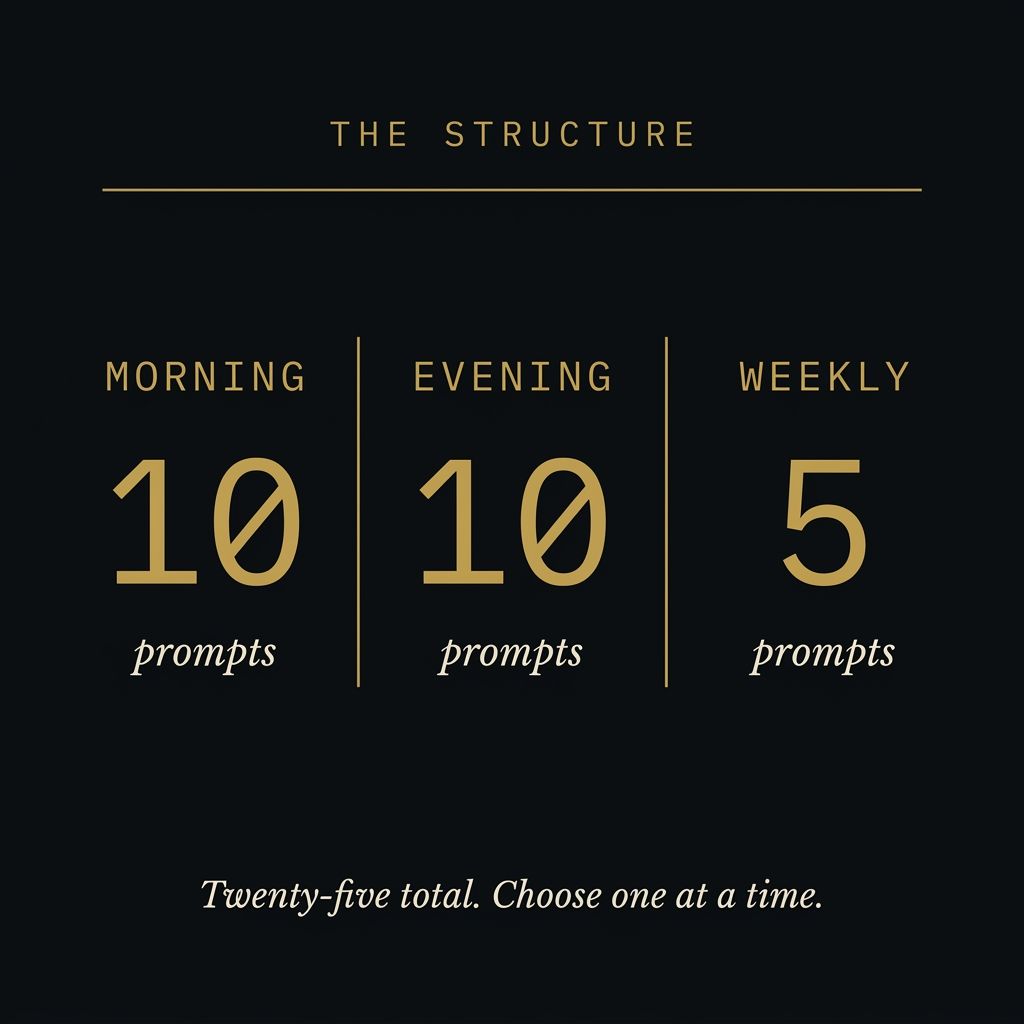
Below are twenty-five prompts, grouped by when to use them: ten for the morning, ten for the evening, and five for a weekly review. Each prompt is paired with its Stoic source and the practice it trains. You do not need a special notebook. You do not need forty minutes. You need five minutes, one prompt, and the willingness to write the honest answer.
What’s inside
How to Use These Prompts
The single biggest mistake is trying to answer too many at once. These prompts are not a questionnaire; they are a rotation. Pick one. Write for three to five minutes. Close the notebook. Come back tomorrow with a different one.
A practical system that works for most people:
- Morning (2–5 min): one prompt to set the day. Rotate through the ten morning prompts over two weeks.
- Evening (3–5 min): one prompt to review the day. Seneca called this examen. Do this even on days you skip the morning.
- Sunday (10–15 min): one weekly prompt. Broader reflection. The five weekly prompts cover a year if you rotate them.
If you can only do one of these, do the evening review. Seneca’s nightly examination, repeated over a year, compounds more than any other Stoic practice.
10 Morning Prompts
Purpose · Morning
Morning prompts prepare you for the day. They rehearse what is coming, set your priorities, and identify what you will refuse to let disturb you. Use before email, before phone, before the first obligation.
Prompt 01
“What difficult people will I probably meet today — and how will I respond without losing my character?”
The practice: Premeditatio malorum — pre-imagining obstacles. If you brace for difficult behaviour before it happens, it does not land as a surprise. Marcus did this every morning of the last years of his life.
Prompt 02
“What is one thing I can do today that is fully within my control and would matter?”
The practice: the dichotomy of control. Forces your attention to the narrow slice of the day you actually own — before external chaos claims it.
Prompt 03
“If today were my last day, what would I keep in my plan — and what would I drop?”
The practice: memento mori as a scheduling filter. Most of what fills your calendar fails this test. That is useful information.
Prompt 04
“Which of the four virtues does today need from me — wisdom, courage, justice, or temperance?”
The practice: intentional virtue selection. Picking one virtue for the day gives you a single rubric to evaluate your actions against — clearer than the vague goal of ‘being a good person’.
Prompt 05
“What is the worst realistic thing that could happen today — and how would I handle it?”
The practice: negative visualization. Counter-intuitive but effective: imagining loss in advance reduces anxiety about it, and increases gratitude for what you still have.
Prompt 06
“What am I grateful for before the day even starts?”
The practice: gratitude as a baseline, not as a reward. Marcus opens his most famous morning passage with this — gratitude first, difficult people second.
Prompt 07
“What hard task am I avoiding — and when, exactly, will I do it today?”
The practice: pre-commitment. The honest answer is almost always the same task as yesterday. Naming it, with a time, is the entire battle.
Prompt 08
“Who is a person I admire — and what would they do today in my position?”
The practice: the Stoic role model. Seneca advised keeping one wise person in mind and asking what they would do. This externalises your own best judgment when emotion is clouding it.
Prompt 09
“What will I refuse to let disturb my mind today, regardless of what happens?”
The practice: pre-declaring your peace. Epictetus: the mind is yours, and the decision to keep it steady is yours alone. Commit in advance.
Prompt 10
“If someone watched me closely today, what would they conclude about my character?”
The practice: the observer test. Character is revealed by behaviour no one rewards you for. Writing the answer in advance makes you notice where you would cheat.
10 Evening Prompts
Purpose · Evening
Seneca kept a nightly review he called the examen. Three questions, every night, without self-punishment. Before bed, before screens. Even on days you skip everything else, do this.
“I make use of this privilege every day, and plead my cause before myself as judge. When the lamp is carried out of my sight, and my wife, who knows my habit, has fallen silent, I examine the entire day.” — Seneca, De Ira 3.36

Prompt 11
“What did I do well today? Be specific — a moment, an action, a choice.”
The practice: virtue reinforcement. Reinforces what you want more of — without self-flattery. Specifics only.
Prompt 12
“What did I do poorly today — and what will I change tomorrow, concretely?”
The practice: self-correction without self-pity. Identify one behaviour, not a personality trait. ‘I snapped at my colleague’ — not ‘I am an angry person’.
Prompt 13
“Where did I spend energy today on something I couldn’t control?”
The practice: dichotomy audit. The wasted energy is almost always in one of three places: other people’s opinions, the news, or imagined future outcomes.
Prompt 14
“Did I react with anger when I should have paused? What triggered it?”
The practice: anger diagnostics. Marcus returned to this so often it is clear he had a temper. The honest question at night is how you did with it today.
Prompt 15
“Did I let someone else’s mood become mine today?”
The practice: emotional perimeter check. Another person’s anger, anxiety, or gossip is not yours by default — you have to accept it. Did you?
Prompt 16
“What did I say today that I wish I hadn’t?”
The practice: speech audit. Words leave your mouth faster than you can evaluate them. A nightly review closes that gap slowly.
Prompt 17
“Did I live today in line with the virtue I chose this morning?”
The practice: closes the loop on Morning Prompt 04. If you named a virtue at dawn, honest evaluation at dusk turns it from an aspiration into a training signal.
Prompt 18
“What am I grateful for that I didn’t notice during the day?”
The practice: retroactive gratitude. The small things you glided past — a kind message, a working body, a quiet hour — were still the day. Writing them down makes them count.
Prompt 19
“Was I fully present, or did I rush through most of today?”
The practice: presence audit. Rushed days leave no residue — not in memory, not in relationships. Notice when you traded presence for speed.
Prompt 20
“What did I do today that I would be ashamed of if someone I respect saw it?”
The practice: the witness test. Seneca’s sharpest prompt. The answer is almost never dramatic — it is the petty thing, the shortcut, the small act no one else noticed. Those are the ones that accumulate into character.
5 Weekly Prompts
Purpose · Weekly
Daily prompts catch behaviour. Weekly prompts catch patterns. Use on Sunday evening or Monday morning — one per week, rotating through the five — and a full rotation lasts a month. Return to it quarterly to see what changed.
Prompt 21
“What pattern keeps appearing in my failures this week?”
The practice: pattern recognition. One bad day is noise. The same failure repeated seven times is signal. The only way to see it is to look at the week, not the day.
Prompt 22
“Where did I grow this week — and where did I coast?”
The practice: growth audit. Coasting feels fine in the moment and obvious in retrospect. The weekly view is when it becomes visible.
Prompt 23
“If I had to describe myself this week in one word, what would it be?”
The practice: honest self-description. The answer is revealing. Keep the list over months; the pattern of your one-word weeks is closer to your actual character than any self-report at a single moment.
Prompt 24
“What am I pretending not to know about my life right now?”
The practice: the uncomfortable honesty drill. Usually a relationship, a job, or a habit you have been quietly deciding not to confront. Writing it down does not require action yet. It just stops the pretending.
Prompt 25
“What is the one thing that would matter most for me to focus on next week — and what will I say no to, to make room for it?”
The practice: priority + sacrifice. Most weekly reviews only identify priorities; Stoics force you to name the trade-off. The priority without the sacrifice is a fantasy.
The 3-2-1 Method (if you only have 5 minutes)
If twenty-five prompts feel like too many to pick from, use the same structure every night. Three numbers, three lines, done.
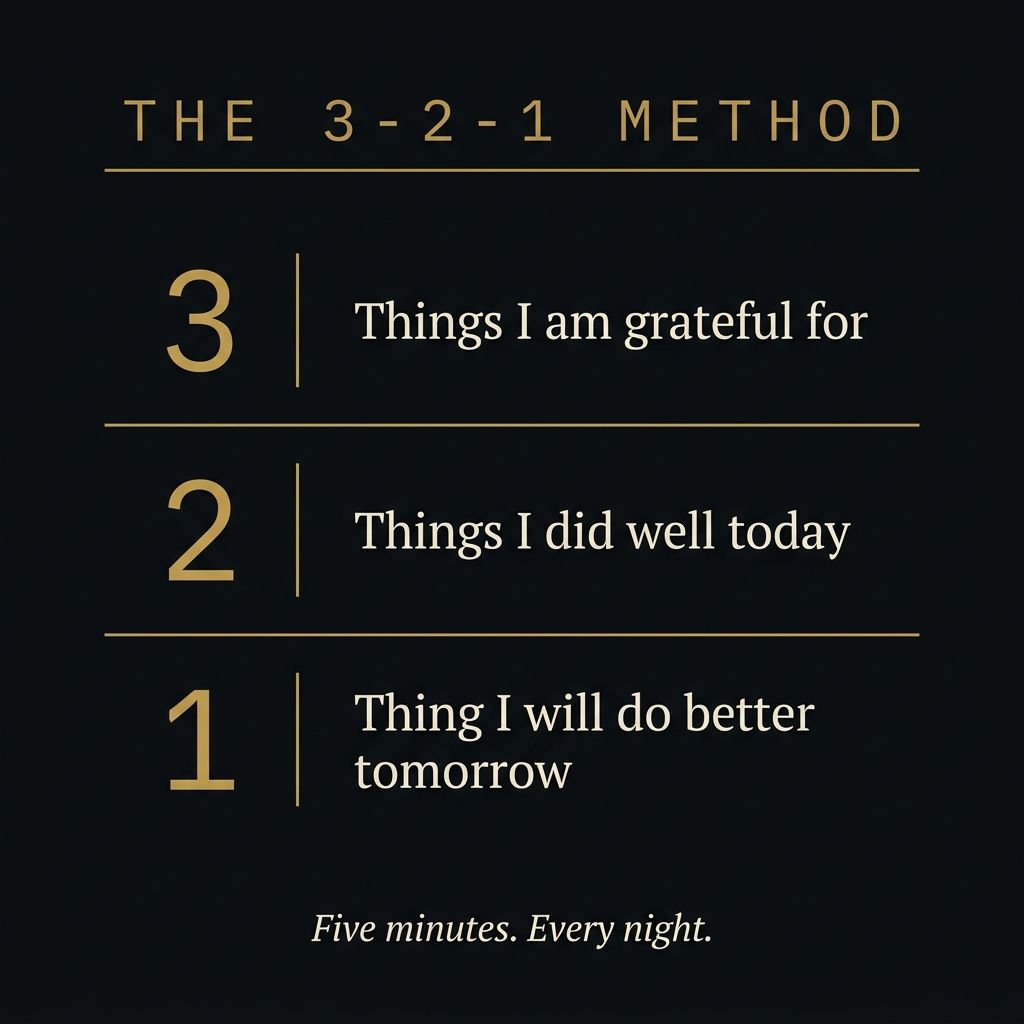
The 3-2-1 Method
Things I am grateful for today
Specific, not abstract. A person. A moment. A sensation. Three short lines.
Things I did well today
Small actions count. Holding your tongue. Finishing the email. Being patient at home.
Thing I will do better tomorrow
One behaviour, not a personality trait. A specific replacement, not a vague wish.
The 3-2-1 is a compressed version of Seneca’s examen and works as a permanent template. Over time, the same repeated patterns will surface — and that is exactly where the growth lives.
Mistakes to Avoid
Writing for an audience
Marcus never published his journal. If you start writing as if someone might read it, you stop writing the truth. Keep the notebook private. Tell yourself in advance that no one will see it, and stick to that.
Turning it into self-punishment
The Stoic evening review is not a verdict; it is a diagnostic. If you find yourself writing the same self-critical sentence every night, drop that prompt and switch to a gratitude or virtue prompt for a week. The goal is correction without cruelty.
Writing in abstractions
‘I want to be more patient’ is not useful. ‘I snapped at Maya during the meeting at 3pm and I will apologise tomorrow’ is useful. Specifics train behaviour. Abstractions do nothing.
Skipping the evening review because you missed the morning
Most people collapse the practice when they miss one part of it. The evening review is independently valuable. Do it on its own, skip the morning if the morning is not happening, and return to the morning when you can.
Stoic journaling, prompts built in
Try StoicNow — Free on iOSFAQ
What is Stoic journaling?
Stoic journaling is the practice of writing short daily reflections based on Stoic philosophy — typically a morning preparation and an evening review. It is the practice Marcus Aurelius used to produce Meditations, and it is explicitly described by Seneca and Epictetus as the core discipline of becoming a better person. The goal is not literary output but self-correction over time.
How long should I spend Stoic journaling?
Five to ten minutes per session is enough. Stoic journaling rewards consistency more than length — a short daily entry over six months will change you more than one long entry a week. Start with five minutes in the evening. Add a morning entry once that habit is sticking.
What did Marcus Aurelius write in his journal?
Meditations is the result — twelve short books of notes to himself, written in Greek, during military campaigns. Most entries are reminders: what he wants to remember, what he is practising, what he keeps forgetting. Some are arguments against his own anger or ambition. None were meant for publication. You are reading a Roman emperor trying to keep himself on track.
Do I need a special journal?
No. Marcus used plain notebooks; any ruled notebook or a notes app on your phone works. The medium does not matter. What matters is the question you are answering and the fact that you actually return to it. A $3 notebook used daily beats a $50 bound journal used twice.
Is Stoic journaling the same as gratitude journaling?
Gratitude is one component, but Stoic journaling is broader. It combines gratitude with negative visualization (imagining loss), self-review (where did I fall short today?), preparation (what will I meet tomorrow?), and examination of judgments. Gratitude alone skews positive; Stoic journaling also confronts failures, without self-pity.
Is there evidence Stoic journaling works?
Yes. Expressive writing has 30+ years of clinical research behind it, starting with James Pennebaker’s studies in the 1980s. Combined with the cognitive restructuring Stoic prompts encourage (identifying judgments, testing them against reality), it maps closely onto Cognitive Behavioral Therapy — the most evidence-based treatment for anxiety and depression. Aaron Beck cited Stoicism as a direct influence when he developed CBT.

Marcus Adler
Founder & Lead Writer, StoicNow
Marcus Adler is the founder of StoicNow. For over a decade he has applied Stoic philosophy to daily life — testing the practices of Marcus Aurelius, Seneca, and Epictetus against modern problems and translating them into simple, repeatable routines. More about the author →