Quick answer
Negative visualization is a Stoic mental exercise in which you deliberately imagine losing what you currently have — a person, your health, your home, your job — in order to feel gratitude for it. The Romans called it premeditatio malorum, the premeditation of evils. Practiced briefly and daily, it counteracts hedonic adaptation, the brain's habit of taking everything for granted.
Most gratitude advice tells you to count your blessings. The Stoics did the opposite: they told you to imagine losing them.
It sounds morbid until you try it. Then it does something nothing else does — it converts an ordinary morning, an ordinary spouse, an ordinary working pair of legs into something you can actually feel as a gift. The Romans called the broader discipline premeditatio malorum, the premeditation of evils. The modern philosopher William Irvine narrowed it to a specific practice and named it negative visualization.
This is the Stoic exercise. Not the most famous one, but the one that, if you do it daily, changes the texture of your life faster than any other.
What Negative Visualization Actually Is
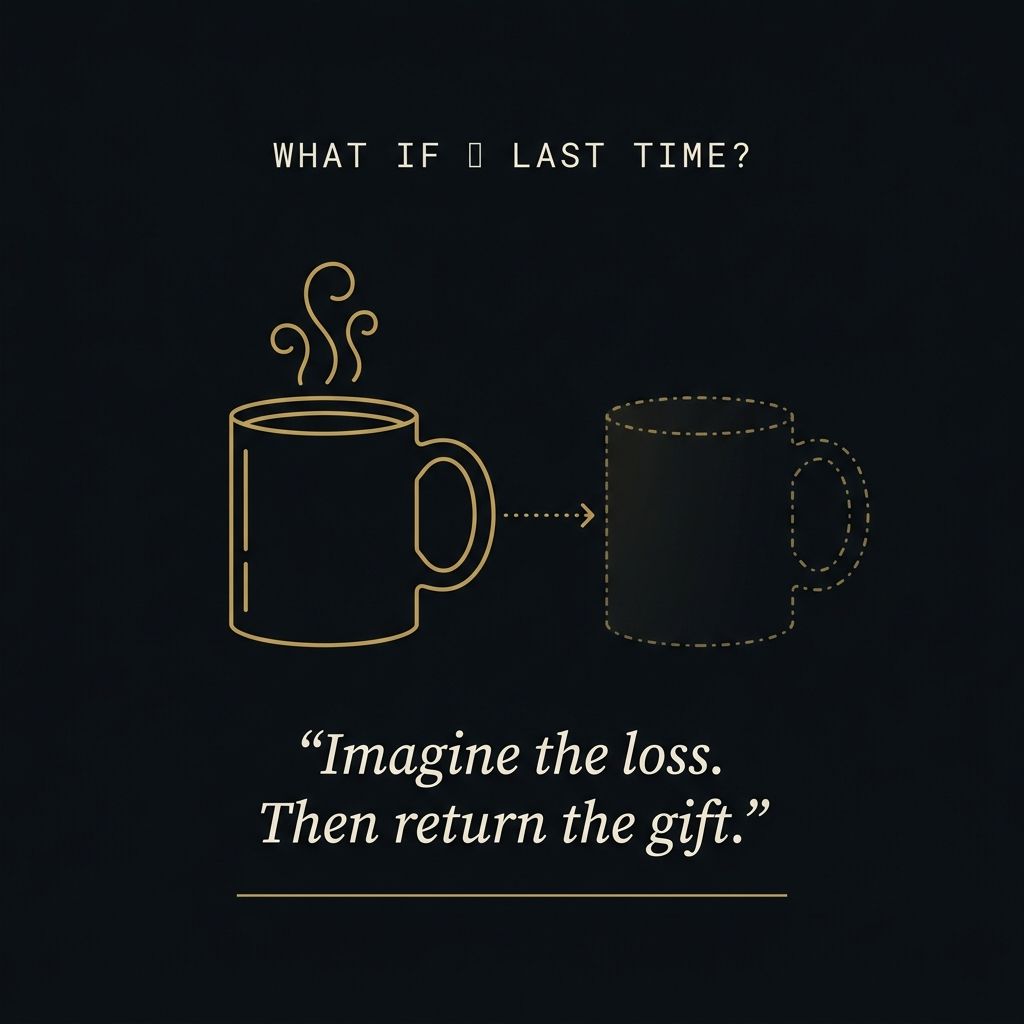
Negative visualization is a brief, deliberate mental exercise. You pick something you currently have — a person, your eyesight, your apartment, today — and you spend two to five minutes vividly imagining it gone. Then you open your eyes and notice that it is, in fact, still here.
That second step is the whole point. The imagined loss is not the goal. The return is the goal. You imagine the absence so that the presence becomes visible again.
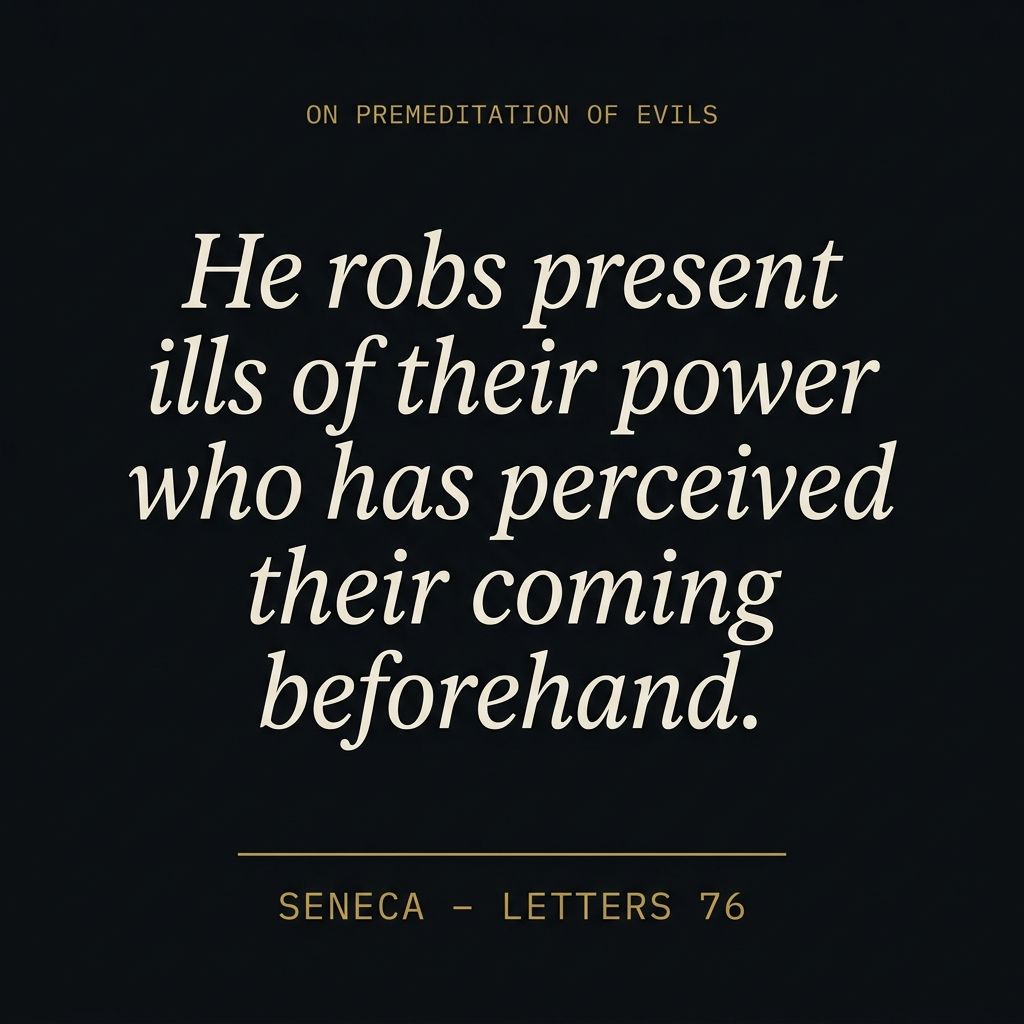
“He robs present ills of their power who has perceived their coming beforehand.” — Seneca, Letters 76
Seneca’s claim is bigger than gratitude. He’s saying that mental rehearsal of misfortune does two things at once: it disarms the future blow when it eventually lands, and it amplifies the present good while it’s still here. One exercise, two effects.
Modern psychology has a name for the problem this fixes: hedonic adaptation. Your nervous system normalizes whatever is constant. The new car becomes the car. The new partner becomes the partner. The job you celebrated becomes the job you complain about. Hedonic adaptation is automatic and almost impossible to switch off — but it can be interrupted. Negative visualization is one of the few tools that interrupts it on purpose.
Negative Visualization vs Worrying
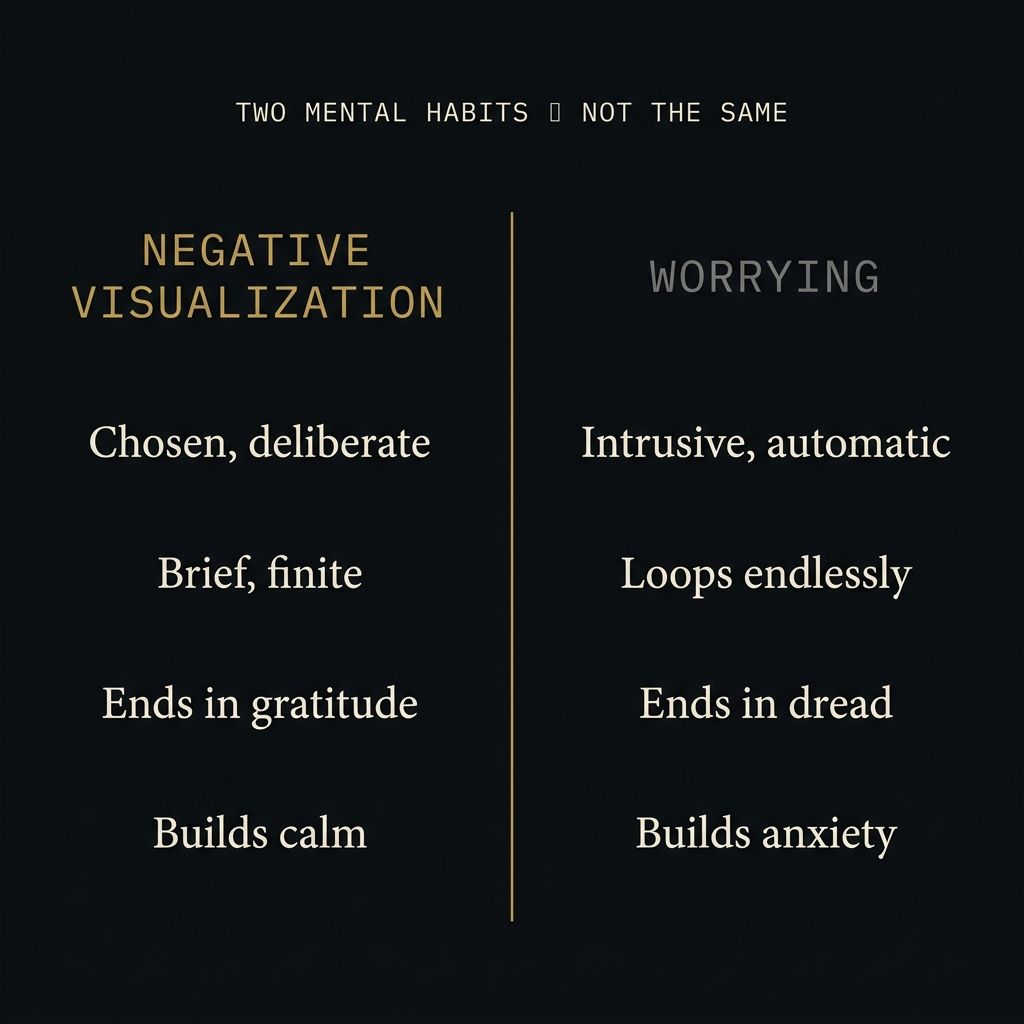
The first time someone explains this practice, the reaction is usually some version of “but isn’t that just worrying?” It looks the same from the outside — you’re thinking about something bad — but the inside is structurally different.
Negative Visualization
- Chosen and deliberate
- Time-bounded (2–5 minutes)
- Ends in gratitude
- Targets one specific thing
- Builds calm and presence
Worrying
- Intrusive and automatic
- Loops without resolution
- Ends in dread or avoidance
- Sprawls across many fears
- Builds anxiety and depletion
Worrying happens to you. Negative visualization is something you do. You start it on purpose, you finish it on purpose, and you choose the ending — the moment you open your eyes and see what’s still here.
If you don’t close the loop with that final return-and-receive step, you’re not doing negative visualization. You’re ruminating. The Stoics were emphatic on this point: the exercise is judged by what state you’re in when it ends.
Why It Works (The Science)
Three converging research lines explain why a 2,000-year-old mental exercise still produces measurable effects.
Hedonic adaptation reset. Sonja Lyubomirsky and her collaborators have shown that gratitude interventions only work consistently when they involve some form of contrast — comparing what you have to what you might not have. Pure positive listing wears off. Loss-anchored reflection doesn’t.
CBT exposure mechanics. Imaginal exposure — vividly picturing a feared scenario in a controlled, time-bounded way — is one of the most evidence-based techniques in cognitive therapy. It reduces the emotional charge of the imagined event over time, exactly as Seneca predicted. Donald Robertson’s The Philosophy of Cognitive-Behavioural Therapy documents the direct line from Stoic premeditation to modern exposure protocols.
Mortality salience and gratitude. Studies on mortality awareness (most cleanly summarized by Laura King and others) find that brief, structured contemplation of death or loss tends to increase meaning, gratitude, and prosocial behavior — provided the contemplation is bounded and reflective rather than panicked. This is the bridge between negative visualization and memento mori: same mechanism, different scope.
The Stoics did not have any of this research. They figured out the practice empirically, by paying attention to which mental habits produced which results, over decades, in their own lives.
The 5-Minute Exercise
Here is the practice, broken into five small steps. The whole thing is five minutes — deliberately short, so it doesn’t become rumination. Do it once a day, ideally before bed or during a morning walk.
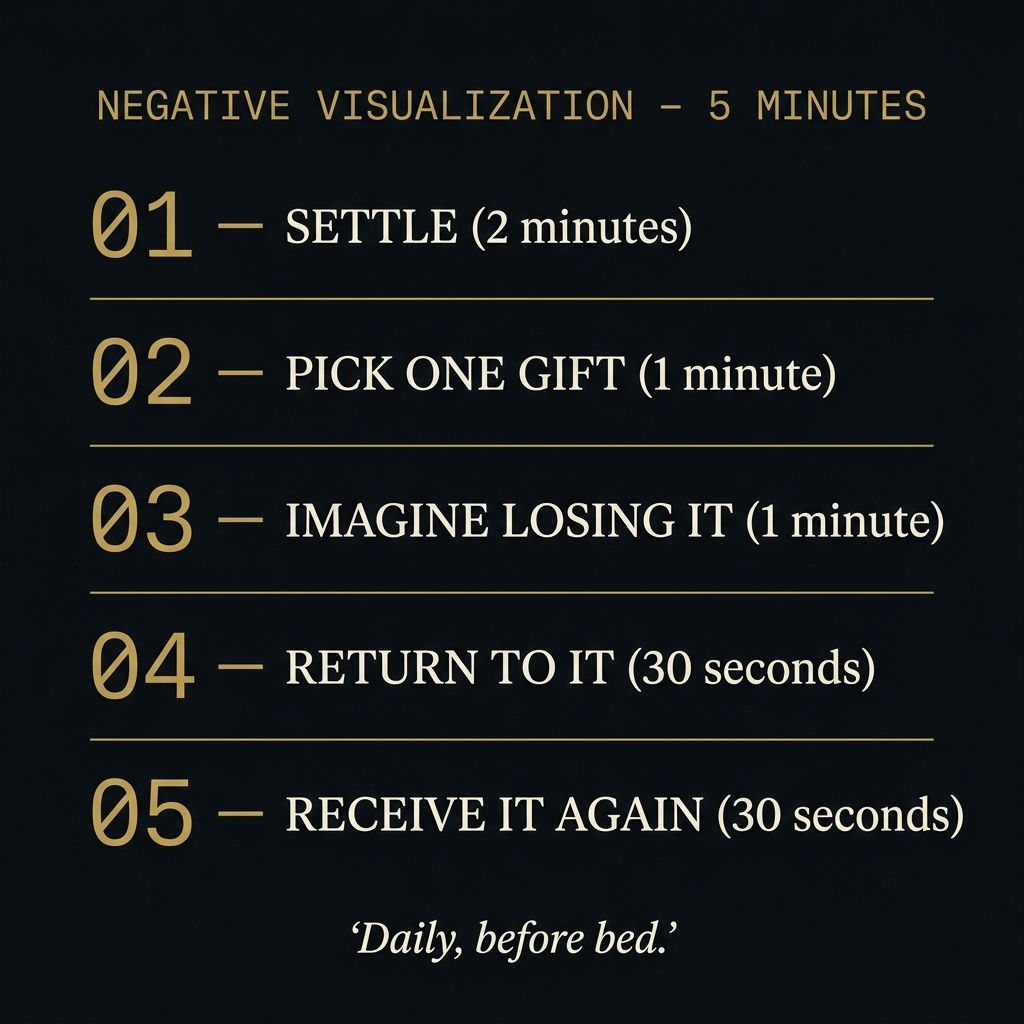
Settle
Sit somewhere quiet. Close your eyes. Take three slow breaths. Let the noise of the day fade. You are not solving anything in this exercise — you are looking. The first two minutes are protected from doing.
Pick one gift
Choose one specific thing in your life right now. Not a category — not “my health,” not “my family.” A particular person. A body part that works without complaint. A small object. The light through your window. Today’s meal. The narrower, the better.
Imagine losing it
Vividly picture this thing being gone. Not dramatically — concretely. The empty chair across the table. The diagnosis read out loud. The phone call that comes at 2 a.m. The morning where the legs that have always worked refuse. Stay with the loss for sixty seconds. Don’t flinch away.
Return to it
Open your eyes. The thing is still here. Notice that it could have been otherwise. Notice that nothing — no contract, no fairness, no merit — guarantees its continued presence tomorrow.
Receive it again
For thirty seconds, look at the thing as if it had just been given to you. Not as something owed. As a gift, currently being lent. Then return to your day with that fact intact.
That’s the whole exercise. The structure matters more than the details — choose, lose, return, receive. Skip any of those four and the practice collapses into either daydreaming or worrying.
Seven Things to Practice On
If you’re not sure what to focus on, rotate through these. Most people find that the targets they avoid are the ones the practice does the most for.
Where the Stoics Wrote About It
The practice runs through every major Stoic text. Three passages in particular are worth reading in full.
Seneca, Letters 91. Written after the city of Lyon burned to the ground overnight. Seneca’s point: nothing exempt from chance, nothing surprising for the prepared mind. The letter is short, devastating, and the closest thing to a primary source on negative visualization as a discipline.
Marcus Aurelius, Meditations 7.27. “Do not indulge in dreams of having what you have not, but reckon up the chief of the blessings you do possess, and then thankfully remember how you would crave for them if they were not yours.” This is the practice in one sentence.
Epictetus, Discourses 3.24. “When you kiss your child, say to yourself, ‘Perhaps tomorrow you will die.’” The most uncomfortable line in the canon. Read in context, it is not cold — it is an instruction to fully see the child while you can.
For more on the broader practice, see our deep dive on amor fati — the Stoic move from accepting loss to actively loving the texture of fate.
Three Common Mistakes
Mistake 01 — making it abstract. “I’ll lose my health one day” produces nothing. “Tomorrow morning my left knee no longer bends” produces something. The vividness is not optional.
Mistake 02 — skipping the return. If you stop after step three, you’re ruminating. The exercise is not complete until you’ve opened your eyes, seen the thing still present, and held it as a gift for thirty seconds.
Mistake 03 — doing it too long. Twenty minutes of negative visualization is not five times better than five. Past a certain point, the brain stops processing it as practice and starts processing it as fear. Keep it short. The Stoics did.
When Not to Use It
The exercise is generally safe and useful, but there are three cases where it should be modified or skipped.
Active grief. If you are inside a recent loss, do not turn imagined-loss exercises onto the same domain. Use a different target — a friend, a sense, a small object — until the acute period passes. The brain doesn’t need rehearsal of pain it’s currently inside.
Severe health anxiety or OCD. If your default mode is already intrusive catastrophic thinking, this practice can deepen the loop rather than break it. The exposure mechanism still works, but it should be guided by a therapist, not self-applied.
Acute crisis. Negative visualization is a maintenance practice for ordinary days, not an emergency tool. If a real adversity is currently unfolding, you don’t need to imagine more — you need to handle the one in front of you. Return to the practice when the dust settles.
If anxiety is the broader question, our companion article on five Stoic techniques for anxiety covers the whole toolkit, with negative visualization as one of five.
Practice with a Stoic mentor
Join the WaitlistFAQ
What is negative visualization?
Negative visualization is a Stoic mental exercise in which you deliberately imagine losing something you currently have — a person, your health, your home, your job — in order to feel gratitude for it. The Romans called it premeditatio malorum, the premeditation of evils. Practiced briefly and daily, it counteracts hedonic adaptation, the brain’s habit of taking everything for granted.
Isn’t negative visualization just worrying?
No. Worrying is automatic, intrusive, and unbounded — it loops without resolution and ends in dread. Negative visualization is chosen, brief, and finite — usually two to five minutes — and it ends in gratitude. The mental act looks similar from outside, but the structure and the emotional outcome are opposite.
How long should I practice negative visualization?
Five minutes a day is plenty. The Stoics treated it as a quick mental hygiene habit, not a meditation retreat. Most modern practitioners do it once before bed or during a morning walk. Going longer doesn’t deepen the effect — it just risks tipping the practice into rumination.
Is negative visualization the same as premeditatio malorum?
Closely related, but not identical. Premeditatio malorum is the broader Stoic discipline of imagining adversity in advance — to prepare your response and to soften the blow if it lands. Negative visualization, the term coined by William Irvine in A Guide to the Good Life, focuses specifically on imagining the loss of things you currently enjoy, in order to produce gratitude.
Where in Stoic texts is negative visualization described?
Seneca describes the practice in Letter 91 (on the burning of Lyon) and Letter 76, where he writes that nothing should be unexpected. Marcus Aurelius uses it implicitly throughout the Meditations — most clearly in Book 7.27, where he tells himself to think of what he would crave if he did not have it. Epictetus references it in Discourses 3.24 when he advises to remind oneself, when kissing one’s child, that the child is mortal.
Is negative visualization safe for people with anxiety or depression?
For most people the brief, structured form is safe and even helpful — clinical psychologists like Donald Robertson have used it within CBT frameworks. But if you have severe health anxiety, OCD, or active grief, the exercise can cross into rumination. Keep it short, time-bounded, and always end on the return-and-receive step. If it consistently increases distress, speak with a therapist.

Marcus Adler
Founder & Lead Writer, StoicNow
Marcus Adler is the founder of StoicNow. For over a decade he has applied Stoic philosophy to daily life — testing the practices of Marcus Aurelius, Seneca, and Epictetus against modern problems and translating them into simple, repeatable routines. More about the author →
Further reading