Quick answer
Stoicism doesn’t call money evil. It calls money a “preferred indifferent” — reasonable to have, useful to use, but never the source of a good life. The goal is to pursue and hold wealth with a light grip: own it without being owned by it.
The relationship between Stoicism and money is more interesting than either its critics or its fans usually admit. The Stoics did not preach poverty, and they did not worship wealth. They built a third position — one that lets you chase a raise, save, invest, and spend, while refusing to let any of it become the foundation your peace of mind stands on.
That distinction matters because it’s the part most people get wrong. They assume a Stoic is supposed to give everything away and live in a barrel. That was the rival school, the Cynics. The Stoics taught something harder and more usable: that money is worth having, worth handling well, and never worth fearing the loss of.

What Stoicism Actually Says About Money
Start with the Stoic value system, because money’s place only makes sense inside it. For the Stoics, there is exactly one genuine good: virtue — wisdom, justice, courage, and temperance. There is exactly one genuine evil: vice. Everything else — health, reputation, comfort, money, even life itself — falls into a third bucket they called the indifferents.
“Indifferent” is a technical term, not a shrug. It doesn’t mean these things have no value. It means they don’t determine whether you are a good person or a bad one. A wealthy person can be just or corrupt; a poor person can be wise or foolish. Money sits outside the thing that actually decides the quality of a life.
But the Stoics drew a further line inside that third bucket. Some indifferents are preferred — reasonable to choose, all else equal — and some are dispreferred. Health is preferred over sickness. Wealth is preferred over poverty. You are not betraying the philosophy by wanting money. You’re betraying it only by mistaking money for the good itself.
The one-line version. Virtue is the only good; money is a “preferred indifferent.” Pursue it, use it, and stay ready to lose it without losing yourself. That single sentence resolves nine out of ten apparent contradictions in Stoic writing on wealth.
Where the Idea Comes From
The framework traces to the founder himself. Zeno of Citium, who started teaching in Athens around 300 BC, was a wealthy merchant before philosophy. According to the ancient biographer Diogenes Laertius, Zeno was shipwrecked off the coast of Athens and lost his cargo — a fortune in purple dye. Only then did he wander into a bookshop, encounter Socratic philosophy, and begin the school that became Stoicism. The line attributed to him afterward: “I made a prosperous voyage when I suffered shipwreck.”
That origin story is the whole attitude in miniature. The wealth was real and useful; its loss was survivable, even fertile. The Stoics who followed kept refining the point across three very different lives.
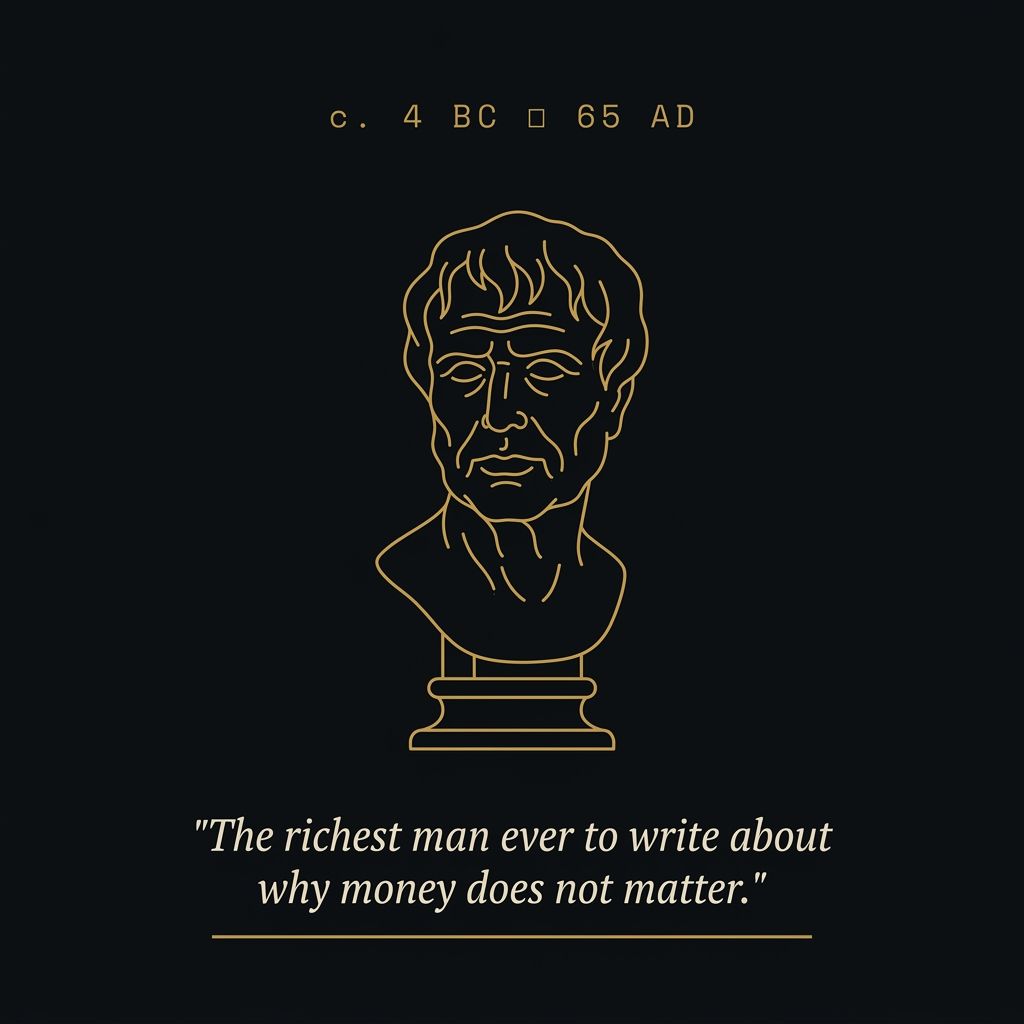
The range is deliberate proof of concept. A slave, a multimillionaire, and an emperor all drew on the same doctrine, because the doctrine was built to work at any income. If it only worked in poverty, Seneca couldn’t have used it. If it only worked in wealth, Epictetus couldn’t have. That it served both is the point.

The Core Principle: Own It Without Being Owned
The mechanism underneath all of this is the dichotomy of control. Epictetus opens his Enchiridion by splitting the world into two categories: what is “up to us” (our judgments, choices, and efforts) and what is not (our body, reputation, property, and outcomes). Money lands squarely in the second category.
“Some things are up to us and some are not up to us. … property, reputation, office — in a word, whatever is not our own doing.” — Epictetus, Enchiridion 1
If money is not fully up to you — and it isn’t, because markets crash, clients leave, and economies turn — then anchoring your peace to it is a category error. You’re tying your inner stability to a thing you don’t control. The Stoic move is to invest your effort fully (work hard, earn, manage well) while detaching your serenity from the result.
Seneca, who knew the temptation better than anyone, put the standard plainly:
“It is not the man who has too little, but the man who craves more, that is poor.” — Seneca, Letters 2
The poverty he’s describing isn’t a number in an account. It’s a posture — the endless wanting that no sum ever fills. A billionaire who needs the next billion to feel secure is, by this definition, poorer than a craftsman content with enough. The cure isn’t more money. It’s wanting what you already have, a theme that runs straight through the practice of negative visualization.
How to Apply Stoic Money Principles Today
None of this is abstract. The Stoics were relentlessly practical, and their teaching on money translates into concrete habits you can run this month.
1. Practice poverty on purpose
Seneca’s most famous financial exercise was deliberate scarcity. He advised Lucilius to set aside a few days to live on the cheapest food and coarsest clothing, then ask the real question:
“Set aside a certain number of days … content with the scantiest and cheapest fare … saying all the while, ‘Is this the condition that I feared?’” — Seneca, Letters 18
The point is to discover that the fear of losing money is almost always bigger than the reality of having less. This is the same logic behind voluntary discomfort — rehearse the worst on your own terms so it loses its grip on you.
2. Separate effort from outcome
Do everything within your control to earn and manage money well — the skill, the discipline, the saving. Then release the outcome. A negotiation, a raise, a market return: these depend on factors outside you. Aim carefully, release the arrow, and accept where it lands.
3. Spend on use, not on status
The Stoics were suspicious of consumption driven by other people’s opinions. Reputation is itself a dispreferred place to anchor your worth. Ask of a purchase: does this serve a real use, or am I buying it to be seen? The second motive is the trap.
A simple test. Before a major purchase, ask three questions: Do I control whether I keep this? Would losing it damage my character or just my comfort? Am I buying the thing, or the image of owning it? Honest answers usually cut spending without any sense of deprivation.
4. Give money a job, then let it go
Hold wealth as a tool, not an identity. Use it for security, for the people you’re responsible for, for work that matters. Build the habit into a routine; a structured evening reflection is a natural place to ask whether the day’s spending and earning matched your values, not just your appetites.

Common Misconceptions
Three errors recur constantly, and clearing them up is most of the work.
Myth 01
“Stoicism means giving up money”
Myth 02
“Stoics don’t care about anything”
Myth 03
“Seneca was a hypocrite, so it’s all empty”

Where Money Fits in Stoic Practice
Money is not a special subject in Stoicism. It’s a test case for the whole system. The same logic that governs how a Stoic handles wealth governs how he handles health, reputation, and outcomes of every kind: invest fully in what you control, hold loosely what you don’t, and locate the good life in character rather than circumstance.
Marcus Aurelius, who controlled the wealth of an empire, kept the perspective brutally clear in his private notebook:
“Receive without pride, let go without attachment.” — Marcus Aurelius, Meditations 8.33
That is the entire teaching in seven words. Money comes; receive it without letting it inflate you. Money goes; release it without letting it crush you. The practice is the same whether the sum is large or small, which is exactly why it survives every change in your circumstances. If you want to build the habit, a daily journaling routine around what you can and can’t control is the most direct on-ramp.
Held this way, money stops being a source of anxiety and becomes what the Stoics always said it was: a useful tool, worth having, never worth fearing.
Build the Stoic habit, one day at a time
Join the WaitlistFree Quiz
Which Stoic Are You?
A 3-minute personality quiz — Marcus, Seneca, Epictetus, or Cato.
FAQ
Does Stoicism say money is bad?
No. Stoicism classes money as an “indifferent” — something that is neither good nor bad in itself. Only virtue (wisdom, justice, courage, temperance) is genuinely good. Wealth is in fact a “preferred indifferent”: all else equal, the Stoics thought it was reasonable to choose having money over not having it. What they warned against was treating money as the source of a good life, or being owned by the craving for it.
What did the Stoics say about wealth?
That it is permitted but not required, useful but not necessary, and dangerous when it owns you rather than the reverse. Seneca, one of the richest men in Rome, argued in De Vita Beata that the sage may possess wealth as long as he holds it without attachment and could lose it without losing his peace. Epictetus, a former slave, taught that property is “not up to us” and should never be where we locate our happiness.
Can you be rich and a Stoic?
Yes. Stoicism never demanded poverty — that was the rival school of the Cynics. A Stoic can be wealthy provided money does not govern his judgments or his peace of mind. The test is simple: if you lost it tomorrow, would your character survive intact? Seneca defended exactly this position, though his own enormous fortune made him a lasting target for the charge of hypocrisy.
What is a “preferred indifferent”?
A “preferred indifferent” is a Stoic category for things that don’t affect whether you are a good person, but are still reasonable to pursue — health, reputation, and wealth among them. They are “indifferent” to virtue, yet “preferred” over their opposites. The point is to seek them with a light grip: pursue money, use it well, and stay willing to lose it without your inner life collapsing.
How do I practice Stoicism with money?
Separate your security from your bank balance. Periodically practice “voluntary discomfort” — live for a few days on little, as Seneca advised in Letter 18, to prove the fear of poverty is larger than poverty itself. Want what you already have before wanting more. Spend on use, not on status. And hold a clear line between what you can control (your effort and choices) and what you cannot (markets, outcomes, luck).
Were the Stoics actually poor?
Some were, some weren’t. Zeno of Citium, the founder, was a wealthy merchant before a shipwreck cost him his cargo. Epictetus was born a slave and lived simply. Seneca was one of the richest men in the empire, and Marcus Aurelius was emperor. The range is the point: Stoicism was designed to work at every station, because it locates the good life in character, not in net worth.

Marcus Adler
Founder & Lead Writer, StoicNow
Marcus Adler is the founder of StoicNow. For over a decade he has applied Stoic philosophy to daily life — testing the practices of Marcus Aurelius, Seneca, and Epictetus against modern problems and translating them into simple, repeatable routines. More about the author →
Further reading