Quick answer
Lucius Annaeus Seneca (c. 4 BC – AD 65) was a Roman Stoic philosopher, statesman, and playwright. He served as tutor and later advisor to the emperor Nero, was one of the richest men in Rome, and is remembered for Letters from a Stoic — 124 short moral letters written to his friend Lucilius in the final years of his life.
Seneca was Rome’s most quotable Stoic because he was writing to be read. Marcus wrote to himself and never expected an audience; Seneca wrote long, literary letters to a friend — and published them. The result: 2,000 years later, his lines still land.
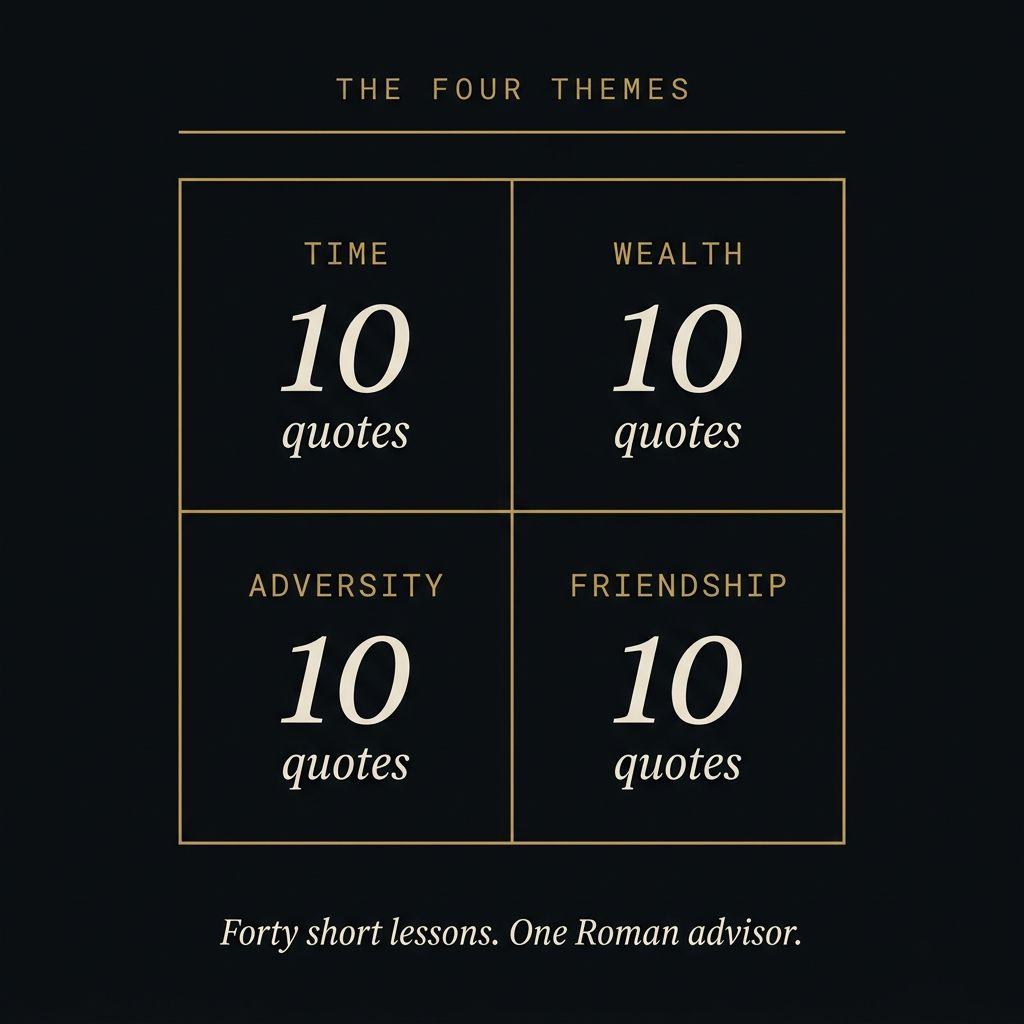
Below are forty of the sharpest, grouped into the four subjects Seneca returns to most often: time, wealth, adversity, and friendship. Each quote is cited by Letter or essay, each followed by a short paragraph of context — why it cut through in Rome, why it cuts through now.
What’s inside
Who Was Seneca (One Paragraph)
Lucius Annaeus Seneca (c. 4 BC – AD 65) was born in Cordoba, trained in Rome, exiled to Corsica by Claudius, then recalled to tutor the future emperor Nero. He became one of the most powerful men in the empire and one of the richest — a fact that embarrassed him and which he wrote about honestly. In the last years of his life, retired and under political pressure, he wrote 124 moral letters to his friend Lucilius, published as Letters from a Stoic. Nero ordered his suicide in AD 65. He opened a vein in the bath.
10 Quotes on Time
Theme 01 · On Time
Seneca’s central economic argument: time is the only irreplaceable resource, and it is the one we guard least. Most of these come from On the Shortness of Life (De Brevitate Vitae, c. AD 49) and the opening letters to Lucilius.
Quote 01
“It is not that we have a short time to live, but that we waste much of it.”
— On the Shortness of Life 1
The opening line, and arguably the most important sentence Seneca ever wrote. The premise of the whole book is not that life is short but that we treat it as if it were long.
Quote 02
“While we are postponing, life speeds by.”
— Letters to Lucilius 1
The first letter opens with Seneca’s version of a morning alarm: most of what you call ‘later’ is the window you will not get back.
Quote 03
“Hold every hour in your grasp. Lay hold of today’s task, and you will not need to depend so much upon tomorrow’s.”
— Letters 1
The corrective to the line above. The solution is not panic; it is the small daily discipline of finishing what the day asks.
Quote 04
“You act like mortals in all that you fear, and like immortals in all that you desire.”
— On the Shortness of Life 3
The sharpest diagnosis of modern life ever made in Latin. We treat small risks as existential and our limitless-feeling goals as routine.
Quote 05
“Life, if well lived, is long enough.”
— On the Shortness of Life 2
Seneca rejects the premise that we need more years. The issue is the density of the ones we have.
Quote 06
“The whole future lies in uncertainty: live immediately.”
— On the Shortness of Life 9
Two thousand years before anyone wrote a book about presence, Seneca put it in three words.
Quote 07
“Begin at once to live, and count each separate day as a separate life.”
— Letters 101
From the letter Seneca wrote after a friend’s sudden death. The proposal is not metaphorical. Each day, closed properly, stands alone.
Quote 08
“Nothing, Lucilius, is ours, except time.”
— Letters 1
Property can be taken. Reputation can be taken. Even your body, as Seneca’s own end would show, can be taken. Only the hours already lived cannot be repossessed. Protect the remaining ones accordingly.
Quote 09
“No one restores the years; no one will give you back to yourself.”
— On the Shortness of Life 8
The line against deferred living. A decade spent waiting for the real life to begin cannot be refunded. See also our piece on memento mori.
Quote 10
“The greatest loss of time is delay and expectation, which depend upon the future.”
— On the Shortness of Life 9
The two thieves Seneca names are delay (I’ll start Monday) and expectation (once this phase is over…). Between them they eat most careers.
10 Quotes on Wealth
Theme 02 · On Wealth
Seneca is uniquely qualified on wealth — he was one of the richest men in Rome while writing this. His argument is not against money; it is against being owned by it. The sharpest lines come from Letters 2, 4, 17, and 101.

Quote 11
“It is not the man who has too little, but the man who craves more, that is poor.”
— Letters 2
Seneca’s central definition of poverty: a mismatch between what you have and what you want. Closing that gap is the only sustainable form of wealth.
Quote 12
“The greatest wealth is a poverty of desires.”
— Letters 4 (citing Epicurus)
Seneca often quotes Epicurus, a philosophical rival, on exactly this kind of observation. His point: good lines don’t care whose team they came from.
Quote 13
“A great fortune is a great slavery.”
— Ad Polybium 6.5
Written from exile, from a man who knew. The larger your holdings, the more of your time they demand to protect, manage, and worry about.
Quote 14
“For many men, the acquisition of wealth does not end their troubles — it only changes them.”
— Letters 17
Letter 17 is where Seneca most directly wrestles with his own wealth. His conclusion: money solves the problems of not having it, and opens a new set.
Quote 15
“It is the mind that makes a man rich.”
— Letters 17
The positive inversion. If contentment is the actual variable, it was always accessible, at any income. Most of what you hoped income would fix is downstream of a judgment about enough.
Quote 16
“Set yourself a certain limit which you cannot even desire to exceed.”
— Letters 89
The Stoic answer to lifestyle creep. Not ‘save more’ — a cap on wanting itself. Above the cap, you notice, the energy spent acquiring has no natural off-switch.
Quote 17
“Will anyone dare to barter life for money?”
— On the Shortness of Life 3
The exchange rate you are implicitly quoting at every career choice. Most of us, Seneca argues, undervalue the asset we are actually selling.
Quote 18
“Philosophy did not find Plato a nobleman; it made him one.”
— Letters 44
Seneca’s case that birth and bank balance are not the hinges of a good life. Character — the thing philosophy trains — is the only nobility that survives into the next generation.
Quote 19
“No person has the power to have everything they want; but it is in their power not to want what they do not have, and to make good use of what comes.”
— Letters 123
The operational rule. You cannot always get the thing; you can always adjust the wanting. Notice how much anxiety lives in the first move and how little in the second.
Quote 20
“Praise the man for what can neither be given nor snatched away — what is peculiarly his own.”
— Letters 41
The test for what is really yours. Money, titles, property — all can be removed without your consent. Anything that cannot is worth cultivating first.
10 Quotes on Adversity
Theme 03 · On Adversity
Seneca lived a hard life: exile, illness, political pressure, and finally a forced suicide. His writing on adversity has the weight of a person who had been through most of it. Most of these come from On Providence and Letters 13, 76, 78, and 99.
Quote 21
“Fire tests gold; adversity, strong men.”
— On Providence 5.10
The clearest Stoic image of difficulty as diagnostic. You do not know what is in you until something pushes on it hard enough to find out.
Quote 22
“Difficulties strengthen the mind, as labour does the body.”
— On Providence 2
The parallel the Stoics return to most often. You would not expect to be strong without training; the same applies to the faculty that handles difficulty.
Quote 23
“We suffer more in imagination than in reality.”
— Letters 13
The line behind half of modern cognitive behavioural therapy. The event, whatever it was, happened once; the mental replay can continue for years.
Quote 24
“Sometimes even to live is an act of courage.”
— Letters 78
From the letter Seneca wrote to Lucilius during a serious illness. A concession almost nobody makes: staying in the day when the day is hard is already the virtue.
Quote 25
“No one is crushed by fortune unless they are first deceived by her.”
— Letters 13
The good stretch is where you become unprepared. The Stoic practice of negative visualization is designed precisely to prevent the deception Seneca names here.
Quote 26
“No tree becomes rooted and sturdy unless many a wind assails it.”
— On Providence 4
The same claim as the fire-and-gold line, from a different angle. A sheltered thing cannot be a strong thing. Seneca is also obliquely saying something about his own exile.
Quote 27
“What need is there to weep over parts of life? The whole of it calls for tears.”
— Letters 99
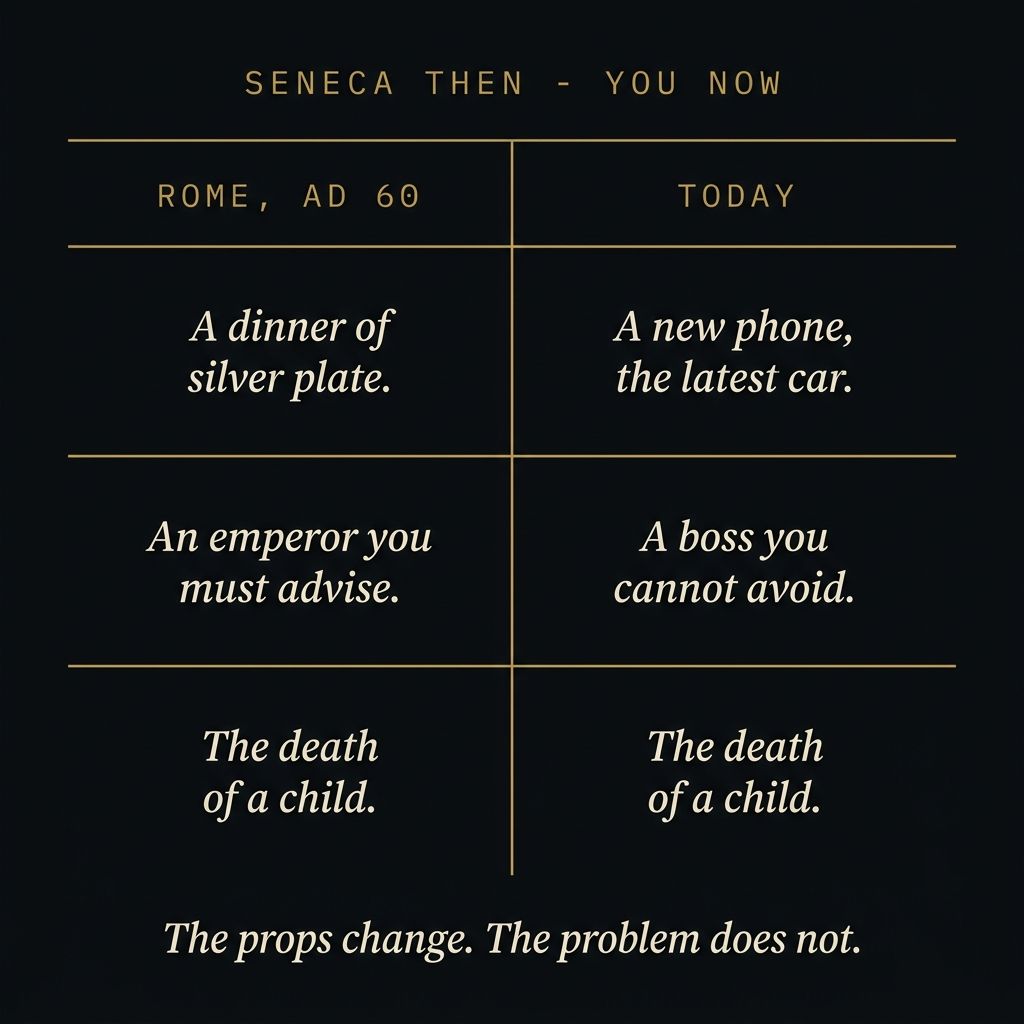
From a consolation letter after the death of a child. It sounds grim, and is. But the logic is liberating: if the sorrow is universal, your share of it is not a personal indictment.
Quote 28
“Calamity is virtue’s opportunity.”
— On Providence 4
A crisis is the only circumstance in which courage, justice, and temperance get to reveal themselves as real. Good fortune displays none of them; it just lets you coast.
Quote 29
“Nothing happens to the wise person against their expectation.”
— On Tranquillity 13
Not prophecy — preparation. If you have already pictured the loss, the illness, the demotion, their arrival is still painful but is no longer a surprise. See our guide to Stoic techniques for anxiety for the practice.
Quote 30
“The good things of prosperity are to be wished. The good things of adversity are to be admired.”
— Letters 66
A distinction most readers miss the first time. Prosperity offers pleasures; adversity offers character — and the second category is rarer, harder-won, and harder to take away.
10 Quotes on Friendship
Theme 04 · On Friendship
Seneca treats friendship as a trained skill, not an accident. The best lines on it come from Letters 3, 6, 9, and 47 — the last one, on how we treat slaves and subordinates, is the one most readers find most uncomfortable and most useful.
Quote 31
“I am beginning to be my own friend. That is a great gain — such a man will never be alone.”
— Letters 6
Seneca’s quiet definition of self-respect. The person who has become tolerable company to themselves has a foundation no external loss can collapse.
Quote 32
“After friendship is formed, you must trust; before that, you must judge.”
— Letters 3
The only sequence that works. Judging during the friendship corrodes it; trusting before it begins is naiveté dressed up as generosity.
Quote 33
“Associate with people who are likely to improve you.”
— Letters 7
Unfashionably direct. Proximity shapes you, Seneca argues, whether you want it to or not. Choose accordingly.
Quote 34
“Treat your inferior as you would wish your superior to treat you.”
— Letters 47
From the most morally revolutionary letter Seneca wrote — a full argument for treating household slaves with dignity, written in a world that did not require it. The test still works on anyone who reports to anyone.
Quote 35
“Part of the good a good friend does is the thought of them.”
— Letters 55 (paraphrase)
Seneca describes the imagined presence of a good friend as a moral anchor — a quiet test you run on your behaviour. Who would you not want to see you do this?
Quote 36
“If you wish to be loved, love.”
— Letters 9 (citing Hecato)
The shortest answer Seneca gives to the question of loneliness. Initiate. The wiring is that simple; the doing is harder.
Quote 37
“One person’s advice can sometimes save a friend’s life.”
— Letters 25 (paraphrase)
The Stoic case for saying the uncomfortable thing once. Held back, it is cowardice dressed as politeness. Said honestly, it is the highest form friendship takes.
Quote 38
“Recall your courtesy to an enemy, your forgiveness to a friend.”
— On Anger 3.5 (paraphrase)
The asymmetry most of us run is the opposite: courtesy to strangers, short fuses with the people we love. Seneca notices and calls it out.
Quote 39
“A man’s character is revealed in how he treats those who can do nothing for him.”
— After Letters 47
A modern distillation of Letter 47’s argument. The colleague with no power to reciprocate, the stranger whose review you will never see — these are where the real signal lives.
Quote 40
“Let us share our good things as freely as the sun shares its light.”
— Letters 6
Seneca’s closing image for what generosity looks like when it is not transactional. Not because you expect anything back — because the giving is itself the return.
Seneca every morning, in five minutes
Try StoicNow — Free on iOSFree Quiz
Which Stoic Are You?
A 3-minute personality quiz — Marcus, Seneca, Epictetus, or Cato.
FAQ
Who was Seneca?
Lucius Annaeus Seneca (c. 4 BC – AD 65) was a Roman Stoic philosopher, statesman, and playwright. He served as tutor and later advisor to the emperor Nero, was one of the richest men in Rome, and is remembered for Letters from a Stoic — 124 short moral letters written to his friend Lucilius in the final years of his life. Nero eventually forced him to commit suicide in AD 65.
What is Seneca’s most famous quote?
The most widely quoted line from Seneca is: “It is not that we have a short time to live, but that we waste much of it.” It opens his essay On the Shortness of Life and summarises his central practical concern — that time, not money or status, is the resource we treat most carelessly. Most of his best lines return to variations on that theme.
Where do these Seneca quotes come from?
Almost all of them come from two sources: Letters from a Stoic (124 letters written to Lucilius in the 60s AD) and On the Shortness of Life (De Brevitate Vitae, c. AD 49). A few come from shorter essays — On Providence, On Tranquillity, and the consolations. Each quote above includes the specific Letter number or essay so you can check it in any translation.
How is Seneca different from Marcus Aurelius?
Marcus wrote a private journal to himself; Seneca wrote letters designed to teach someone else. The tone differs accordingly. Marcus is terse, often repetitive, arguing with his own weaknesses. Seneca is conversational, warm, literary, and often funny. If Marcus shows you how a Stoic talks to himself, Seneca shows you how one talks to a friend who is struggling. For the companion, see our 50 Marcus Aurelius quotes.
Was Seneca a hypocrite?
This is the most honest question about him. Seneca preached simplicity while amassing a fortune. He advised a tyrant he could not control. His contemporaries criticised him for it, and he was aware of the tension — several Letters (especially 17 and 87) address it directly. The charitable read: his philosophy is better for acknowledging that he was still working on himself. The uncharitable read: he had the luxury to say so.
Which Seneca book should I read first?
Start with On the Shortness of Life (about 40 pages). It is the most compressed statement of his thought and is often the one that converts readers. Then move to Letters from a Stoic — do not read all 124 on your first pass; pick Letters 1, 2, 4, 13, 28, 47, 76, and 101. Our Meditations summary applies the same reading strategy to Marcus Aurelius, if you want the companion piece.

Marcus Adler
Founder & Lead Writer, StoicNow
Marcus Adler is the founder of StoicNow. For over a decade he has applied Stoic philosophy to daily life — testing the practices of Marcus Aurelius, Seneca, and Epictetus against modern problems and translating them into simple, repeatable routines. More about the author →
Further reading