Quick answer
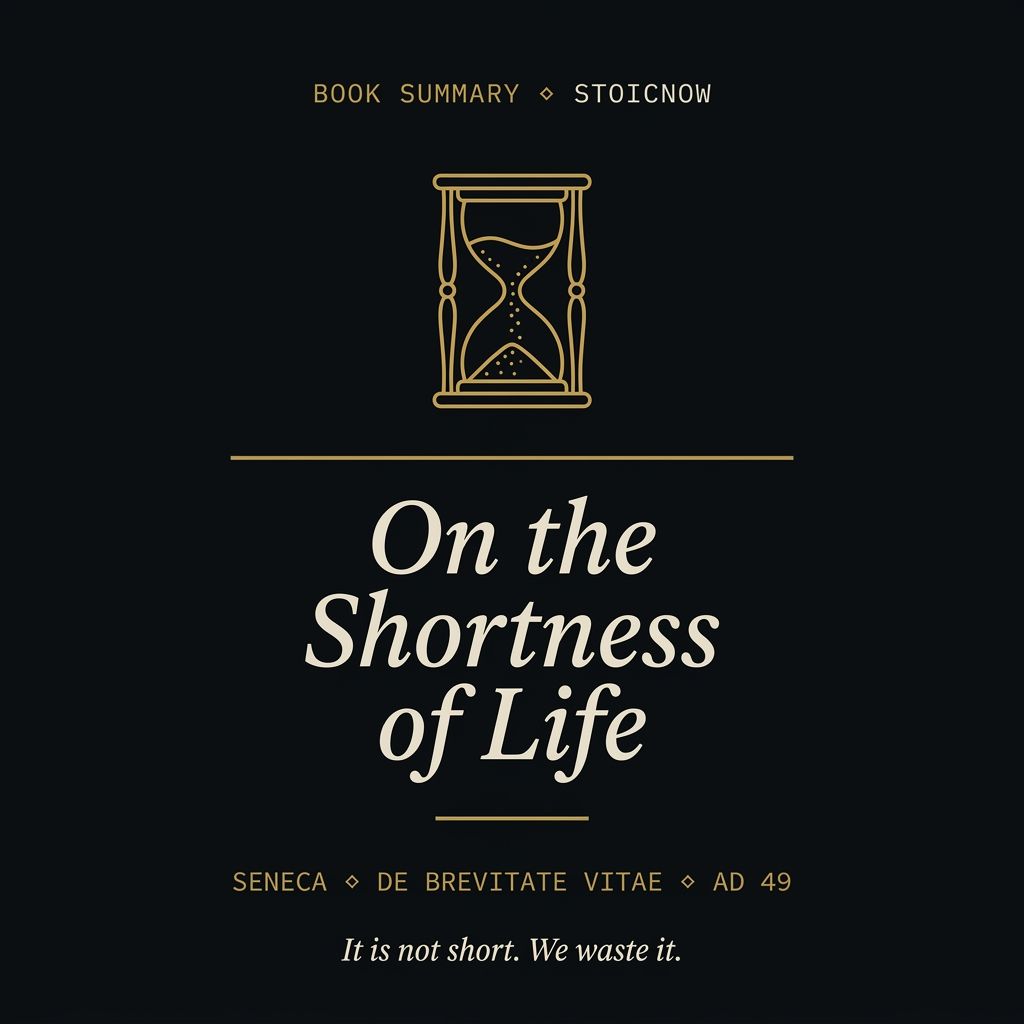
On the Shortness of Life (De Brevitate Vitae) is a short essay by Seneca written around AD 49, addressed to his father-in-law Paulinus, who at the time managed the Roman grain supply. Seneca's argument is simple and uncomfortable: life is not too short.
Life is not too short. We are simply spending it on things that do not matter. That is the whole argument of one of the most uncomfortable essays ever written — and it is only fifty pages long.
Seneca wrote On the Shortness of Life — in Latin, De Brevitate Vitae — around AD 49, addressed to his father-in-law Paulinus, who at the time managed the Roman grain supply. It was not a private letter; Seneca wrote it knowing it would be read. Twenty short chapters. Roughly fifty pages. The single most concentrated argument about time in Western philosophy.
Most readers finish the essay in one sitting and then carry one or two of its lines around for the rest of their life. This guide gives you the central argument, the five specific ways Seneca says we waste our time (with the modern analogue of each), the best passages to read, and a two-week reading plan if you would rather pace it.
What’s inside
What the Book Actually Is
On the Shortness of Life is a single essay, not a collection. Seneca composed it as a long letter to his father-in-law Paulinus, who held one of the most demanding administrative posts in the empire — praefectus annonae, in charge of importing the grain that fed Rome. Seneca’s opening move is the obvious one: Paulinus, you have spent decades counting bushels for other people. When are you going to have a life of your own?
From that personal opening, the essay broadens. Seneca shifts from advising Paulinus to addressing the reader, and the reader is everyone — the senator buried under clients, the wealthy man supervising his slaves polishing silver, the philosopher who postpones living until the next decade. The argument applies to all of them, equally, and Seneca is unusually willing to name it without softening.
The text is 20 short chapters. Modern paperback editions run 50 to 70 pages. A focused reader finishes it in a single afternoon. The Penguin Great Ideas edition is the most common entry point.
The Central Argument
Seneca’s thesis is in the opening paragraph and never wavers:
“It is not that we have a short time to live, but that we waste much of it. Life is long enough, and a generous amount has been given to us for the highest achievements, if it were all well invested.”— De Brevitate Vitae 1
The book’s sharpness comes from how Seneca frames the problem. Most people, he observes, treat their property carefully and their hours carelessly. They lock their possessions in chests and let strangers consume their afternoons. They negotiate ruthlessly over money and give away whole decades on impulse. The supply of time, Seneca argues, is not the issue. The accounting is.
The corrective is also simple: take ownership of time the way you take ownership of money. Notice who is taking it. Refuse to grant any more than you would grant a bag of coins. And start the real life now, not at retirement — because the retirement most people are waiting for arrives at the funeral.
5 Ways You’re Wasting Your Life
Seneca lists more than five categories of time-waste in the essay, but five recur most often. Each one was a recognisable Roman type in AD 49 and is a recognisable modern type now. The props change. The mechanism does not.
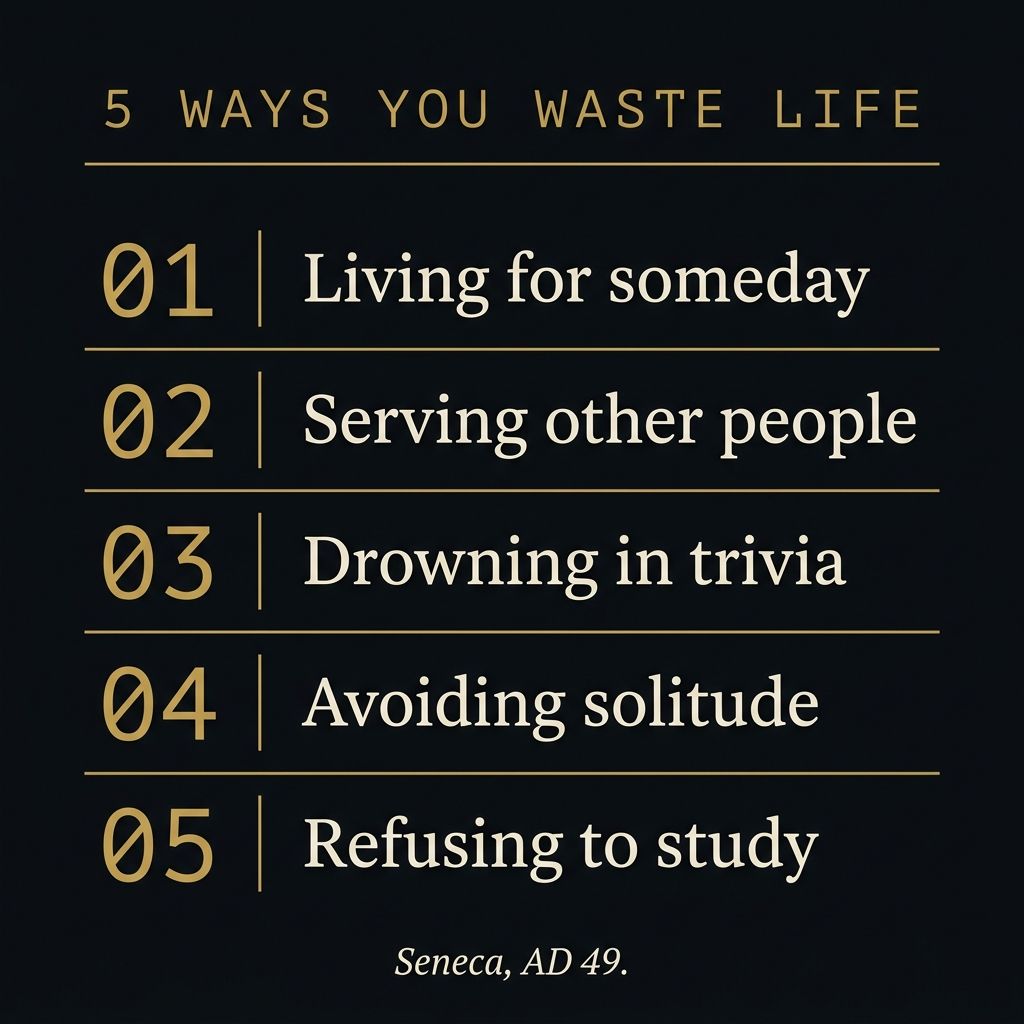
Living for Someday
The Roman who was always one promotion, one estate, one campaign away from his real life. Senators planning their retirement villas in Campania while losing their actual fifties to other people’s requests.
The career version: once I get the title, once the kids are older, once we hit the round number in the bank. The actual life is permanently postponed to a phase that arrives older, sicker, and shorter than the projection said it would.
“Begin at once to live, and count each separate day as a separate life” (echoed in Letters 101). Live the day you are in, not the day you are planning to arrive at. Anchored by memento mori.
Serving Other People
The patron whose entire morning was consumed by clients waiting in his atrium for favours, the senator obliged to attend dinners he despised, the lawyer pleading cases he did not believe in. Every one of them, Seneca says, treats his time like a resource that belongs to anyone who asks for it.
The calendar full of meetings nobody requires; the “quick chats” that close the morning; the email that demands a response by end-of-day for no reason. You did not budget the hours; they were spent on your behalf.
Begin saying no. The Stoic frame: every yes is a no to something else, and the something else is usually your own life. Seneca: nobody would let strangers walk in and steal a few coins, yet most people happily let them walk in and steal an afternoon.
Drowning in Trivia
Chapter 12 is the most savage page in the book. Seneca lists, with visible contempt, the ways Romans wasted hours: the man with fifty hairdressers, the man who could not eat unless his food was arranged by colour, the man who employed staff to remember the names of his guests for him.
The endless feed; the optimisation of optimisation; the apps for organising the apps. Seneca would recognise the pattern instantly — the same human compulsion to fill the day with sensation rather than substance, dressed in 2026 packaging.
An hourly inventory: ask, this hour, what did I actually do? If the honest answer is “scrolled,” “managed inboxes,” or “rearranged a list of things I will never do,” you have just found Chapter 12 in your own week.
Avoiding Solitude
The Roman who could not stand to be alone with himself. He filled his villa with guests, his evenings with theatre, his ears with music — not for the love of any of it, but because silence with himself was unbearable. Seneca’s diagnosis: a person who cannot stand his own company has not done the work of becoming someone worth keeping company with.
Headphones in for every walk. The phone reached for at the first second of stillness. The TV on to no one. The compulsion to escape the room you are in — and, behind it, the room in your head.
Practised solitude. Ten minutes daily, no input. Seneca’s point is not that solitude is virtuous on its own — it is that you cannot do the work of becoming yourself without it.
Refusing to Study
The Roman who never sat down with the great writers — not because they were unavailable, but because he was always too busy. Seneca calls this the saddest waste of all: a person too occupied to be in conversation with Socrates, Zeno, or Cicero, all of whom would gladly have given him their afternoon.
The book on the shelf you have been meaning to read for nine years. The hour each evening that could be philosophy and is instead something forgettable. Seneca’s observation: the great minds are never busy. They are waiting on your shelf for whenever you decide to show up.
One serious book, one chapter per night. Marcus, Seneca, Epictetus — pick one and start. See our Meditations summary and Letters from a Stoic summary for entry points.
The Math: How Many Weeks Are Left
Seneca did not have actuarial tables. We do. The numbers are bracing.

A 78-year life
weeks
If you are 30, roughly 1,560 are spent. About 2,500 remain. Of those, perhaps 1,200 will be lived in good health and full energy.
Seneca’s argument compresses into a single sentence when you put it next to those numbers: you do not have time to be casual about how you spend your weeks. There is no second draft, no reset button, no later phase that is going to be more available than this one. If you want a longer treatment of the visualisation, see our memento mori calendar — the same exercise, more interactive.
Best Passages to Mark
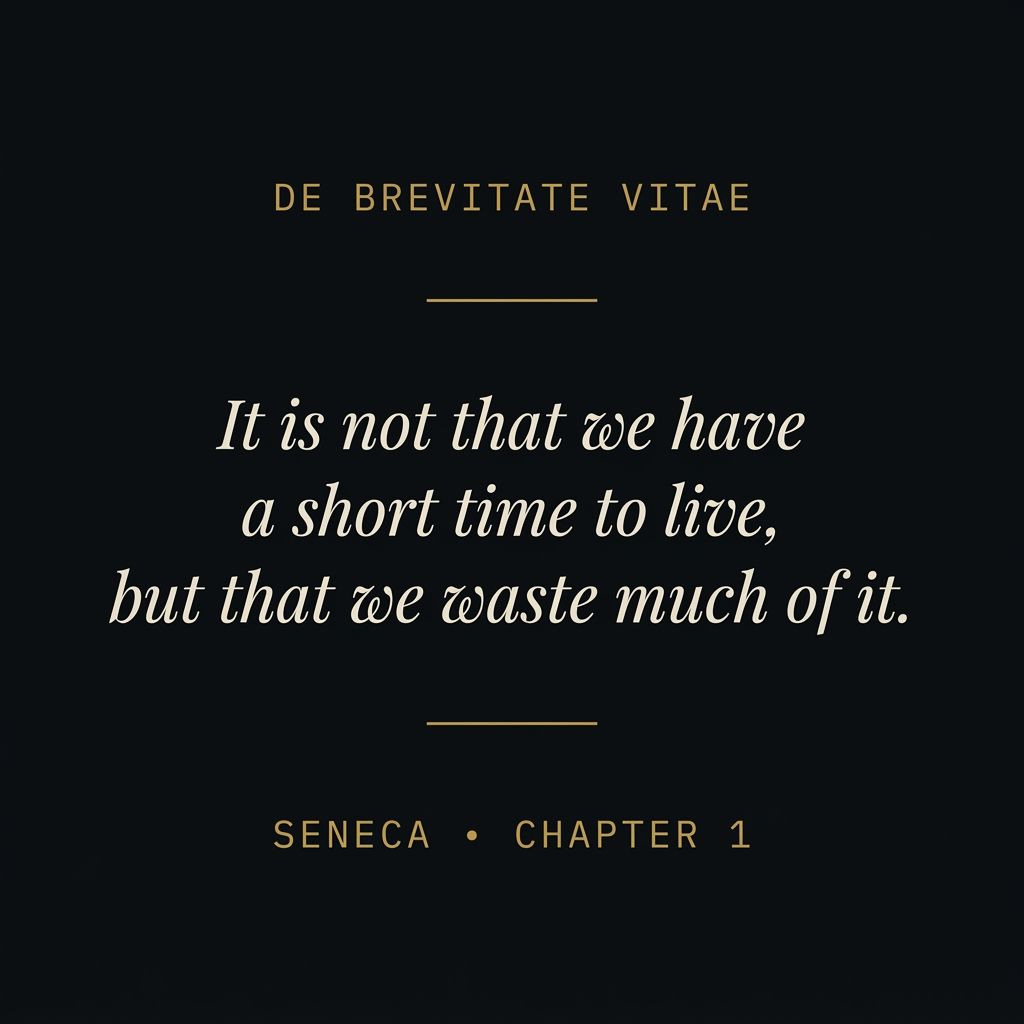
If you are pressed for time and want only the lines that matter, mark these. Each is from a different chapter, and together they give you the spine of the essay.
“It is not that we have a short time to live, but that we waste much of it.”— Chapter 1
“You act like mortals in all that you fear, and like immortals in all that you desire.”— Chapter 3
“No one will give you back your years; no one will return you to yourself.”— Chapter 8
“The whole future lies in uncertainty: live immediately.”— Chapter 9
“Life is divided into three periods, past, present, and future. Of these, the present is short, the future doubtful, the past certain.”— Chapter 10
“Will anyone dare to barter life for money?”— Chapter 3
If you want a fuller selection of Seneca’s sharpest lines from across his work, see our 40 Seneca quotes guide — ten of them are pulled directly from this essay.
How to Actually Read It
The essay is short enough to read in a single sitting — many people do, and never quite re-open the book again. A more useful approach: pace it across two weeks, one or two chapters per night, with a notebook open. The argument compounds, and you give the lines time to land.
Which translation
| Translation | Year | Format | Best for |
|---|---|---|---|
| C. D. N. Costa (Penguin Great Ideas) | 2004 | Slim paperback, ~110 pp incl. extras | First-time readers. The default. |
| John Davie (Oxford World’s Classics) | 2007 | Bundled with On Tranquility & On the Happy Life | Readers who want the related dialogues too. |
| Aubrey Stewart (public domain) | 1900 | Free online, Edwardian English | Skip on first read. Use later for comparison. |
A two-week reading plan
- Days 1–3: Chapters 1–5. The central argument and the diagnosis.
- Days 4–7: Chapters 6–10. The five wastes laid out, with examples.
- Days 8–11: Chapters 11–15. The deeper analysis: why we cannot stand solitude, why we mistake busyness for life.
- Days 12–14: Chapters 16–20. The corrective: study, philosophy, and the only real possession of time.
Read with a pen. Mark one line per chapter. The marked lines are the part of the book you will return to.
Don’t waste this week
Try StoicNow — Free on iOSFree Tool
Your Life in Weeks
See exactly how many weeks you have left — a Memento Mori calculator.
FAQ
What is On the Shortness of Life about?
On the Shortness of Life (De Brevitate Vitae) is a short essay by Seneca written around AD 49, addressed to his father-in-law Paulinus, who at the time managed the Roman grain supply. Seneca’s argument is simple and uncomfortable: life is not too short. Most people simply spend it on things that do not matter — chasing wealth, serving the powerful, drowning in trivia, deferring real living to a someday that never arrives.
How long is On the Shortness of Life?
The essay is 20 short chapters, roughly 50 to 70 pages depending on the edition. A focused reader can finish it in a single sitting of two to three hours. Most people, however, get more from it by reading one or two chapters per evening over two weeks — the argument compounds, and pacing the read mirrors what the book is actually telling you to do.
What is the main argument of On the Shortness of Life?
Seneca argues that life is long enough if you live it well — the problem is not the supply of time but how we spend it. Most people, he says, treat their wealth carefully and their hours carelessly; they postpone the real life until retirement, then die before it arrives. The corrective is to take ownership of time as the only resource you actually own and start the real life now.
What is the most famous quote from On the Shortness of Life?
The opening line: “It is not that we have a short time to live, but that we waste much of it.” The whole book is essentially an extended argument for that one sentence. Other often-cited lines include “You act like mortals in all that you fear, and like immortals in all that you desire” (Chapter 3) and “Begin at once to live” (echoed in Letters 101).
Which translation of On the Shortness of Life is best?
The Penguin Great Ideas edition (translated by C.D.N. Costa) is the standard short paperback most readers start with. John Davie’s Oxford World’s Classics translation is more scholarly and includes the related dialogues On Tranquility and On the Happy Life. Avoid the free Aubrey Stewart 1900 translation as your first read — the prose is heavy. Costa is the entry point.
Should I read On the Shortness of Life or Letters from a Stoic first?
Read On the Shortness of Life first. It is shorter, sharper, and gives you Seneca’s central worldview in 50 pages. Letters from a Stoic is the long-form expansion — 124 letters that elaborate the same ideas across years of correspondence. Most readers who enjoy the short book go on to the Letters; many who try the Letters first stall before they get the core argument.

Marcus Adler
Founder & Lead Writer, StoicNow
Marcus Adler is the founder of StoicNow. For over a decade he has applied Stoic philosophy to daily life — testing the practices of Marcus Aurelius, Seneca, and Epictetus against modern problems and translating them into simple, repeatable routines. More about the author →
Further reading