Quick answer
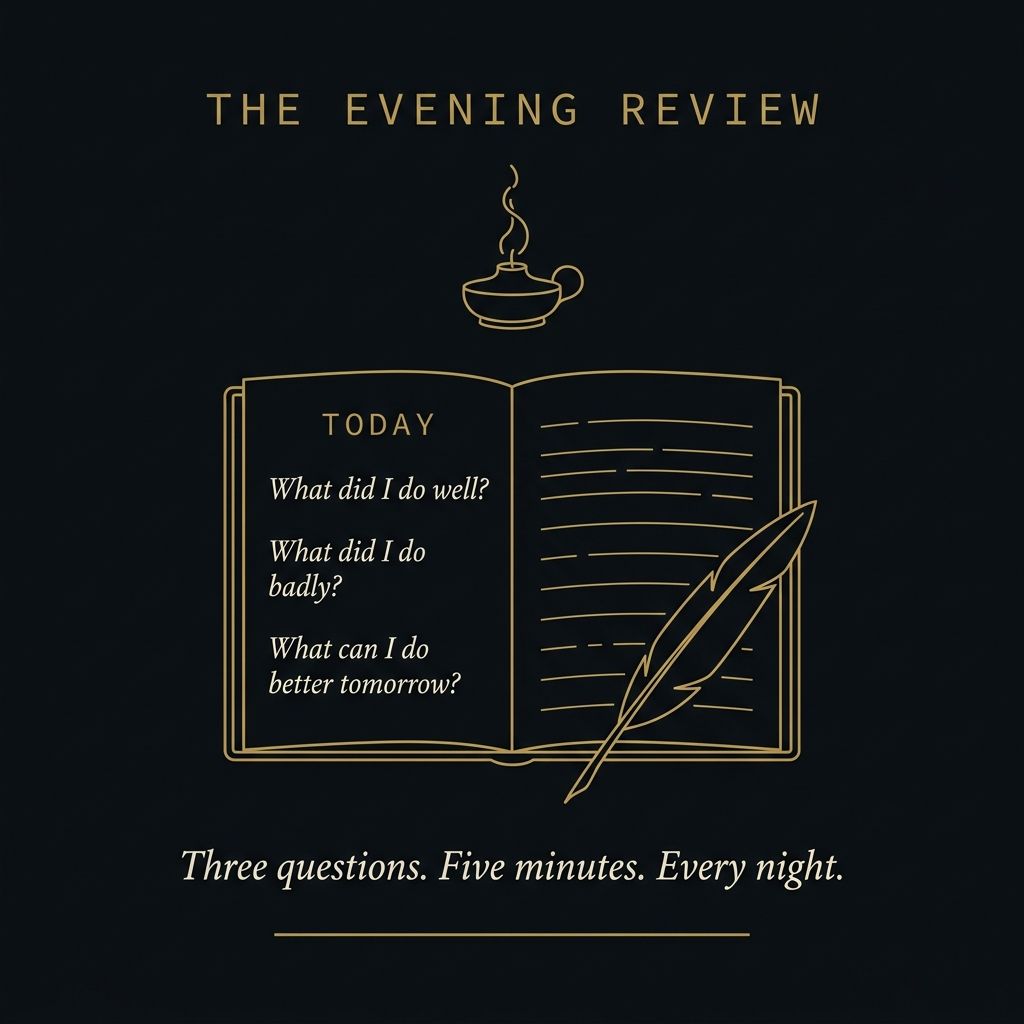
Stoic journaling is a short daily written review of your own judgments and actions, measured against Stoic principles. Each entry asks what happened, what was in your control, what you did, and what you would do differently. Five minutes in the evening is enough.
Most journaling advice says to write down how you feel. The Stoics asked a harder question: what did you do today, and was it right? Stoic journaling replaces open-ended venting with a short, honest audit of your own conduct, and it is one of the few ancient practices we can trace to a specific habit of a specific man.
That man is Seneca, who reviewed his day each night and called himself to account. This guide covers what Stoic journaling is, where it comes from, a morning-midday-evening rhythm, a five-minute template with a worked example, and the mistakes that turn it into a diary.

What Stoic Journaling Actually Is
Stoic journaling is the habit of writing a brief, structured review of your own judgments and actions. The unit of analysis is not your mood. It is your conduct: what you assumed about a situation, what you did about it, and whether that matched the person you are trying to be.
The sorting tool is the one Epictetus opens his Enchiridion with: “Some things are up to us and some are not” (Enchiridion 1.1). Your opinions, choices, and efforts are up to you. Other people’s behavior, your reputation, and the outcome of a negotiation are not. A Stoic journal entry applies that split to one real event from your day, which is why it pairs naturally with the dichotomy of control.
Three features separate it from ordinary journaling:
- It is evaluative. You judge your judgments. A feeling is recorded as data, then questioned.
- It is short. A few lines, on purpose. Length invites rumination.
- It ends in action. Every entry closes with one concrete adjustment for tomorrow.
Where It Comes From: Sextius, Seneca, and Marcus
The clearest ancient source is Seneca’s essay On Anger. In Book 3, section 36, he describes a practice he attributes to the Roman philosopher Sextius: at the end of each day, before sleep, Sextius questioned his own mind. In the standard English renderings, the questions run roughly: What fault have you cured today? What vice have you resisted? In what respect are you better?
Seneca then says he does the same. When the lamp is out and his wife has fallen silent, he goes over the whole day and weighs what he said and did. His rule is strict about visibility and gentle about punishment:
“Why should I fear any of my errors, when I can say: ‘See that you do not do that again; this time I pardon you’?” — Seneca, On Anger 3.36 (one common translation)
Notice what is and is not in that passage. It is a review, not a confession. The aim is a corrected habit, not guilt. Seneca returns to the daily accounting in his letters to Lucilius, where he describes examining how each day has gone (see Letters from a Stoic for the best starting points).

Marcus Aurelius adds the morning half. His Meditations open Book 2 with a rehearsal: he tells himself he will meet meddling, ingratitude, arrogance, and ill will that day, and that these people act this way out of ignorance of good and bad (Meditations 2.1). That is preparation, not reflection. Epictetus supplies the instruction to make it a habit. He tells his students that these are thoughts to keep at hand, to write down, and to practice (Discourses 3.24.103).
A caution on Marcus. The Meditations are private, undated notes he wrote to himself. They show Stoic exercises in action, but they are not a diary you can copy line by line. For more on the man and the book, see our summary of the Meditations.
The Three Entries: Morning, Midday, Evening
Seneca documented the evening review. The morning rehearsal comes from Marcus. The midday pause is a modern synthesis built from the Stoic idea of attention, and it is optional. Together they make a light rhythm you can run in under ten minutes a day.
If you only do one, do the evening. It is the best documented, and it has real material to work with: an actual day rather than a forecast. The Stoic evening reflection guide covers Seneca’s method in more detail.
A Five-Minute Evening Template
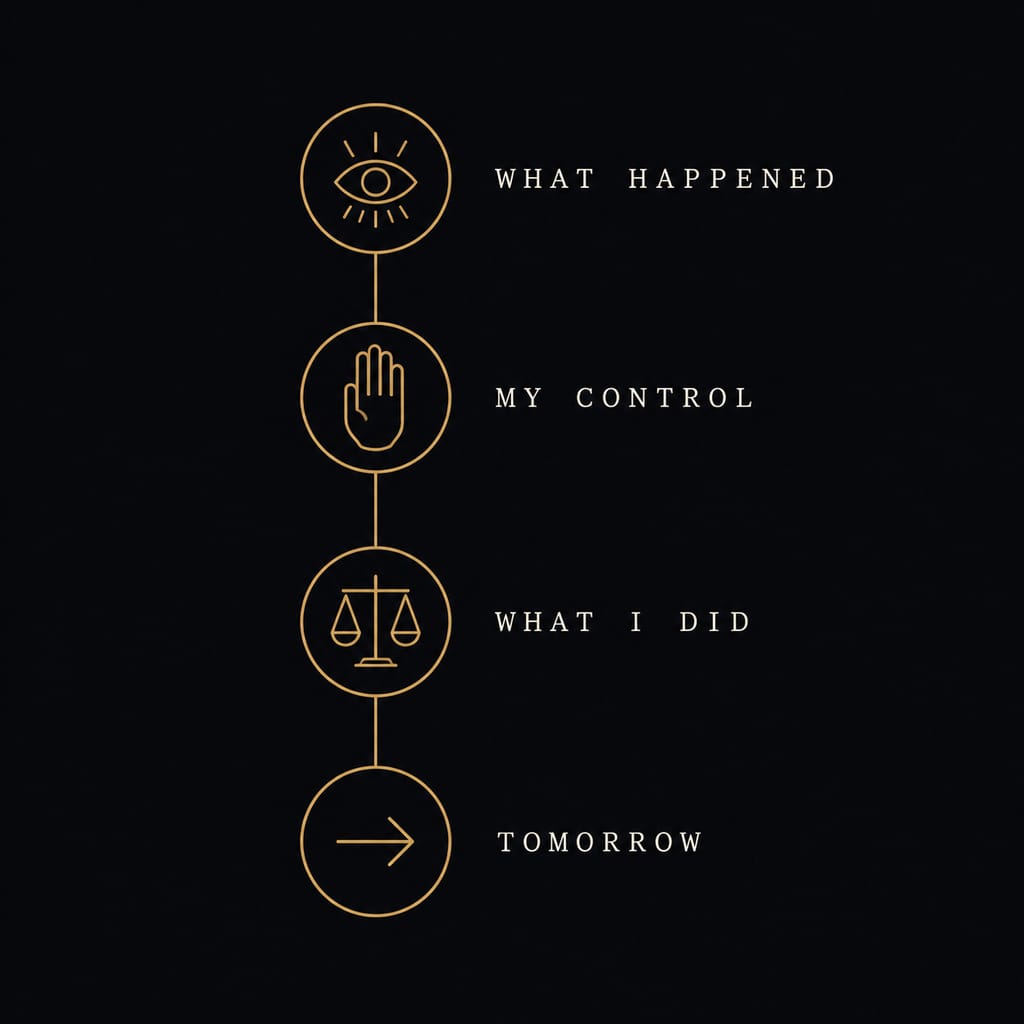
Pick one event from the day, preferably one where you felt friction. Then answer five questions in a sentence or two each.
- What happened? Facts only, as a neutral observer would record them.
- What did I assume? The judgment you attached to the facts. This is where most distress lives.
- What was up to me, and what wasn’t? Sort it into two short lists.
- What did I actually do? No flattering edits.
- What will I do differently tomorrow? One specific, small action.

A worked example
Here is what a real entry looks like. It is deliberately ordinary.
Happened: In the team meeting, a colleague presented my analysis as part of his slide and didn’t name me.
Assumed: “He did it on purpose to look good. He doesn’t respect me.”
Up to me: whether I raise it, how I word it, my own record of the work. Not up to me: his motives, what the room concluded.
Did: Sent a clipped email within ten minutes. It read as angry.
Tomorrow: Wait an hour before sending anything. Ask him in person to credit the analysis next time.
Look at what the entry did. It separated the fact from the story (“he doesn’t respect me” was an assumption, not an observation), identified the one lever the writer actually holds, and admitted the mistake without drama. That is the whole method. If you want ready-made questions to rotate through, our 25 Stoic journal prompts cover anger, ambition, grief, and more.
What Stoic Journaling Is Not
Because the practice looks like ordinary journaling from the outside, it gets bent into things the Stoics never recommended. Three common distortions:
Misconception 01
“It’s a feelings diary.”
Misconception 02
“Marcus Aurelius journaled, so I should write like the Meditations.”
Misconception 03
“The review is self-punishment.”
Watch for rumination. If you are rewriting the same grievance for the third night, the entry has stopped being an audit. Cap it at a few lines, finish with the tomorrow action, and close the notebook. The goal is to stop thinking about it, not to think about it on paper.
Where It Fits in a Stoic Practice
Journaling is not the whole of Stoicism. It is the exercise that checks whether the others are working. The historian Pierre Hadot argued in Philosophy as a Way of Life that ancient philosophy was practiced as a set of spiritual exercises, and that reading Epictetus this way reveals three disciplines: how you desire and avoid (Discourses 3.2 sets out all three), how you act, and what you assent to as true.
An evening entry maps onto each one almost by accident. “What did I want from that meeting?” is the discipline of desire. “What did I do?” is the discipline of action. “What did I assume?” is the discipline of assent. A page that touches all three has done real Stoic work, even if it took five minutes.
The practical order for a beginner is simple. Start with the evening review for two weeks, and add the morning rehearsal once the habit holds. Treat the rest of the daily exercises as a separate layer you add later. For the wider toolkit, the Stoic virtues are the standard you are measuring your conduct against, and the larger set of exercises sits alongside this one.
The honest expectation is modest. You will not feel transformed after a week. You will notice, probably around the second week, that you catch your own assumptions a few seconds earlier than before. Seneca would have called that progress, and he never claimed more than that for himself.
“As long as you live, keep learning how to live.” — Seneca, Letters 76
Run your evening review in StoicNow
Join the WaitlistFree Quiz
Which Stoic Are You?
A 3-minute personality quiz — Marcus, Seneca, Epictetus, or Cato.
FAQ
What is Stoic journaling?
Stoic journaling is a brief written practice in which you examine your own judgments, reactions, and actions against Stoic principles. Instead of recording feelings for their own sake, you ask what was in your control, what you got right, and what you would change. Its closest ancient model is Seneca’s nightly self-review in On Anger 3.36.
How do you start a Stoic journal?
Start with one notebook and one fixed set of evening questions: What did I do well today? Where did I act against my values? What was up to me, and what wasn’t? Spend five minutes, write plainly, and stop. Add a morning line later if the evening habit holds. Consistency matters more than length or format.
Should you journal in the morning or the evening?
Both work, and the Stoics used both. Evening review follows Seneca’s example in On Anger 3.36 and checks the day’s actions. Morning writing follows Marcus Aurelius’s habit in Meditations 2.1 of anticipating difficult people and choices. If you can only manage one, start with the evening, because you have real material to examine.
How long should a Stoic journal entry be?
Five minutes and a few lines is enough. A useful entry names one event, separates what was in your control from what wasn’t, and ends with one concrete adjustment for tomorrow. Long entries tend to drift into rumination, which is the opposite of the goal. A short entry written daily beats a long one written weekly.
Did Marcus Aurelius keep a journal?
Not exactly. The Meditations were private notes Marcus wrote to himself (the traditional Greek title means roughly ‘to himself’), and they read as philosophical exercises rather than a dated diary of events. They show the method: rehearsing principles, reminding himself of duties, and correcting his own habits of judgment. They were almost certainly not written for publication.
How is Stoic journaling different from regular journaling?
Regular journaling often aims at expressing and processing feelings. Stoic journaling adds an evaluative step: you test your judgments, sort what was in your control from what wasn’t, and commit to a corrected action. It is closer to an audit than a diary, though it doesn’t ban emotion. Noting what you felt is useful data.

Marcus Adler
Founder & Lead Writer, StoicNow
Marcus Adler is the founder of StoicNow. For over a decade he has applied Stoic philosophy to daily life — testing the practices of Marcus Aurelius, Seneca, and Epictetus against modern problems and translating them into simple, repeatable routines. More about the author →
Further reading