
Quick answer
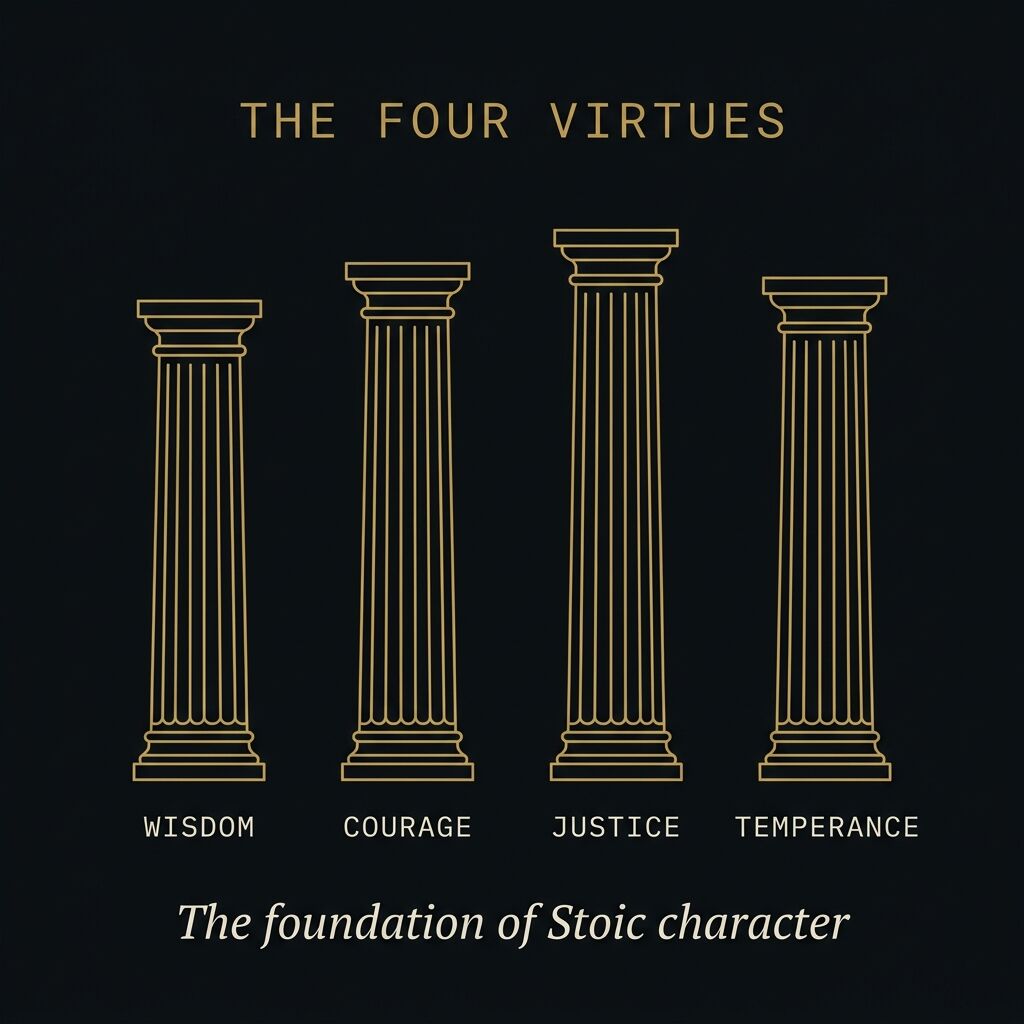
The four Stoic virtues are wisdom (phronesis), courage (andreia), justice (dikaiosyne), and temperance (sophrosyne). The Stoics held these to be the only true goods — everything else, money, health, reputation, is preferred indifferent, valuable but not sufficient for a good life. The virtues function as a single character expressed in four directions.
For the Stoics, the four virtues were not personality traits or aspirational goals. They were the whole of ethics — the only things worth calling truly good.
Everything else — money, health, reputation, long life — the Stoics called preferred indifferents. Worth pursuing, but not sufficient for a good life. Not good in themselves. Only virtue, they argued, is good without qualification, in every circumstance, for every person. Seneca wrote it plainly in Letters 85: “Virtue is the only good.”
The four Stoic virtues — wisdom, courage, justice, and temperance — were not invented by the Stoics. They inherited them from Plato and refined them into something harder-edged and more practical. Plato used them to describe the ideal city. The Stoics used them to describe the ideal moment: what to do right now, in this situation, with these constraints.
Most explanations treat them as abstract ideals. They were always meant as decision tools.
The Four Stoic Virtues at a Glance
Here is the complete picture. Every section below unpacks one row of this table with real examples and a daily practice you can start today.
| Virtue | Definition | Real-life example | Daily exercise |
|---|---|---|---|
| WisdomPhronesis | Knowing what actually matters — and what doesn’t | Choosing not to escalate an argument you could win | Before deciding: “What actually matters here?” |
| CourageAndreia | Acting rightly despite fear, discomfort, or social cost | Telling your manager the project is off track | Do one thing today you have been avoiding |
| JusticeDikaiosyne | Treating every person fairly, as a fellow rational being | Giving honest feedback instead of flattery | One fair act toward someone who irritates you |
| TemperanceSophrosyne | Taking the right amount — of food, speech, reaction, attention | Stopping a conversation before it tips into lecture | Name one excess today; cut it by half |
Wisdom: Knowing What to Do Right Now
Wisdom is the master virtue. The Stoics used two Greek words for it: sophia (theoretical understanding of what is good) and phronesis (practical judgment about what to do in this moment). Phronesis is the one they cared about most. You could memorize every page of Meditations and still lack it.
People conflate wisdom with intelligence, or worse, with book knowledge. Plenty of brilliant people make terrible decisions — they know a lot but can’t judge what matters. Stoic wisdom is a sorting function: of everything demanding your attention right now, what actually matters?
Epictetus described wisdom in Discourses 3.1 as knowing “what to choose, what to avoid, and what to be indifferent to.” Three categories. Most of what stresses us falls into the third.
Example 01
The argument you could win
Your colleague makes a factually wrong claim in a meeting. You know the correct answer. Wisdom doesn’t mean staying silent — it means asking whether correcting them publicly does any good. Sometimes it does. Often, a quiet word afterward costs less and accomplishes more. Wisdom is recognizing which situation you’re in.
Example 02
The career decision with no clear answer
A higher-paying job offer arrives. Wisdom cuts through the salary number and asks: what do I actually value, and does this offer more of it? Marcus Aurelius, who ran an empire, wrote in Meditations 6.2 about distinguishing what is truly good from what merely appears good. Salary appears good. What it finances may or may not be.
Example 03
Information overload
You have 47 open browser tabs, three podcasts queued, and two newsletters unread. Most incoming information is noise dressed as signal. The Stoics called these phantasiai — impressions demanding your attention. Before opening another tab, ask: “Is this something I can use, or am I avoiding the harder work of thinking?”
Daily practice
The Three-Question Sort
Before any significant decision — how to respond to an email, whether to take on a project, how to handle a conflict — pause and run three questions: What actually matters here? What am I tempted to confuse with what matters? What would I regret focusing on? Five seconds. The habit builds the reflex.
Courage: The Virtue People Get Wrong Most Often
Courage has an image problem. Most people picture physical bravery — running into a burning building, fighting on a battlefield. The Stoics didn’t disagree that physical bravery takes courage. They just thought it was the least interesting case.
Stoic andreia covers every situation where doing the right thing costs something: social approval, comfort, an easy life, a comfortable illusion. Marcus Aurelius in Meditations 5.1 writes about the courage required simply to get out of a warm bed and do your work. That is not metaphor. He meant it literally. The Stoics believed small courageous acts trained the character for larger ones.
Courage goes with wisdom for a reason: without wisdom, courage is just recklessness. A soldier who charges into an unwinnable battle and serves no purpose isn’t courageous; he’s foolish. Courage is knowing the cost and paying it anyway — because you’ve already decided it’s worth it.
Example 01
Telling the truth in a meeting where no one else will
The project is behind schedule. Everyone in the room knows it. No one says it. Courage is naming the problem clearly — not aggressively, not as a performance — because clarity serves the group even when it creates discomfort. This is moral courage. It costs social capital. The Stoics would say it is the only choice consistent with virtue.
Example 02
Ending a relationship that no longer serves either person
Staying in a friendship or relationship out of inertia or guilt isn’t kind. It’s cowardice disguised as consideration. Courage is having the honest conversation, accepting the pain it causes, and trusting that both people are better served by honesty than by comfortable avoidance. This connects to the dichotomy of control — you can control your honesty, not their reaction.
Example 03
Sitting with grief instead of numbing it
When something genuinely bad happens — a death, a failure, a diagnosis — the culturally available options are to either perform strength or drown in distraction. The Stoic approach, described in Seneca’s Consolations, is a third path: feel the grief fully, acknowledge it as appropriate, and refuse to let it become the whole of your identity. That takes courage. Most people choose the distraction.
Daily practice
One Avoided Thing
Each morning, find one thing you’ve been avoiding. Not a project — one specific act. Send the difficult message. Make the call. Say the thing you’ve been not-saying. Do it before noon. The Stoics called this askesis: deliberate practice of the uncomfortable. Over weeks it rewires your relationship with discomfort.

Justice: Your Obligation to Everyone, Not Just Your People
Of the four Stoic virtues, justice is the most misread. Most people bring a punitive frame to the word: wrongdoers face consequences, courts are fair, equality before the law. The Stoics meant something nearly opposite: your active obligation toward every person you encounter, whether they’ve earned it or not.
The Stoics took cosmopolitanism seriously: they believed in a universal community of rational beings. As Marcus wrote in Meditations 11.18, each time he encountered a difficult person, he reminded himself that they were part of the same rational whole — that dealing with them unjustly was an injury to that whole, and ultimately to himself. Justice was not charity. It was recognition of a shared nature.
This is why Epictetus — a slave — became one of the Stoics’ most important voices on justice. His whole philosophy rests on one claim: what happens to you doesn’t determine what you are. His master could break his leg. He could not touch what Epictetus was.
Example 01
Honest feedback instead of comfortable agreement
A friend shows you their business plan. It has a serious flaw. Telling them what they want to hear is easier and feels kind. Stoic justice requires giving them what they need — an honest assessment, delivered with care, that lets them make an informed choice. Flattery treats the other person as someone too fragile for the truth. That is not respect. It is a form of contempt.
Example 02
Treating the service worker the same as the CEO
People tend to adjust their behavior based on status — more patient with important people, more dismissive with those they consider beneath them. The Stoics considered this a failure of justice. Marcus Aurelius governed an empire and wrote about how to treat those around him with fairness regardless of rank. The kitchen staff mattered as much as the senators. This is not sentiment. It is a logical consequence of the Stoic view that reason is universal.
Example 03
Acknowledging your mistake rather than deflecting
When something goes wrong in a collaboration, the temptation is to explain why the situation was complex, why your contribution was minor, why others were equally responsible. Justice means taking your share — exactly your share, not more, not less — without the theatrical self-flagellation that is really just another form of attention-seeking. Clean acknowledgment. Then correction.
Daily practice
The Fair Witness
Pick one person each day who irritates you — a difficult coworker, a demanding family member, someone in traffic. Before reacting, apply one question: What would I think of this behavior if a stranger did it? This strips out the history, the resentment, the accumulated grievances, and lets you respond to what is actually happening. Justice requires seeing clearly before acting.
Temperance: The Virtue Nobody Talks About
Temperance gets the least attention in popular Stoicism. Ryan Holiday’s framing tends toward bold action and resilience — and temperance sounds like restraint, which sounds like timidity. It isn’t.
Stoic sophrosyne is not abstinence. The Stoics were not Cynics. They did not believe you had to strip life bare of pleasure, comfort, or beauty. Seneca drank wine and lived well. Marcus Aurelius ate meat and enjoyed hot baths. The Stoic position was more precise: right amount, right time, right reason. Not none — enough.
Temperance is the virtue that governs all the others. Without it, wisdom becomes pedantry, courage becomes aggression, justice becomes self-righteous excess. Temperance is the internal governor that keeps character from tipping into its distorted form.
Example 01
Stopping the conversation before it becomes a lecture
You know something relevant. You say it. Then you say it again with slightly different words. Then you add a supporting point, and then the historical context, and then an example. You have crossed from communication into performance. Temperance is knowing when enough has been said. This is one of the most socially difficult expressions of the virtue — and one of the most important.
Example 02
The second drink you didn’t need
Seneca wrote in Letters 88 that temperance makes the other virtues possible. In practice: the second drink is not the problem. Reaching for it out of anxiety, boredom, or social reflex — without awareness — is. Stoic temperance is the pause between impulse and action: Do I actually want this, or am I reacting? That pause is the whole practice.
Example 03
Reacting proportionally to bad news
Your flight is delayed. Your laptop crashes. A project gets reassigned. Each of these is genuinely inconvenient. None of them warrants the full weight of a catastrophic reaction. Stoic temperance applied to emotional response means: feel the frustration proportionally — not suppressed, not amplified. A two-minute problem deserves a two-minute reaction. Temperance is the volume knob on your inner life.
Daily practice
Name One Excess
Each evening, identify one area where you took more than the situation required — more food, more screen time, more talking, more reaction, more worry. Name it specifically. Tomorrow, cut that one thing by half. Not elimination: moderation. The Stoics believed that practicing voluntary restraint in small things built the capacity for restraint in large things. This is the same logic as Stoic daily practice generally — consistency over intensity.
Why You Cannot Have One Without the Others
The Stoics taught a doctrine known as the unity of the virtues: the four are not separate skills. They are four angles on a single character. You cannot genuinely possess one while lacking another.
Take the person with courage but no wisdom: they charge forward whether or not the goal deserves it. That’s recklessness. The person with wisdom but no courage sees what needs doing and does nothing. That is cowardice dressed in self-awareness. The just person without temperance tips into moralism — demanding standards of others they cannot sustain themselves. The temperate person without justice is merely self-contained — orderly and fair to no one but themselves.
This doesn’t mean it’s all-or-nothing. The Stoics recognized prokoptōn — the person making progress. Most of us develop each virtue unevenly, working to close the gaps. Work on one tends to pull the others forward. Practicing temperance makes justice easier; courage without wisdom is the first thing temperance corrects.
When facing a hard choice, you don’t run through the virtues like a checklist. Together they describe a character that knows what matters, acts on it, does right by others, and doesn’t overdo it. One thing, not four. The Stoics just found four ways to talk about it.
The Stoic approach to anxiety draws on all four: wisdom to see what is and isn’t in your control, courage to act despite uncertainty, justice to recognize you are not the only person affected by your decisions, and temperance to keep fear from becoming the loudest voice in the room.
Practice the four virtues — one challenge at a time
Try StoicNow — Free on iOSFAQ
What are the four Stoic virtues?
The four Stoic virtues are wisdom (phronesis), courage (andreia), justice (dikaiosyne), and temperance (sophrosyne). The Stoics held these to be the only unconditional goods — everything else, including money, health, and reputation, is valuable but not sufficient for a good life on its own. The virtues are practical: they function as real-time filters for decision-making, not abstract ideals.
Which of the four Stoic virtues is most important?
The Stoics considered wisdom the master virtue because it governs the use of the other three. Without knowing what actually matters, courage becomes recklessness, justice becomes rigid moralism, and temperance becomes mere habit without purpose. Epictetus and Marcus Aurelius both treat practical wisdom — knowing what to do in this situation — as the foundation everything else rests on.
Are the four Stoic virtues the same as the cardinal virtues?
They overlap substantially. The Christian cardinal virtues — prudence, fortitude, justice, and temperance — were largely inherited from Plato and Stoic philosophy via Cicero. Prudence maps to wisdom, fortitude to courage. The Stoic version differs in being purely rational and natural, rooted in the idea that human beings share a universal reason (logos), rather than depending on theological command.
How did Marcus Aurelius practice the four virtues?
Marcus used the Meditations as a private accountability journal, not a published philosophy. He tested himself against each virtue constantly: questioning whether his decisions were wise, whether he was facing difficult truths with appropriate resolve, whether he treated soldiers, slaves, and senators with equal fairness, and whether he was consuming and reacting with appropriate measure. The book is less a system and more a record of someone trying to close the gap between knowledge and character.
What is the unity of the Stoic virtues?
The Stoics taught that the four virtues are ultimately one character expressed in four directions. You cannot genuinely have any virtue without the others: courage without wisdom is recklessness, justice without temperance collapses into excess, wisdom without courage is passivity. In practice, most people develop the virtues unevenly. The Stoic point is that progress in one naturally supports the others — they are not a checklist but a single orientation toward living well.
Can you practice the four Stoic virtues without being a Stoic?
Yes. The four virtues describe character dispositions that most ethical traditions recognize and value. Before acting, running four checks — Is this wise? Does this require courage? Is this fair to everyone involved? Am I taking more than the situation requires? — applies the framework without any philosophical background. The Stoic contribution is insisting these checks become habitual and non-negotiable, not occasional.

Marcus Adler
Founder & Lead Writer, StoicNow
Marcus Adler is the founder of StoicNow. For over a decade he has applied Stoic philosophy to daily life — testing the practices of Marcus Aurelius, Seneca, and Epictetus against modern problems and translating them into simple, repeatable routines. More about the author →
Further reading