Quick answer
Epictetus (c. 50 – 135 AD) was a Greek Stoic philosopher who was born into slavery in Hierapolis, gained his freedom, and founded an influential Stoic school in Nicopolis. He wrote nothing himself; his teachings survive because his student Arrian recorded them as the Discourses and the Enchiridion (the 'Handbook').
The single most influential idea in practical philosophy — the one that runs through Marcus Aurelius, modern therapy, and every “focus on what you can control” poster ever printed — was first taught by a man who was, for the first decades of his life, legally owned by someone else.
His name was Epictetus. Or rather, that is what he was called — epiktetos is Greek for “acquired,” the kind of word you use for property. He was born a slave and given a slave’s name. He died the most respected teacher in the Roman world, having taught an emperor’s philosophy without ever owning anything worth mentioning.
This is his story, and the origin story of the idea he is famous for — because the two cannot be separated.
A Slave in Nero’s Rome
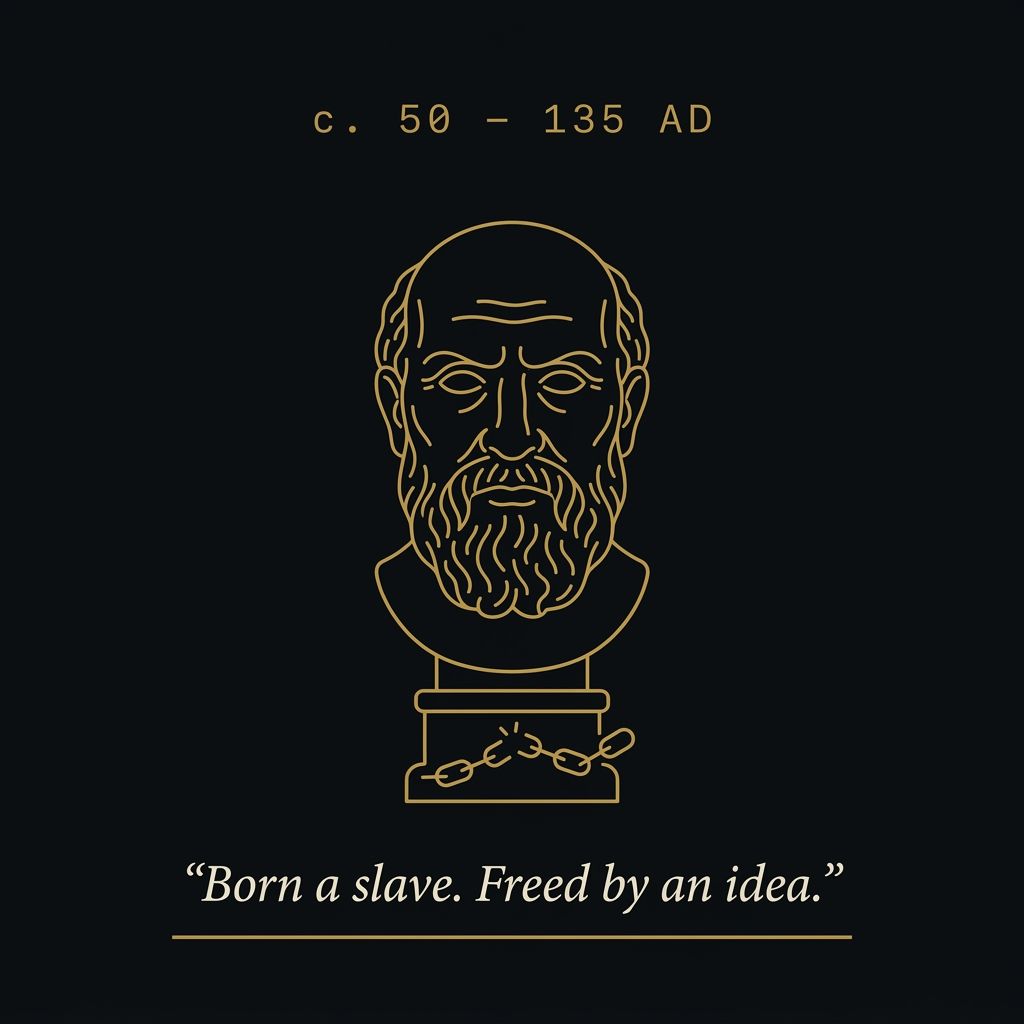
Epictetus was born around 50 AD in Hierapolis, in Phrygia (modern Turkey). By his youth he was enslaved in Rome, owned by Epaphroditus — himself a freedman, and a powerful administrative secretary to the emperor Nero. So Epictetus grew up at the bottom of a household that sat near the top of the most powerful court on earth: close enough to power to see exactly how little it had to do with a good life.
Ancient tradition holds that he was lame, possibly from a leg deliberately broken or twisted by a master — one account has him calmly warning that the leg would break, and then, when it did, remarking without anger, “There, did I not tell you?” The story is probably embellished. What matters is that it was told about him and not contradicted: the picture of a man whose composure did not depend on his circumstances was credible to people who knew his teaching.
Crucially, while still enslaved, he was permitted to study Stoic philosophy under Musonius Rufus, one of the great teachers of the era. This is the hinge of the whole story. The philosophy that became famous for the line between what is and isn’t in your control was developed by someone who had almost nothing in his control — not his labor, not his body, not his freedom — except the one thing the philosophy says is the only thing that finally matters.
The Idea That Freed Him
Epictetus was eventually freed, most likely after Nero’s death in 68 AD. But the central claim of his philosophy is that the important freedom happened earlier, and internally. His teaching opens with the most quoted sentence in Stoicism:
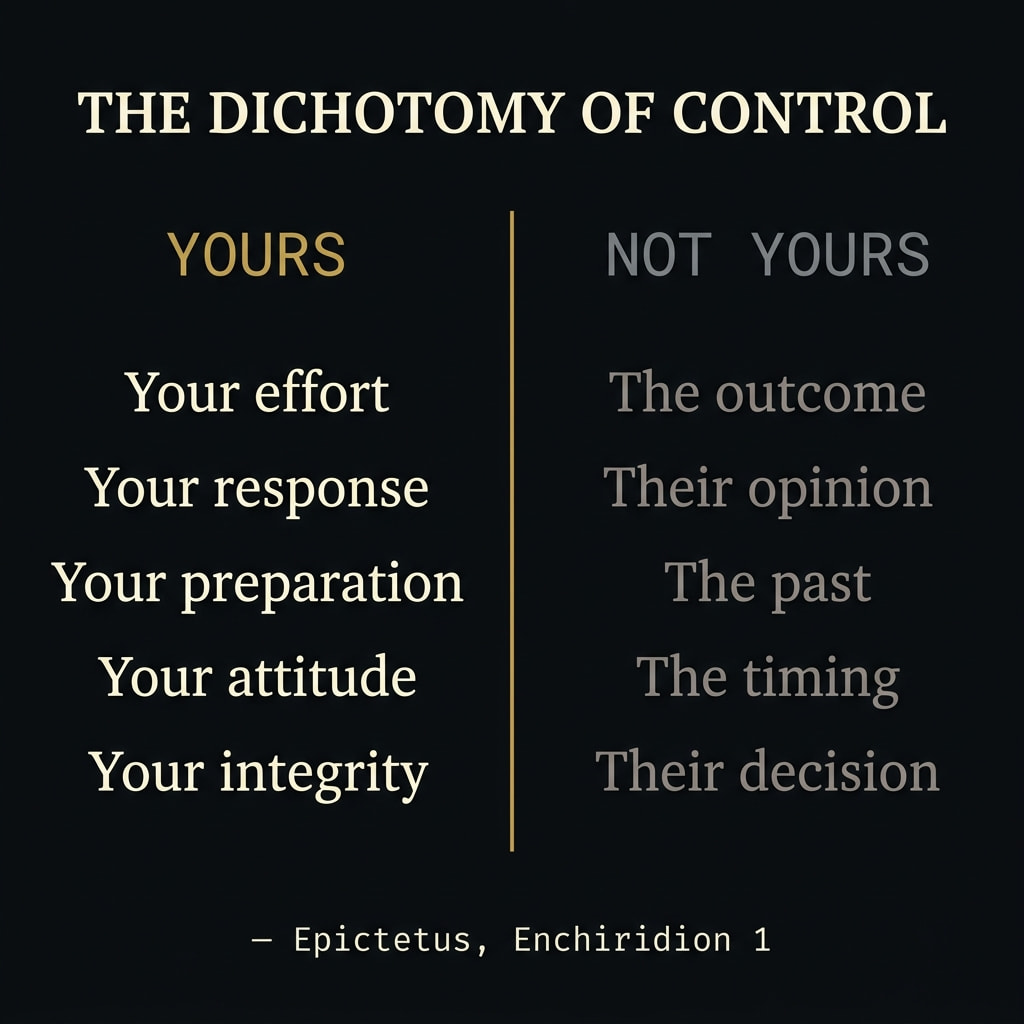
“Some things are within our power, while others are not. Within our power are opinion, motivation, desire, aversion — in short, whatever is of our own doing; not within our power are our body, our property, reputation, office — in short, whatever is not of our own doing.” — Epictetus, Enchiridion 1
This is the dichotomy of control. Coming from a comfortable man it can sound like a slogan. Coming from a former slave it is something else: a description of the only territory a person in his position actually had. He was not theorizing about powerlessness. He was reporting from inside it.
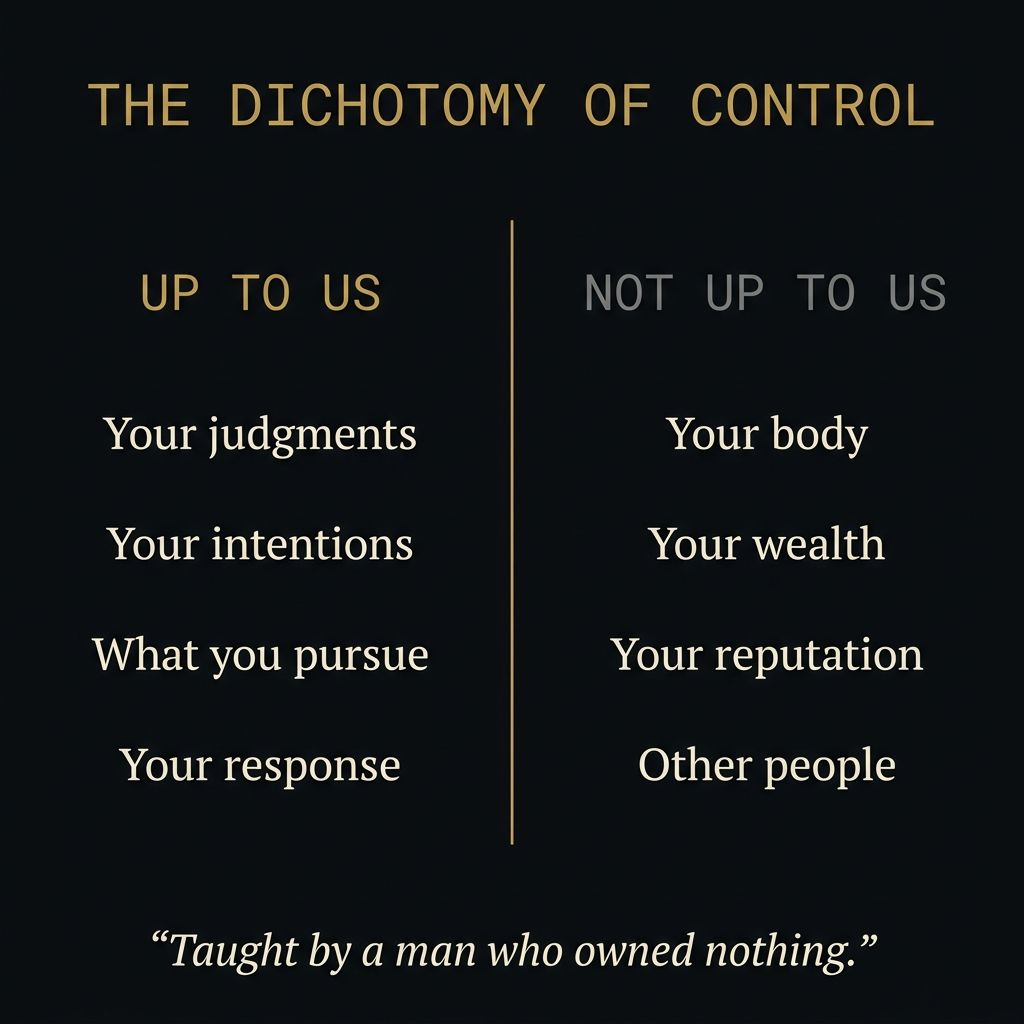
Up to us
- Our judgments
- Our intentions
- What we pursue and avoid
- Our response to events
Not up to us
- Our body and health
- Property and wealth
- Reputation and status
- Other people’s actions
Epictetus’s argument was blunt: nearly all human misery comes from trying to control the right-hand column, and nearly all human freedom comes from fully claiming the left. A free man who is enslaved to his own cravings is, in the only sense that counts, less free than a slave who has mastered his own mind. He had been both kinds of person, and said so.
The School at Nicopolis
After gaining his freedom, Epictetus taught philosophy in Rome until around 93 AD, when the emperor Domitian expelled philosophers from the city. He relocated to Nicopolis, in western Greece, and founded a school that became one of the most respected in the empire. Students — including young men from the Roman elite — travelled across the Mediterranean to study with the former slave.
He lived, by every account, exactly as he taught: with almost no possessions, in a simple dwelling, reportedly leaving his door unlocked because he owned nothing worth stealing. His authority did not come from status. It came from the visible match between the philosophy and the man.
The Man Who Wrote Nothing
Here is the detail that should be more famous: Epictetus never wrote a word of philosophy. Like Socrates, everything we have of him exists because a student wrote it down. That student was Arrian, later a Roman governor and historian, who transcribed Epictetus’s lectures and circulated them as the Discourses — and then distilled the essentials into the Enchiridion, the “Handbook,” a text short enough to read in an hour and dense enough to reread for life.
Arrian insisted he was not composing anything — he was preserving the plain, direct, often confrontational way Epictetus actually spoke. That accounts for the tone. Epictetus does not soothe. He interrogates. He uses the second person. He tells you, specifically, that your problem is your judgments and not your situation, and he does not soften it.
The Enchiridion is arguably the highest-leverage short text in practical philosophy. If you read one primary Stoic source and only one, this is a strong candidate — it is the compressed teaching of a man who had every external excuse and refused all of them.
The Slave Who Taught an Emperor
The most striking line of influence in philosophy runs from the bottom of Roman society to the very top. Around fifty years after Epictetus taught, a young Roman named Marcus was given a copy of the Discourses by his tutor. That young man became the emperor Marcus Aurelius, and his private notebook — the Meditations — is saturated with Epictetus, quoting and paraphrasing him throughout.
Sit with the symmetry. The philosophy an emperor used to govern himself through plague and war was, in its operational core, the philosophy a former slave had worked out from a position of total powerlessness. The same idea served the man with the least power and the man with the most. That is the strongest possible evidence that the dichotomy of control is not about circumstances — it is about the one thing every circumstance has in common.
The influence didn’t stop in Rome. Epictetus is a direct ancestor of modern Cognitive Behavioral Therapy — Albert Ellis cited the Enchiridion’s core claim, that people are disturbed not by events but by their judgments about events, as a foundation of REBT. Two thousand years later, his teaching is still being prescribed, just under a clinical name. For the practical version, see our guide on how to practice Stoicism every day.
“It’s not what happens to you, but how you react to it that matters.” — Epictetus
Practice the dichotomy daily in StoicNow
Join the WaitlistFree Quiz
Which Stoic Are You?
A 3-minute personality quiz — Marcus, Seneca, Epictetus, or Cato.
FAQ
Who was Epictetus?
Epictetus (c. 50 – 135 AD) was a Greek Stoic philosopher who was born into slavery in Hierapolis, gained his freedom, and founded an influential Stoic school in Nicopolis. He wrote nothing himself; his teachings survive because his student Arrian recorded them as the Discourses and the Enchiridion (the “Handbook”). His central idea — the dichotomy of control — is the foundation of practical Stoicism.
Was Epictetus really a slave?
Yes. He spent his early life enslaved in Rome, owned by Epaphroditus, a freedman secretary of the emperor Nero. His name is not even a personal name — epiktetos is Greek for “acquired” or “gained.” He was eventually freed, likely after Nero’s death, and went on to teach philosophy.
What is Epictetus best known for?
The dichotomy of control: the principle that some things are up to us (our judgments, intentions, and responses) and some things are not (everything else), and that nearly all suffering comes from confusing the two. It opens the Enchiridion and is arguably the single most influential idea in practical philosophy.
Did Epictetus write any books?
No. Like Socrates, Epictetus wrote nothing. Everything we have comes from his student Arrian, who transcribed his lectures. The Discourses are the longer record of his teaching; the Enchiridion is a short distilled handbook of the core practices. Both have survived nearly two thousand years.
How did Epictetus influence Marcus Aurelius?
Marcus Aurelius never met Epictetus but studied his teaching closely — a copy of Epictetus’s Discourses was given to him by his tutor Junius Rusticus, and Marcus quotes and paraphrases him throughout the Meditations. The Stoicism a Roman emperor practiced was, in large part, the Stoicism a former slave taught.
What should I read to understand Epictetus?
Start with the Enchiridion — it is short, blunt, and practical, and can be read in an hour. Then move to the Discourses for the fuller picture. The Robin Hard translation (Oxford) is a strong modern option. Our guide on the dichotomy of control is a faster on-ramp to his central idea.
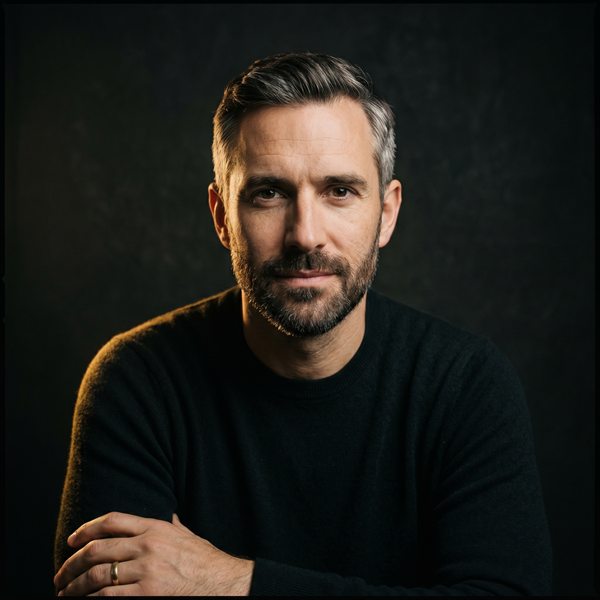
Marcus Adler
Founder & Lead Writer, StoicNow
Marcus Adler is the founder of StoicNow. For over a decade he has applied Stoic philosophy to daily life — testing the practices of Marcus Aurelius, Seneca, and Epictetus against modern problems and translating them into simple, repeatable routines. More about the author →
Further reading