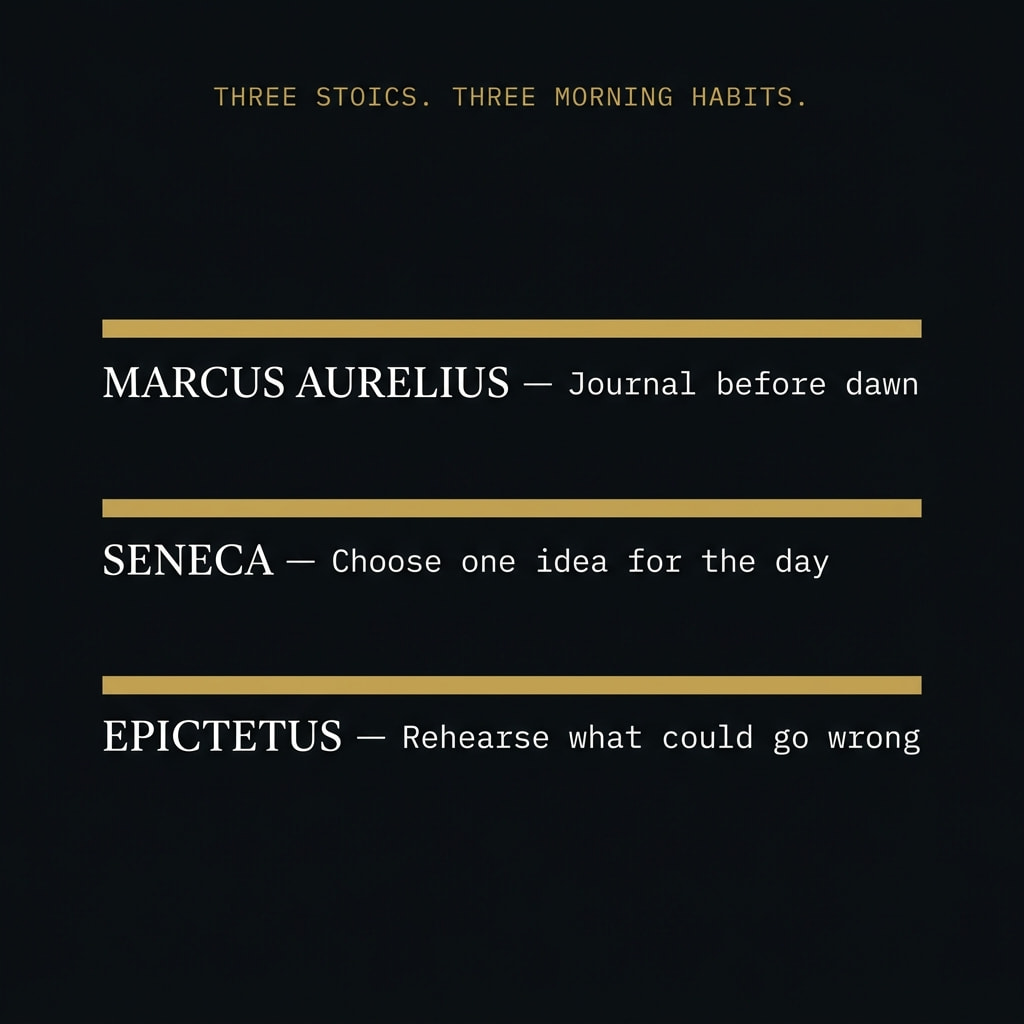
Quick answer
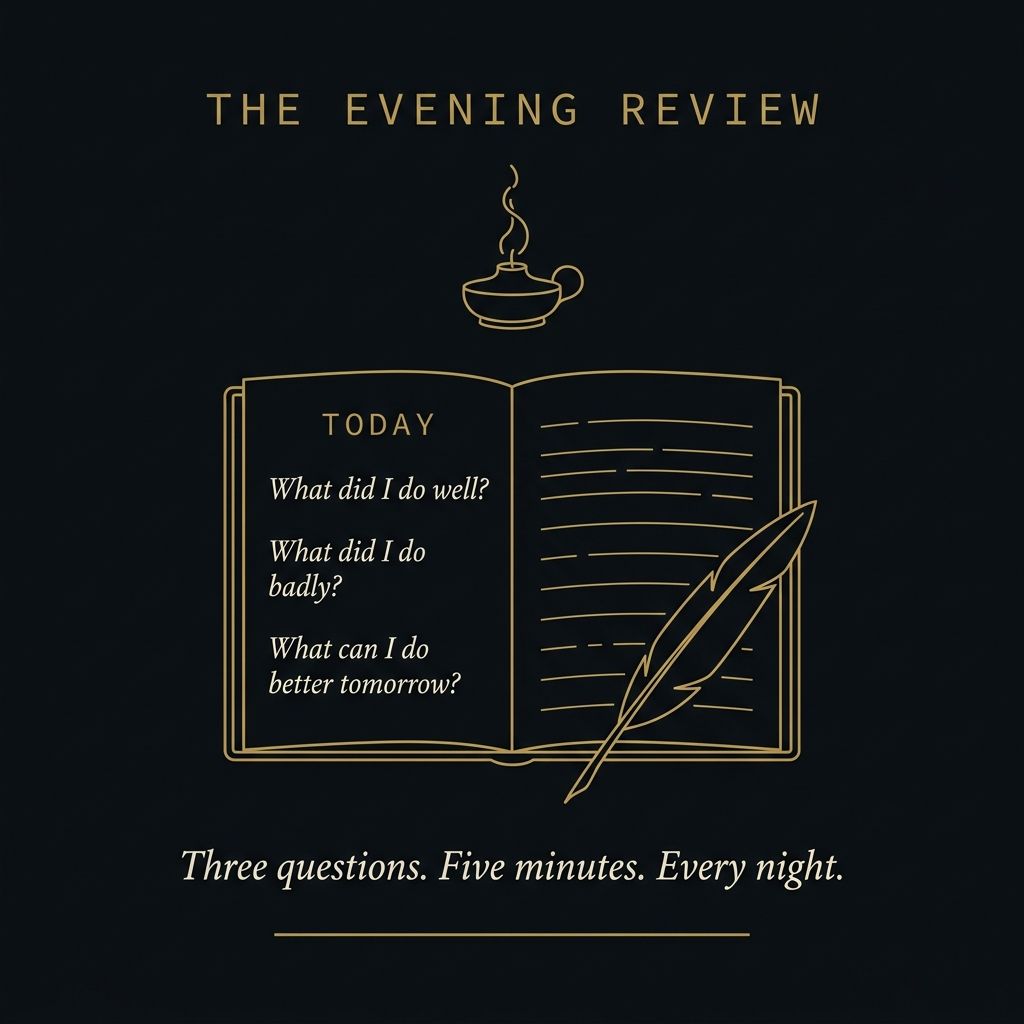
The Stoic evening reflection is a short nightly self-audit in which you review your day and ask three questions: what did I do well, what did I do badly, and what can I do better tomorrow.
Every night, two thousand years ago, one of the most powerful men in Rome closed his door, opened a notebook, and put himself on trial.
He wasn’t writing a diary. He was running an audit. Three questions, five minutes, every night — a practice he kept until the day Nero ordered him to die. Seneca describes it in De Ira (On Anger), Book 3, Chapter 36. It is the closest thing the Stoics ever wrote to a productivity manual, and it still works.
This is the Stoic evening reflection. Not the most famous practice in the canon, but arguably the most compounding one. Done for thirty days, it changes how you make decisions. Done for a year, it changes who you are.
What Seneca Actually Did
The primary source is short and worth quoting in full. From De Ira 3.36, in the Robert Campbell translation:
“I make use of this opportunity, daily pleading my case before myself. When the light has been taken away and my wife has fallen silent, aware of this habit that is now mine, I scrutinize the whole of my day and go back over what I have done and said, hiding nothing from myself, passing nothing by. For why should I fear any of my mistakes, when I am able to say: ‘See that you don’t do that again; this time I pardon you’? … Sleep follows on this self-examination — and how deep and untroubled it is, when the mind has been either praised or admonished, and the conscience, having become its own examiner and judge, has investigated its own conduct.” — Seneca
Three things stand out in that passage, and all three matter.
First, it’s a private practice. Light off, partner silent. No audience, no Twitter thread. The Stoic evening review is something you do alone with yourself, and Seneca treats that solitude as essential — an honest record only exists when nobody is being performed for.
Second, the tone is non-punitive. “See that you don’t do that again; this time I pardon you.” The Stoics did not flagellate themselves. They noticed, corrected, forgave, and moved on. Self-criticism without self-forgiveness is just rumination dressed as virtue.
Third, it ends in sleep. Seneca is explicit: this practice improves rest, because it closes the day’s loops. Modern cognitive psychology has rediscovered the same effect — structured pre-sleep journaling reliably reduces sleep onset time and middle-of-the-night rumination.
The Three Questions
Seneca didn’t hand down a three-question template explicitly — he handed down the practice. But every Stoic teacher who has followed him, from Marcus Aurelius (who structured his Meditations Book 1 around a similar review) to modern teachers like Donald Robertson, has narrowed it to three.
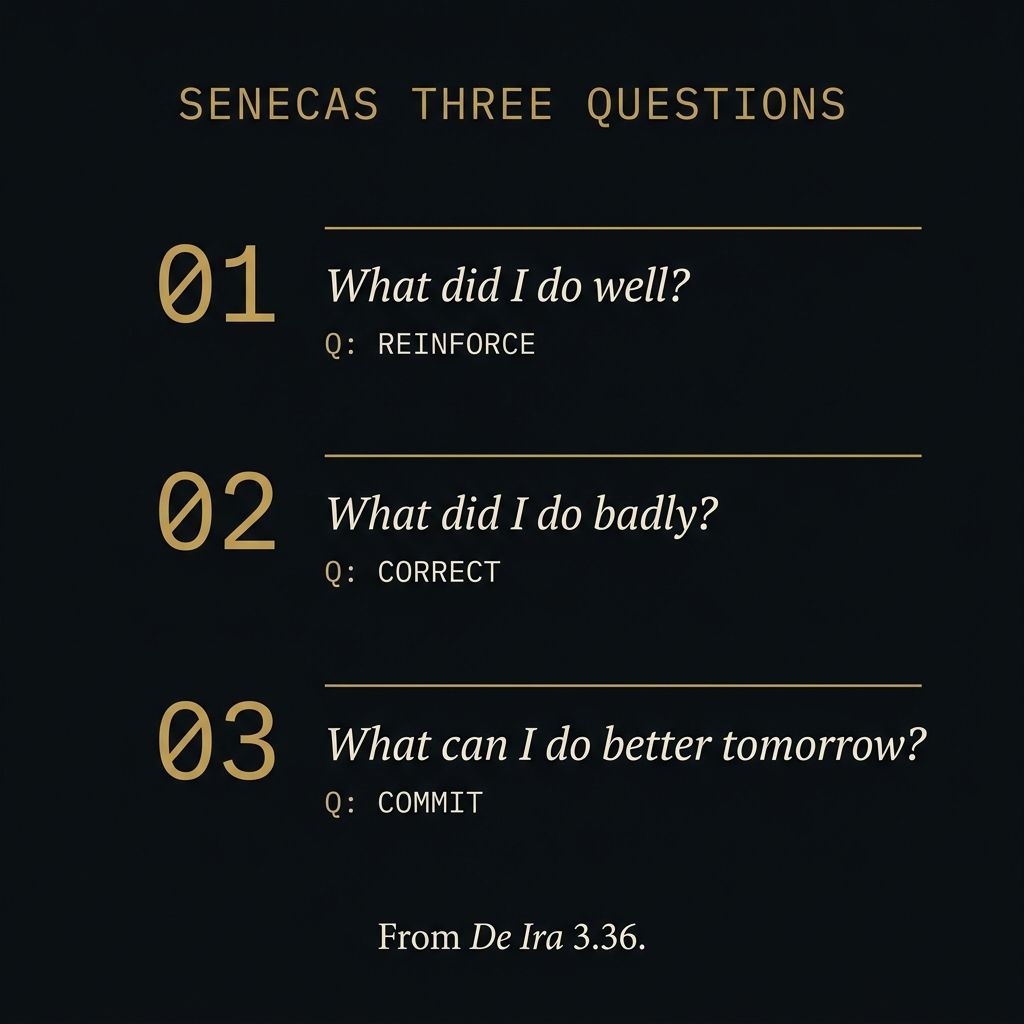
“What did I do well today?”
Name one specific thing. Not a vague mood — a concrete moment. The patient way you handled a difficult email. The hour you protected for the work that matters. The time you stayed quiet when you wanted to be loud.
Most people skip this question and go straight to the failures. Don’t. The point of starting here is not to feel good — it is to reinforce a behavioral pattern by noticing it. Unwitnessed behavior fades. Witnessed behavior compounds.
“What did I do badly today?”
Name one thing you handled poorly. Be specific. Not “I was unproductive” — “I spent forty minutes on my phone after lunch when I’d planned to read.” Not “I was a bad partner” — “I cut her off mid-sentence twice during dinner.”
The Stoics call the standard for this question hiding nothing from yourself. No excuses, no context-padding, no story about why it was someone else’s fault. An accurate record. And then — Seneca’s key move — pardon yourself. The audit is for tomorrow, not for self-punishment.
“What can I do better tomorrow?”
Translate the failure into one concrete change. One sentence. “Phone in a drawer between 12 and 2.” “Wait three breaths before replying to her.” “Do the writing first, before the email.”
This question is the one that makes the practice compound. Without it you have a journal. With it you have a feedback loop. Each evening produces one input for the next morning — small, specific, applied.
That’s the whole method. Reinforce, correct, commit. The Stoics handed down very little that is this operational.
Why It Works (And Why It Compounds)
Three mechanisms run in parallel, and each of them is now documented in modern research.
It builds metacognition. The single largest predictor of long-term behavioral change in cognitive therapy is the patient’s ability to observe their own patterns. Most people can’t. The evening review is the cheapest, fastest training method for that skill ever devised — you literally rehearse self-observation every night.
It closes the day’s loops. The Zeigarnik effect, named for psychologist Bluma Zeigarnik, is the brain’s tendency to keep open tasks mentally active until they’re closed. Unprocessed days replay at 2 a.m. Writing down what happened and what you’ll do tomorrow gives the brain permission to release the day. Hence Seneca’s “deep and untroubled” sleep.
It compounds via small commitments. One behavioral correction per day is 30 corrections per month. Most are tiny. Most won’t stick. But a few will, and those few will stack — and the people who run this practice for a year are recognizably different from the people who don’t. The structure is identical to what modern habit research calls a review loop: observe, adjust, repeat.
The Stoics did not know any of the modern terminology. They figured the mechanism out empirically, by paying attention to which mental habits produced which outcomes, over decades, in their own lives.
A 5-Minute Template You Can Use Tonight
Copy this into a notebook or note app. Three short blocks. Five minutes total. The brevity is intentional — longer reflections turn into rumination, which is the failure mode this practice is designed to prevent.
The closing matters. Seneca treats it almost as a ritual — the day has been examined, the judge has ruled, court is adjourned. You don’t carry the day into bed with you. That, more than any single question, is what changes the texture of sleep.
The 30-Day Tracker
If you want compounding, you need consistency. The Stoics treated the practice as nightly hygiene — like brushing teeth, not like a retreat. The simplest way to enforce that is a 30-day grid you fill in each night.
Day 17 of 30 · one cell per night
Two rules make the tracker work, and both are non-obvious.
Rule one: never two in a row. Miss one night, fine. Miss two consecutive nights and the habit collapses. The data on streaks is unambiguous — the second miss is almost always the one that ends the run, not the first.
Rule two: a 30-second entry counts. The goal of the tracker is the unbroken chain, not the depth of each entry. A bad day with a thirty-second “01: nothing notable. 02: snapped at her. 03: pause first” is infinitely better than a skipped night. Quality emerges from quantity here, not the other way around.
How It Pairs With the Morning Routine
The Stoics ran the practice as a pair. Morning sets the target; evening corrects the aim. Used separately each works; used together they form a feedback loop that compounds dramatically faster than either alone.
Morning Routine
- Forward-looking
- Sets intention for the day
- Anticipates likely friction
- Chooses your response in advance
- Marcus Aurelius’ method
Evening Reflection
- Backward-looking
- Audits what actually happened
- Extracts one correction
- Feeds tomorrow’s intention
- Seneca’s method
If you only have time for one, the evening wins on most evidence — you can’t correct what you don’t observe, and the evening practice trains the observation skill that everything else rests on. But the full pair is what produces the compound effect most people are actually looking for. See our separate guide on the 3-step Stoic morning routine for the front half.
Three Common Mistakes
Mistake 01 — making it a gratitude journal. Question 01 asks what you did well, not what you’re thankful for. Those are different practices with different effects. Gratitude reframes; the Stoic review trains behavior. Mixing them dilutes both.
Mistake 02 — turning it into rumination. Five minutes. One example per question. If you notice yourself relitigating the same failure for the third night in a row, you’re not reviewing anymore — you’re looping. Close the notebook and move on. The next correction will arrive in the morning, not at midnight.
Mistake 03 — skipping the forgiveness. “See that you don’t do that again; this time I pardon you.” The Stoic review without that final clause becomes a self-prosecution. People who do that quit the practice within two weeks. People who include it run it for years.
Run the evening review in StoicNow
Join the WaitlistFAQ
What is the Stoic evening reflection?
The Stoic evening reflection is a short nightly self-audit in which you review your day and ask three questions: what did I do well, what did I do badly, and what can I do better tomorrow. Seneca describes the practice in De Ira (On Anger) 3.36, where he says he goes back over the whole day, hiding nothing from himself, passing nothing by.
How long should the evening review take?
Five minutes is enough. Seneca did not describe a lengthy ritual — he described a brief, honest scan of the day before sleep. Going longer tends to turn the practice into rumination, which is the opposite of what it’s for. Two to three sentences per question is plenty.
What did Seneca say about the evening review?
In De Ira 3.36, Seneca writes: “I make use of this opportunity, daily pleading my case before myself. When the light has been taken away and my wife has fallen silent, aware of this habit that is now mine, I scrutinize the whole of my day and go back over what I have done and said, hiding nothing from myself, passing nothing by.” He treats it as both a courtroom and a calming ritual.
Is the Stoic evening reflection the same as journaling?
It is one form of journaling, but with a specific structure: three questions, anchored to today, focused on action rather than mood. Open-ended journaling has its place, but the Stoic version is narrower and produces faster behavioral change because every entry ends with a concrete commitment for tomorrow. See our separate 25 Stoic journal prompts for the more open-ended version.
Does the evening reflection help with sleep?
Often yes. Seneca explicitly noted that after his nightly review, “sleep follows on this self-examination — and how deep and untroubled it is.” Modern cognitive psychology agrees: writing down what’s still unfinished or unresolved before bed reduces rumination and improves sleep onset, which is exactly what the review does.
What’s the difference between morning and evening Stoic routines?
The morning routine is forward-looking: you set intention, anticipate friction, and choose how you will respond. The evening routine is backward-looking: you audit what actually happened and extract one improvement. Used together, the morning sets a target and the evening corrects the aim — a feedback loop that compounds quickly.

Marcus Adler
Founder & Lead Writer, StoicNow
Marcus Adler is the founder of StoicNow. For over a decade he has applied Stoic philosophy to daily life — testing the practices of Marcus Aurelius, Seneca, and Epictetus against modern problems and translating them into simple, repeatable routines. More about the author →