Quick answer
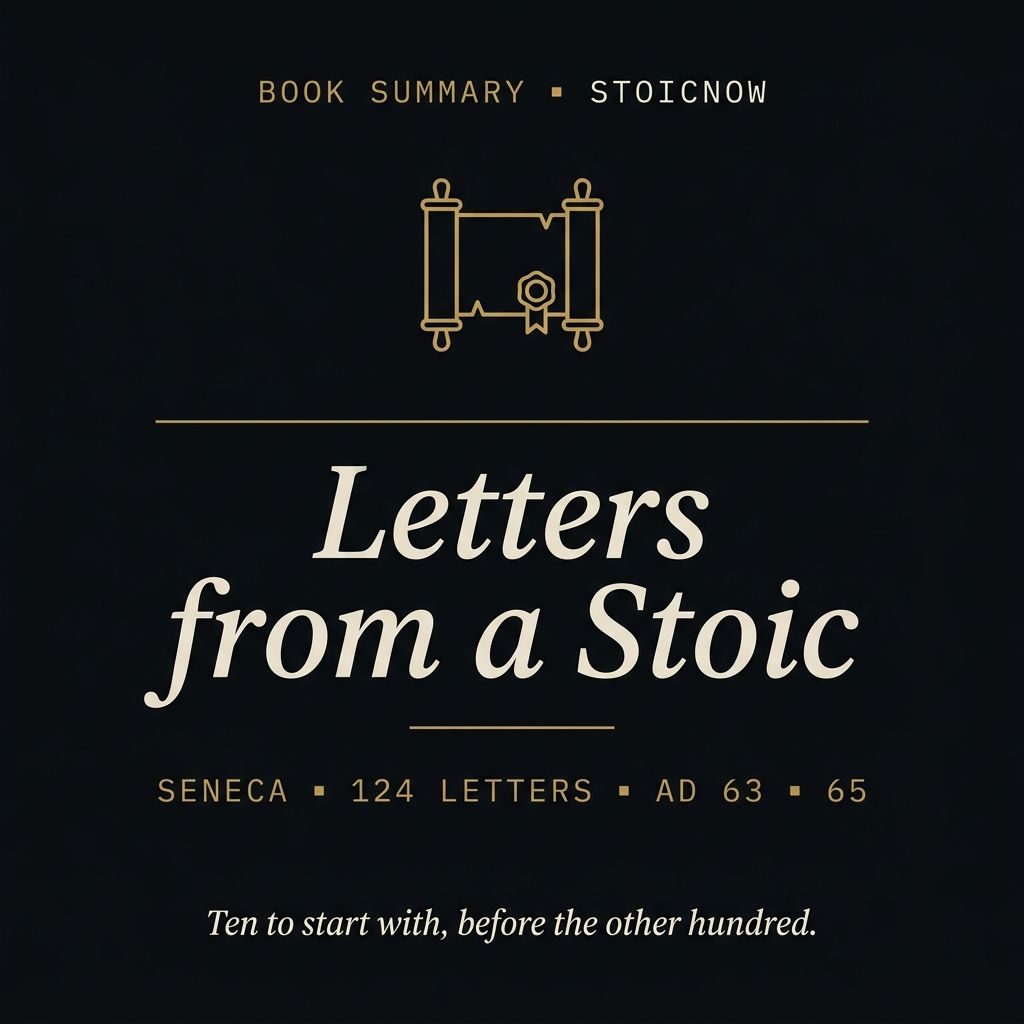
Letters from a Stoic is a collection of 124 short letters Seneca wrote to his friend Lucilius in the last years of his life, between roughly AD 63 and 65. Each letter takes one practical question — time, fear, death, friendship, wealth, virtue — and works through it in two to four pages.
Seneca did not write a philosophy book. He wrote 124 letters to a friend, and the friend published them after he died. That is why, two thousand years later, the book still reads as if someone you know is sending you notes.
Letters from a Stoic — in Latin, Epistulae Morales ad Lucilium — is the single most practical text in the Stoic canon. Each letter takes one concrete question — time, fear, travel, money, friendship, death — and works through it in two to four pages, using Seneca’s own life as the evidence. You do not need to read all 124 to benefit; you need to read the right ten, in the right order.
This guide gives you: what the book actually is, the ten letters to start with (each summarised, with one quote and a one-line case for reading it), a thematic index to the other 114, a comparison of the three English translations, and a four-step reading plan.
What’s inside
What the Book Actually Is
Seneca wrote the letters between roughly AD 63 and 65, the final years of his life. He had been forced into retirement from Nero’s court and was living quietly on his estate, writing. His correspondent, Lucilius Junior, was a younger friend in administrative service in Sicily. The letters are addressed to him but clearly composed with a wider readership in mind — Seneca is teaching Lucilius and, through him, anyone willing to read over the shoulder.
Each letter is short — typically 500 to 1,500 words. Seneca opens casually (a travel note, a household detail, a philosophical question Lucilius raised), works through it, and often closes with a borrowed maxim he pins to the end like a stamp. A handful of letters run much longer — the technical discussions of Stoic physics in Letters 58 and 65, the lecture on seating at a dinner in Letter 87 — and most first-time readers skip them.
The surviving collection is 124 letters. Ancient sources reference up to 20 more that were lost before the medieval copies we read today. Seneca was forced to commit suicide by Nero in AD 65, shortly after the letters were completed.
10 Best Letters to Start With
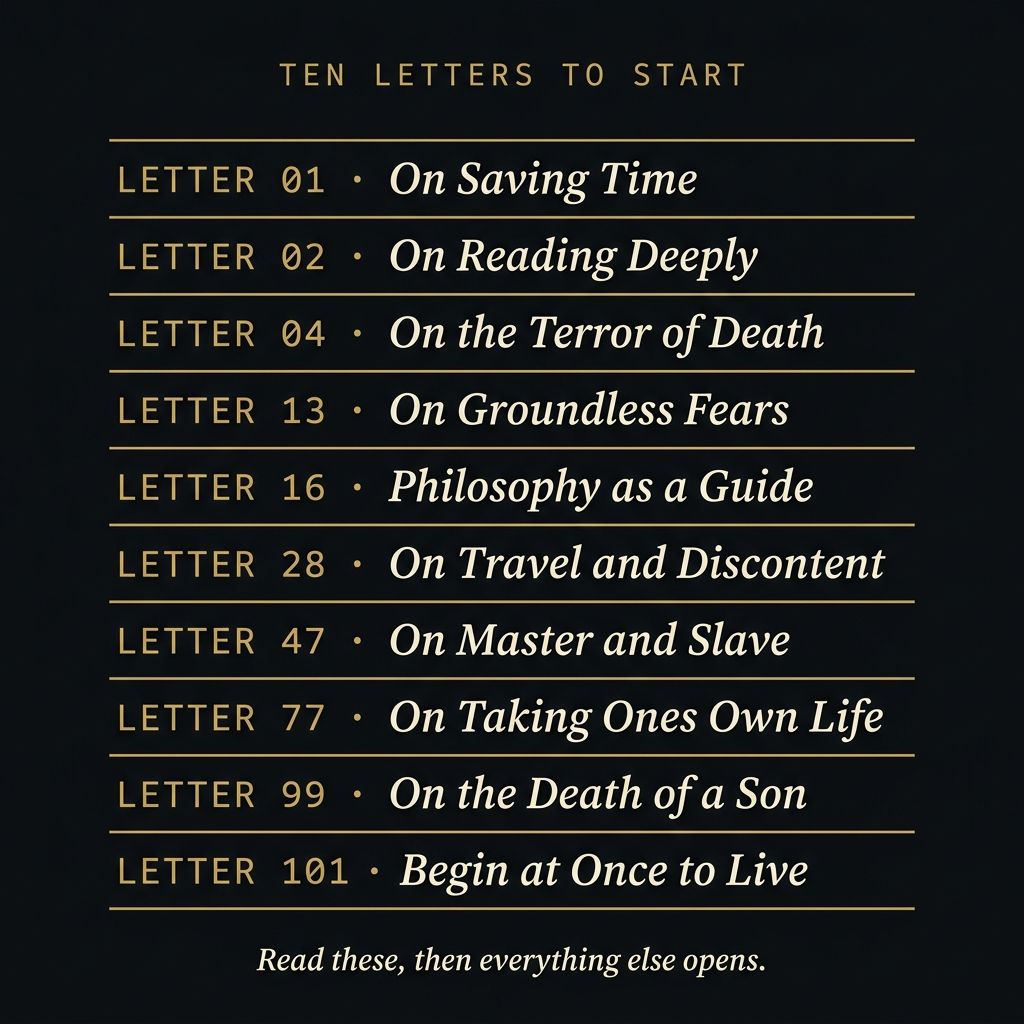
The full book can feel overwhelming. These ten cover Seneca’s core themes, avoid the long technical letters, and work as a self-contained reading list. You will not miss anything essential by starting here.
On Saving Time
The opening letter, and the one that contains Seneca’s single most quoted line about time. He scolds Lucilius — affectionately — for letting hours slip through his hands, and names the only asset worth guarding.
“While we are postponing, life speeds by. Nothing, Lucilius, is ours, except time.”— Letters 1
On Reading Deeply, Not Widely
Seneca’s case against reading twenty books at once. He argues for a different practice: fewer authors, reread slowly, with one passage mined deeply before moving on. The letter predates the internet by 1,900 years and still describes it perfectly.
“To be everywhere is to be nowhere. The primary indication of a well-ordered mind is a man’s ability to remain in one place and linger in his own company.”— Letters 2
On the Terrors of Death
Seneca’s most direct confrontation with the fear of dying. He argues not that death is nothing, but that most of what we call the fear of death is actually the fear of losing what we have — a different problem with a different solution.
“The greatest wealth is a poverty of desires.”— Letters 4 (citing Epicurus)
On Groundless Fears
The letter that essentially anticipates Cognitive Behavioral Therapy. Seneca’s core claim: most of what we suffer is not the event but the story we run about the event, and most of those stories, examined closely, do not hold.
“We suffer more in imagination than in reality.”— Letters 13
On Philosophy as a Guide
Seneca’s argument for why philosophy is not a pastime or academic subject but the single tool that determines how well you live. He is specifically defending the practice to Lucilius, who has started wavering. The defence is unusually sharp for Seneca.
“Philosophy is no trick to catch the public; it is not devised for show. It moulds and constructs the soul; it orders our life, guides our conduct.”— Letters 16
On Travel as a Cure for Discontent
Lucilius has written to say he is unhappy and thinking of a trip. Seneca replies with one of the most useful observations in the book: you take yourself with you. A new city does not fix a mind that is not fixable at home first.
“How can you wonder your travels do you no good, when you carry yourself around with you? You are saddled with the very thing that drove you away.”— Letters 28
On Master and Slave
The single most morally radical letter Seneca wrote. A full argument — in AD 64, inside a slave-holding empire — for treating household slaves as human beings with dignity, and for noticing how you treat subordinates as the real signal of your character.
“Treat your inferiors as you would be treated by your superiors.”— Letters 47
On Taking One’s Own Life
The most famous Stoic image of life as a play. Seneca’s argument is not in favour of suicide but about the broader question of how a life is to be judged — by length, or by completeness. If this sounds heavy: it is, and it is also one of his most beautifully written letters.
“As it is with a play, so it is with life — what matters is not how long the acting lasts, but how good it is.”— Letters 77
To Marullus, on the Death of His Son
A consolation letter written to a mutual acquaintance whose young son had died. This is Seneca at his most human — no grand Stoic posture, no demand that Marullus suppress grief. Just the honest argument that grief is part of love, and that the love was worth the grief.
“What need is there to weep over parts of life? The whole of it calls for tears.”— Letters 99
Begin at Once to Live
Triggered by the sudden death of an acquaintance, Cornelius Senecio, who had died mid-career while planning the next decade. Seneca’s response is one of the cleanest statements of his central ethic: the only life you have is the one happening now.
“Begin at once to live, and count each separate day as a separate life.”— Letters 101
Thematic Index to the Other 114
Once you have read the ten, the rest of the book opens up. Four through-lines run across the whole collection — here are the letters that develop each most fully. Use this as a map, not a checklist.
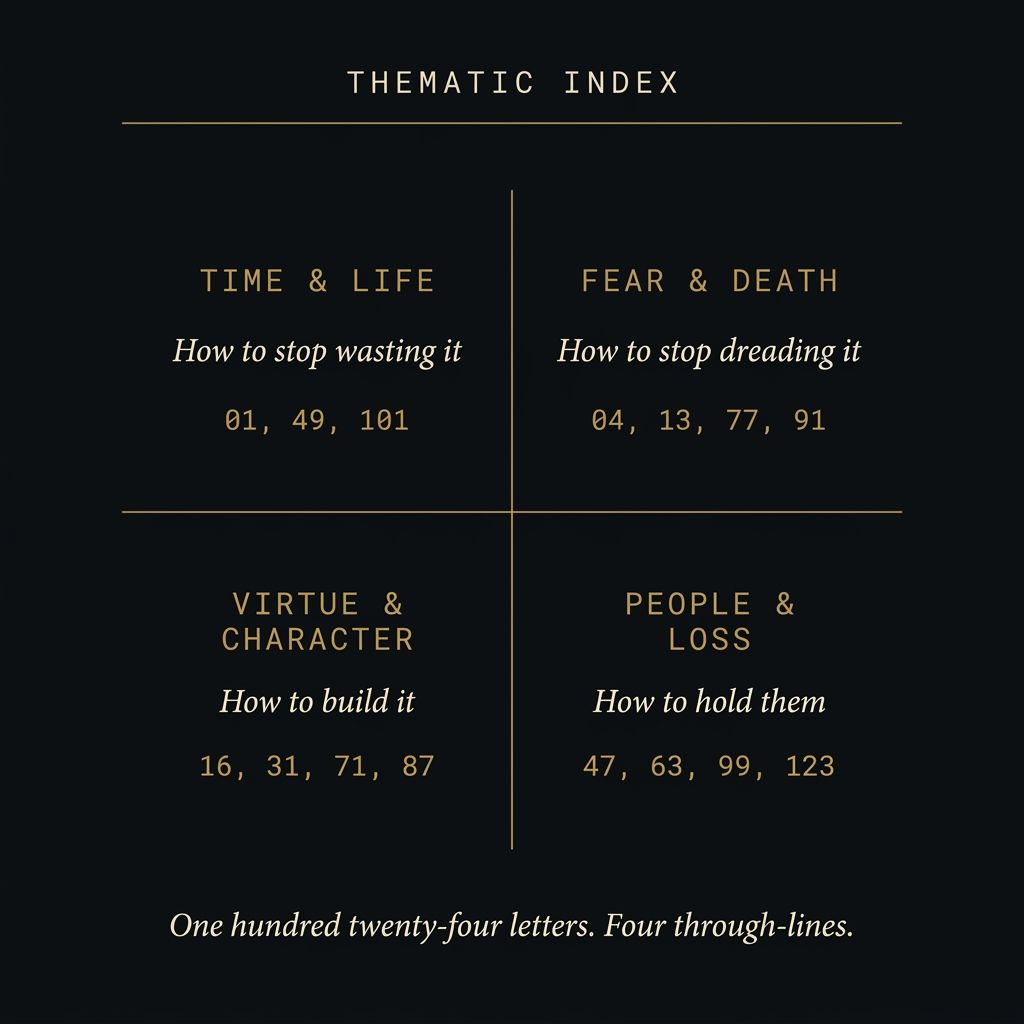
Theme 01
Time & Life
How to stop wasting it. Seneca’s central economic argument: time is the only irreplaceable resource, and it is the one we guard least.
Letters 01 · 49 · 62 · 101
Theme 02
Fear & Death
How to stop dreading the thing that makes life valuable in the first place. Most of these letters sit with death long enough that it stops being the monster.
Letters 04 · 13 · 24 · 77 · 91
Theme 03
Virtue & Character
How to actually become a better person — not in theory, not eventually, but in specific behaviours over real weeks. See our four virtues companion guide.
Letters 16 · 31 · 52 · 71 · 87
Theme 04
People & Loss
Friendship, grief, the management of difficult relationships, and the surprising place kindness occupies in Stoic ethics.
Letters 03 · 06 · 47 · 63 · 99 · 123
If you want a cross-index to Seneca’s sharpest lines from any of these letters, see our companion 40 Seneca quotes, grouped by the same themes.
Which Translation to Read
Letters only work if the English sings. Three serious translations exist. Here is how to pick.
| Translation | Year | Coverage | Best for |
|---|---|---|---|
| Robin Campbell (Penguin Classics) | 1969 | 40 selected letters (the essential ones) | First-time readers. The default. |
| Margaret Graver & A.A. Long (Chicago) | 2015 | All 124 letters, complete | Serious readers, after a first pass with Campbell. |
| Richard Gummere (Loeb) | 1917 | All 124 letters, Latin on facing pages | Scholars and Latin readers. Free online but stiff. |
Start with Campbell. If you finish it and want all 124 letters, buy Graver & Long. Do not try to read Gummere as your first encounter — the 1917 English will kill the book for you before Seneca has a chance.
How to Actually Read It
The book rewards a very specific reading practice. Most people who give up were not reading it wrong in principle — they were reading it like a novel.
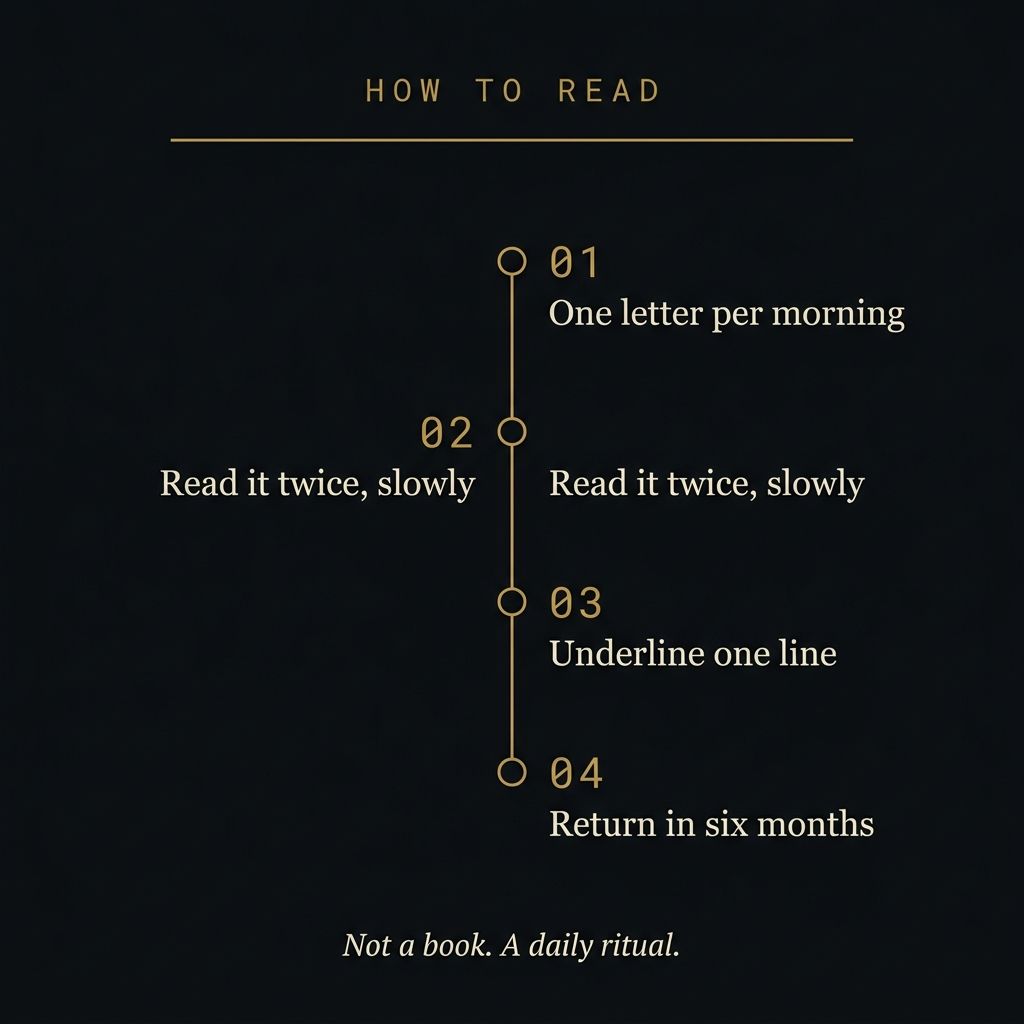
1. One letter per morning
Not one chapter. Not ten pages. One letter. Read it with coffee, slowly, and close the book. Seneca wrote each letter to sit on its own; honouring that pace is how the book lands. Over 40 days you will have finished Campbell; over roughly four months you will have finished the full 124.
2. Read it twice
Once for pace, once for substance. The second read, always the same morning, is where the letter actually opens. Seneca’s structure is deceptive — the turn in the argument is often in the second half, and the first read is mostly orientation.
3. Underline one line
Only one. Over-underlining defeats the purpose. Pick the single sentence you want to remember a year from now, underline it, and move on. When you revisit the book — and you will — your own marginalia are the map back in.
4. Return in six months
Letters from a Stoic is a book you return to, not finish. A letter that meant nothing at 28 can break you open at 38 — and a different one at 48. Keep a single well-read copy, mark it ruthlessly, and revisit the letters that were most alive the first time. Those are the seams where your life is still growing.
Seneca in five minutes a day
Try StoicNow — Free on iOSFAQ
What is Letters from a Stoic about?
Letters from a Stoic is a collection of 124 short letters Seneca wrote to his friend Lucilius in the last years of his life, between roughly AD 63 and 65. Each letter takes one practical question — time, fear, death, friendship, wealth, virtue — and works through it in two to four pages. It is Stoic philosophy delivered as private correspondence, which is why it still reads so warmly two thousand years later.
How many letters are in Letters from a Stoic?
124 letters survive. Seneca almost certainly wrote more — ancient sources reference up to 20 additional letters that were lost between antiquity and the medieval copies we have today. The surviving collection is traditionally called Epistulae Morales ad Lucilium (Moral Letters to Lucilius) and was written during Seneca’s forced retirement from Nero’s court, roughly AD 63 to 65.
Which letters from Letters from a Stoic should I read first?
For first-time readers: Letters 1, 2, 4, 13, 16, 28, 47, 77, 99, and 101. These cover Seneca’s core themes — time, reading, fear, death, philosophy, travel, dignity, grief, and living now — without any of the long letters on Roman politics or Stoic physics. Start with Letter 1 and read one per morning.
Which translation of Letters from a Stoic is best?
The Penguin Classics translation by Robin Campbell (1969) is the standard for beginners — readable, warm, and it selects 40 of the best letters. For the complete 124 letters, Margaret Graver and A.A. Long’s translation (Chicago, 2015) is the scholar’s choice and is still highly readable. Richard Gummere’s 1917 Loeb translation is free online but reads as stiff Edwardian English.
Is Letters from a Stoic a religious book?
No. Seneca writes in the classical Stoic tradition, which was a philosophy rather than a religion. He occasionally speaks of the divine — usually in the abstract, as rational order in the universe — but the book is a practical ethics manual, not a theology. Readers of every religious background (and none) have found it useful; Christian, Muslim, and secular readers have all adopted it without conflict.
Can I skip letters?
Yes. Seneca did not write the Letters to be read in sequence, and a few of the later ones are long technical discussions of Stoic physics or logic that most modern readers find dry. Skipping Letters 58, 65, 87, and 117 on a first pass is a common strategy. If one lands flat, close it and open the next. The book rewards the letters that reach you, not dutiful completion.

Marcus Adler
Founder & Lead Writer, StoicNow
Marcus Adler is the founder of StoicNow. For over a decade he has applied Stoic philosophy to daily life — testing the practices of Marcus Aurelius, Seneca, and Epictetus against modern problems and translating them into simple, repeatable routines. More about the author →
Further reading