Quick answer
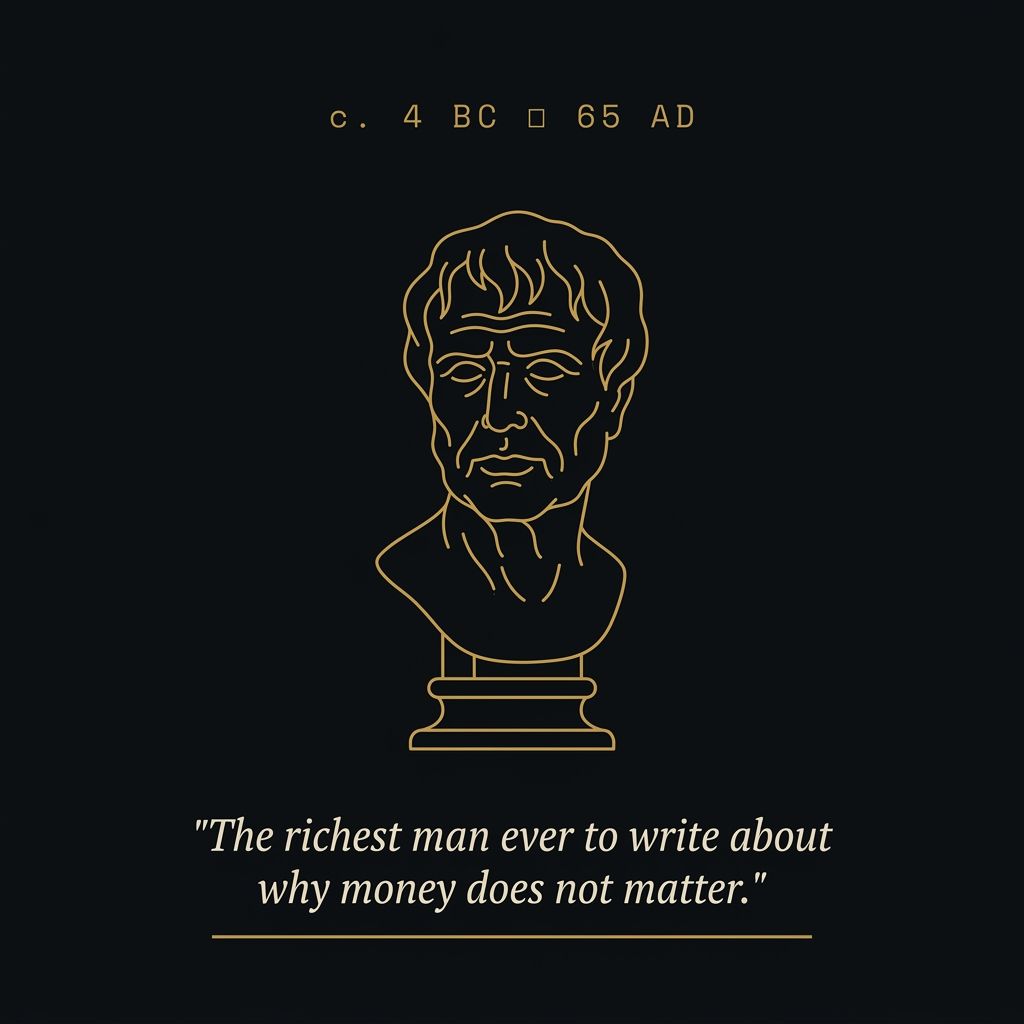
Lucius Annaeus Seneca (c. 4 BC – 65 AD), known as Seneca the Younger, was a Roman Stoic philosopher, statesman, and playwright.
Seneca wrote the most quoted lines in Stoicism about why money doesn’t matter — while sitting on one of the largest private fortunes in Rome. He preached virtue and restraint — while drawing a salary from Nero. He is the most useful Stoic to read and the easiest one to dismiss, and both facts come from the same biography.
Most introductions to Seneca quietly skip the awkward parts. This one doesn’t, because the awkward parts are the point. You can’t understand his writing on wealth, power, and death without understanding that he had too much of the first, served the second, and was eventually handed the third by his own student.
Here is who Seneca actually was — the case against him, his own defense, and why he is worth reading anyway.
The Basics
Lucius Annaeus Seneca — “Seneca the Younger,” to distinguish him from his rhetorician father — was born around 4 BC in Corduba (modern Córdoba, Spain), in the Roman province of Hispania. He came to Rome young, trained in rhetoric and philosophy, and built a career that braided three things almost no one else combined: high politics, hugely successful playwriting, and serious Stoic philosophy.
He was, by turns, a senator, an exile, an imperial tutor, the most powerful adviser in the empire, an immensely wealthy landowner and money-lender, the author of tragedies that shaped European drama for 1,500 years, and the writer of the Letters to Lucilius — the single best entry point into practical Stoicism ever written. The contradictions are not a footnote to his life. They are his life.
The Case Against Him
The controversy around Seneca is old — it started in his own lifetime, with a critic named Suillius, and never stopped. It comes down to three charges. It is worth stating each one at its strongest before looking at the defense.
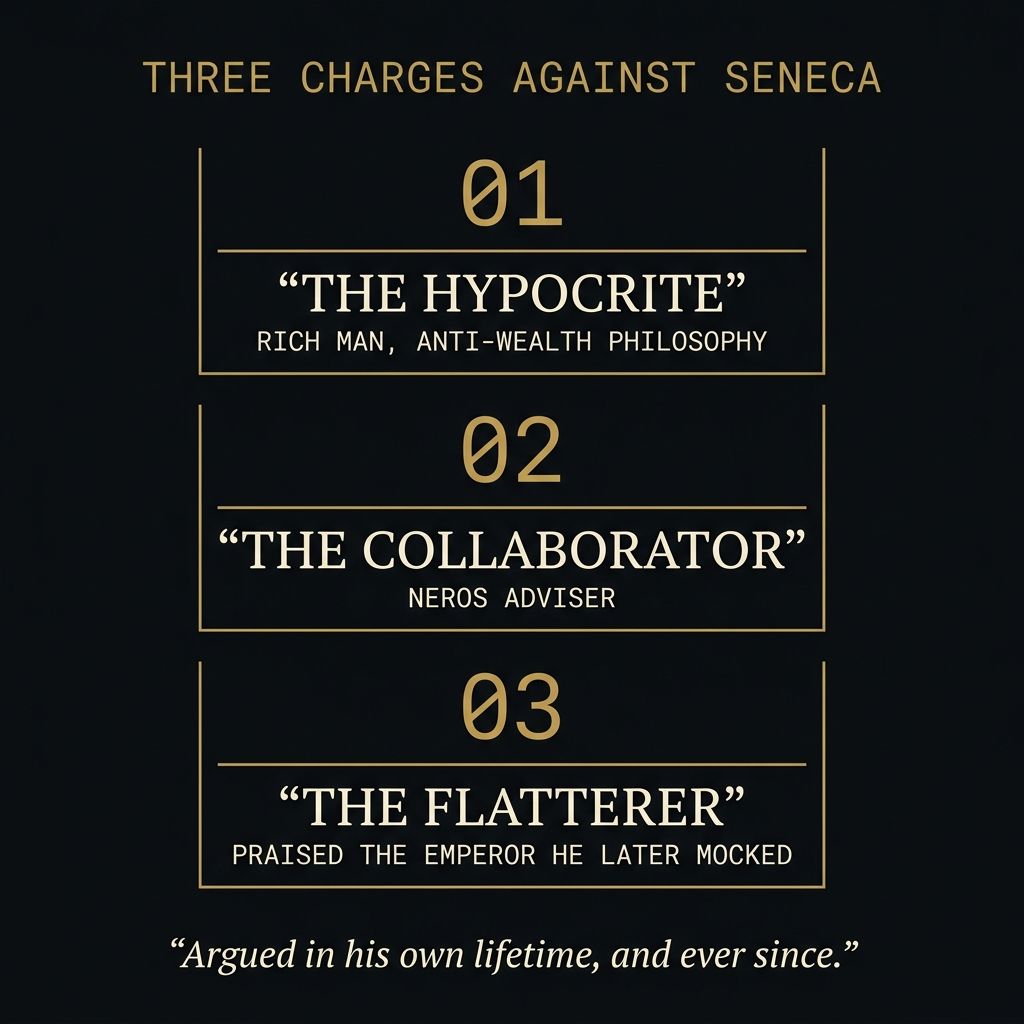
Charge 01
The Hypocrite
Charge 02
The Collaborator
Charge 03
The Flatterer
His Own Answer
Seneca knew exactly how he looked. The remarkable thing — the thing that separates him from a simple hypocrite — is that he wrote about it openly, against his own interest, in a culture where he didn’t have to.
“I am not a wise man and… I never shall be. And so require not from me that I should be equal to the best, but that I should be better than the wicked.” — Seneca, De Vita Beata
This is the key to reading him honestly. Seneca never claimed to be the Stoic sage. He explicitly placed himself among the proficiens — the ones making progress, still failing, still trying. His philosophy is not a report from the summit. It is field notes from the climb, written by someone who kept slipping. That is precisely why it is more useful than philosophy written by people with nothing to lose.
When he tried to retire in 62 AD, he reportedly offered to hand his entire fortune back to Nero — an attempt, late and imperfect, to act on the thing he had been writing. Nero refused, which kept Seneca rich and exposed. The gesture failed. But it was made.
The Death That Reframed Everything
In 65 AD a plot to assassinate Nero — the Pisonian conspiracy — was discovered. Seneca was implicated, probably falsely, but proximity was enough. Nero sent soldiers with an order: end your life.
The historian Tacitus describes the scene in detail, and it is the single most consequential passage for Seneca’s reputation. He did not panic. He comforted his weeping friends, reminded them of the philosophy he had taught, and asked why they were surprised — had he not been preparing for exactly this? His death by opened veins was slow and physically agonizing; he reportedly continued dictating to scribes as it happened.
Whatever you make of his life, the death is hard to dismiss. A man who spent thirty years writing that one should rehearse for death and not fear it was given, by his own former student, the worst possible exam — and, by the only account we have, passed it. The premeditation of adversity he preached was, in the end, tested on him.
It is fair to be suspicious of how clean the story is — Tacitus was writing decades later and the scene is half-literary. But even discounted, it changes the frame. The hypocrite charge assumes a man who didn’t mean it. The death is the strongest single piece of evidence that, at least about the thing that mattered most to him, he did.
What to Make of Him
Three honest conclusions, none of which cancel the others.
The contradictions are real. He was richer than his philosophy recommends and closer to power than was clean. Pretending otherwise — as some modern fans do — is its own kind of dishonesty.
He never claimed otherwise. Seneca’s self-description was “a man making progress, not a sage.” Judged against that claim rather than an invented one, the record is far more defensible.
The writing outlived the politics. Nobody reads Seneca for his record as Nero’s adviser. They read him because almost no one has written more usefully about anger, time, grief, and mortality — precisely because he wrote from inside the temptations, not above them.
This is the resolution, if there is one: Seneca is the Stoic for people who are compromised, busy, wealthy enough to be comfortable, and entangled in systems they can’t fully control — which is to say, most of his modern readers. He is not the marble sage. He is the man in the arena, taking notes, getting some of it wrong, and telling you the truth about it. Start with the Letters.
“As long as you live, keep learning how to live.” — Seneca, Letters 76
Read one Seneca letter a day in StoicNow
Join the WaitlistFree Quiz
Which Stoic Are You?
A 3-minute personality quiz — Marcus, Seneca, Epictetus, or Cato.
FAQ
Who was Seneca?
Lucius Annaeus Seneca (c. 4 BC – 65 AD), known as Seneca the Younger, was a Roman Stoic philosopher, statesman, and playwright. He served as tutor and later chief adviser to the emperor Nero, became one of the wealthiest men in Rome, and wrote the Letters to Lucilius and the moral essays — among the most widely read Stoic texts ever written. Nero eventually ordered him to take his own life.
Why is Seneca controversial?
Because his life appears to contradict his philosophy. He preached that wealth is indifferent while amassing an enormous fortune, and he taught virtue while serving one of Rome’s cruelest emperors. Critics — ancient and modern — call him a hypocrite. Defenders argue that Stoicism never required poverty, only non-attachment, and that his writing has outlived the politics.
Was Seneca a hypocrite?
It depends on the standard. By a strict reading, a man writing On the Shortness of Life while accumulating one of Rome’s largest fortunes invites the charge. By the Stoic standard, wealth is a “preferred indifferent” — permitted if held without attachment. Seneca defended himself directly in De Vita Beata: the sage does not have to be poor, only unowned by money. Whether he lived up to that is the open question.
What was Seneca’s relationship with Nero?
Seneca was Nero’s tutor from around 49 AD and his chief adviser in the early reign. Historians generally credit the relatively well-governed first five years of Nero’s rule partly to Seneca’s restraining influence. As Nero grew more violent, Seneca tried to withdraw, was implicated (probably falsely) in the Pisonian conspiracy of 65 AD, and was ordered to die.
How did Seneca die?
In 65 AD, Nero ordered Seneca’s death after the failed Pisonian conspiracy. Following Roman custom for the elite, Seneca was permitted to take his own life. Ancient sources (chiefly Tacitus) describe a slow, difficult death by opened veins, during which Seneca reportedly stayed composed and continued dictating to scribes — a scene later read as his final Stoic test.
Should I still read Seneca?
Yes — arguably more so because he was compromised. Seneca writes about wealth, power, anger, and mortality as someone who lived inside all of them, not as a detached observer. His Letters to Lucilius and the essay On the Shortness of Life remain among the most practical entry points into Stoicism. Read him knowing the biography, not despite it.

Marcus Adler
Founder & Lead Writer, StoicNow
Marcus Adler is the founder of StoicNow. For over a decade he has applied Stoic philosophy to daily life — testing the practices of Marcus Aurelius, Seneca, and Epictetus against modern problems and translating them into simple, repeatable routines. More about the author →
Further reading