Quick answer
Marcus Aurelius (121–180 AD) was Roman emperor from 161 to 180 and a practicing Stoic philosopher. He is the last of the 'Five Good Emperors' and the author of the Meditations, a private notebook of philosophical reflections he never intended to publish. He ruled through the Antonine Plague, near-constant frontier wars, and a military rebellion, while privately practicing Stoicism to stay steady.
The most powerful man in the world spent his evenings writing a notebook of reminders to himself — about death, duty, anger, and the shortness of life. He never meant anyone to read it. Eighteen centuries later, it is the most widely read book a head of state has ever written.
That man was Marcus Aurelius, Roman emperor from 161 to 180 AD, and the notebook is the Meditations. He is usually introduced as “the philosopher king” — the rare ruler who actually tried to govern by a philosophical system. That label is true but lazy. It makes him sound serene. He was not serene. He was a man under continuous pressure who used Stoicism the way a soldier uses a field manual: not because it was elegant, but because he needed it to function.
This is his life told as a Stoic case study — not the dates and titles, but the crises, and what he actually did inside them.
The Man Who Didn’t Want the Job
Marcus was born in 121 AD into a wealthy, well-connected Roman family — not the imperial line. His path to the throne was an accident of politics. The emperor Hadrian, with no direct heir, engineered a two-step succession: he adopted Antoninus Pius on the condition that Antoninus, in turn, adopt the teenage Marcus. Marcus was, in effect, drafted into power before he was old enough to refuse it.
By all accounts he would have preferred philosophy to politics. As a young man he was drawn to Stoicism through his tutor Junius Rusticus, who gave him the lectures of Epictetus — a former slave whose philosophy would shape Marcus for the rest of his life. There is a real irony here that the Stoics themselves would have appreciated: the one Roman who arguably least wanted absolute power is the one history remembers as having handled it best.
He became emperor in 161, at age 39, and almost immediately did something uncharacteristic of Roman rulers: he insisted on sharing power, ruling jointly with his adoptive brother Lucius Verus. Co-rule was nearly unprecedented. It was also, arguably, the first visible Stoic decision of his reign — an act against the natural pull of ego.
Crisis One: A Plague He Could Not Stop
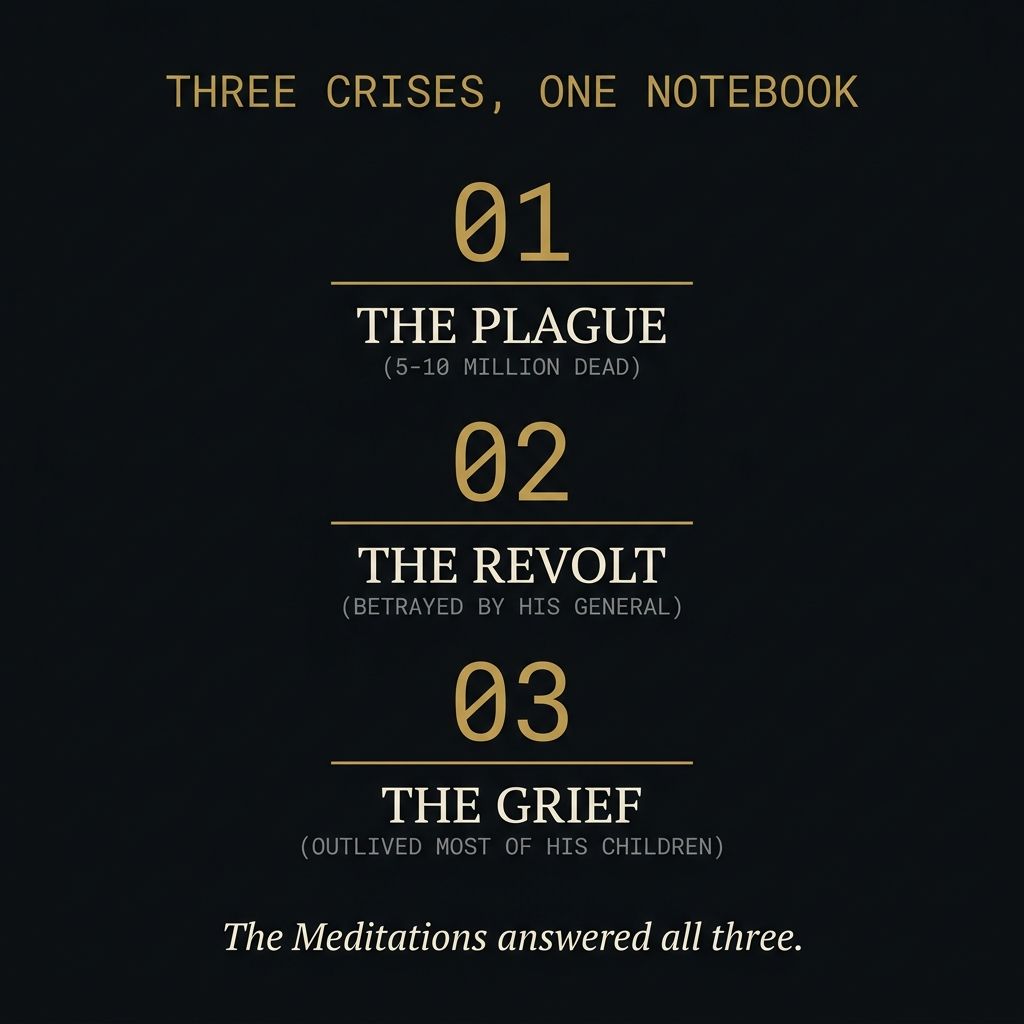
Within four years of taking power, Marcus faced a catastrophe that no philosophy could prevent: the Antonine Plague, probably smallpox, carried back by returning legions. Modern estimates put the death toll between five and ten million people across the empire — somewhere around a tenth of the population. It recurred for fifteen years.
Crisis 01
The Antonine Plague (165–180 AD)
You can watch him process it in real time in the Meditations. The book’s relentless theme — that death is natural, universal, and not to be feared — is not abstract philosophy. It is a man surrounded by mass death, training himself every night not to be destroyed by it.
“You could leave life right now. Let that determine what you do and say and think.” — Meditations 2.11
This is the central misunderstanding people have about the Meditations. It reads as calm wisdom. It was written as emergency maintenance.
Crisis Two: Betrayed by His Own General
In 175 AD, one of his most trusted generals, Avidius Cassius, declared himself emperor — reportedly on a false rumor that Marcus had died. Suddenly the philosopher faced the most personal political test possible: a betrayal, a civil war, and the question of what to do with the man who started it.
Crisis 02
The Revolt of Avidius Cassius (175 AD)
Whether every detail is historically airtight is debated — ancient sources idealize him. But the broad pattern is consistent with everything else we know: he did not purge Cassius’s family, and he treated the captured correspondence of the conspirators as something to be destroyed unread rather than weaponized. For a Roman emperor, restraint of this kind was not normal. It was a philosophical choice, made under maximum provocation.
The Meditations is full of pre-written instructions to himself for exactly this scenario — how to deal with people who wrong you, written before the wrong arrives. That is the Stoic practice of premeditation, applied to treason.
Crisis Three: The Grief He Lived With Daily
The crisis that most shapes the Meditations is the quietest one. Marcus and his wife Faustina had at least thirteen children. Most of them died before he did — some in infancy, some as young children. He outlived the majority of his own family.
Crisis 03
Repeated Personal Loss
This is worth dwelling on, because it corrects the biggest myth about Stoicism. The Stoic ideal was never to feel nothing. Marcus clearly felt enormous grief. What he trained for was to keep functioning — to remain just, patient, and present — while carrying it. The Meditations is the visible residue of that training.
What the Meditations Actually Is
It is essential to understand what the Meditations is not. It is not a treatise. It is not addressed to anyone. It has no argument, no structure, and no audience. The Greek title Marcus may have used translates roughly as To Himself.
It is a private notebook of Stoic exercises — the same three or four ideas, restated hundreds of times in slightly different words, the way you repeat something you are trying to make automatic. The repetition that can frustrate first-time readers is the entire point. He was not writing a book. He was doing reps.
If you want the contents distilled, our Meditations summary walks through the key lessons and the best way to read it. The short version: it is a working journal of someone applying Stoicism under pressure, which is exactly why it has outlived every official document of his reign.
What We Get Wrong About Him
Marcus Aurelius has become a wellness icon, which flattens him. Three corrections are worth making.
He was not serene. The Meditations is not a record of a calm man. It is a record of a man arguing himself toward calm, repeatedly, because it kept slipping. The struggle is the document.
He was not a modern liberal saint. He was a Roman emperor of the 2nd century. He waged aggressive frontier wars and his administration persecuted Christians. Reading him honestly means holding the philosophy and the historical man in the same frame.
He failed at his single most consequential decision. He chose his son Commodus as successor — abandoning the adoptive-merit succession that produced him. Commodus was a disaster. The philosopher king did not produce another one.
None of this diminishes the achievement. It sharpens it. The value of Marcus is not that he was perfect. It is that we have his private evidence — the rare case where we can see a powerful person genuinely trying, and sometimes failing, to be good. That is more useful than a saint.
Death and Legacy
Marcus died in 180 AD near the Danube frontier, probably of plague or illness, age 58 — still on campaign, still working. He was the last of the “Five Good Emperors,” a roughly 80-year run of competent, restrained rule that the historian Edward Gibbon called the period in which the human race was most happy and prosperous. With Commodus, that run ended, and Rome’s long unraveling is conventionally dated from there.
His real legacy is not political. It is the notebook. The Meditations survived by luck, copied and recopied through the Byzantine world, and became the single most influential demonstration that Stoicism is not a theory but a usable practice — one that worked for a man under more pressure than almost any of his readers will face.
“Waste no more time arguing about what a good man should be. Be one.” — Meditations 10.16
Read one Marcus passage a day in StoicNow
Join the WaitlistFree Quiz
Which Stoic Are You?
A 3-minute personality quiz — Marcus, Seneca, Epictetus, or Cato.
FAQ
Who was Marcus Aurelius?
Marcus Aurelius (121–180 AD) was Roman emperor from 161 to 180 and a practicing Stoic philosopher. He is the last of the “Five Good Emperors” and the author of the Meditations, a private notebook of philosophical reflections he never intended to publish. He ruled through the Antonine Plague, near-constant frontier wars, and a military rebellion, while privately practicing Stoicism to stay steady.
Why is Marcus Aurelius called the philosopher king?
The phrase comes from Plato’s Republic, which argued the ideal ruler would be a philosopher. Marcus Aurelius is history’s closest real example: a man with absolute power who genuinely tried to govern according to a philosophical system — Stoicism — rather than appetite or vanity. His Meditations are the private evidence that he meant it.
What did Marcus Aurelius actually do as emperor?
He spent most of his reign managing crises: the Antonine Plague (which killed an estimated 5–10 million people), prolonged wars on the Danube frontier, and the revolt of his own general Avidius Cassius in 175. He reformed law, funded relief, and chose mercy over vengeance after the revolt — decisions consistent with Stoic ethics.
Was Marcus Aurelius a good person?
By the standards of Roman emperors, exceptionally so — contemporaries and later historians regarded his rule as just and restrained. But he was a man of his time: he persecuted Christians and waged aggressive frontier wars. The Meditations show someone genuinely trying to be better, not someone who believed he had arrived.
What was Marcus Aurelius’s biggest mistake?
Most historians point to his succession: he named his son Commodus as heir, breaking the adoptive-merit pattern of the previous Good Emperors. Commodus’s reign was erratic and cruel, and is often treated as the beginning of Rome’s long decline.
What should I read to understand Marcus Aurelius?
Start with the Meditations itself — ideally the Gregory Hays translation. Then read Marcus Aurelius: A Life by Frank McLynn for the history, or How to Think Like a Roman Emperor by Donald Robertson for the Stoic-psychology angle. Our Meditations summary is a faster on-ramp.

Marcus Adler
Founder & Lead Writer, StoicNow
Marcus Adler is the founder of StoicNow. For over a decade he has applied Stoic philosophy to daily life — testing the practices of Marcus Aurelius, Seneca, and Epictetus against modern problems and translating them into simple, repeatable routines. More about the author →
Further reading