Quick answer
Epictetus (c. 50–135 AD) was a Greek Stoic philosopher born into slavery in Rome, freed after Nero's death, and the founder of an influential Stoic school in Nicopolis. He wrote nothing himself; his teachings survive because his student Arrian transcribed them as the Discourses and the Enchiridion (the 'Handbook').
Almost everything you have ever heard about “focusing on what you can control” comes, in a direct line of descent, from one man — and he was, for most of his life, somebody else’s property.
Epictetus (c. 50–135 AD) was born a slave in Roman Hierapolis. He studied philosophy while still in chains, was freed after Nero’s death, and went on to teach at one of the most respected Stoic schools in the empire. He wrote nothing himself; his lectures survive only because his student Arrian wrote them down as the Discourses and the short, devastating Enchiridion.
The reason his quotes still hit is that they were never theory. He worked the ideas out from inside actual powerlessness — which is why the philosophy he handed down is so uncompromising about where real freedom actually lives.
Below are thirty quotes, grouped into six themes. Each one carries a short note on what it’s answering and where to find it in his work. For background on Epictetus the man, see our companion piece on who he was.
Jump to a theme
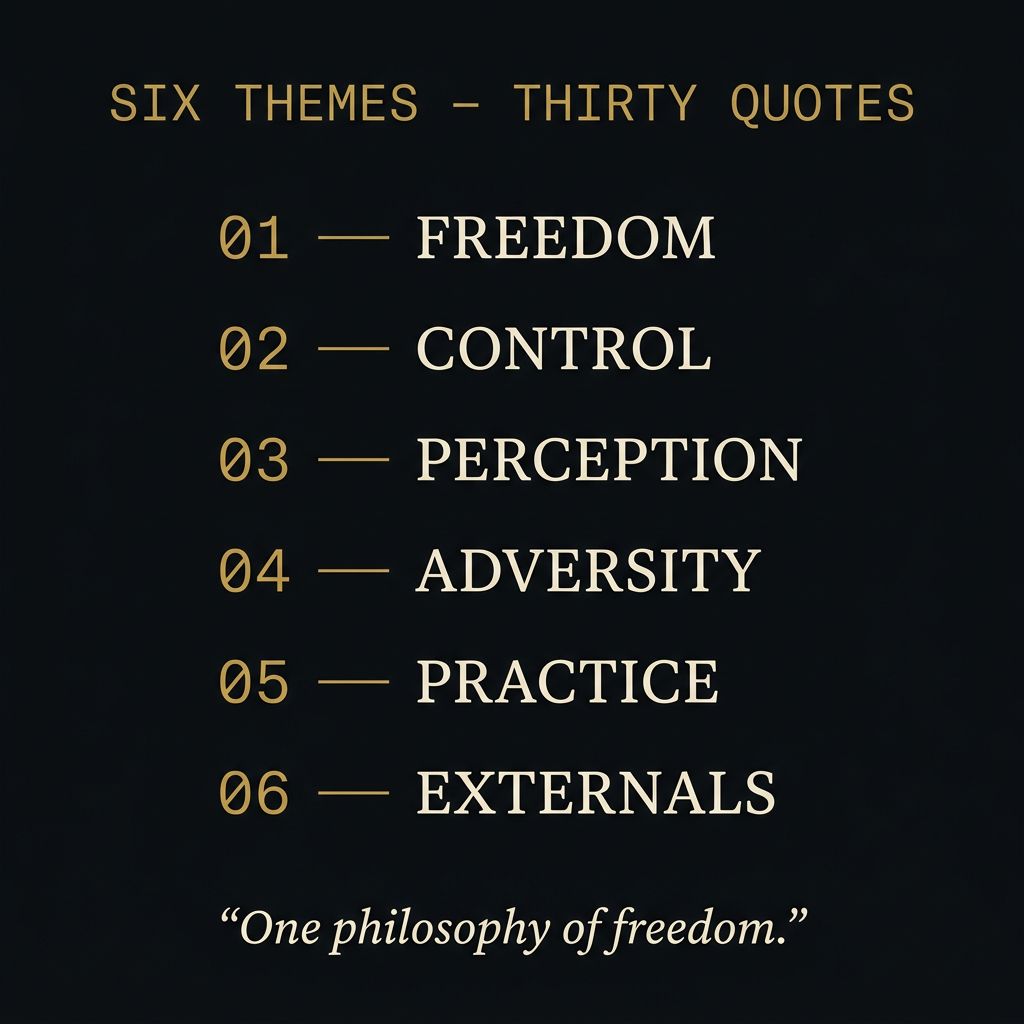
- On Freedom — 5 quotes
- On Control — the Dichotomy — 5 quotes
- On Perception & Judgment — 5 quotes
- On Adversity & Character — 5 quotes
- On Daily Practice — 5 quotes
- On Wealth, Status & Externals — 5 quotes
1. On Freedom
Theme One · 5 Quotes
Freedom is Epictetus’s most personal subject. The Stoic move he makes — that the only real freedom is internal — is not a thought experiment for him. It is the answer he had to find while his body was owned by someone else.
Quote 01
“He is free who lives as he wishes to live; who is neither subject to compulsion nor to hindrance, nor to force; whose movements to action are not impeded, whose desires attain their purpose, and who does not fall into that which he would avoid.”
— Discourses 4.1
Definition first. Epictetus is unfolding what “free” actually means — and noting that most outwardly free people fail his test.
Quote 02
“Whoever then would be free, let him wish nothing, let him decline nothing, which depends on others; else he must necessarily be a slave.”
— Discourses 4.1
The line that compresses his whole project. Wanting what you don’t control — or fearing it — is the actual definition of slavery he’s working with.
Quote 03
“Freedom is not procured by a full enjoyment of what is desired, but by controlling the desire.”
— Discourses 4.1
Why getting what you want doesn’t free you — you remain hostage to the next thing. Real freedom is upstream of getting, in the wanting itself.
Quote 04
“Any person capable of angering you becomes your master; he can anger you only when you permit yourself to be disturbed by him.”
— Discourses (paraphrase)
A piercing test of who actually rules you. Apply it to your inbox, your family, your group chat. Most of us have more masters than we’d care to count.
Quote 05
“No man is free who is not master of himself.”
— attributed, Discourses
The summary line. Internal sovereignty is the prerequisite. Without it, every external freedom is borrowed.
2. On Control — The Dichotomy
Theme Two · 5 Quotes
His single most influential idea. The dichotomy of control — that some things are up to us and some are not — opens the Enchiridion for a reason. Every other piece of his philosophy is downstream of it.
Quote 06
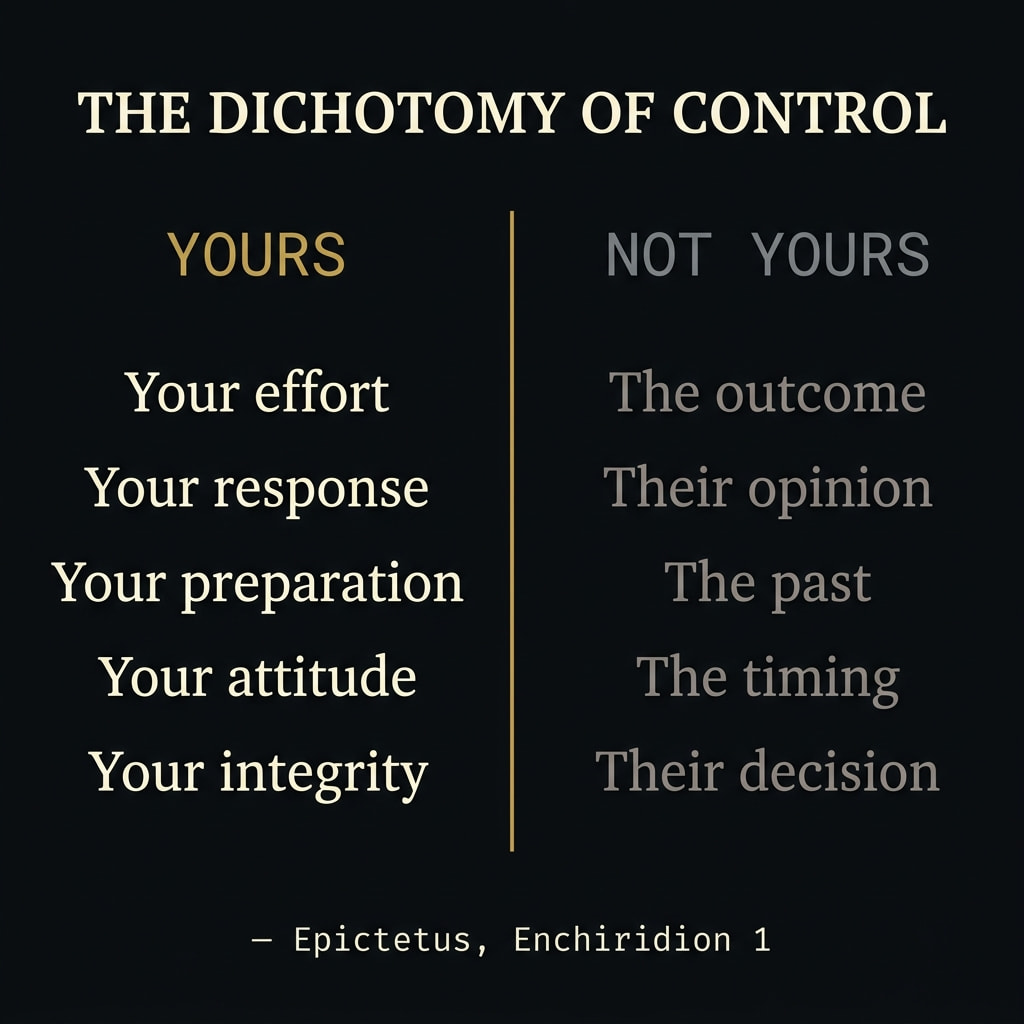
“Some things are up to us, and some are not. Up to us are opinion, motivation, desire, aversion — in short, whatever is of our own doing; not up to us are our body, our property, reputation, office — in short, whatever is not of our own doing.”
— Enchiridion 1
The foundational sentence in practical philosophy. Read slowly. The rest of Stoicism is an unpacking of this one distinction.
Quote 07
“Make the best use of what is in your power, and take the rest as it happens.”
— Discourses 1.1
Operational version. Two clauses, both required. Effort on what’s yours; acceptance of what isn’t.
Quote 08
“The chief task in life is to identify and separate matters so that I can say clearly to myself which are externals not under my control, and which have to do with the choices I actually control.”
— Discourses 2.5 (Lebell rendering)
He calls this the chief task — not a useful technique, the main job. Almost all suffering, in his diagnosis, comes from blurring the line.
Quote 09
“Don’t demand that things happen as you wish, but wish that they happen as they do happen, and you will go on well.”
— Enchiridion 8
The inversion that defines mature Stoic practice. Stop bending reality to your preferences; bend your preferences to reality. Often misread as passivity — it is the opposite.
Quote 10
“If you wish for anything that belongs to another, you lose what is your own.”
— Enchiridion 24 (paraphrase)
The hidden cost of misplaced wanting. Every minute spent grasping at the uncontrollable is a minute not spent on the one thing that is yours: your response.
3. On Perception & Judgment
Theme Three · 5 Quotes
The line modern Cognitive Behavioral Therapy is built on. Albert Ellis cited Epictetus directly; Aaron Beck cited the Stoics. The claim that events do not disturb us — our judgments about events do — is the single most evidence-based principle in clinical psychology, and it is 1,800 years old.
Quote 11
“Men are disturbed not by the things which happen, but by their opinions about the things.”
— Enchiridion 5
The sentence behind CBT. Notice the structural claim: not some disturbance comes from judgment — all of it does. The event has no built-in emotional content until you assign one.
Quote 12
“It’s not what happens to you, but how you react to it that matters.”
— Discourses (commonly attributed)
The popularized version — less precise than Enchiridion 5, but more usable in the moment. Useful as a mid-event interrupt.
Quote 13
“On every occasion, remind yourself: this is just an impression, not the thing it represents.”
— Enchiridion 1.5 (paraphrase)
The intervention point. Between the event and your story about it there is a small gap. Stoic practice is widening that gap until it’s wide enough to choose.
Quote 14
“It is impossible for a man to learn what he thinks he already knows.”
— Discourses 2.17
A line about epistemic humility, dressed as a line about learning. The unexamined judgment is the dangerous one precisely because you don’t notice you’re making it.
Quote 15
“First learn the meaning of what you say, and then speak.”
— Discourses (paraphrase)
Discipline applied to language. He is suspicious of speaking before judging, judging before examining, examining before observing. The order matters.
4. On Adversity & Character
Theme Four · 5 Quotes
The bracingly honest part. Epictetus does not romanticize hardship, but he refuses to treat it as the wrong question. To him, difficulty is the only diagnostic instrument we have for finding out who we actually are.
Quote 16
“Difficulties are things that show a person what they are.”
— Discourses 1.24
Not what shapes you — what shows you. The character was already there. Adversity makes it visible to its owner.
Quote 17
“Circumstances don’t make the man; they only reveal him to himself.”
— Discourses 1.24 (paraphrase)
Reframed for modern reading. The disturbing implication: the panic, the courage, the cowardice that comes out under pressure — that was always who you were.
Quote 18
“Sickness is a hindrance to the body, but not to your ability to choose, unless that is your choice.”
— Enchiridion 9
The line that survived through the Stockdale prison memoirs. The body can be constrained; the faculty of choice cannot, unless you abandon it.
Quote 19
“Remember, you are an actor in a drama, of such a kind as the author pleases to make it. Your business is to act well the part assigned to you; to choose it is another’s.”
— Enchiridion 17
The role is given; the performance is yours. Worth re-reading whenever the cast list of your life feels unfair.
Quote 20
“If you wish to improve, be content to appear clueless or stupid in extraneous matters — don’t wish to seem knowledgeable.”
— Enchiridion 13
The cost of growth is dignity. Anyone trying to actually improve will look incompetent in public for a while; refusing to is refusing to improve.
5. On Daily Practice
Theme Five · 5 Quotes
Epictetus was a working teacher, not a system-builder. These five quotes are the most operational lines in the canon — instructions for what to do today, tomorrow, this hour.
Quote 21
“First say to yourself what you would be; and then do what you have to do.”
— Discourses 3.23.1
Identity before action, not after. Most people do the action and wait for the identity to follow. He inverts it.
Quote 22
“On no occasion call yourself a philosopher, nor talk among laymen about philosophical principles; but act in accordance with these principles.”
— Enchiridion 46
The anti-performance line. If your philosophy can’t be inferred from how you behave, you don’t actually have one. Especially relevant in the internet era.
Quote 23
“Every habit and faculty is preserved and increased by corresponding actions.”
— Discourses 2.18
The clearest pre-modern statement of behavioral neuroplasticity. Whatever you do today, you become slightly better at doing — whether you wanted to or not.
Quote 24
“How long will you delay to demand of yourself the best things?”
— Enchiridion 51
The hardest sentence in the Enchiridion. He does not ask whether you will get around to it; he asks how long you intend to delay. The delay is the position.
Quote 25
“If you would be a reader, read; if a writer, write.”
— Discourses 2.18
Strip away the romance. The thing you do is the thing you are. The thing you intend to do is, until proven otherwise, fiction.
6. On Wealth, Status & Externals
Theme Six · 5 Quotes
Sharper here than any of the other Stoics. Epictetus had nothing, taught from a room with an unlocked door — because he owned nothing worth stealing — and remained skeptical for life about the things most people optimize their existence around.
Quote 26
“Wealth consists not in having great possessions, but in having few wants.”
— attributed, Discourses
Wealth redefined as a property of desire, not inventory. By this definition, the ratio matters more than the numerator.
Quote 27
“If anyone tells you that a certain person speaks ill of you, do not make excuses about what is said of you, but answer: ‘He was ignorant of my other faults, else he would not have mentioned only these.’”
— Enchiridion 33
A vaccine against reputation-defense as a way of life. The honest response to most criticism is to assume the critic was being kind.
Quote 28
“If you ever happen to turn your attention to externals, so as to wish to please someone, be assured that you have ruined your scheme of life.”
— Enchiridion 23
The brutal one. Wishing to please other people, in his accounting, is not a small leak — it’s a sunk ship. Read with care.
Quote 29
“Don’t hope that events will turn out the way you want, welcome events in whichever way they happen: this is the path to peace.”
— Enchiridion 8 (Dobbin)
The Dobbin rendering of the same dichotomy. “Welcome” is doing a lot of work in this sentence — it is the active version of acceptance.
Quote 30
“Don’t just say you have read books. Show that through them you have learned to think better, to be a more discriminating and reflective person. Books are the training weights of the mind.”
— Discourses (Lebell rendering)
The last word he’d want you to take. Reading him — reading these thirty quotes — is worth nothing unless something downstream of your behavior changes. That was the only test he ever cared about.
Where These Come From
Two sources, both written by his student Arrian:
The Discourses. Eight books of his lectures, of which four survive. Long, conversational, often funny — the lectures of a working teacher caught in mid-thought. The fullest picture of his philosophy. Start with Robin Hard’s Oxford translation or Robert Dobbin’s Penguin edition.
The Enchiridion. The “Handbook” — Arrian’s distillation of the practical core into about fifty pages. The single highest-leverage short text in practical philosophy. Read it once in an hour, then once a year for the rest of your life.
For a fuller picture of Epictetus’s life — how a slave became the most respected teacher in the empire and ended up shaping a Roman emperor’s private journal — see who was Epictetus.
Read one Epictetus quote a day in StoicNow
Join the WaitlistFree Quiz
Which Stoic Are You?
A 3-minute personality quiz — Marcus, Seneca, Epictetus, or Cato.
FAQ
Who was Epictetus?
Epictetus (c. 50–135 AD) was a Greek Stoic philosopher born into slavery in Rome, freed after Nero’s death, and the founder of an influential Stoic school in Nicopolis. He wrote nothing himself; his teachings survive because his student Arrian transcribed them as the Discourses and the Enchiridion (the “Handbook”).
What is Epictetus’s most famous quote?
The opening of the Enchiridion: “Some things are up to us and some are not. Up to us are opinion, motivation, desire, aversion — in short, whatever is of our own doing.” It is the foundation of practical Stoicism and the direct ancestor of the modern “focus on what you can control” frame.
Where are Epictetus’s quotes from?
Two sources, both written down by Arrian. The Discourses are eight books of his lectures (four survive). The Enchiridion is a short, ~50-page handbook distilling the practical core. Modern translations to look for: Robin Hard (Oxford), Robert Dobbin (Penguin), and the older but public-domain George Long.
Did Epictetus really write anything?
No. Like Socrates, Epictetus wrote nothing. Everything attributed to him was recorded by his student Arrian, who insisted he was transcribing Epictetus’s lectures rather than composing original work. The blunt, second-person voice in the quotes reflects how he actually taught.
Why is Epictetus so focused on freedom?
Because he spent the first decades of his life enslaved. His philosophy was developed from the inside of powerlessness — when you have no external freedom, the only territory you can claim is your own mind. That’s why his version of Stoicism is sharper and more uncompromising than his peers’.
Which Epictetus quote should I start with?
Enchiridion 1: “Some things are up to us and some are not.” Read it slowly. The entire rest of his teaching is an unfolding of that single sentence. Then read Enchiridion 5: “Men are disturbed not by things, but by their judgments about things.” Those two cover most of what people need.

Marcus Adler
Founder & Lead Writer, StoicNow
Marcus Adler is the founder of StoicNow. For over a decade he has applied Stoic philosophy to daily life — testing the practices of Marcus Aurelius, Seneca, and Epictetus against modern problems and translating them into simple, repeatable routines. More about the author →
Further reading
- Epictetus, Enchiridion (full text, MIT Classics) MIT Classics